My Blog List

Wednesday, March 29, 2023

FROM THE DESERT TO THE DESERT Part 1

 An upcoming tour from Tohono Chul Garden to Organ Pipe Cactus National Monument, to view spring wildflowers at the end of February, caught my attention. It has been a wet winter in the desert and a good wildflower season was expected. It seemed like the perfect time for a visit. It was a good time for a quick getaway with the trailer so I booked 6 nights at the campsite at the park for the end of February. 

At the same time there was a lot of chatter on local forums about the Mexican poppy bloom at Picacho Peak State Park. As the park was on the way we decided to pull in. I can't tell you the number of times we have driven by Picacho. The dominating peak of Picacho stands out for miles and on the drive from Phoenix down to Oro Valley signals we are nearly home. We were not disappointed.


It was just to be a brief visit but during the short time we were I there took hundreds of photographs of the Mexican gold poppies that covered the hillsides. The Mexican gold poppy, Eschscholozia californica ssp. mexicana, differs little from the California poppy. Maybe it is a little smaller in size and leaf structure and maybe one has a more pronounced area between flower and stem but really hard to tell. 


 I was happy to see, scattered among the poppies and just coming into flower, lupins. Coulter's lupine, Lupinis sparsiflorus, as its name suggests, has flowers spread more thinly up the stem. It makes them less showy than the Texas bluebonnets and harder to photograph but still lovely. 

The knotch-leaf scorpionweed, Phacelia crenulata were also just starting to flower. These little beauties made us determined to return in 2 weeks to see them in full flower. 


I am trying to familiarize myself with all the new wildflowers I am starting to see. Here the lyreleaf jewel flower, Streptanthus carinatus. 


We needed to be on our way as the drive would take at least 4 hours. We passed through the town of Ajo but didn't stop as we knew we would be returning there on Saturday for the Saturday Market, continuing down highway 86, through Why (who knows why)to the entrance to the park. The road continues for just a few miles to the border with Mexico. We headed straight to our campsite and were really pleased to find it was a pull-through and was on hard standing. So much easier than having to reverse into a site. 


They can cater for a large number of campers here and have designated areas for generator use, non generator use and tent camping. I had chosen a generator site because this was to be a real test of our solar panels which we hoped would keep us in power for the week. Just in case we had a generator with us. The campground has no hook-ups, electric, sewer or water, but there is a water spigot at various places around the park and nice flush toilets. That was a nice bonus. There is a place to fill up tanks with water at the sewer dump but we filled with water before we left. We were  already to be self sufficient bringing all the food for the week. That was needed because the closest store was in Why and then only a gas station.

We were warned to keep the hood on our vehicle open to discourage pack rats from taking up residence or just going in there to chew a few wires. They love to nest beneath the organ pipe cactus where you can see large mounds of anything they can lay their hands on. Maybe the campsite here was too noisy so they didn't bother with this large one in the photo. 

It takes a while to get everything set up and there was a surprise waiting for me when I went in the trailer. Airstream in all their wisdom had added one of those slide out pantry shelves with racks. We had already had the experience of the racks bouncing off and everything collapsing in a heap. To stop this happening I had used zip ties to secure them. Not well enough it would seem. This time  a couple of cans of V8 had punctured and blown their contents all over the insides. My first job was to do a huge clean up. 

I felt I needed a slight reward for this and walked around checking what my little garden of the week held. A small ironwood tree with several fruiting desert mistletoe, Phorodendron californicum. A robin and a thrasher were to be frequent visitors for the ripe berries. 

 Several brittle bush in flower and on the far side a cholla, creosote, Larrea tridentata


By the time we had set up camp and familiarized ourselves with the surroundings it was time for dinner and then darkness fell. We made plans for the following day which included the desert walk to the visitor center to pick up maps of the trails. And so to bed. Its going to be a pretty chilly night.

Tomorrow we head out on adventures.

Saturday, March 18, 2023

HOME IS WHERE THE GARDEN IS

We recently returned home from a wonderful trip to Organ Pipe Cactus NP. It is only 3 hours away and we towed our trailer there, spending 6 nights. When it came time to leave I was wishing we could stay longer but then arriving back at our house I felt, for the first time, that this was coming home. There were many things I had been missing over the year but one of them was enthusiasm for writing a blog post, as well as continuing work in the garden. I began to feel as though the whole blogging thing was at an end. I started but failed to finish several posts. I wasn't even reading any blogger posts. It was a missing part of my life that I had enjoyed so much. Feeling in a much more positive mood I am hoping to revive it. 

While we were gone Oro Valley was treated to 4" of snow. The internet was full of pretty photos of the saguaros and all trees dressed in white. Oops! I had already put several cactus and succulents outside. It was as though I was being encouraged to stop gardening in pots in a harsh summer climate with occasional surprise winters. My Mexican lime tree, the least hardy of all the citrus and still in its pot, had been put outside again. It was in full flower as we left. 

We left the highway and made our way across the desert floor and into the neighborhoods surrounding the house I couldn't help but notice the damage on many of the bushes already in leaf. The brittle bushes were brittle! I didn't hold out much hope for some of my plants and particularly my trailing lantana which had survived several freezes, the pots of spring flowers, the blooming lime tree. As we pulled into the driveway I was greeted by the lantana, still blooming and the first of the penstemons, P. greggi. 


The flowering lantana was a surprise. I wonder if this area is more sheltered. Is it possible that being at the high spot on the street we get the benefit of any frost rolling away. Having previously lived years in a low frost pocket this will be a treat. 

I walked out onto the patio and startled a big, fat rabbit. It was feasting on the wild red flax I had so lovingly and patiently grown from seed. Eaten down to a couple of inches. Poppies and nigella were left intact. The good news is the flax is now growing again and possibly better for the pruning. It is now protected from nibblers, at least for the time being. A firecracker penstemon blooming behind the red flax plant.The problem here is that I can keep the javelinas out but the smaller critters are a devil for eating smaller succulents, the fresh centers of young agave and small cactus. I am protecting a few small plants with the wire waste baskets I picked up at the dollar store.


The rabbit really likes the chocolate daisy-well who doesn't- and I was successful in starting some from seed last year so I have quite a few to protect. More trips to the dollar store in my future.

The grapefruit tree, planted last spring was also on my worry list but it came through the snow like a trooper and is now making flowers buds. Will we have grapefruit this year? I have learnt that citrus are incredibly fussy and the slightest thing to upset them will make them drop their fruit. The wrong kind of watering is number one. They must have deep watering and be allowed to dry out some between watering.

In the event it doesn't produce I can fall back on the 3 neighborhood grapefuit trees which have provided us with a morning grapefruit since the beginning of the year. 

The self watering planter boxes I picked up an estate sale for a few dollars survived a week away. I filled up the tank before I left and the Swiss chard and herbs were looking very good. I like these boxes so much I have just ordered 3 more. You can find them https://www.agardenpatch.com


 I plan to use the area under the bedroom window, with the boxes raised up on blocks and  partially shaded during the summer. David is in the process of adding an irrigation line. In the past we have used a battery powered line for pots, but I always have concern about leaving the house water on when we leave. This way watering will be independent of the house line. David visited the sprinkler parts store where they kitted him out with everything he needed. Our irrigation is drip feed as the most important thing here is long slow watering.


The ground here is nothing but desert sand so is fairly easy to dig a trench by hand, following the two other lines, to trees and shrubs. Well done David. The hard part will be deciding where to put the emitters as it is usual in the desert to put the emitter in the pipe rather than at the end of the 1/4" line. This will be my job. The boxes should arrive this week and then we will set up the boxes and emitters. 

Lots of plants are beginning to break dormancy including the bougainvillea, anacacho orchid tree, and Meyer lemon.


There are small buds on the lemon that was planted in the ground and the calamondin is once again flowering like crazy. I think it may be another stress bloom where no fruit sets. 


Stay tuned for views of the desert superbloom.

Tuesday, January 17, 2023

DAY 2 OF WET AND WILD IN THE DESERT

 I am remembering some stretches of wet and cold days in Austin when David would grumble about getting away. I asked him this morning how he was feeling about day 2 of wet and cold in the desert. He surprised me by not seeming to be bothered at all. The fact is that these days don't come along too often in winter and when they do our thoughts are filled with the increasing chances of having a bumper wildflower season in the desert.

Of course I stood at the front window this morning looking out on a dreary, wintry scene and when I stepped outside to fill the bird feeder I noted the bird bath was full. It really is time I bought myself a rain gauge as well as a rain barrel. This is where I regret not bringing at least one barrel from my old garden. 


 There are cold day things to do in the kitchen. I brought a bag of lemons home from my son's house with a plan to make some lemon marmalade and maybe some limoncello. Last year I made calamondin and sour orange marmalade but I have not been able to get hold of those two fruits this year. Once that is all used we will have lemon marmalade on our toast. Not having ever made lemon marmalade before I dug out my very old Jams and Jellies book from England and found the page for lemon marmalade. 


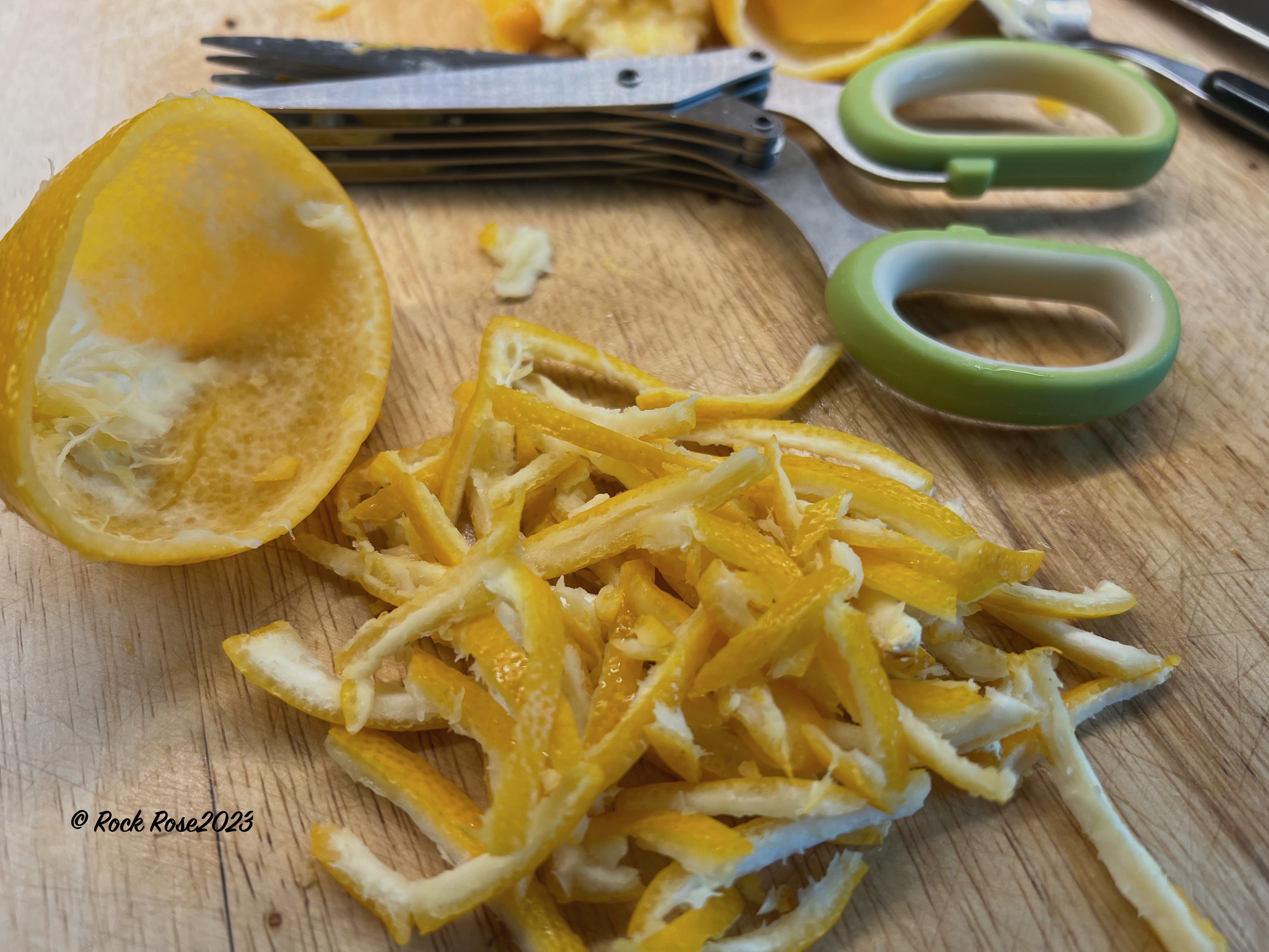
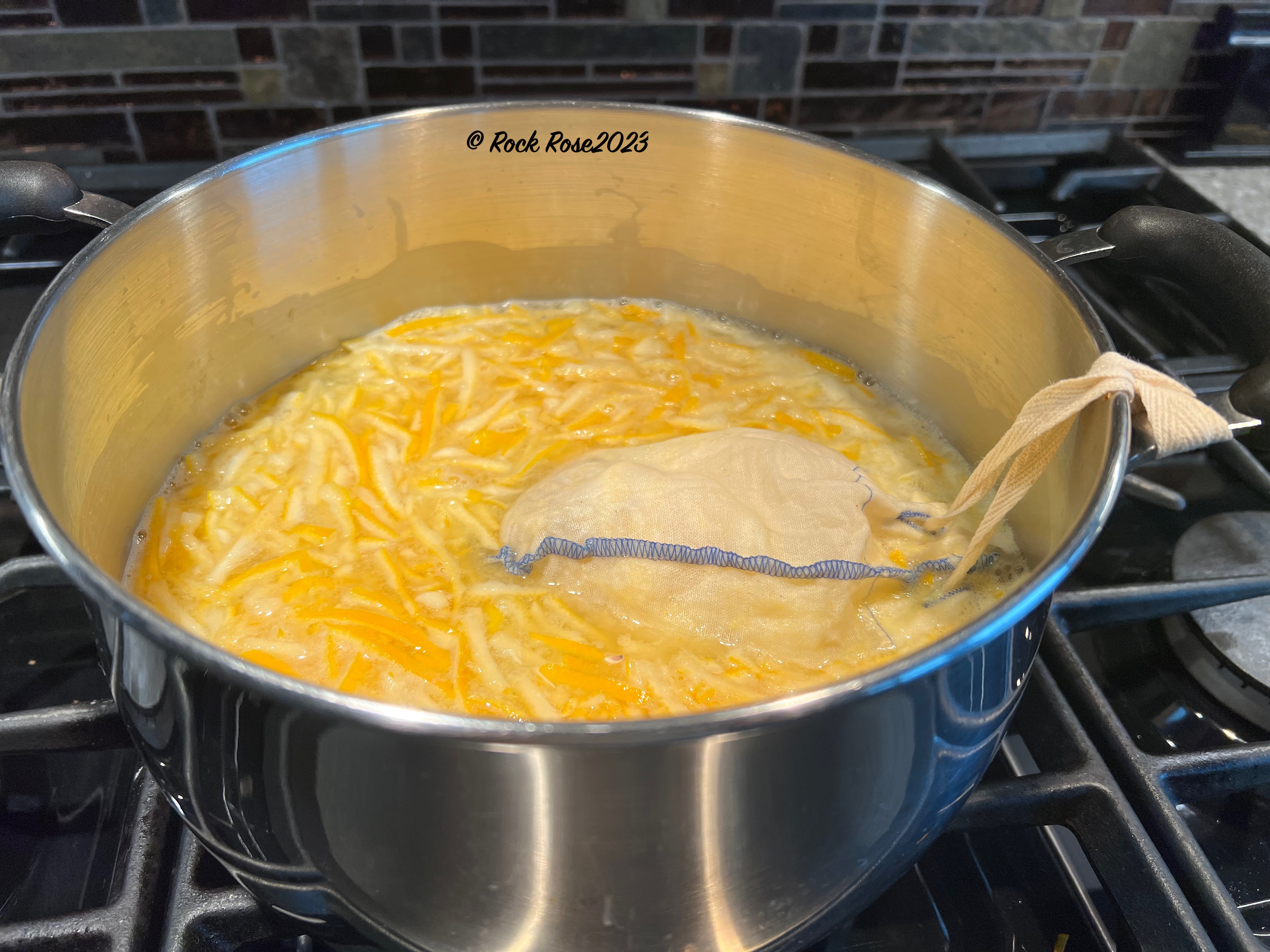
Having been a science major I really like to work with definite quantities. 3lbs lemons, and 6 pints is fine but then to have reduced to 4½lbs of liquid! Or did they mean pints. Confusing. Right from the start I am gambling on getting this right as I am working with cups. I should have looked elsewhere for a recipe. The electric lemon squeezer made light work of getting out the juice and scraping the pith from the peels is very easy with Meyer lemons.  Pips and pith went in to a cotton bag to ensure plenty of pectin. The peel was shredded quickly using these herb scissors. Thanks to my garden friend Barbara Segall for this suggestion. I measured the juice and peels and added water per the recipe and boiled down for 1½hrs until the peels were soft. Left overnight to make the following morning.

I added sugar at one cup for each cup of juice/peels and boiled until the setting point was reached.

 That setting point always seems to be a gamble. There are several methods to use and I find it best to use a combination. A jelly thermometer, the cold plate and the spoon drop. The suggested temperature is 220° but what do you do when your two thermometers read differently? Then you use the cold plate test. And if you can't get a good fix from that then drop some from a spoon and see if it forms a flake. The ultimate test is when a few hours later you dip a spoon into the small test pot and are delighted to find it has set to the perfect consistency and tastes pretty good.


The rain is due to end soon but there is bad news on the horizon. They are forecasting some night time temperatures in the 20s next week. In will come the plants and out come all the blankets again.

Monday, January 9, 2023

ONE YEAR ANNIVERSARY AND BEYOND!

What started out as a story at 9 months then 10 and 11 and finally...... we are here in the New Year and a month past the anniversary of the day we moved into the house in Oro Valley, Arizona.  I think I may have asked David whether he wanted to carry me over the threshold. He declined.

I was about to get a few hard lessons on desert gardening. But, they have not deterred me from trying to make the small garden areas around the house more to my liking. You may wonder if the summer heat stopped all outside work. That was not the case, although all outdoor work must be done before 10am. It was a small window. Even so the summer has been quite a surprise and much cooler than expected. (We were gone for 3 weeks when we drove up to Wisconsin to attend the Madison Fling). Elevation undoubtedly makes a difference, we are at 3000'. Just when the desert started to take on a dry dusty beige look, the monsoon rains arrived. The days and nights were cooler and the desert became green and bloomed again. 

But during this time there was much to observe and learn. 


POTS IN THE DESERT

                The lace cactus and paddles went into the ground in the early spring. They seem at home.

In Austin I had many cactus in clay pots. There they were happy to spend the summer out in the garden where they had afternoon shade and the winter in the greenhouse or potting shed. Not here. Very few of them can tolerate the summer sun in Arizona, even the morning sun, and being in a clay pots makes them doubly susceptible to a slow death, their roots dried and fried. That Austin 'death star', bears no resemblance to the fierce sun that shines down on my small garden. All my potted plants are hungry for shade. A few are in temporary places under trees but they will either find a home in the ground or go to The Little Free Garden Stands. I aimed to have dealt with them before winter arrives. (It did not happen). Many have succumbed and I have boxes of empty pots in the garage. And one thing I didn't have in Austin was critters who like to eat succulents although the birds did peck them from time to time. Some of my prettiest plants have been nibbled mercilessly. One of the miniature prickly pears was eaten down to nub overnight. The tops of some succulents just eaten off. They were so shocked they didn't produce any blooms this year. They just got busy repairing the damage.

This plant started to close up the wound and began making a new baby.

 And now has a chubby little offspring.

 There is no counting the times I moved pots around. Firstly settling them along the north wall of the house which had complete shade. 


But not for long as the sun moved across the back of the house to its final summer solstice location. That shady area was now in full sun for a good part of the day. Now they moved to the east facing patio. A better location for the summer but only if the solar screen was down. With insufficient large pots the numbers of successful potted plants dwindled. This photo is a good reminder of exactly what I have lost since the spring.

CRITTERS

Almost all pots have to be elevated to prevent the pack-rat snacking. The one disadvantage of living right on the edge of the desert. There is little hope of stopping them. The pest people put out traps with bait but they ate it and pooped all around the edges of the wall. I regretted having left 3 Havahart traps at our last house and had to buy another one. The snacking I could stop but I could not tolerate the rat poop. We showed no mercy. A few staddle stones would be in order( look at those on line prices for genuine antique staddle stones) or I could make my own with upturned pots or any other supports that will hold a pot. The challenge is to make the scene look attractive. Another answer is to put the smaller succulents inside a large planter. Or find a place to hang on the wall. Call me fussy but from a design point of view these pots just don't go with the style and color of the house. It would be a good place to have a cactus theater. Unfortunately I don't think we have the equipment anymore to make one.


The Euphorbias are a pretty safe bet. I thought the huernias would be safe too, placing them on the ground, but the flower on one was taken during the night before they began snacking on the ends. Not my favorite way to prune. The two pots are now safely on the wall.

A complete pot of paddle plants was decimated but ones I planted in the ground have so far been left alone. Those rats prefer to run along the edge of walls.

The agave, A. desmettiana variegata and A. demettiana Joe Hoak found a home in in the ground in the shelter of our overhead patio. This and the fact that they don't get any rain may also protect them from low temperatures in the winter. We are more susceptible to winter frost at 3000' Unfortunately pups growing at the base are perfect for the rats to nibble and they did.

 The barrel cactus I had in pots have all been planted among barrels that were already here. They seem happy. Damianita is a great companion plant and has been highly successful with almost continuous flower.

 One planter that will probably remain has the only squid agave that I brought from my old garden. So far no pups but it has had a happy summer on its pedestal. 


We recently found a home  in the garden for the potted Meyer lemon tree. It involved taking out a photinia -why did they plant so many- and digging a large hole. The bigger job was getting the plant out of the pot and getting it settled. Then creating a shade structure to help it through the summer.  Fingers crossed that it will settle in and bear fruit next year. It has not taken well to the conditions here and even though it bloomed twice it never set fruit.


 The lime tree will remain in a pot as it is the least hardy of the citrus. It bloomed twice and only began to set fruit in the fall. Now, in January it is blooming once more and looking as healthy as ever. 


The grapefruit, planted a year ago seems to have settled in. It is looking a little yellow from the cold but soon it will be time to fertilize and hope for a crop this year. 


It doesn't stop us from looking enviously, over garden walls, at trees laden with fruit but ignored. They are probably at least 15 years old.


AGAVE REMOVAL

The A. weberi looked pretty impressive on first glance. Some of them were about the size of the ones I had had in Austin before the devastating winter event of 2021, but I knew well that they didn't have many more years left. A decision was made to remove the ones in the front bed and one down the side of the house which was planted too close to the path. 


David undertook the job of removing them. One thing I had noticed was how few pups there were, once again remembering my Austin agave. A few months later we were to find out why. The agave weevil had been at work removing most of them and now moved on to some of the larger ones. In fact a message went out in the neighborhood that someone had lost his A. ovatifolia to the dreaded weevil. One of the telltale early signs is rat and rock squirrel activity going after the grubs in the base. Although I had experienced weevils in smaller agave in Austin there were usually only one or two. This time there was an infestation of grubs. In all we took out 10 agave. The bonus was a space to plant the lemon tree and a pomegranate.

THE PALO VERDE


Oh! how we enjoyed the blooming of the palo verde tree. We learnt ours was a hybrid "desert museum' Thornless, upright and less messy than the native variety. We remarked on the sound of bees as it bloomed not once but several times after a rain event. I was cleaning the rocks along the side of the driveway when I came across a root that had been severed as it tunneled under the paving. Several pavers had lifted. That was when I put two and two together and came up with the cause of the blocked sewer line we had shortly after moving in. Tree roots had invaded the line which runs down the driveway. The tree still stands but has been pruned heavily, several roots going under the driveway removed and reluctantly we will take it down in the New Year. How they could possibly have thought of planting this tree so close to the sewer lines just shows the thoughtless planting of the landscaper.  I have already planted a replacement, a desert willow, further away. It is small but I am told it is a fast grower. It was one of the 3 trees I ordered from our electric company along with the another desert willow and a pomegranate.  They offer the following selection of trees from which I have ordered 3 more.

I have some space along the driveway and between our and our neighbor's property. Yesterday, David took out a Texas Olive which was planted far too close to an Anacacho orchid tree. It has exposed the neighbors electric meters but I will plant some evergreen bushes to shield them. The removal of the olive means one less tree to keep pruning and less fruit to dispose of. I have at lest 6 more that may be for the chop.

THE SUN

I was aware of the sun's movement across our garden in Austin but it never seemed to cause much of a problem. Suddenly plants that were shade by the patio in summer we’re exposed to the lower travel of winter sun. I have yet to have  full understanding of what will work well under such exacting conditions. But so far I have had success with white alyssum, damianita, Chrysactinia mexicana, dahlbery daisy, Thermophylla tenuiloba, purple skullcap,  S. suffrutescens, Gold coin daisy, Asteriscus maritimus, blackfoot daisy, Melampodium leucanthum, chocolate flower, Berlandiera lyrata. All made it through the summer. Some may be short lived.

White alyssum. A survivor.

All the shrubs I planted have survived and some are coming into bloom. We had generous rain over Christmas so I'm looking forward to the wildflowers I planted showing their faces soon.

Happy New Year everyone. Rock Rose is back in the garden with renewed energy.