When it rains in the desert at just the right time, the desert becomes a carpet of flowers. These are plants that rely on rainfall to grow, bloom and set seed in a very short period of time before the summer heat arrives.. It doesn't happen every year but this year was a particularly good one and we made the most of it by visiting the places where wildflowers were blooming. We took trips to the Anza Borrego Desert, the Boyce Thompson Arboretum and surrounding areas of Superior and our nearby Catalina State Park and Pima Canyon. We have hiked there multiple times this spring awaiting the desert bloom.

The Mexican poppy or Gold poppy, Eschscholzia californica ssp mexicana is the most prolific of the annual desert flowers in our area. It is similar to the California poppy except for missing the small green sepal underneath the flowers.

It appears in shades of gold and yellow and seen here with owl's clover, Castilleja exerta..

The first time I saw it I thought how much it reminded me of Indian paintbrush and I was correct. It is in the same family.

Cream cups, Platystemum californicus, also blooming alongside the poppies and as the poppy prefers the open, hillside meadow area. Where it finds a happy place it blooms in large swathes opening its petals once the sun shines but remaining closed on cloudy days.

The desert zinnia, Zinnia acerosa, is on my list of seeds to buy. I hope to find a small patch of my garden to plant a wildflower patch.
This hike is is one of my favorite hikes, the wildflowers just adding an extra layer of joy. The scenery is superb and at this time of the year there is water trickling down the mountain into pools known as bathtub tanks.
.jpeg)
Another wildflower blooming prolifically is the scorpion weed, Phacelia distans. It is very showy when found in large numbers.

Some flowers are prolific along the roadisdes including the Arizona lupin, mallows and penstemons where they receive just a little more rain. They are different from the Texas bluebonnet in being a little taller, having finer leaves and smaller more upright flowers.
.jpeg)
Lupin, Lupinus arizonicus
.jpeg)

Mallow Sphaeralcea ambigua
Desert chicory, Rafinesquia neomexicana, is abundant in washes and on the hillsides and is particularly showy when found in a clump.

There are many more wildflowers blooming in the spring and every day when we are out hiking I feel fortunate when I find another new one to add to the list of the many flowers that bloom under the harsh conditions of the desert.

As the gold poppies fade the brittlebush, Encelia farinosa, comes into flower. It is a perennial shrub growing to about 3'. It seeds easily and I don't understand why it isn't used more frequently in the landscape. In our neighborhood of landscaper-tended gardens there is only one. The use of pre-emergent means it never gets to germinate. As you might imagine my garden has many blooming specimens with more showing up every year. It is so plentiful that I can be choosy about where it gets to grow.
But our visit to the Anza Borrego Desert yielded the most prolific of blooming carpets. It was a spur of the moment decision. We packed up the car for an over-nighter along with picnic supplies and headed west towards the Salton Sea. We had been only once before on a Thanksgiving trip in our VW camper in 1981. We had forgotten about the fact that it would be dark by 6 o'clock and with no campfires allowed and no other campers foolish enough to be out there. We ate and had the earliest night ever. And it was cold. We did enjoy hiking the next day and determioned to go back during a better time of the year. It had taken 43 years!
We knew exactly the spot to aim for. Henderson Canyon and were not disappointed.


It was incredibly windy and trying to get the flowers to sit still for a photo was almost impossible. The best spot was to find a larger growing creosote bush and hide behind. We planned to come back the next day.

I was on the lookout for the desert lily, Hesperocallis undulata. If someone on instagram had not mentioned he had found it I would not have known what or where to look, but as we drove along I had my eyes peeled for them. They are mostly found growing alone but I could spot the open lily from the car as we drove along. We had to stop and then walk back. The ones we saw were about 1' tall although I hear that in more favorable conditions they can reach as high as 3'

How could such beauty spring from this cracked earth?

We spent the night in Indio and returned the next morning. The wind had dropped and the fragrance from the field of flowers was incredible. Then we drove to look at the desert sculpture we had heard about stopping first at the Friday market in Borrego Springs.

The serpent or dragon

The Spanish priest

The gold miner
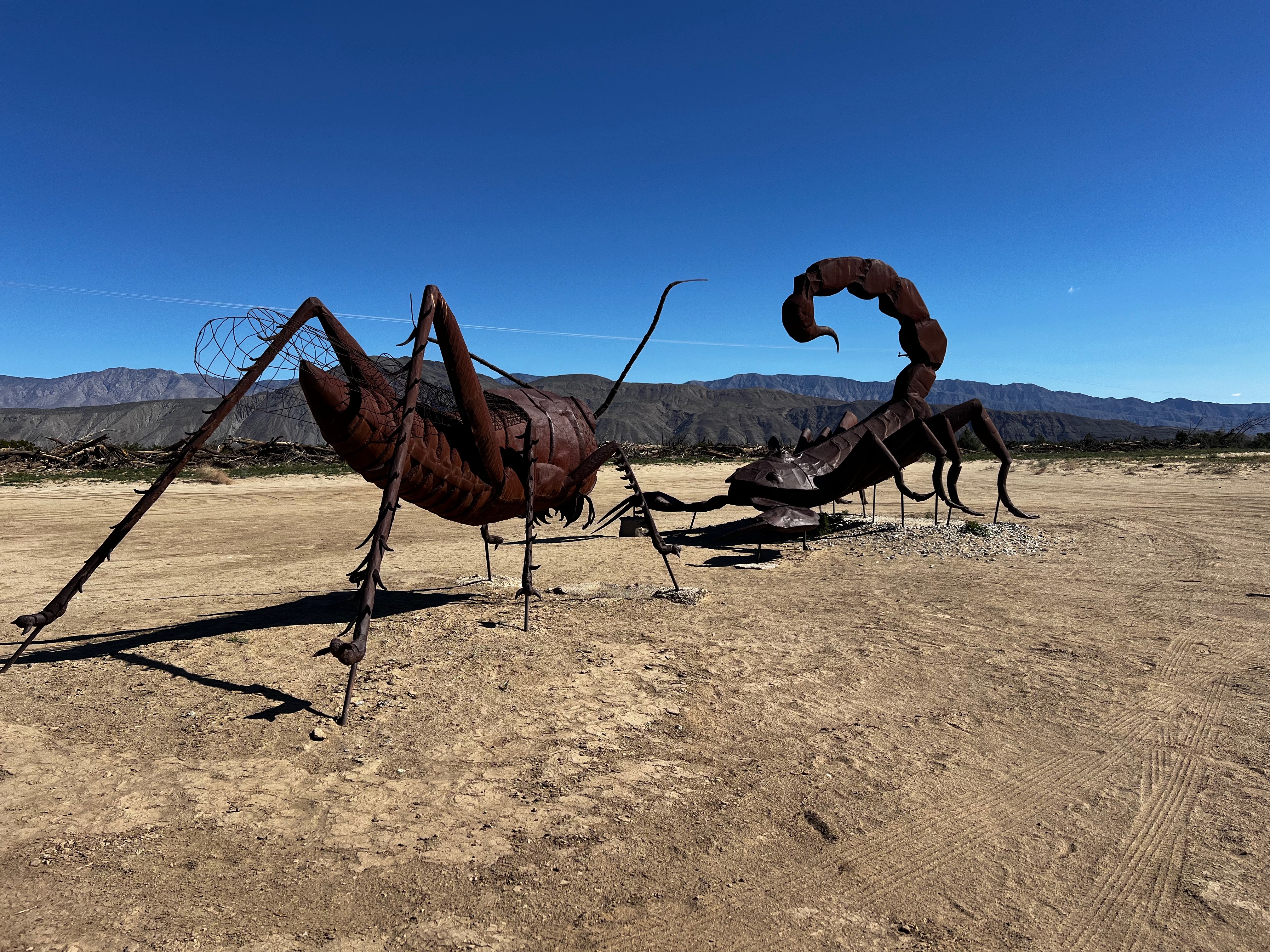
Over 100 pieces of metal sculpture created by Ricardo Breceda are spread over 1500 acres of undeveloped land. These are just a few of our favorite pieces. They were gifted to the town by the town's benefactor Dennis Avery. All manor of animals; camels, sloths tigers, pigs, sheep, tortoise and the dragon seen above. Also the Spanish explorer Juan Bautista de Anza.
The Anza Borrego desert is surrounded by BLM land and camping is permitted in many areas. Most of the people who camp here have all terrain vehicles and derive enjoyment from driving the desert trails. Not our cup of tea but we are open to dry camping inside the park where there are one or two designated campsited. It is our plan to return next year and explore more of the hiking trails.
Because we had a long 6 hour drive home we quickly went over to look at one of the hikes into a slot canyon. We had not planned to hike so had no boots or poles with us. We did a short distance but the going got tough and a 5' drop made us turn back. Next time!

.jpeg)
All in all it was worth those long drives there and back.





.jpeg)