My Blog List

Showing posts with label Sonoran Desert. Show all posts

Saturday, August 23, 2025

THE SHROUDED GARDEN

 It's summer in the desert and that means intense heat and little in the way of gardening. Each morning, and I am usually up by 5:30am, I open the patio doors and step outside to sample the temperature. On a good morning the temperature will be around the 70 degree mark. Maybe a little lower and there will be a slight breeze. I must make the choice between going for a walk and doing some gardening. All must be done by 9am.We make the most of these early morning hours. 


I have come to love this time of day, whether doing a few chores outside, taking a walk or eating breakfast on the patio.


This is the first summer we have been here at this time so it is somewhat of a novelty. We should have left in mid June, with our trailer, to head up to the cool mountain air of Idaho. Unfortunately a routine breast MRI ( I have been having them every year since having cancer treatment in my right breast 5 years ago) detected something suspicious. It was a new cancer. I was once again on the roller coaster ride of multiple tests and there were more serious decisions to be made. I saw our summer travel plans fly out the window. When I met with the surgeon I was pretty sure that this time it would be a full mastectomy and all I could say was " How quickly can you do this?" And so mid June I had a mastectomy. I have recovered well and I think I was very lucky in that I had no pain and did not lose any arm movement at all and continued pretty much as normal. Except for not really being able to do any gardening or lifting anything over 5lb. Try and tell that to yourself when lifting doesn't elicit any pain. You may think that this was perfect timing to be mostly in doors. But we have had a very difficult winter with no winter rain. Couple that with a poor monsoon last year and some excessively hot days and things have not played out well in the garden and I was powerless to do anything. I am seeing more and more failure and am making plans for some changes as soon as fall arrives ( October at the earliest) We are praying for a summer monsoon to help out. 


No-one would doubt that this part of the Sonoran desert is not a beautiful place but if you were to look around and assess which plants are native and do well here without irrigation you would find a limited palate. Plenty of small trees, all with their small leaves ideally suited to desert heat, and they do put on a magnificent show in the spring, and a number of cactus including the saguaro, lots of fishhook barrel cactus, a sprinkling of echinocereus and small mammillaria, a few yuccas prickly pear, ocotillo and the very successful cholla. The mammillaria are quick to respond to a little sprinkle and lowering of temperatures. 


But few of the cactus you may come across at the local cactus nursery will you seen the wild desert landscape. And we certainly have plenty of the finest in the country. When I visit Bach's cactus nursery I ask them which cactus can survive everything that the desert has to throw at it. They show me a small table of plants both summer and winter hardy. That said there are some additional plants that do well here and add some variety to the home landscape particularly as many have a drip irrigation system. I can't say that I have ever seen this bunny ear cactus, Opuntia microdasys,  growing wild ( native to Northern Mexico) but it is beyond happy in the summer garden. Nor is it eaten by critters. It is best suited to an outdoor planting where the gardener can keep well away from it. I once walked out of my old greenhouse with a pot of this plant and the door swung to and the cactus promptly hit me in the face leaving behind thousands of tiny glochids. 

This euphorbia, Moroccan mound, Euphorbia resinefera, is also a success story. Slow growing but also unlikely to be eaten by critters. Not always easy to find at a reasonable price because it takes so long to grow to a decent size. 


One trick that the growers do is to put three smaller ones in a larger pot. When you come to plant they simply fall apart. The best way to overcome that is to dig the hole, cut the bottom out of the pot, slip the plant in and cut away the rest of the pot. You need a strong utility knife to cut through the plastic but this is the way  I have seen the landscapers plant their big pots and cactus in particular.  

When I began writing this in late June I had no idea if we would ever get away this summer. We did, making the journey up to the Wood River valley in Idaho where we were able to spend 4 lovely weeks on our favorite campsite. 


We hiked, 


visited museums, gardens, watched the birds ands animals visiting our campsite, enjoyed the summer symphony, the arts festival, farmers markets and I felt my former self coming back. On our last weekend I pushed myself up 1300' at 9000' on the Norton Lakes trail to Smokey Lake. Then it was time for the 3 day journey back to our own valley. 

But I dreaded what I would find when I got home. The hoped-for monsoon rains had been sparse and never in our area and they are so desperately needed-especially after the dry winter. I scouted the vegetation as we approached home and noticed the ocotillo were in full leaf. That was a good sign as ocotillo will drop their leaves in drought and as soon as it rains they will leaf out again, doing this multiple times in a year. There had been rain at our house because I could see flowers on the Texas sage had bloomed and withered. Those plants that had made it through dry June and July were springing back to life. I had lost several plants in pots........some had been eaten. There were plenty of holes at the base of plants where small desert critters had sought coolness. And now another rain this week has really brightened up the desert with trees and bushes coming to life. 

                                                         barrel cactus are blooming

Everything has taken a big drink. Will it be enough to see the desert through the rest of the summer remains to be seen. And there is still a lot of summer left. 

Sunday, June 8, 2025

THE WEIRDLY, WONDERFUL SAGUARO

The saguaros ( pronounced sa-war-o) are in bloom and they look fabulous. With their white-flowered bouquets held mainly on the crown they look positively bridal. How fortunate we are to look out every day at our Belle, who never fails to disappoint us through the month of April, May and into June. 


This spring we have eagerly watched her from the very first time we took out the binoculars looking for those tell-tale little pips to appear. You can barely make out the tiny protuberances close to the crown, but as the days go by and they start to swell you know the saguaro is going to bloom. 


We were concerned she might take a year off from blooming because she is not looking her best this year because of the drought. 3 years ago she was looking quite plump having filled with water during a decent rainy winter. 


The monsoon last year did not deliver and we have had no rain this winter. Barely half an inch since November. Saguaros are perfectly adapted to drought and immediately there is any rain falls on the ground they quickly send out tiny roots close to the surface to take up the moisture. They fill up their stems and the pleats expand to full size. I remarked recently how wavy and thin many the saguaros were looking so it will be interesting to see the change when and if we get rain. 


And yet they have bloomed heavily this year. Is this a stress bloom? 


Saguaro, Carnegiea ( Cereus)  gigantia, along with prickly pear are known as arboreal cactus, meaning they are tree-like with a center supporting structure similar to a tree. It is rare to find an old one standing with such a well defined skeleton. This one is on an old, abandoned nearby golf course.


They are usually found more like this.


A close up of the skeleton shows the trunk as being made up of a series of woody ribs.


Tree-like bark on a 150+ year old saguaro. 


The saguaro are primarily native to the Sonoran desert, the upper edges of the Colorado desert and a small area of California near to the Colorado river, growing between 600' and 3,600' It is an extremely important plant in the Sonoran desert ecology. Its fruits have been gathered by indigenous peoples to make conserves and drinks. The seeds, high in fat  used as food and more recently used as chicken feed. The ribs of the plant are used for building materials and as a tool for collecting the fruits. 

The saguaro is also important to many species of birds and bats who feed on the nectar within the flower.  The distribution of white winged dove and the elf owl almost completely mirrors that of the distribution of saguaro. The fruits, when the pods split open are a major food source of desert birds. Woodpeckers make holes in trunks which provides a nesting are for many birds. Even branches of the saguaro make a good nesting site for larger birds.


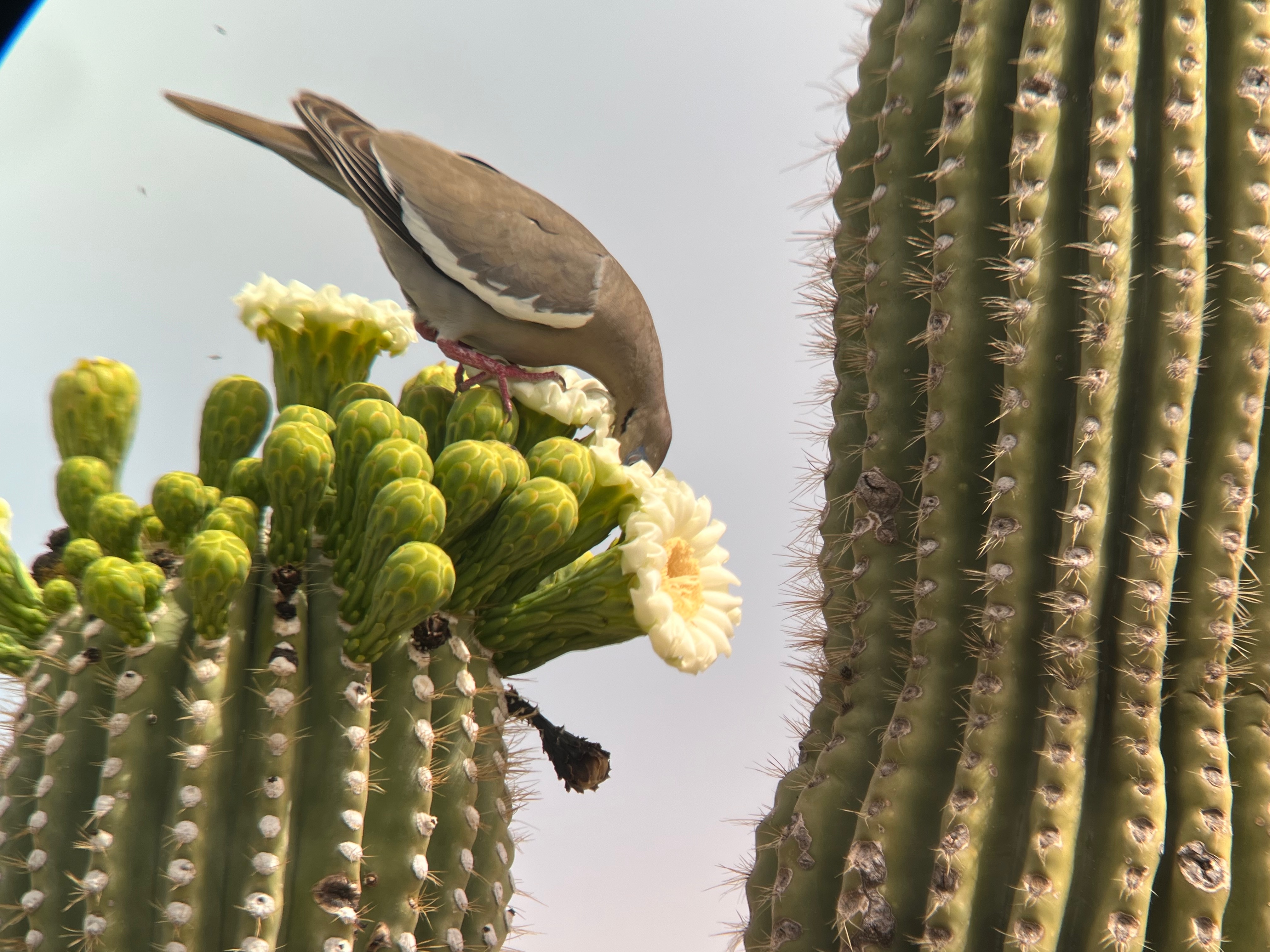
White winged dove sips nectar from the  open flower of the saguaro and doing double duty pollinating the flowers. 


But it is the woodpecker holes that are responsible for the rather curious structure known in the desert as the 'boot'. Often seen  on display at nature centers or in the visitor center at the Saguaro National Park and Sabino Canyon. When woodpeckers carve out their hole the tree protects itself by producing a rough bark-like material, completely walling off the intrusion. Following the death of the saguaro, after it has fallen to the ground and much of its substance decayed the boot will remain. We have been fortunate to find two of these among fallen saguaros. Once dried they make a curious artifact that maybe only a desert dweller will prize. A good intact boot might have been used by indigenous peoples as a water carrier or holder. 


A saguaro does not grow arms until it is at least 50+ years old. Many saguaros take on the regular candelabra shape but sometimes there is no rhyme nor reason to where the branches appear. Some are spectacularly wild in appearance. 


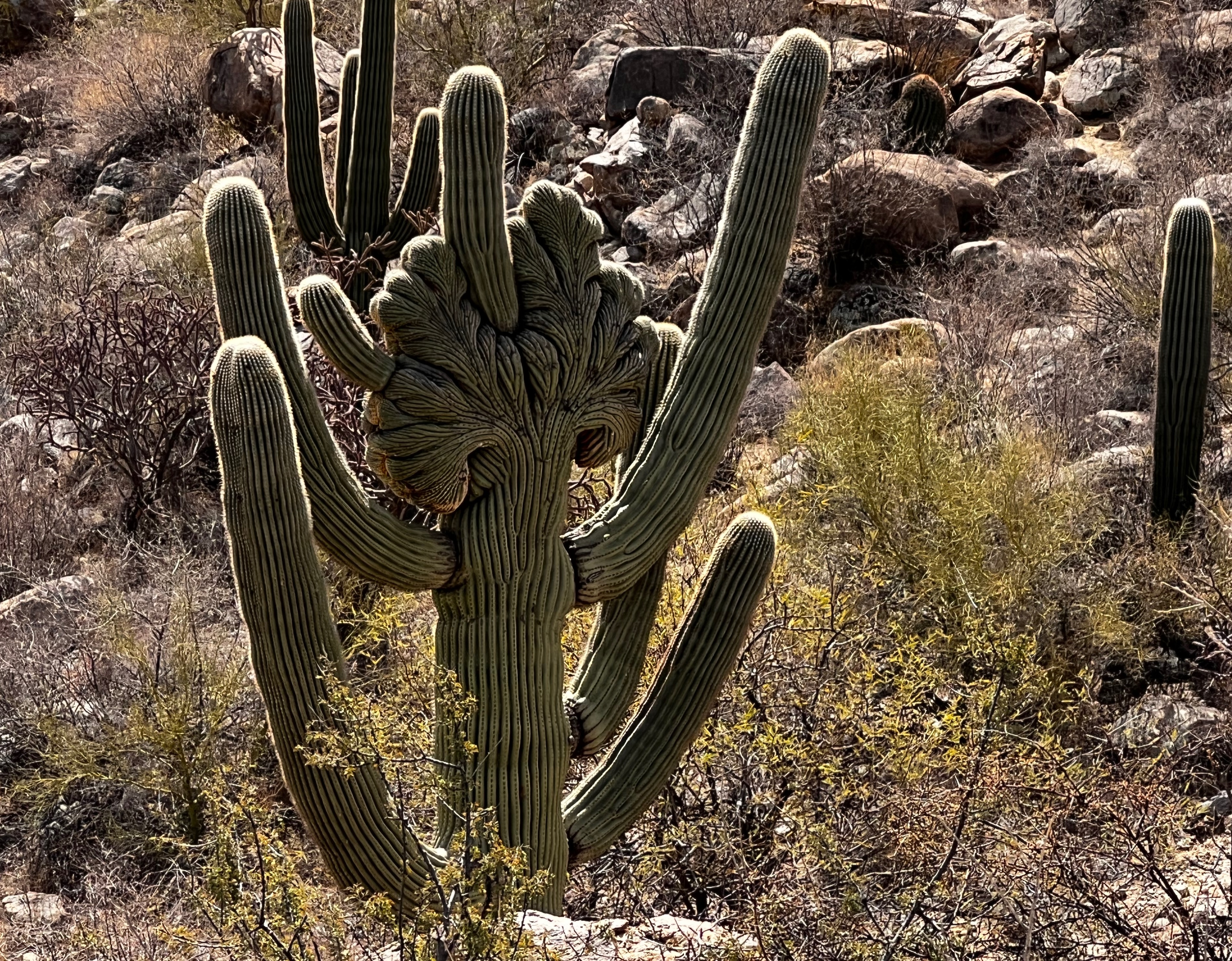
and then there are some spectacular cristate forms where the arm creates pleats on the end of the tip which grow upwards instead of in a cylindrical manner. No-one knows why this happens. It appears to be neither causes by virus or damage to the growth point. It is probably genetic. 


Then some appear to change their mind and start sending up a normal branch. 


Estimates show that 1 in every 100,000-200,000 will cristate. Where we live in Stone Canyon, in an area of 1400 acres with an estimated 14,000-25,000 saguaros, there are 22 crested saguaros. An extremely high ratio. Someone in our neighborhood has donned his snake boots and combed the area to record all the crested saguaros. He led us on a hike one day to share a few of his findings. We also like to leave the trail and follow up one of the many washes in search of the crested form. 

Now into June the height of flowering season is over. The fruits begin to swell and will provide the bird life with food through the hottest part of the summer. 


On the golf course while saguaro may benefit from some additional water they are also at the mercy of the errant golf ball. 

Global warming is causing the death of thousands of saguaros. The saguaro closes its pores during the day and opens them up at night for photosynthesis. Overly high nighttime temperatures, this last two summers  have meant their pores have failed to open. They have had to rely on stored water with the resulting loss of integrity of the stem. They will often drop and arm in the same way that trees will drop leaves in order to survive. We have been a little more fortunate that the desert floor because we are at 3000' and about 8 degrees cooler than Phoenix but even here the changing weather conditions have taken their toll on the saguaro count. Plus in order for saguaros to germinate and survive they need at least 3 good wet seasons. We are all hoping for a really good monsoon this year although the predicted extreme highs in the coming weeks have us all a little worried. 


Saturday, April 26, 2025

YELLOW IS THE COLOR OF THE MOMENT

Two weeks ago we had friends visiting from Denver. We were so excited to show them our wonderful desert home but disappointed that the lack of rain this year was making the desert look very drab and dowdy.  Usually the desert behind our house is a sea of yellow, at this time of year, with flowering brittle bush, Encelia farinosa. This year their leaves are brown and dried up living up to their name. I wish our friends had come a couple of weeks later, as following a brief shower and a cold front passing through, all the trees burst into bloom. Maybe the shower and drop in pressure had nothing to do with it and the flowering had more to do with daylight hours and the natural cycle of blooming. The Palo verde, mesquite and acacia are now putting on a magnificent show. Just driving down the road with the trees in flower and the backdrop of the mountains is the most magnificent sight. 


This is the  Palo Verde, Parkinsonia x Desert Museum, in our front garden. Regrettably this tree was overwatered by the previous occupants and has grown very large. We have had to do some canopy pruning as well as root pruning as the roots were bringing up our driveway in several places. We were also fearful of them making their way into our sewers system. But for all these negatives we love the tree for the filtered shade it provides for the plantings beneath its canopy. It is the sterile hybrid of three palo verde species, P. aculeata, P. microphyllum and P. florida. Its attributes are that it is thornless, fast growing, drought tolerant and attracts many pollinators.

When the flowers drop the ground is a carpet of yellow  


Below is another common spring bloomer, the mesquite, Prosopsis sp.  producing long pods later in the season. These are a favorite of the javelina and can also be ground to make a flour as the Hohokam  lived did many years ago. For all their messy nature the trees both stabilize and being a legume, improve the soil.


Above the sweet acacia, Vachellia farnesiana, The desert trees and shrubs are competing for who is the most fragrant. 
Other shrubs like the hop bush, Dodonaea viscose, are also blooming. These reseed quite readily and I have a couple which seeded in a perfect place among the rocks and which I intend to keep. Yesterday, I collected the papery winged fruits, with the intention of sowing some behind the house in what we now call the hinterland. 


This tree loves dry rocky slopes so will be quite at home. 

In my limited space areas damianita,  Chrysactinia mexicana, is very much at home in fast draining desert soils. It is extremely tolerant of heat and drought. If I had one complaint is that the yellow color is just a shade too bright. It germinates quickly from seed but bringing it to even childhood even under controlled conditions is very challenging. The wiry roots are thin and easily damaged. I have had success with only one plant. It makes thousands of seeds but never produces seedlings naturally. 


In truth I think I prefer the gently sprawling nature of the yellow evening primrose, Oenothera primiveris. It is planted along the edge of the walkway between two rosemary bushes. 

evening primrose


The first of the prickly pear blooms are opening. 


The barrel cactus make up for having the smallest of blooms by making a bold statement with their structure. 


Flowers on the Blue barrel cactus, Ferocactus glaucescens


The blooms are barely noticeable on the golden barrels, Echinocactus grusonii, but they leave behind dry prickly pods with small black seeds. I don't know what the conditions are for seedlings to grow but I never find any. The quail are very good foragers.


Next time I'll introduce you to the saguaro. There is much of interest to share.

Friday, May 3, 2024

MY DESERT GARDEN COMES TO LIFE

Spring is a wonderful time for all gardeners but particularly so for desert gardeners. It is the season of spectacular bloom brought on by winter rains. I have taken advantage of that by adding many blooming plants to my garden to complement the cactus and succulents. Some are perennial and some are annuals like this scarlet flax Linum grandiflorum rubrum. Annuals like to seed themselves along the edge of the paths where they driven by rain. Not always the best place.

Flax are dotted all over the front garden among rocks and cactus. I have always favored growing from seed and finally had success with damianita, Chrysactinia mexicana. This one I grew from seed planted 2 years ago. If I'm not careful it will be crowded out by these penstemon seedlings and a desert marigold. Despite the enormous numbers of seed they produce I have only ever found one growing naturally in my garden. No doubt the fault of the hungry quail who frequent the garden.

Damianita, blackfoot daisy and skullcaps are perfect low-growing perennials for the desert rock garden although not easy to come by. I did manage to find 2 purple skullcaps but unless they are in bloom they are sometimes miss-labeled and turn out to be the more common pink variety. Despite the many flowers and seeds produced it is very difficult to get these three to self-seed.


I'm trying to maintain a good balance of flowers and succulents for the quieter time of year when the cactus are center stage.

The damianita will  need to be sheared back soon so they can bloom again when and if the monsoon rains come. 


Just coming into bloom is the chocolate daisy, Berlandiera lyrata. I bought one plant 2 years ago and have been able to grow several more plants from seed over the winter. It has always performed well throughout the year opening new flowers every day. It is a morning bloomer, closing its petals by noon. It's chocolaty fragrance cannot be missed when walking around the garden. 

 This is one of three hedgehog cactus, Echinocereus triglochidiatus, I inherited,  which has bloomed successfully each year.  Their location is not ideal as they receive sun only in the later parts of the day. A place in a more open spot would probably result in a more spectacular bloom. I have allowed this native cudweed to remain. I love its silvery soft leaves which are the closest we would get to growing lambs ears in the desert. Some call it pearly everlasting as the flowers do well when cut and dried. 

My desert marigold,  Baileya multiradiata, has become so successful that it threatens to overgrow the driveway. I think it must be getting too much water. It reseeds quite readily where the layers of rock are not too deep or too large.

Spring is a very yellow time of year in the desert and I think I may just have a little too much of it. Between the brittle bush, damianita and the desert marigold I need to find a happier balance. Brittle bush is a wonderful desert plant which also reseeds heavily. I think it is underused as a native plant filling the roadsides with its yellow and dusky sage colored leaves. 


Seeds of blanket flowers grown from seed last year have been immensely successful. They are acting as though they are perennial. Last year they bloomed all summer long. You couldn't ask more of a plant in this desert climate.

 And there are frequent pop-ups in the spring of native wildflowers like the verbenas.

                                                         Verbena gooddingii

                                                              Moss verbena, Verbena tenuisecta

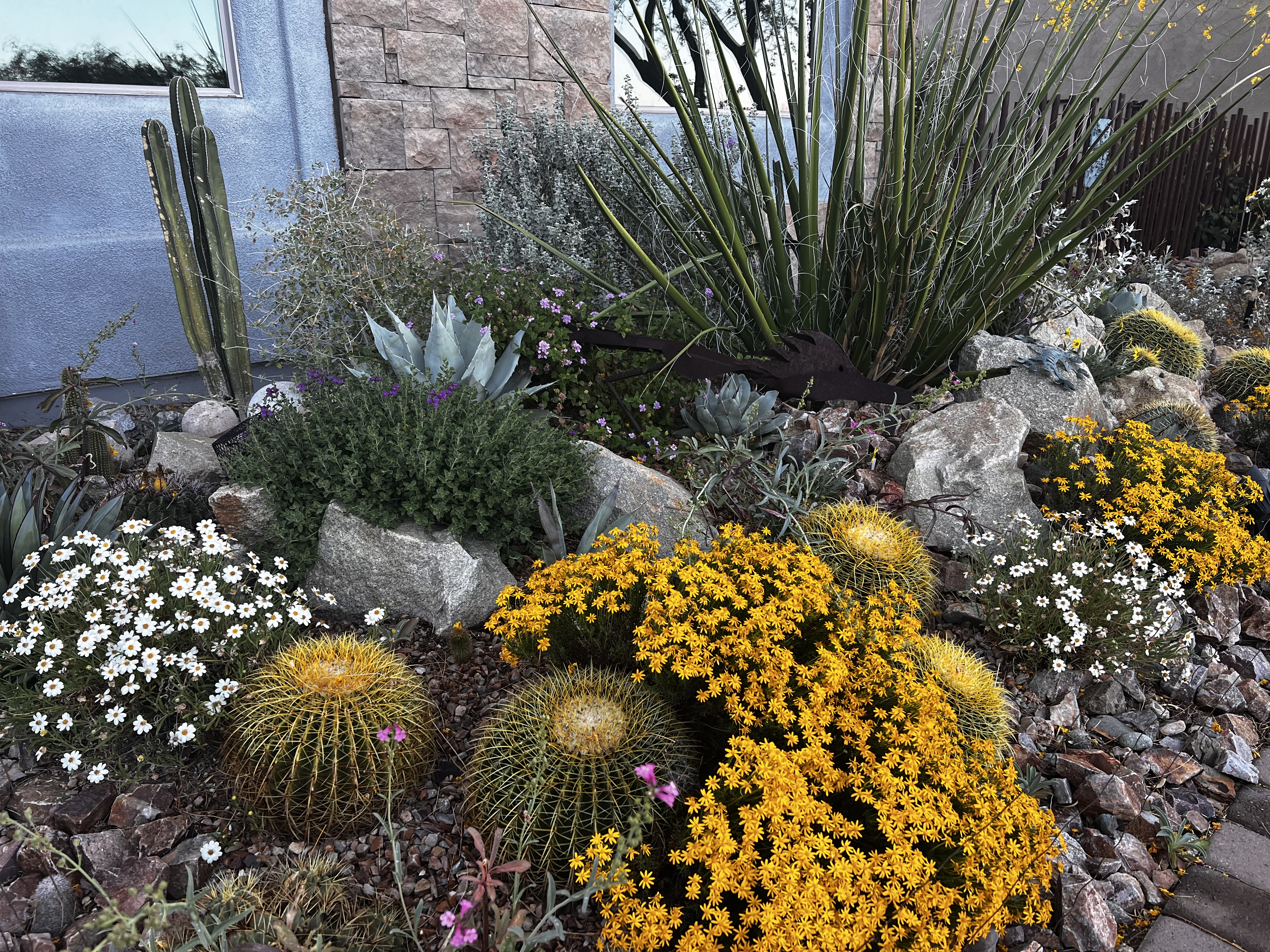
 The mix of colorful annual, perennials, cactus and succulents is a joy to behold on my early morning stroll around the garden. And it is always early.  Spring and summer in the Sonoran desert is a time to get up early to enjoy the cool mornings. The sun rises early and we must make the most of the best part of the day. Now we are in our dry summer with no rains expected until the monsoons arrive in July. Fingers crossed we will get good rains this summer.