My Blog List

Showing posts with label knockout roses. Show all posts

Friday, April 24, 2020

THE ENGLISH GARDEN...NOT EXACTLY

I named the English garden for the dry stone wall I created. A reminder of my childhood in the north of England where drystone walls were created to divide farmers' fields. I quickly discovered when we started building the house that there was a wealth of perfect stone at my fingertips. Flat pieces of stone suitable for building stone walls without any mortar. I began saving them and shortly after we moved in the house I began the project.


The wall creates a raised bed which follows the curved wall which encloses the garden. This was really necessary if I wanted to grow anything.
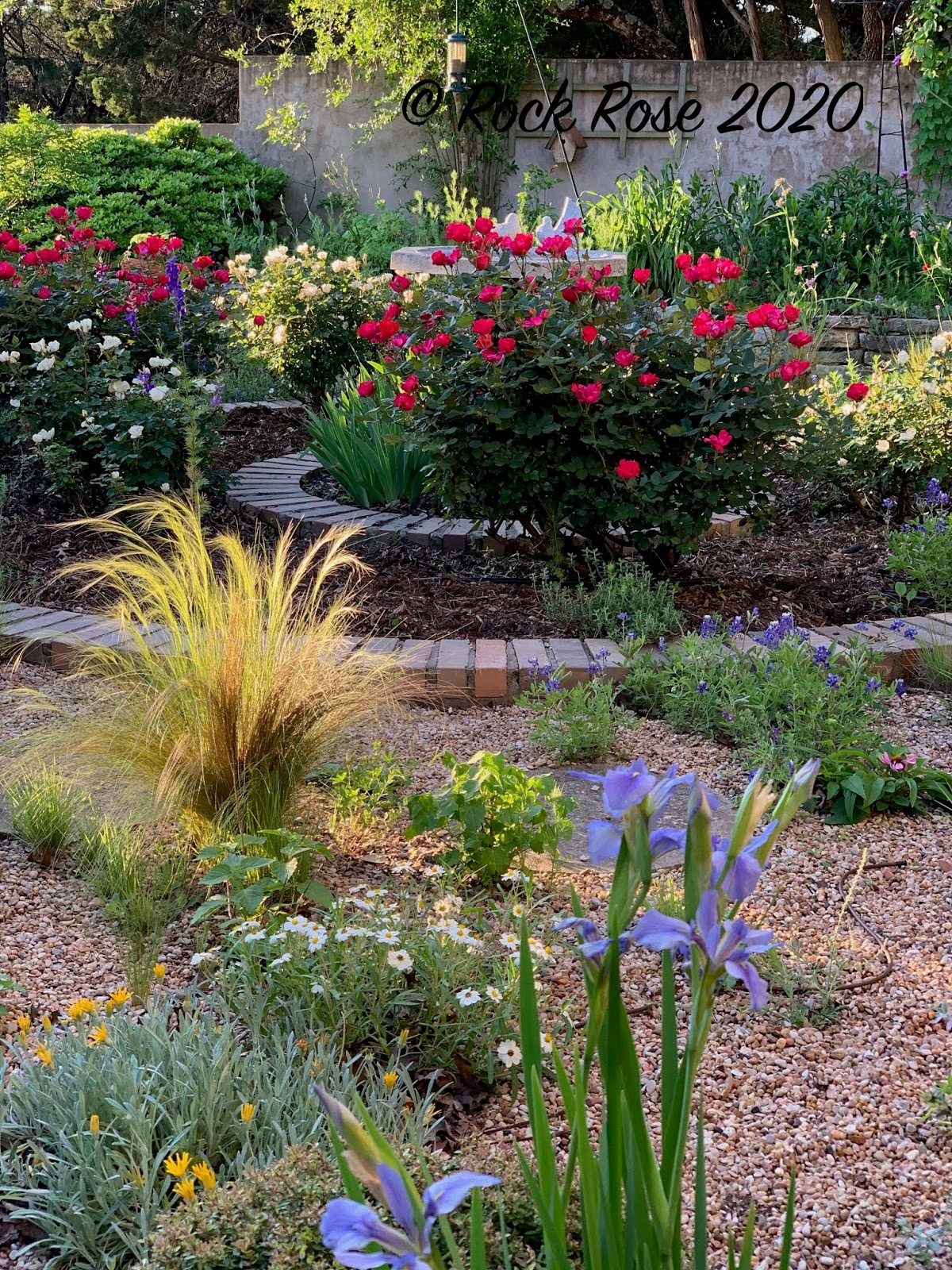
I love to capture the sun just as it peaks through the archway in the morning.


It lights up the Mexican feather grasses.


Not all English gardens are cottage gardens with lawns. In England there are many gravel gardens and gardens planted in the Mediterranean style, and although I didn't imagine this at the time, it is the way the garden developed and it made sense to eliminate lawns completely. It would have been so much work getting a lawnmower in here and so much more water to keep it looking good. Instead I decided on gravel and I am really happy with the way it looks most of the time.
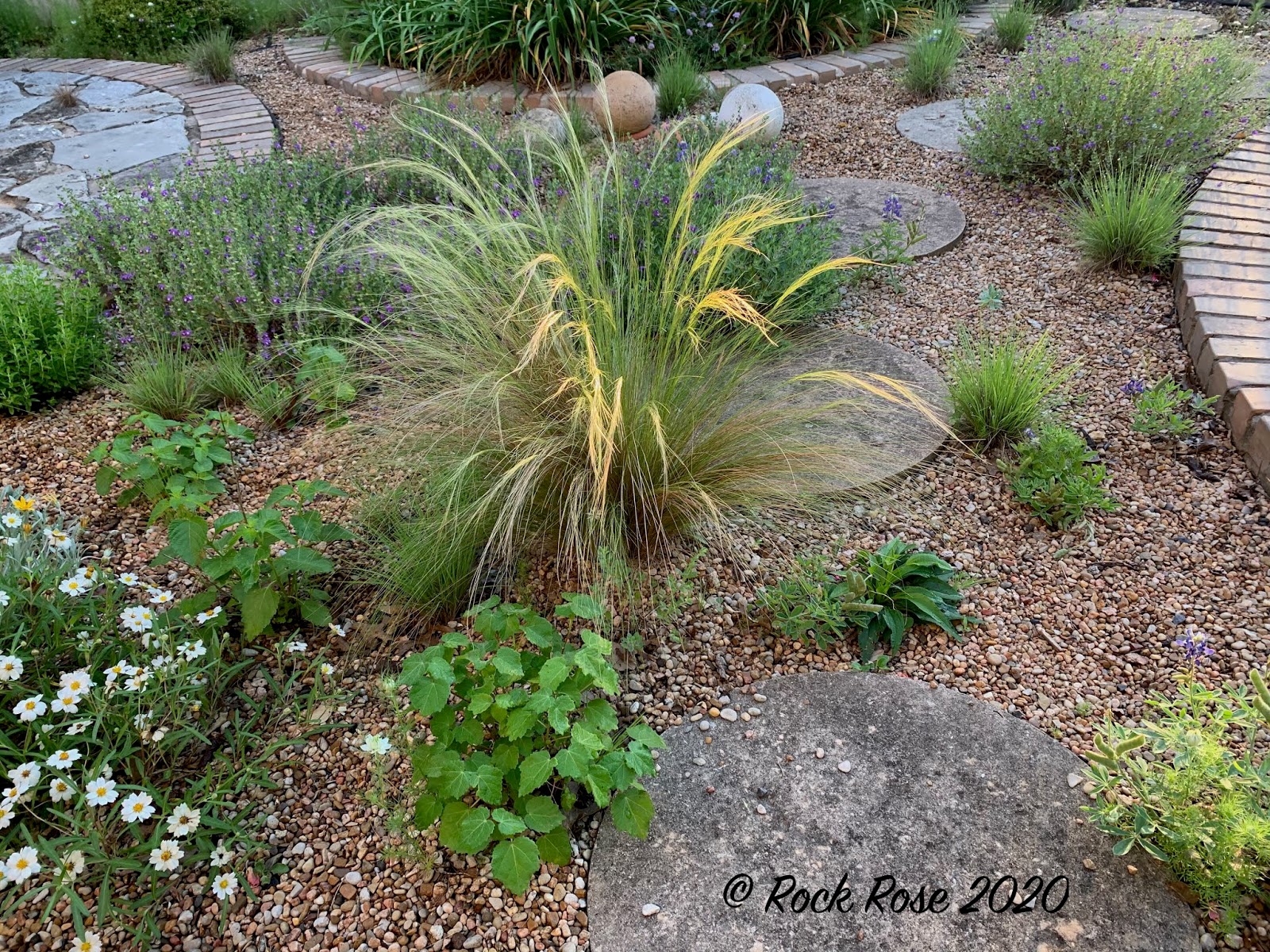

In my usual style a majority of the plants growing in the gravel have self-seeded and although it is work to keep it under control when it is at its best it looks great.

I confess I did plant the silver leaf gazania last year and it survived the winter.


A few days ago the gazania was looking wonderful and then with the heat yesterday and today it just started to wilt. Maybe the underlying soil was just too wet from all the rain we have had this spring.
One of my favorite flowers which have had wonderful success are the skullcaps-particularly the native Wright's skullcap, Scutellaria wrightii. It is one of the few plants that will last all through the year and with an early spring trim will stay in a mounding shape. When I prune off old growth I walk around sprinkling the seed into other areas. That and the Blackfoot daisy, Melampodium leucanthum, require no irrigation.


An English garden should have roses and yes there are a few of these but I could be doing so much better. I originally planted 3 knockout roses around the birdbath in memory of my mother and a friend who died of breast cancer. Then added 3 white ones in between. Unfortunately one of the red ones died and I have been planning to replace it for several years. Yes, with just another knockout rose but quite honestly they are fuss free-so far. No bugs, no blackspot and as long as they don't get rose rosette disease they will stay. And if that happens I will switch to salvias.


But my other roses are not doing so well. So far this year Felicia has had blackspot and thrips but still still she has managed to provide me with wonderful fragrance when I have been working outside.
My idea was to replicate the pillar roses I had seen at Mottisfont, but then I am afraid I don't have their expertise. It's not too late to give them a big trim back because Felicia is a reliable repeat bloomer through the season.


But my big failure has been in that raised bed I created. I never put any thought into the planting and just put plants in there willy nilly. Mostly passalongs. The shasta daisies have almost taken over one section and the pale pavonias are crowding out other plants with their scrappy stems reaching for the sun. One side gets more sun than the other and the vines on the wall have moved into the beds. It is my plan to overhaul the whole bed or in the very least move some plants out of there. But that has been in the plan for a few years so we will see how far I get this year.
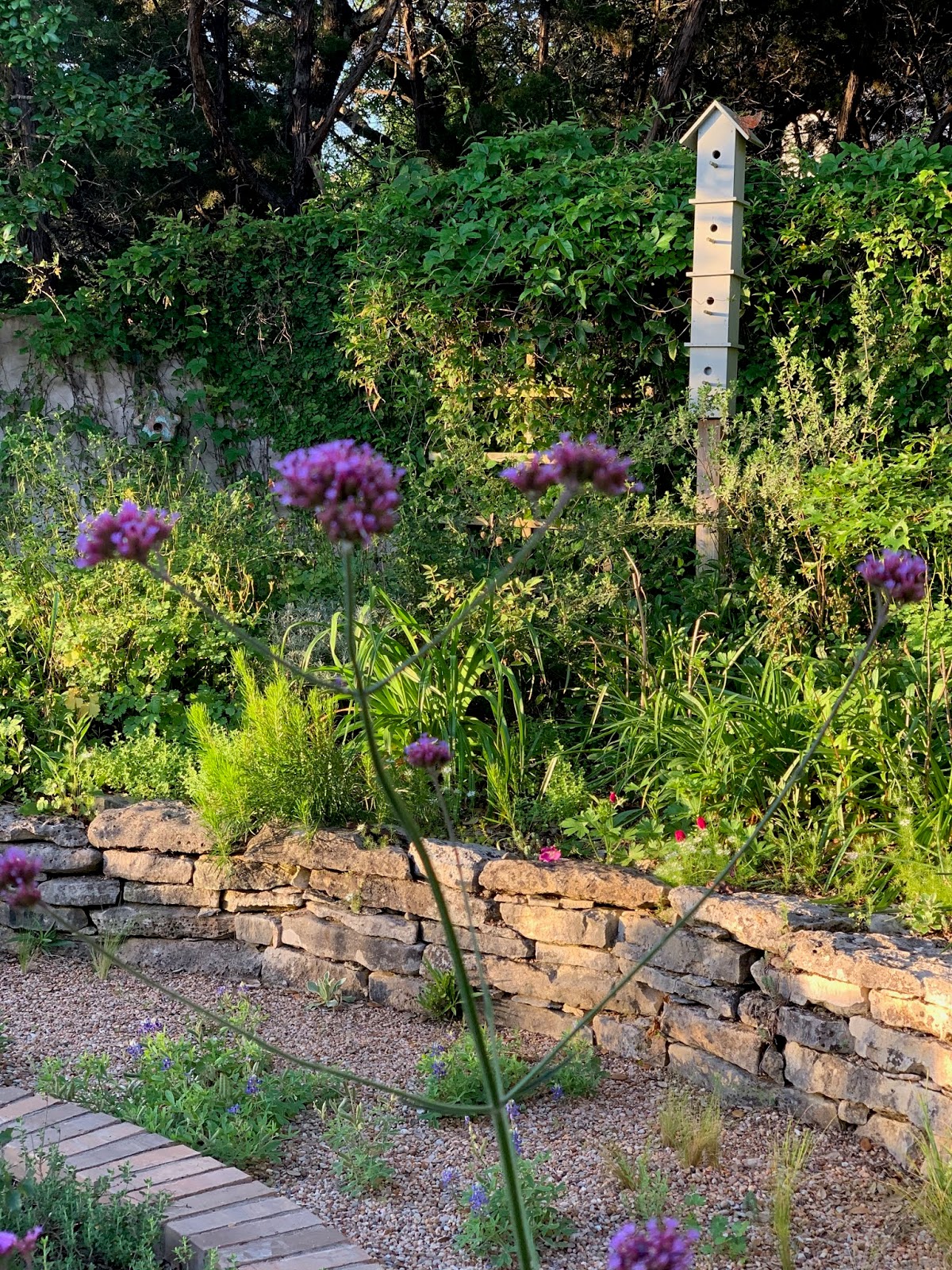


The garden is always a work in progress.

Monday, October 12, 2015

ENGLISH GARDEN? REALLY

Yes, it's a little confusing to say the least because in my English garden you will find Carolina jessamine, Japanese anemone, Texas clematis, Mexican feather grass, Australian leatherleaf acacia and of course the Philippine violet which is blooming in my garden as I write.


So why did I call it an English Garden? The dry stone wall. It was the very first thing I did. With so little native soil underpinned by deep rock it really was the only answer to being able to plant. The 2' high wall follows the contour of the concrete garden wall. It took months of stone collecting as the house was being built and hours of labor to put it together. Not to mention some trapped finger nails.
Walls like this, but much higher, were built all over the North of England to fence off the fields after Enclosure. They are a part of my heritage. And to be honest it is one of my favorite gardening jobs.


If truth be known most of the flowers you see growing in the English gardens are not native but brought to England by the great plant collectors of the 18th and 19th centuries. However, I would like my garden to look a little more English and that is one of my ongoing projects.

English gardens are known for their roses so this week I added a new English rose to the garden. It was actually an impulse buy. I kept checking my local nursery to see if they had Rosa 'Felicia' which I needed to replace due to hail damage, but to no avail. Then I spotted this rose, Rosa 'Molineux' and fell in love with her musky tea-rose scent and her peachy yellow bloom. Plus, she is a shrub rose suitable for a pot.


I have the Rock 'n Oaks garden club to thank for the addition of Rosa 'Molineux' following their visit to my garden this spring and their generous gift following the hail damage. I still plan to keep looking for 'Felicia'. She is truly the most wonderfully fragrant, repeat blooming musk rose there ever was! Even with all the stem damage she is putting out the odd bloom in response to some cooler nights


But a little more about Rosa 'Molineux'. She is a David Austin rose, patented in 1994 and named for the Wolverhampton Wanderers Football club which is located close to the David Austin Gardens, in England. Another gardener wrote of her, ' I do not know of another Austin with all the virtues of 'Molineux' This rose has a lot to live up to. Our climate may not be as welcoming as that of England but
she has a nice location on an east facing wall. I will move her up to the house for winter protection.
There are other roses in the garden. A circle of knockout roses around the bird bath....


and lots of rock roses, Pavonia lasiopetala, that seeded themselves in front of the bedroom window. New blooms open up every morning.


We added a couple of trellises this year with a Clematis jackmanii on each. Both were from bare roots . One did better than the other which I may have to replace next year. Another trellis is planned for the opposite wall and I am looking into plans for a wooden pillar on which to grow a pillar roses. I saw this idea at Mottisfont gardens in England. These will be on each side of the archway. If only we could have a rainy day so that I could bury my nose in a few gardening books.

Monday, June 9, 2014

WILL IT WON'T IT

This morning I pumped up 500 gallons of water from our stock tanks into the garden. I am banking on the fact that they are promising rain. The sky is dark and when the wind blows you can smell the rain. Most of my beds are bone dry even though we had 3" of rain 2 weeks ago. The dark skies are adding depth to the color of flowers in the garden.


The pink knockout roses along the back of the pool were the recipient of some of that water. As I held the hose in one hand I snipped off the dead flowers with the other. They are mostly self cleaning but those flowers that got the soaking when it rained were just glued to the sepals. Untidy as I am I just didn't like seeing it.


It's the norm after an extended trip for my garden to get very untidy. I let plants grow and seed in the pathways and there is a price to be paid. That price is hours of pulling out. A few select plants will get to stay. This blanket flower, Gaillardia pulchella, on the corner, is one. Please watch out as you turn the corner!! There is the return of the flame acanthus Anisacanthus quadrifidus, right there between the two beds. I hacked at the root last year but there was one piece I couldn't remove without disturbing the pavers. It's back again but I have pruned it back so it will not be the monster of the past by the fall.


Verbena bonariensis wafts among the blanket flowers in the herb garden. How could I pull them out. Maybe in a few weeks when the narrow leaf zinnias arrive.
We just had a quick shower. The tanks are starting to fill again.


Monday, May 5, 2014

WHITE IS A COLOR TOO

I didn't realize how many white flowers I had int he garden until I went out to photograph them today.


The mock orange, Philadelphus sp Natchez is putting on the biggest white show.


Followed by the Anacacho orchid tree, Bauhinia lunariodes.


There's even a single rain lily, Cooperia drummondii, coaxed into blooming by the recent rains.


In the English garden the white knockout rose puts on her first full flush of blooms.


The native blackfoot daisy, Melampodium leucanthum.


Love-in-a-mist, Nigella sativa, with the spiky foliage. A faithful spring returner.


Larkspur,

A single white Shirley poppy.


The multiplying onions, Allium sepa, making a great stand. I think I may mix them in with my other garden flowers next year.


The potatoes are flowering.


And the snow pea flowers mean lots of peas over the next few weeks. I always plant Pisum sativum 'Cascadia' because they are open pollinated and I can save the seeds for next year.


The first pods.


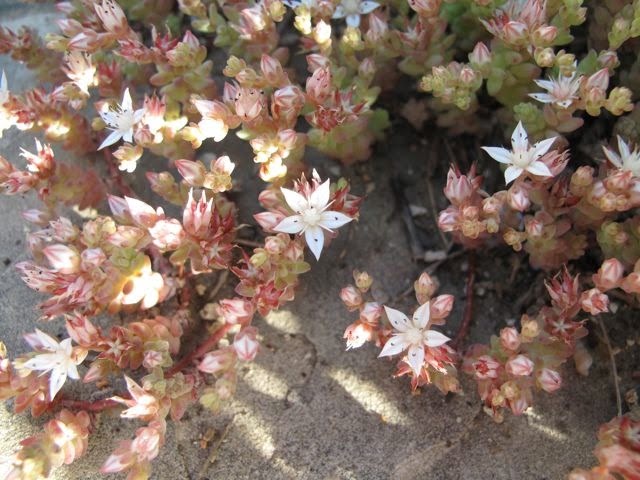
And the tiny star flowered sedum, Sedum potosinum.

Monday, April 21, 2014

NO GARDEN SHOULD EVER STAY THE SAME

Sometimes it is necessary to make changes to the garden. Maybe you don't like a particular planting or a tree grows too big or maybe it is simply a measure to reduce the amount of work you have to do.


The main planting in this bed: spineless prickly pear and pink knockout roses had become a free for all of larkspur, cone flowers, poppies, love-in-a-mist and other annuals. I'll call them my weeds. So I redid the sprinkler system putting a circle of drips around the roses. Then I shovel full of rabbit poo and a covering of hardwood mulch. I couldn't quite bring myself to pull out the germander, ice plant and the rose campion but maybe later in the year I will.


  I think the rose campion, Lychnis coronaria, and spineless prickly pear cactus make a happy combination and the rose campion will only be there for a short time longer.
I like the tidy look and there are plenty of places in the garden where it is a free-for-all. Maybe just a little ice plant to soften the edges of the stone but that is all.

Tuesday, April 15, 2014

GARDEN BLOGGERS BLOOM DAY APRIL 2014

Welcome to my April garden for Garden Bloggers' Bloom Day hosted by Maydreams Gardens. It is a gorgeous day here in Texas after yesterday's lashing rain, wind and hail and the threat of a frost last night. Thankfully it never got down to 32°. There is a mighty clashing of colors going on out there.


Eyes down to the Claret-cup cactus, Echinocereus coccineus.


Eyes up to Zepherine drouhin. Both are putting on a spectacular show.


Of course the Lady Banks rose is also in full bloom right now although somewhat smaller in bloom size this year.


 My yellow Rosa banksia 'lutea' is enormous compared with the white one.


I purchased this white one at the Rose Museum in Tombstone, Arizona, which boasts the largest Lady Banks' rose in the world. It came originally from Kew gardens as a cutting and this is a cutting from the Tombstone rose. I have it planted on the fence behind the pool; not the best place as I have to continuously cut it back.


While on the subject of white roses this white Knockout lights up the English garden.


Along with the lovely fragrant Felicia.


There are lots of native plants. The yellow Missouri primrose, Oenothera macrocarpa.


And the square-bud primrose, Calylophus berlandiera, along with bluebonnets in the sunken garden.


Gulf coast penstemon, Penstemon tenuis.


And my ever blooming chocolate daisy, Berlandiera lyrata.


Rose campion, Lychnis coronaria.


Mock orange, Philadeplhus X 'natchez'


The sweetest smelling stocks, Mathiola incana.


The cross vine, Bignonia capreolata back again on the greenhouse.


Beautiful heads on my multiplying onions, Allium cepa.


Blue flax, Linum lewisii


 An unknown tiny rock daffodil with wiry stems. Planted several years ago this is the first time it has bloomed. It must have liked the extra chilling.


Orange mallow, Sphaeralcea ambigua.

There are poppies galore, and columbines and so many more flowers in bloom. Come back again later this week and take the long tour of all the gardens enjoyed by a visiting garden group today. In the meantime visit other garden bloggers sharing their blooms on the mid April day.