My Blog List

Showing posts with label bird of paradise. Show all posts

Monday, August 12, 2019

HOME IS WHERE THE GARDEN IS

After visiting a wealth of gardens in temperate zones it was time to come back down to earth 10 days ago, when we returned from our nine-week trip. Once again I had to get on, what I call, my Texas Eyes. I wonder what others think when they come from those lush, green gardens of England to the burnt up landscape of Central Texas in August. Does it take their eyes time to adjust?


Much had died in my absence so that was the first job. I am still not finished with removing weeds, and spent annuals. 12 bins so far. And there is much cutting back to do...the lantanas, salvias and roses. We still have a long season ahead of us and I must prepare for the cooler times in October.
The front garden is not under irrigation so I spent some time with hose in hand. The sennas are just starting to grow. One of the toughest plants I grow.


I ahd to remove almost all the blanket flowers. They had been attacked by some sap-sucking bug. But  ave no doubt that as the weather cools I will begin to see seedlings develop.


This is a garden with little shade. But the sentinel Yucca rostrata does offer a little respite for some plants from the mid-day sun.


Even so the plumbago is bleached out. I am grateful for that little patch of color.


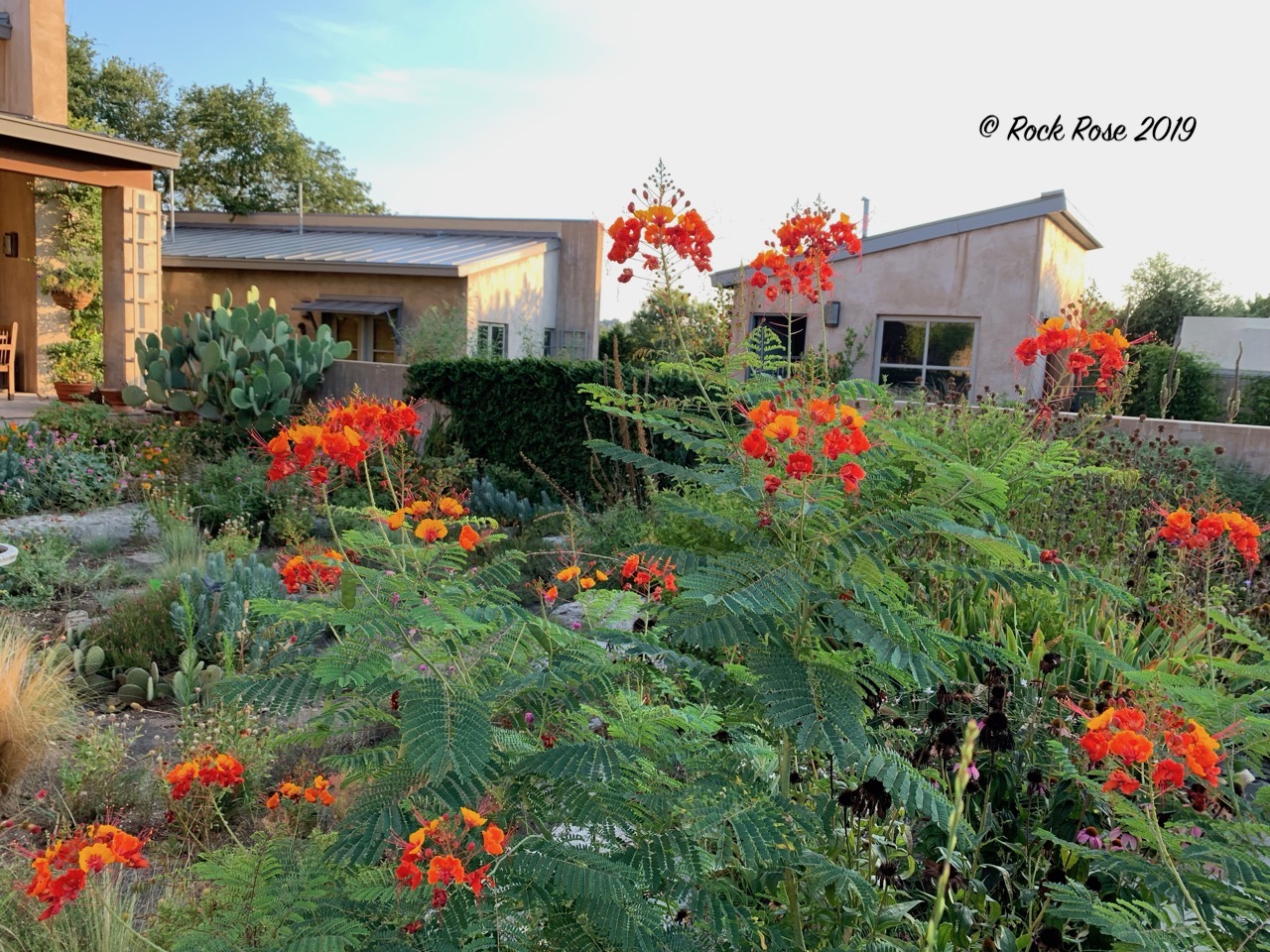
The only other color in the garden is from the Pride of Barbados, Caesalpinia pulcherimma.


There is only a short window in the morning when I can work outside comfortably. Daytime temperatures are starting off at 80° and soon climb above 90° We are in for a full week of temperatures in the triple digits. I set myself a couple of jobs every day but much is left undone. It has taken me a week to getting round to fill up the bird bath. Tomorrow I plan to cut back the roses so that they will bloom again in October.


I have moved many of my cactus and succulents into the shade of the patio, and away from the brutal afternoon sun.

Monday, August 27, 2018

SUMMER'S BRIGHTEST STAR

A few years ago a seed germinated in my garden. I wasn't totally sure what it was at the time but I was hoping that it might be what it turned out to be, Pride of Barbados, Casaelpinia pulcherrima. The tiny bipinnate leaves and stem had small spines and that was what made me think it was the Pride of Barbados.


I have no idea how it got there. Maybe I cast out a handful of unknown seeds and this was among them. That winter the small plant died back to the ground. When I searched for it in the spring it was nowhere to be seen. I forgot about it and then one day in early summer, when the ground was truly warm, it began to grow again. That's how it goes every year-me looking for it and not seeing it, and finally thinking it has died, and then weeks later here it comes to brighten the summer garden. Since then it has flowered every summer putting out more side branches until it is now overhanging the pool. I might have to do a little pruning.


This is a plant that you see growing in desert gardens so not surprising it does well here. In warmer climates it is evergreen and can grow to enormous size so I am happy that it dies to the ground in winter. Just having one in the pool garden is enough for me, although I did try to transplant a seedling this spring. It died. And the 3 plants I grew from seed and planted in the front garden also died, probably from lack of water during my absence. I do have one growing out at the front which is even slower to come back. It just started blooming but is quite spindly compared with the one in the back. A little rain might help.


I often turn my head, to look out of the window and across the garden, at this flowering wonder. At least one plant likes endless 100º days.

Friday, August 24, 2018

THE FIRST THOUSAND MILES- AUSTIN TO PHOENIX.

To stay I am addicted to gardening would be an understatement. I garden, I read books and magazines about gardens, I visit gardens, I visit nurseries everywhere. I search them out when I visit foreign countries, although I know I can't take any of those plants home, and I listen to podcasts about gardening,  When I leave my garden I do all of those things except the gardening part, although there have been times when I have taken plants with me. When we drive out west my eyes are constantly searching the roadsides for plants and even rocks!
The drive from Austin to Phoenix takes us through some interesting country; from the rolling Hill Country of the Edwards Plateau, into Chihuahuan desert areas of west Texas and New Mexico and finally the Sonoran desert in Arizona.
Our timing happened to coincide with monsoon rains so I was pleasantly surprised to see wildflowers on the Air B&B ranch, in Alpine, where we spent our first night. It was raining when we arrived so there was no chance to look around that evening but in the morning the air was clear.


We ate breakfast outside and then I walked around the area by our cabin. There was no garden just the scrubby ground you see here but the wildflowers growing there were amazing.

How exciting to see chocolate flowers, Berlandiera lyrata, growing in their native habitat. I grow this
plant with great success in my garden. One plant, growing in the sunken garden is more than 12 years old. There is no irrigation in the spot although I do occasionally pass the hose over the area. It has never reseeded in this area although that could be because I cut it back several times a year to prevent it getting too straggly.


Although I have never grown this plant I believe this is snake herb Dyschoriste linearis. I remember seeing it in an Austin garden once but can't recall seeing it in the nurseries. I like its compact nature and clearly this would be another good plant for the rock garden.


Here's another native I have never had in my garden and would love to have. Scarlet musk flower,  Nyctaginia capitata. Another native missing from our nurseries.


I had to call on Texas Flora on Facebook for an id on this plant. What a great resource for identifying unknown plants growing in Texas, although it is not exclusively for native plants. This is the Woolly paper flower, Psilotrope tagetina. According to my research it does grow on the Edwards Plateau and would make another good low-growing plant for my rock garden....if I could find it.


And wild gaura was plentiful.


Our second night was spent in Mesilla, New Mexico, in a delightful adobe casita.


The owners had built the small casita with traditional adobe bricks and lived in it while renovating the original adobe house that was on the property. That was where we spent the night.  Between the two was a shady courtyard where we sat in the evening to have a glass of wine.


I was rather left wishing we had a similar tree under which we could sit on summer evenings, although I know they are rather messy trees.

Continuing on our way we stopped at a rest area and I hopped out of the truck to take this photo of, what I thought was, a lovely tree. Great structure with gnarled bark and hanging purple blooms. I later learnt that it was the tamarisk, an invasive tree with a long tap root which enables it to live in these desert conditions. There have been ongoing attempts to eradicate this tree using a bark beetle and herbicides.


Then on to stop again at Texas Canyon, actually in Arizona, an area of precariously balanced rocks formed 50 million years ago when magma pushed up but didn't quite break through the earth's crust. Eventually both weather and chemical weathering produced the scene we see today.


And on into the Sonoran desert with the appearance of ocotillo, fully in leaf, and stately saguaro. Then we pulled off into the foothills of Tucson to visit my friend, Syd Teague, who had just relocated to Tucson last year. Syd created a beautiful garden in Austin in which it was abundantly clear to see she was a lover of desert plants. Over the past year she has created a new desert garden in the desert. While she may not need to worry about freezing temperatures and excessive rain gardening in the desert does not come without its challenges. For one many plants would not survive without some additional irrigation and then there are the desert critters.


Syd is holding a saguaro 'boot', a thick cork-like callus that forms within the flesh of the saguaro after the Gila woodpecker or flicker have excavated a nest. The 'boot' is so sturdy that it will survive on the ground long after the saguaro has rotted away to dust.


Although the property came with some trees and cactus Syd has added hundreds more as well as bringing in tons of rock and sculpting the land to form berms.


One large addition was this Texas ebony tree, Ebenopsis ebano. The tree is native to south Texas but I wonder how it would do here-or have I ever seen it at the nursery.


In a side courtyard area a familiar face soon to be cloaked in bougainvillea rather than fig ivy!


and the lovely green man I remember from her old garden. I wonder what he thinks about his new desert home.


The property backs to the golf course and makes full use of a borrowed landscape with a backdrop of mountains and green spaces.  Let someone else water and mow the grass!


If you look closely you will see that those tall cactus are not cactus at all but stone disappearing fountains. The tell-tale area of wetness on the rocks below is the only indication that they are not the real thing. There are three in all. Shortly after we left Syd sent me a photo of a bobcat drinking from one of them. It doesn't take wild life long to catch on. Just as long as they don't attract the javelinas!!


And finally a row of pots I remember from her Austin garden.


Thanks Syd for a wonderful visit to your new garden and for lunch. We needed to press on to our final destination of the day; our son and family in Phoenix. We had completed 1000 miles of a summer that would put 5000 miles on the clock!

Thursday, August 18, 2016

RAIN COMES TO TEXAS

Three weeks ago, when I returned from vacation, I moved all my cactus and succulents under cover. Temperatures were at 100º or close to every day. Even cactus don't like our afternoon Texas heat.


A little morning sun suits them just fine and that place happens to be on the patio. Some of the other plants in the front, where there is no shade, I covered with shade cloth.


At this time of year I certainly envy those who have filtered sun through their live oak trees. There is little of that here. Of course we expect such heat in August. What we don't expect is for it to be followed by a week of endless rain amounting to over 12" in some places. Over a 4 day period my garden had nearly 11" Now we are drowning. Rainy day visitors are showing up. Some of them are welcome others are not.


Of course we all expect rain lilies after a rain event and sure enough they arrived within days. I have lots of the white ones, and the pink ones, Zephyranthes labufarosa series, looking a little bedraggled after this last rain. This is a hybrid of Z. grandiflora and does not produce seeds.


 Today a new one appeared in the garden. This yellow rain lily with a burnt orange center is Texas copper lily, Habranthus tubispathus var. texensis. Where did it come from, I wonder?


I think it is so much more striking than the pale yellow Zephyranthes


I only have one clump of pink rain lilies but they have been outstanding this year, blooming 4 times over the last few weeks.
But an even bigger surprise today as I found a another of my daylilies blooming. This one behind the pool hiding among the bent stems of cone flowers.


There are other day lilies blooming too.


But by far the biggest surprise this year is the arrival of a Mexican red bird of paradise, Caesalpinia pulcherrima. The seedling appeared last year and I was not sure of its identity so left it. It disappeared over the winter but began to grow again. When a flower bud began to develop I felt pretty sure that it was a bird of paradise. Today it opened its first flower. The sad thing is that it is growing in a narrow strip alongside the pool. I can't afford for it to get much bigger.


It is in good company with the gomphrenas growing alongside. They too have grown enormously with all the rain.


All the blooms are making for a very colorful August garden.