My Blog List

Showing posts with label Mexican marigold mint. Show all posts

Saturday, January 2, 2021

PARSLEY, SAGE, ROSEMARY, AND THYME

Very shortly after we moved into the house, and with a clean slate, I began work on designing the herb and vegetable garden. The good growing season was coming up and I wanted to be able to plant a fall/winter crop. There is rarely a day goes by when I do not go into the garden to pick some herbs to enhance my dinners.

And like many herb gardens there is a sprinkling of flowers, some of them edible, and a few grasses to soften the paving made by David. (Today it is easier to find larger pavers but 20years ago it was impossible.)

Whether fresh or dried, herbs are plants that I could never do without and they are so easy to grow. Parsley, sage, rosemary and thyme plus chives, oregano, marjoram, mint, cilantro, and lemon grass all have found a home in my garden. And for those who do not have a garden many of these can be grown together in a single pot placed outside the kitchen door or on a sunny kitchen window ledge in the house.

This is a herb garden I made for my son for Christmas. Unfortunately it never reached him as we had to cancel our plans to go visit. Notice the addition of edible flowers. Among the herbs I planted are chive (onion and garlic) parsley, cilantro, marjoram and mint. If grown organically, flowers of violas can be added to your salads. 

Below I have picked thyme and rosemary which are the only herbs needed to flavor  my slow cooker pot of white beans. 

I also use rosemary chopped with garlic, salt and olive oils as a marinade for rack of lamb.

A sprinkle of dried thyme leaves, olive oil and salt is all you need to enhance the taste of roast tomatoes.


I grow two different kinds of sage. The first, Salvia officinalis, is the culinary sage. It grows year round in my garden. In early spring it flowers with the most amazing blue flowers worthy of any garden setting. It is easily propagated in the fall by bending a stem and pinning it to the ground ( the technique of layering)..

The second one is more ornamental, although it can be used in the kitchen. It has more rounded leaves Salvia officinalis 'Berggarten'


I use sage in stuffings and fried in butter or oil as a delicious finishing touch on the top of Italian dishes such as risotto..


Mint has been given a dedicated place alongside the potting shed and beneath the window box where I can
control it. It does need continual cut back to prevent it taking over the path but has found a happy home in this spot. This year I started using in in lamb burgers along with cumin and feta cheese. So delicious. Also, in mint sauce which we have with lamb, although I still prefer redcurrant jelly. It is great in a water melon salad with feta cheese and arugula. 

 I also use mint chopped with feta cheese and cumin in lamb burgers. 


It is impossible in our climate to successfully grow French tarragon but a good substitute in Mexican mint marigold, seen below with yellow flowers. I grow it mainly as a late-flowering ornamental.  


I grow 2 varieties of chive, onion chives and garlic chive. I prefer the former but it is more difficult to grow because the snails seem to really like it and frequently sever the plant at the base. It grows best throughout the winter blooming with beautiful balls of lilac flowers, which can also be used in salads. It is distinguished from garlic chives by its hollow round stems. Garlic chives have flat stems and have the typical allium white flower heads. 

Onion chive.

I also grow society garlic but only for its flowers and performance in our Texas climate. I have been told that the leaves can be used as a flavoring and the reason it was called society garlic was because it did not cause the same breathy problem that garlic does. I'm not sure this is really true!
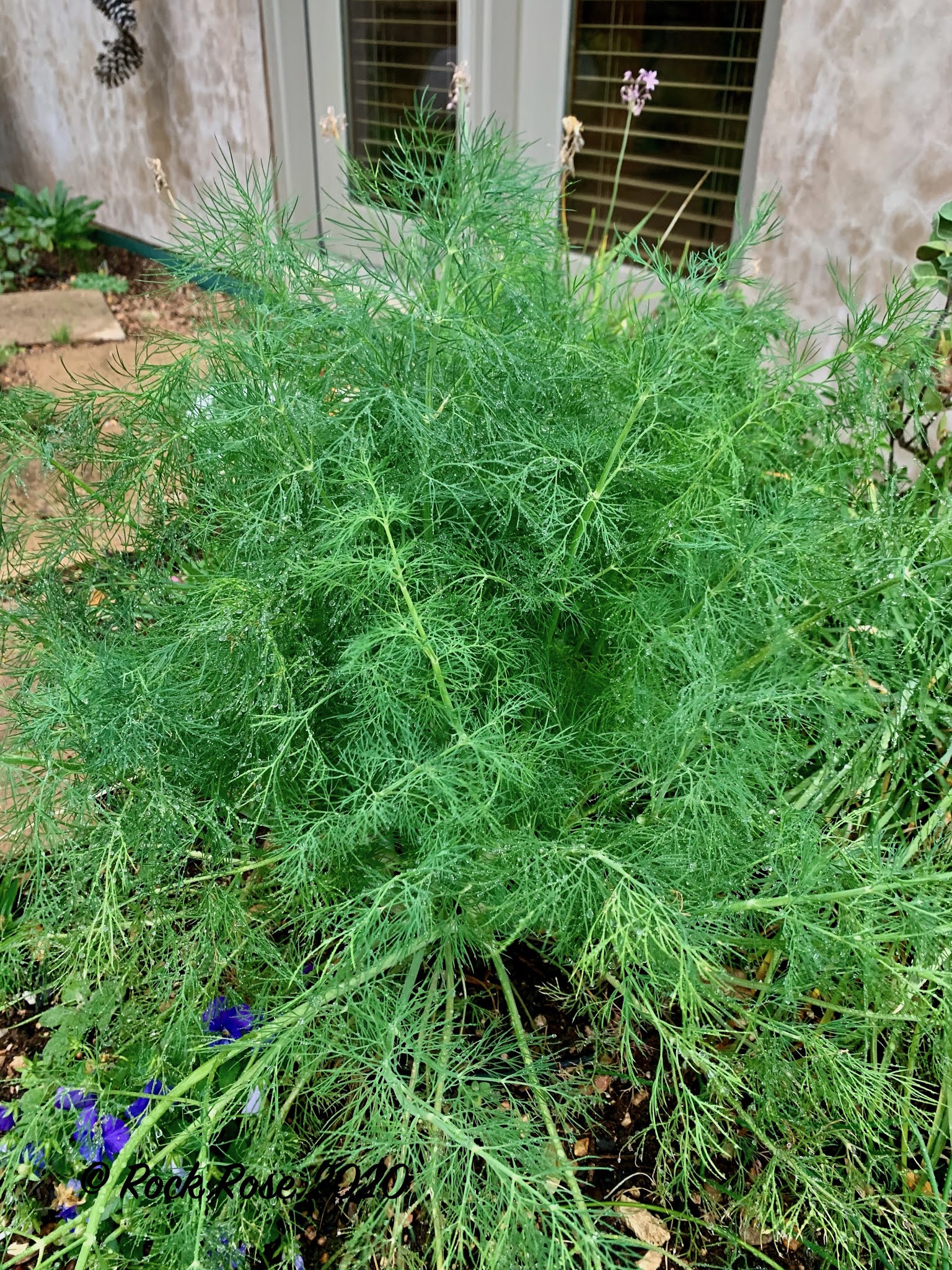
                                                                                dill

The feathery fronds of dill are wonderful with fish and eggs. 

Cilantro I always allow to flower and go to seed so every year, in the fall,  cilantro pops up all over the garden. It is growing in among beets and carrots this year as well as in the herb garden path.


I grow Italian parsley, another herb I permit to go to seed, and find it popping up in many places. 


And finally oregano. I try to pick the stems early in the morning to hang in bunches to dry. I then crumble the leaves into a jar to use in many Italian dishes. Mixed chopped herbs are delicious in polenta. Oregano grows throughout the year and must be cut back frequently if you want to prevent it going to seed and keep it nicely shaped. It makes a useful small evergreen shrub for the garden. 

Basil is a summer herb which grows well for us in Texas. It dies over the winter and must be replaced every spring when temperatures are well about 50°

If you don't have a specific place for growing herbs then plants them in among garden plants. They will reward you by flavoring your food year round as well as saving you money at the grocery store. 


Thursday, August 27, 2020

CAN YOU TAKE ANOTHER WEEK OF TRIPLE DIGITS?

 It’s no surprise to Texas gardeners that we are in for another week of triple digit temperatures. They will likely be around for quite a while before we start to feel that little breath of cooler air in the mornings.  This morning I asked my garden if it can hang in there for a few more weeks. I am always amazed how refreshed the plants can look in the early morning hours. At the end of the day not so much. We really have to give the plants their due as so far we have had 23 triple digit days in August with nothing less than 93ยบ and still they soldier on.

 I am slowly removing the spent blanket flowers. When the goldfinches have had their fill I will be hoping they haven’t been too tidy with their eating habits. I’d like some for next year. At the same time I am culling some of the ruby crystal grasses Melinis nerviglumis, and the Mexican mint marigold, Tagetes lucida. The latter makes a lovely small bushy plant which blooms in the fall but it is a prolific re-seeder. I cut it back to the ground in the late winter.

 One thing about the sunken garden is it mostly plants itself. Not always in the right places of course and often a little too much of some plants than I need. For instance, zexmenia, Wedelia acapulcensis var. hispida. But as long as I am around to tend to the garden then the visual effect is to my liking. However hard I try the sunken area will not accept nursery grown plants.

 I have better success with adding plants to the upper level and this year I have plans to reduce the numbers of plants growing there. More blackfoot daisies, Melampodium leucanthum, like this one. I'm usually a 4" gardener but I chanced to buy a rather healthy 1gallon plant at the grocery store this spring and it took to its surroundings quite happily.  It is shaded a little by the fragrant white mistflower, Ageratina havanensis. It is my plan to remove the mistflower in the fall as it is far too big and crowding out some more valuable plants.

Backfoot daisies seed quite well in the English garden gravel but never look quite as healthy as the one above.

I should have given these ones a light trim several weeks ago but sometimes that is a risky thing in this heat. 

Tropicals just lap up the heat like these beautiful tree-shaped potted plumerias in the English garden. I am more than happy they are white but would love some of the colored ones. They have now reached the most perfect size but I have concerns about what to do with them this winter. I don't really want to start all over but even without pot, soil and leaves they weigh a ton.

In the right foreground the Philippine violet, Barleria cristata,  waits patiently for its time to bloom. The once single plant is now three separate plants and another one has seeded by the edge. Such a wonderful plant that seems to attracts no bugs or diseases. I am happy that there are at least 3 more that have seeded themselves around the garden. This one along the edge of the patio above the sunken garden. Fortunately they die to the ground in the winter or they would be monsters.

But like the Philippine violet I wait patiently for the the temperature to drop so that I can get out and work in the garden.

Saturday, October 6, 2018

OUT AND ABOUT IN THE OCTOBER GARDEN

Trying to work outside in this horrendous humidity is downright miserable. Where is our October weather? Those clear, dry days we expect after a brutal summer. They are just not happening this year and it means a delay in our fall gardening jobs.  This morning I took a walk around the garden with camera, while waiting for some garden visitors to arrive.


The entry garden doesn't see much in the way of change through the seasons although it won't be long before many of these plants will be moved to their winter homes.

In the front courtyard the pink crystal grass, Melinus nerviglumis is starting to flower. Those seed heads will ensure a new crop of grasses for next year.


You wouldn't know there was sunken garden here. Viewed over the wall from the English garden.


In the English garden Rosa 'Felicia' with her beguiling fragrance. Just a glimpse of her through the Sun and Moon archway.


The Philippine violet on the corner of the patio is just starting to bloom.


As is the shrimp plant. A new addition to this same corner.


The planter of bunny ears cactus, Opuntia microdasys, is back on the wall.


Peas are up.


Mexican mint marigold, Tagetes lucida, is just starting to bloom.


Lots of grasses in the herb garden and one big one over by the potting shed. This one is lemon grass, Cymbopogon.


The stock tank pond surrounded by gaillardia, cosmos and narrow leaf zinnias.


A splash of pink from the Japanese anemone. Are their petals supposed to be distorted?


The fall bloomers have definitely enjoyed our recent rains. And there is more to come this weekend.

Saturday, October 21, 2017

PLANTS BEGIN TO SIGNAL WINTER IS ON THE WAY

My garden is beginning to signal that winter is on the way. Sometimes it seems as though it is never going to arrive  and when it does happen is is usually overnight with our first good frost. But there are subtle changes in the garden. The plants look more colorful because of cooler days and nights.


Among the whites and oranges of the narrow leaf daisies a new flower begins to bloom.


It is the Mexican mint marigold, Tagetes lucida.  The leaves make a good substitute for French tarragon, which cannot withstand our hot summers, and is therefore often called Spanish tarragon. This herbaceous perennial dies back during the winter but and spring and summer the plant is green, before bursting into flower in October. It flowers only where winter comes late to the garden.


Another late bloomer is the Philippine violet, Barleria sp. Pest free and seemingly no diseases it also dies back during winter but has been a reliable returner even giving me a few new plants from seed.


The orange cosmos, Cosmos sulphureus, has been in non-stop bloom throughout the summer. It is both heat, drought and pest resistant. I threw a few seeds into this bed less that a month ago and they are now flowering.


The citrus fruit are starting to ripen. The bitter Calamondin, which I make into marmalade. No other marmalade comes close to the tangy orange flavor of this fruit. Not even the Seville marmalade.


The Meyer lemon. The fruits aren't quite so big this year. Maybe because of our dry summer.


Rusty seedheads appearing on the dwarf papyrus, Cyperus papyrus.


Plants spill over the low wall completely covering the pathways. The last to flower will be the Copper Canyon daisy, Tagetes lemmonii.


There are changes among the succulents too.

Echeveria Devotion, Hana Bay flowerswith its velvety leaves takes on more color with the cooler nights. When I bought it it was like this and then lost most of its color during the summer. I am so happy to see it back again. It should enjoy being in the potting shed for the winter.


Kalanchoe thrysifola, the flapjack or paddle plant is also coloring up with the cooler nights. I am on the lookout for its cousin K. luciae, which gives more brilliant color during winter.


It is also the bloom season and several are starting to send up a boom stalk. The plant is monocarpic so these plants will die after flowering but leave plenty of pups behind.


Euphorbia lactea cristata form. Possibly Grey( white) ghost with cresting.


Today the heat and humidity are back again.