My Blog List

Showing posts with label zinnia. Show all posts

Saturday, May 15, 2021

ONCE MORE UNTO THE BREACH, DEAR FRIENDS.

I can assure you Shakespeare was not thinking bluebonnets when he penned those words. But those words often come into my head at bluebonnet clearing time.

You may recall having seen this photograph earlier this year when the bluebonnets were at their peak. Who could not love this view of the front of our house? But what happened this year? In the past there were but a few bluebonnets in this dry creek. Almost all were in the larger area of granite to the right. It would suddenly seem that they prefer to be in the creek bed and I'm afraid I don't care for all the work that is involved in their removal from the rocks.
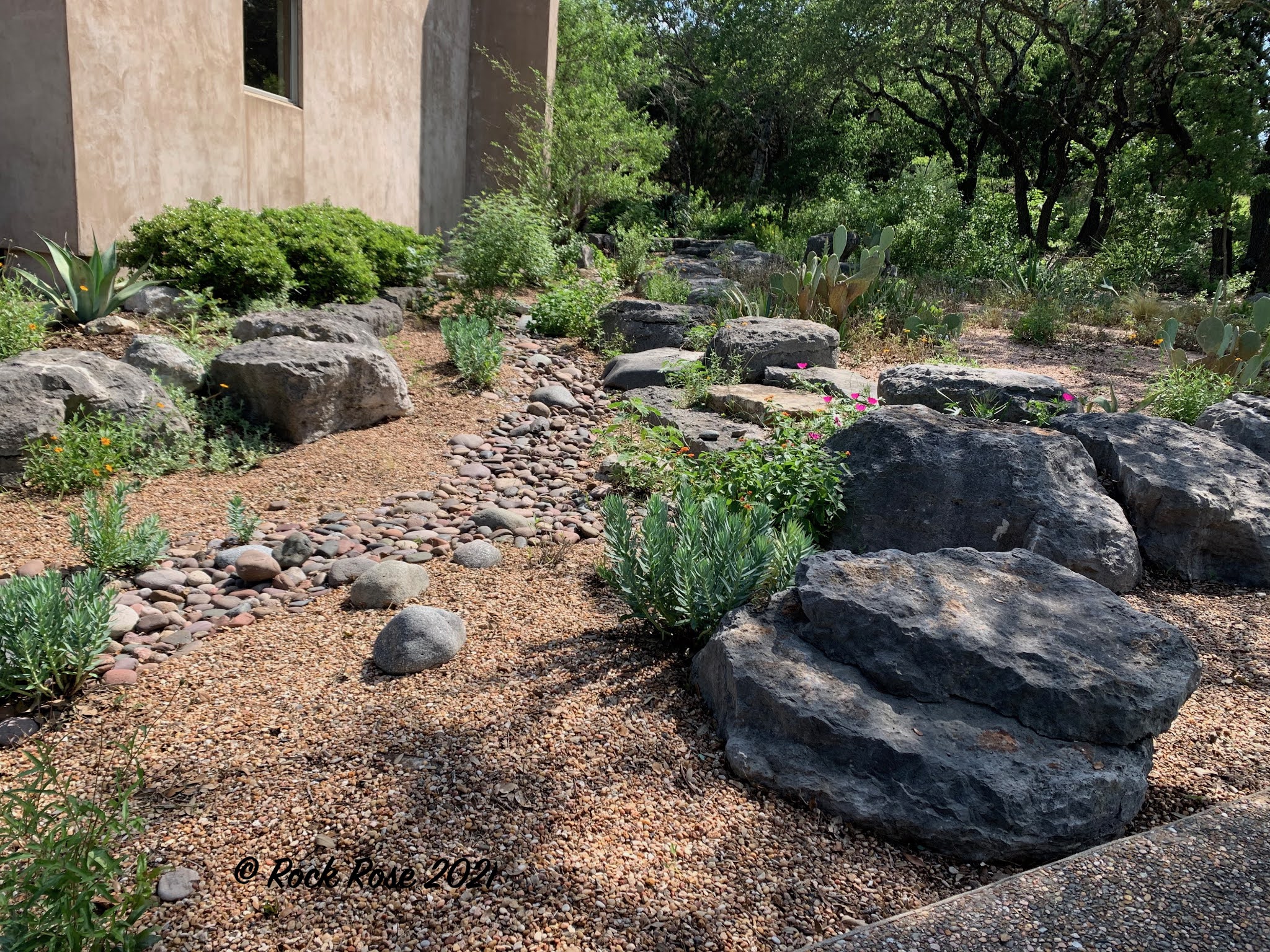
It took 2 hours to remove them followed by another hour of blowing and collecting. And then a further pass with the blower.

 On the second day I moved to the area closer to the entrance pathway. First the bluebonnets removed , then the raking of a mass of oak leaves secreted under the bluebonnets and then blowing and gathering. 

And in both areas there were other plants to remove, such as woolly stemodia, Stemodia lanata, that had crept over the wall and set down roots. lantana, Mexican feather grass, Stipa tennuisima,  and weeds. A few like gopher plants, Euphorbia rigida,  and trailing winecup, Callirhoe involucrata, and the native lantana , Lantana horrida, were allowed to stay-for now! 

David took care of the oak sprouts which have really taken over since we removed the failing oak tree. Nothing will stop them.

That accomplished I turned my attention to a bare spot in the corner of the wall. The Anacacho orchid tree, which over the years, had failed to thrive ( probably my fault) expired during the winter. But as luck would have it I had left the little oak tree that had seeded there and I moved a large pot that, was hidden among the trees out at the front, into the bare spot.  
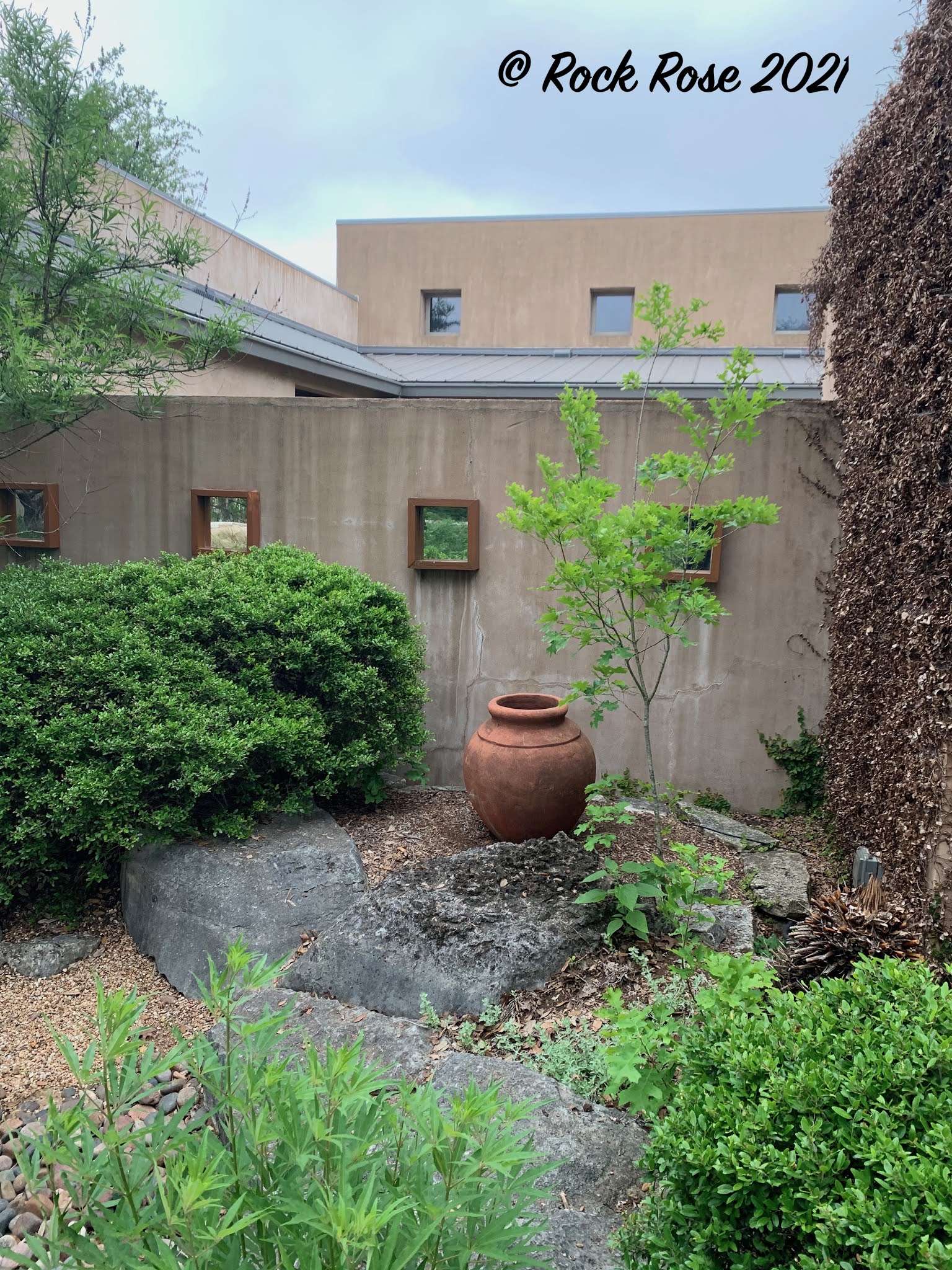
And the color of the pot is a perfect match for the mirror boxes on the wall.
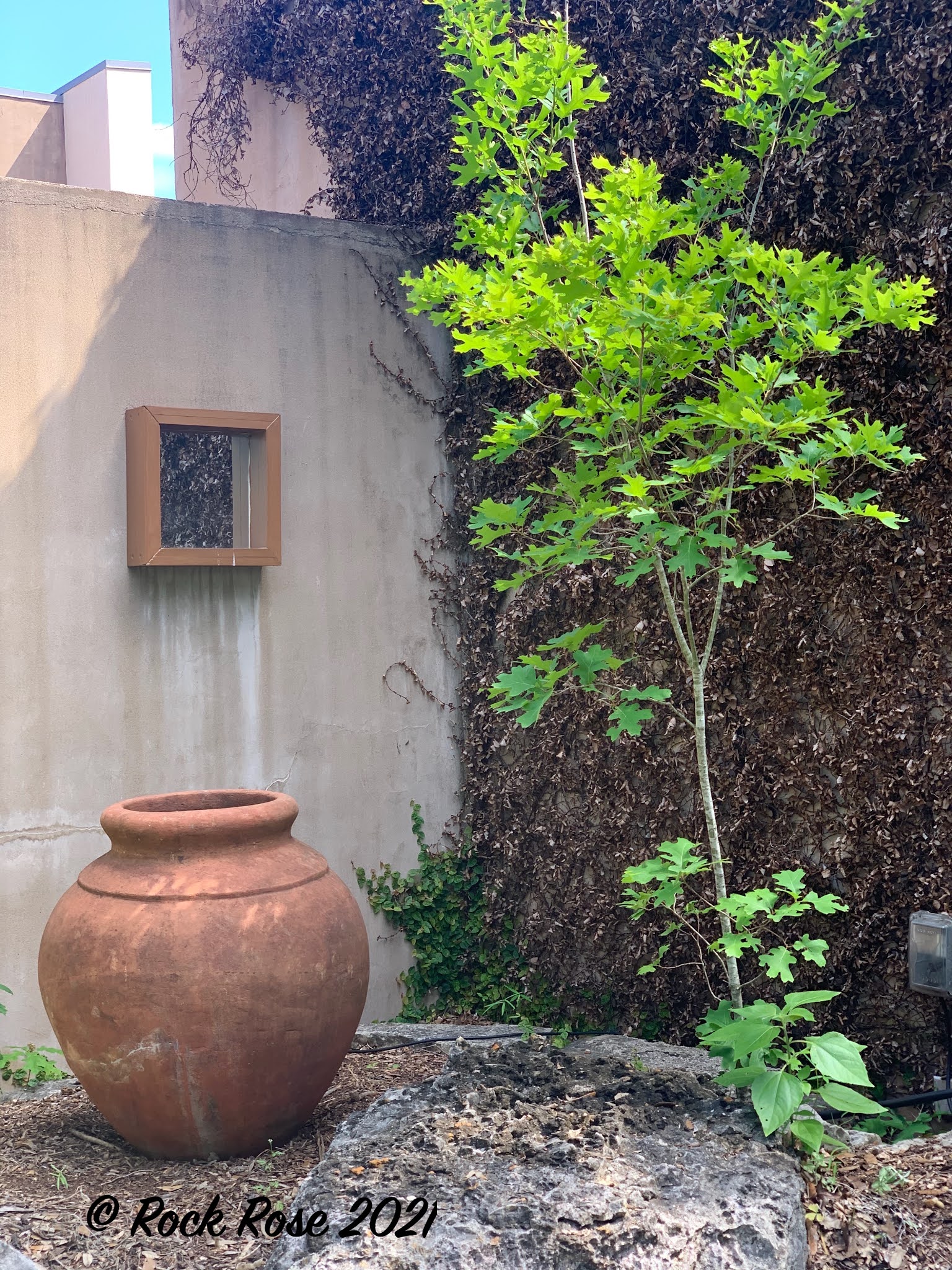
Just the dead fig ivy yet to remove!

And onto the much larger area, once a parking area. The removal of bluebonnets,  raking and blowing of oak leaves plus collecting and disposing took 2 days. Then the weeds. 

As you can see there are just a few plants remaining none of which are very inspiring but I will leave for now. The only plants that are sure to stay are the 4 plains zinnia, Zinnia grandiflora. How I wish there were more. I must look for seeds because the plants are never available at our local nurseries, and they bloom all summer long.

A few prickly pear, A. lophantha and liatris have survived and there are also a few rose campion, Lychnis coronaria, liatris,  and Liatris spicata, which have been pruned by the deer but the other plants have been safe so far. 

I have plans! We have some large flat rocks and I would like to make a walkway through this area with just a few select plants. I realize that it is not the desert but this is a garden I saw recently in Tucson and which I love. Surely I can do something similar? I'm definitely going to try. David!!!!!!


Thursday, September 15, 2011

GARDEN BLOGGERS BLOOM DAY,SEPTEMBER 2011

This may be the most difficult bloom day posting I have done. Not because I have nothing blooming in my garden. I do. I am thinking of those people who have lost their gardens and their homes this last month in the Texas fires.
So, I begin with the natives because they will be the survivors through all this. I know from experience about controlled burns at the Wildflower Center that new plants will pop up. It is all part of what nature does, although at terrible cost to some.

And so my first plant is a new one. David asked me last night where it had come from and I told him I didn't know. I noticed it growing by the faucet in the front courtyard. I knew from the leaf and flower that it must be from the mallow family, but I can't get a sure id even after consulting my wildflower book. I'm leaning towards Velvet Leaf, Allowissadula holosericea. ( That's one latin name I am not likely to remember). But six petals instead of the five is confusing.

Blue gilia, Gilia rigidula, is another one of my favorite bloomers. If you get the impression that I like the delicate small bloomers you would be right. Gilia is a member of the phlox family, reseeds easily and is perfect for the chalky soils of my garden.

I undraped the Whale's tongue agave, A. ovata, in order to take a photo for bloom day. She has attendant Blackfoot daisies, Melampodium leucanthum, surrounding her. They have a delicious early morning scent of honey and almonds.

Rock rose, Pavonia lasiopetala, after which I named my blog, is a constant bloomer in my garden. it is also a member of the Mallow family.

Another non-stop bloomer is the Chocolate daisy, Berlandiera lyrata. I usually cut it back in early July but never did this year so it has sprawled across the pavers in the Sunken garden.

The very weedy but attractive zexmania, Wedelai texana, but I wouldn't be without it. A cut-and- come back again plant and very tough.

Gregg's Blue Mist flower, Eupatorium greggii, has spread into a large clump and is in full flower. It is a favorite of the butterflies.

How the goldfinch love the Texas sunflower, Helianthus annuus. They are worth having just to watch their antics.

Lindheimer's senna, Senna lindheimeriana, pops up all over the sunken garden.

By September the zinnias are usually flowering in profusion. I have a few and am grateful from their sunny yellow and orange faces.

I would love my garden to look as it did in previous September Bloom Days, but it is not to be in this year of record heat with drought. Thanks Carol, at Maydreams for hosting this monthly Bloom day.

Sunday, October 10, 2010

AND THE WINNER IS........

Zinnia linearis, Mexican or narrow leaf zinnia.

Just to show how tough these plants are. The seeds survived prolonged freezing temperatures last winter. In the decomposed granite, at the foot of the vegetable garden steps, orange white and yellow zinnias germinated in the spring, survived with no water during the long mid summer dry spell, but bounced back with vigor after the rain we had two weeks ago.

They are now basking in the 'wows' I give them every time I walk by.

They are putting on a similar show in the herb garden.

and the vegetable garden. Wouldn't you make a place for these little gems in your own garden? It's easy. Just buy some seeds and you'll have them every year. They flower from spring to frost. The original packet was from the 'star' series, which I have never seen again, but then even though I collect seeds every year, just in case, I hardly ever have to use them.

Thursday, July 15, 2010

GARDEN BLOGGERS' BLOOM DAY JUNE 2010

Summer is well and truly underway in every part of the USA and the northern hemisphere. We are all invited to share our garden blooms with gardeners everywhere, as part of Garden Bloggers Bloom Day hosted by Carol, at May Dreams Gardens.

Sometime back in the year 2001, at a Newcomers' garden club meeting, I took some cuttings from the above plant. Photographs showed a beautiful stand of pink blooms among green foliage.

For the last nine years I have tried to rid my garden of this plant. It spreads by underground runners and pops up all over the place. It is rather smelly when you rupture the stems. One runner finally made its way into the corner of the front garden. It is rather a no man's land where I just allow columbines to grow. However, this plant was softening the corner so I let it stay. Lo and behold it has flowered and I remembered why I was so taken with the plant when I saw its photo. I would love an identity if anyone can help me out.

The pink rose, Felicia responded to recent rains by growing a long stem clustered with pink fragrant roses.

Verbena bonariensis along the edge of the dry creek.

In the background a glimpse of the Texas fish hook cactus which bloomed especially for bloom day. Another plant responding to the recent rains.

Along with rain lilies and

Texas sage, Leucophyllum frutescens, our barometer bush.

Gazanias and native cosmos are reliable bloomers in any heat.

As are the rudbeckias. Behind is the snapdragon vine, Maurandella antirrhiniflora.

This delicate vine resembles the snapdragon in looks only. It produces a mass of flowers in late summer, dying back to the ground in winter.

The garden snapdragon, is a very late bloomer this year.

Lurking behind the blanket flowers is the red spider zinnia, Zinnia tenuifolia.

I couldn't be without the zinnias, especially the narrow leaf zinnia, Zinnia linearis, seen here in the orange and white forms.

Gomphrena globosa returns from seed for another year. This plant is a favorite of the hispid cotton rats. They will sit and pick at the seeds for hours on end leaving behind a mass of snowy litter.

This little plant is Texas tough. Ruellia, the Mexican wild petunia took root in a crack along the wall. Cut it back and it will bloom on and on into the fall.
HAPPY JULY BLOOM DAY GARDENERS.