My Blog List

Showing posts with label mammillaria. Show all posts

Saturday, August 23, 2025

THE SHROUDED GARDEN

 It's summer in the desert and that means intense heat and little in the way of gardening. Each morning, and I am usually up by 5:30am, I open the patio doors and step outside to sample the temperature. On a good morning the temperature will be around the 70 degree mark. Maybe a little lower and there will be a slight breeze. I must make the choice between going for a walk and doing some gardening. All must be done by 9am.We make the most of these early morning hours. 


I have come to love this time of day, whether doing a few chores outside, taking a walk or eating breakfast on the patio.


This is the first summer we have been here at this time so it is somewhat of a novelty. We should have left in mid June, with our trailer, to head up to the cool mountain air of Idaho. Unfortunately a routine breast MRI ( I have been having them every year since having cancer treatment in my right breast 5 years ago) detected something suspicious. It was a new cancer. I was once again on the roller coaster ride of multiple tests and there were more serious decisions to be made. I saw our summer travel plans fly out the window. When I met with the surgeon I was pretty sure that this time it would be a full mastectomy and all I could say was " How quickly can you do this?" And so mid June I had a mastectomy. I have recovered well and I think I was very lucky in that I had no pain and did not lose any arm movement at all and continued pretty much as normal. Except for not really being able to do any gardening or lifting anything over 5lb. Try and tell that to yourself when lifting doesn't elicit any pain. You may think that this was perfect timing to be mostly in doors. But we have had a very difficult winter with no winter rain. Couple that with a poor monsoon last year and some excessively hot days and things have not played out well in the garden and I was powerless to do anything. I am seeing more and more failure and am making plans for some changes as soon as fall arrives ( October at the earliest) We are praying for a summer monsoon to help out. 


No-one would doubt that this part of the Sonoran desert is not a beautiful place but if you were to look around and assess which plants are native and do well here without irrigation you would find a limited palate. Plenty of small trees, all with their small leaves ideally suited to desert heat, and they do put on a magnificent show in the spring, and a number of cactus including the saguaro, lots of fishhook barrel cactus, a sprinkling of echinocereus and small mammillaria, a few yuccas prickly pear, ocotillo and the very successful cholla. The mammillaria are quick to respond to a little sprinkle and lowering of temperatures. 


But few of the cactus you may come across at the local cactus nursery will you seen the wild desert landscape. And we certainly have plenty of the finest in the country. When I visit Bach's cactus nursery I ask them which cactus can survive everything that the desert has to throw at it. They show me a small table of plants both summer and winter hardy. That said there are some additional plants that do well here and add some variety to the home landscape particularly as many have a drip irrigation system. I can't say that I have ever seen this bunny ear cactus, Opuntia microdasys,  growing wild ( native to Northern Mexico) but it is beyond happy in the summer garden. Nor is it eaten by critters. It is best suited to an outdoor planting where the gardener can keep well away from it. I once walked out of my old greenhouse with a pot of this plant and the door swung to and the cactus promptly hit me in the face leaving behind thousands of tiny glochids. 

This euphorbia, Moroccan mound, Euphorbia resinefera, is also a success story. Slow growing but also unlikely to be eaten by critters. Not always easy to find at a reasonable price because it takes so long to grow to a decent size. 


One trick that the growers do is to put three smaller ones in a larger pot. When you come to plant they simply fall apart. The best way to overcome that is to dig the hole, cut the bottom out of the pot, slip the plant in and cut away the rest of the pot. You need a strong utility knife to cut through the plastic but this is the way  I have seen the landscapers plant their big pots and cactus in particular.  

When I began writing this in late June I had no idea if we would ever get away this summer. We did, making the journey up to the Wood River valley in Idaho where we were able to spend 4 lovely weeks on our favorite campsite. 


We hiked, 


visited museums, gardens, watched the birds ands animals visiting our campsite, enjoyed the summer symphony, the arts festival, farmers markets and I felt my former self coming back. On our last weekend I pushed myself up 1300' at 9000' on the Norton Lakes trail to Smokey Lake. Then it was time for the 3 day journey back to our own valley. 

But I dreaded what I would find when I got home. The hoped-for monsoon rains had been sparse and never in our area and they are so desperately needed-especially after the dry winter. I scouted the vegetation as we approached home and noticed the ocotillo were in full leaf. That was a good sign as ocotillo will drop their leaves in drought and as soon as it rains they will leaf out again, doing this multiple times in a year. There had been rain at our house because I could see flowers on the Texas sage had bloomed and withered. Those plants that had made it through dry June and July were springing back to life. I had lost several plants in pots........some had been eaten. There were plenty of holes at the base of plants where small desert critters had sought coolness. And now another rain this week has really brightened up the desert with trees and bushes coming to life. 

                                                         barrel cactus are blooming

Everything has taken a big drink. Will it be enough to see the desert through the rest of the summer remains to be seen. And there is still a lot of summer left. 

Tuesday, April 15, 2025

SPRING IS HERE AGAIN!

 It seems the arrival of spring flowers has jogged me into writing a post. This, after an absence of 11 months. I don't know what happened. Maybe it was being away from my garden for 3 months last summer, or the daily walks and hikes which take up most of the morning. Maybe it was the long breakfasts after the morning exercise... they certainly eat into your day, or maybe it is my shortening attention span for everything I do. Could it have been our purchase of a new trailer and the planning it takes to book campsites. Or was it quite simply the ease of posting a few pictures on Instagram and the scrolling that goes along with it. Sheer laziness?


So here we are, our third spring in the desert. It has been a magnificent winter with lots of warm sunny days but no rain all winter long. My newly acquired rain barrels filled up during a rain in November. I emptied the contents into 50 gallon milk jugs and used the rest. Since then not a drop. And no rain in the desert really means no rain and no spring wildflowers. Of course we have a drip irrigation system but it has been very difficult judge how often to run them. I fear not often enough. Even with all that warmth the budding of leaves and the opening of cactus flowers did not happen earlier. It has been right on schedule. 

For any gardener seeing that first green leaf begin to unfurl brings enormous relief. Relief that the lack of rain did not kill it. The first to break were the two Wonderful pomegranates, purchased for $5 each from our power company. The one from the first planting produced one tiny pomegranate last year, too late in the season for it to mature. This year I have counted 14 flowers on that tree and one is starting to swell. Undoubtedly I will have to protect it from birds and wandering javelina. This morning I noticed 1 flower bud on the second pomegranate, planted a year later than the first. 

The next, of the deciduous trees to begin leafing out were the desert willows. Similarly purchased from TEP. I have 4 of those all of which are coming along nicely. We removed a Texas olive from this spot in favor of desert willow. 


And another deciduous Sonoran tree is the Arizona wild cotton, Gossypium thurberi. Growing to about 10' 
this tree was nearly eradicated because of a fear of the boll weevil which had attacked the cultivated cotton fields. It turned out it was not the same weevil and the cotton tree is now returning. I first saw it growing at Tohono Chul garden and was able to buy one from their garden shop. I look forward to its pretty white blooms later in the spring. 

   
                                                                Arizona cotton tree


                                                               Cotton tree bloom from last year.


And then the cactus begin their spring routine. They sit quietly all year until the first buds start to appear. At this point they need to be checked every day as if you blink you can miss them. 

Yesterday the first bloom on the ladyfinger cactus, Echinocereus pentalophus, followed today by two blooms on another plant. 


And then a cluster open on another plant.


When we moved here I brought a number of plants with me. One was the Myrtillocactus geometrizans, or
bilberry cactus. I had planted it alongside the garage, far too close to the wall. Unfazed it began to send out arms and last year produced a pup and yesterday I noticed flower buds. This morning when I took David over to show him one of the buds had opened. It is not showy as many cactus flowers are but certainly welcome. 


A purchase last year at Tohono Chul plant sale. 


                                                           Echinocereus engelmannii

It is a great time of year for the aloes to bloom and for the first time in its life the Aloe vera, I brought with me in a pot and planted in the ground, is blooming. I found the perfect place for it alongside the fence where there was another Aloe vera clump. Both have produced many pups. 


The large stand of giant aloes in the back garden have bloomed with one side taller than the other. I can only assume that the uneven growth is due to the lack over overall watering provided by rain and one side receiving some irrigation water. I would love to divide this aloe but it looks like a daunting task which would likely damage the symmetry of the plant. 


It is visited by the hummingbirds and Gila woodpecker. 

New blooms on the mammillaria open in tiers every day for several weeks. 


There is sure to be something new every day and it looks as though tomorrow it will be the first flowers on the Gymnocalcium baldianum.

Sunday, August 27, 2023

HOME FROM THE HILLS

After 6 weeks away you can imagine I was a little nervous about how my garden would look. The summer monsoon had not materialized and temperatures had been unseasonably hot. Tales from the DBG in Phoenix told us of the saguaro suffocating in the unusually high night-time temperatures. We are a little higher in Oro Valley (3000') which makes us cooler by about 8° More than my fingers were crossed when we pulled into the driveway. But I had to wait until morning because it was already dark too late to walk around. We had arrived home to a strong thunderstorm and temperatures in the 70s so next morning I was delighted to find the front garden looking very good.

The bougainvillea on the front walkway had a few blooms. Just enough to brighten the wall. 

 It looks as though a bird has been busy making a nest. For now it is just a platform of twigs and may even have been abandoned. Possibly a thrasher or cactus wren. Our comings and goings may be too much for it.


The chocolate daisy, Berlandiera lyrata, opens up with new flowers every morning, so I was happy to see it was still putting on a show. It is getting a little lanky and could do with a prune but is now the right time? Like most I am not happy to cut off a good bloom.

And the blanket flower, Gaillardia pulchella, still going strong. It was blooming when we left six weeks ago.


Other native plants likes the skullcap, Scutellaria potosina ssp platyphylla add a splash of purple in front of the young Whale's tongue agave, Agave ovatifolia. Despite all the structural plants I am not happy to do without a little color.

Along with the bright white of the blackfoot daisy, Melampodium leucanthum. 


So many of these plants are a reminder of my Austin garden, although there the barrel cactus were in pots. I regret now that I didn't bring the larger ones. I think I could have pulled them out of their pots and brought them bare root.

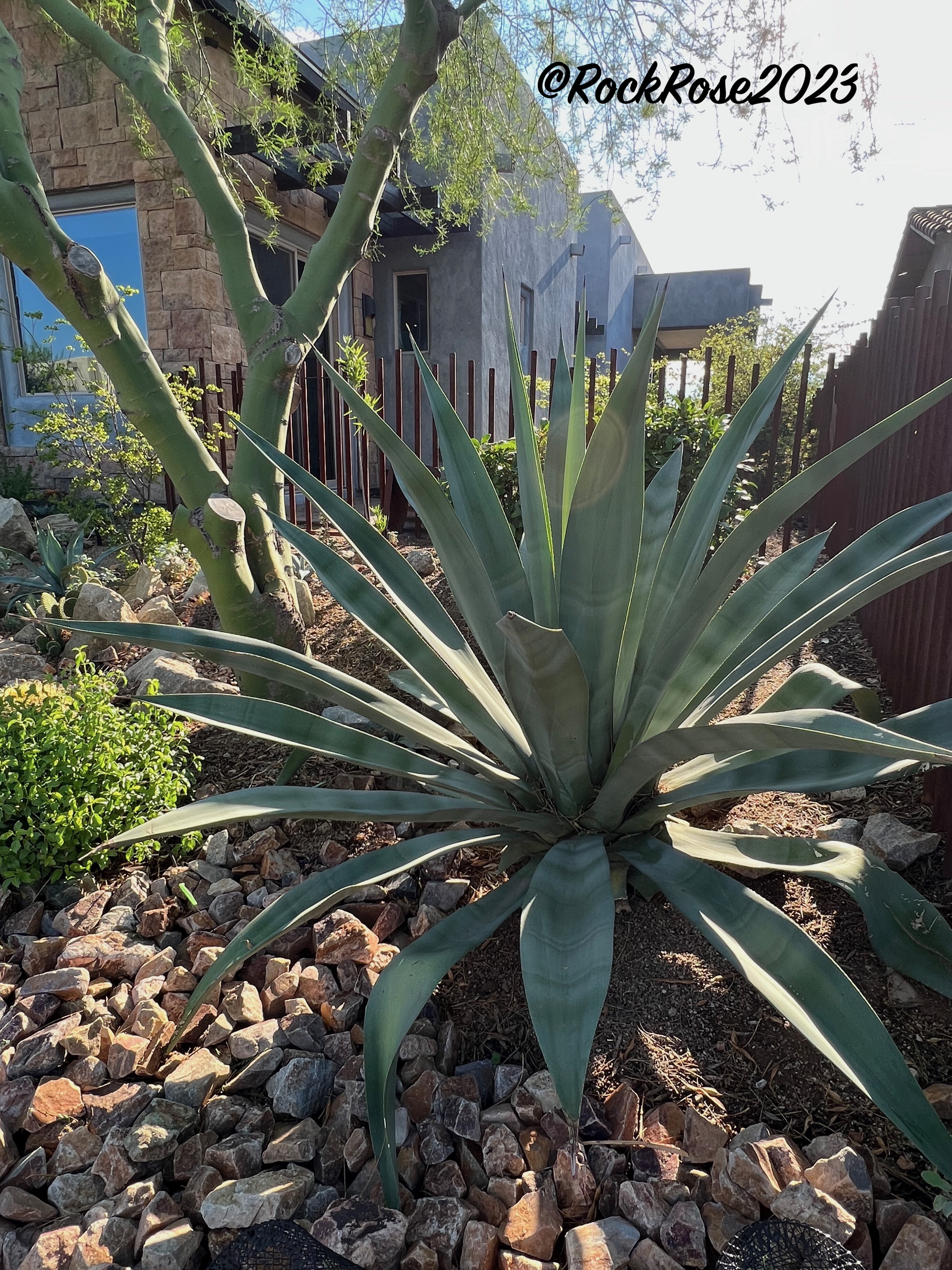
There are only a few large agave remaining. This one is on the corner beneath the palo verde. But wherever we took out the Agave weberi new pups are springing up. I am potting some of them up to plant out behind the house. There is good value to be had out of these large structural agave and I find I miss them. For the first time ever I have started to protect them from the weevil by using the systemic Imidacloprid around the base.

 Another very spiny agave guards the edge of the driveway and is forever in risk of being run over. It is a slow grower but it puzzles me why they would have planted it so close to the edge. It has produced only one pup which I relocated.

I am really quite fond of the brittle bush, Encelia farinosa, which blooms in the spring with masses of yellow flowers. It reseeds around the garden and I leave some of them to grow into small bushes.


One of the plants I was most concerned about was the Meyer lemon tree. It had lived in a large pot for 12 years, providing us with tens of lemons every year. We brought it with us and last year planted it in the ground. It looked good during the winter and produced many blooms but it wasn't happy and by May almost all its leaves had turned yellow and dropped off. I full expected it to be dead and was already planning to put in a new one this winter. Amazingly extra watering and some summer showers had brought it back to life and there is new growth.I will always give any sign of life in a plant a chance so it remains to be seen whether I will be replacing this after all.

Also down the side of the house the grapefruit tree is looking great and the 6 grapefruit are getting bigger. They have about 4-5 months to grow to full size and ripen.

It is my potted plants that suffered the most and many died. The lime tree had fallen over along with the plumerias. I must try to get the lime in the ground although the Mexican lime is one of the least hardy of the citrus. I may just have to give up in the plumeria. A large jade plant had completely rotted away. I don't know if it was the heat or lack of water but there was no9thing left of it. Of my herb and vegetable raised planters only the basil, sage, chive and peppers survived. David had put in a new water line to water them from beneath but I think they were getting too much water being on every day. This was really due to there being mixed water need plants on the same circuit. There is a lesson to be learnt here, although I think I have had the same lesson many times before. A constant presence in the garden is the only answer.

 Another storm blew through and was the trigger for all the Mammillaria grahamii to bloom. They have certainly put on a big show-a show always worth waiting for. 


One of the benefits of living in an arboreal desert.