My Blog List

Showing posts with label Ladyfinger cactus. Show all posts

Tuesday, April 15, 2025

SPRING IS HERE AGAIN!

 It seems the arrival of spring flowers has jogged me into writing a post. This, after an absence of 11 months. I don't know what happened. Maybe it was being away from my garden for 3 months last summer, or the daily walks and hikes which take up most of the morning. Maybe it was the long breakfasts after the morning exercise... they certainly eat into your day, or maybe it is my shortening attention span for everything I do. Could it have been our purchase of a new trailer and the planning it takes to book campsites. Or was it quite simply the ease of posting a few pictures on Instagram and the scrolling that goes along with it. Sheer laziness?


So here we are, our third spring in the desert. It has been a magnificent winter with lots of warm sunny days but no rain all winter long. My newly acquired rain barrels filled up during a rain in November. I emptied the contents into 50 gallon milk jugs and used the rest. Since then not a drop. And no rain in the desert really means no rain and no spring wildflowers. Of course we have a drip irrigation system but it has been very difficult judge how often to run them. I fear not often enough. Even with all that warmth the budding of leaves and the opening of cactus flowers did not happen earlier. It has been right on schedule. 

For any gardener seeing that first green leaf begin to unfurl brings enormous relief. Relief that the lack of rain did not kill it. The first to break were the two Wonderful pomegranates, purchased for $5 each from our power company. The one from the first planting produced one tiny pomegranate last year, too late in the season for it to mature. This year I have counted 14 flowers on that tree and one is starting to swell. Undoubtedly I will have to protect it from birds and wandering javelina. This morning I noticed 1 flower bud on the second pomegranate, planted a year later than the first. 

The next, of the deciduous trees to begin leafing out were the desert willows. Similarly purchased from TEP. I have 4 of those all of which are coming along nicely. We removed a Texas olive from this spot in favor of desert willow. 


And another deciduous Sonoran tree is the Arizona wild cotton, Gossypium thurberi. Growing to about 10' 
this tree was nearly eradicated because of a fear of the boll weevil which had attacked the cultivated cotton fields. It turned out it was not the same weevil and the cotton tree is now returning. I first saw it growing at Tohono Chul garden and was able to buy one from their garden shop. I look forward to its pretty white blooms later in the spring. 

   
                                                                Arizona cotton tree


                                                               Cotton tree bloom from last year.


And then the cactus begin their spring routine. They sit quietly all year until the first buds start to appear. At this point they need to be checked every day as if you blink you can miss them. 

Yesterday the first bloom on the ladyfinger cactus, Echinocereus pentalophus, followed today by two blooms on another plant. 


And then a cluster open on another plant.


When we moved here I brought a number of plants with me. One was the Myrtillocactus geometrizans, or
bilberry cactus. I had planted it alongside the garage, far too close to the wall. Unfazed it began to send out arms and last year produced a pup and yesterday I noticed flower buds. This morning when I took David over to show him one of the buds had opened. It is not showy as many cactus flowers are but certainly welcome. 


A purchase last year at Tohono Chul plant sale. 


                                                           Echinocereus engelmannii

It is a great time of year for the aloes to bloom and for the first time in its life the Aloe vera, I brought with me in a pot and planted in the ground, is blooming. I found the perfect place for it alongside the fence where there was another Aloe vera clump. Both have produced many pups. 


The large stand of giant aloes in the back garden have bloomed with one side taller than the other. I can only assume that the uneven growth is due to the lack over overall watering provided by rain and one side receiving some irrigation water. I would love to divide this aloe but it looks like a daunting task which would likely damage the symmetry of the plant. 


It is visited by the hummingbirds and Gila woodpecker. 

New blooms on the mammillaria open in tiers every day for several weeks. 


There is sure to be something new every day and it looks as though tomorrow it will be the first flowers on the Gymnocalcium baldianum.

Friday, May 6, 2022

THE THREE Rs OF DESERT GARDENING

 I have been reading Jeff Moore's book. Under the Spell of Succulents. It is a wonderful book, beautifully illustrated and loaded with information.  There is only one problem. Many of the gardens are in California- In my eyes the perfect climate for growing, well____ just about everything. It seems I squandered my 6 years in Southern California growing the wrong thing! Sadly he devotes only two pages to desert gardens. Clearly he knows what will and what won't grow here.

I did learn two major things which seemed to be directed at my new adventure in desert gardening. His mantra of the 3 Rs. Rocks, Restraint and Repetition. Let's see how I am doing. 

Rocks-I had 9. I knew I wanted more, even before I read his book. We have now collected from a local source over 36 decent sized which I have been using to create a rock garden. It may look a little bit currant bun at the moment but I am hoping plants will fill in and soften the look. They are not rocks I would have chosen but this is what we have. The expense of having someone bring in and place larger ones was beyond what we wanted to spend. These broken chunks of granite tend to be rather angular but surely I can soften their edges with plantings. 


 I am also thinking of giving them a diluted paint wash to help them blend in. I did that with some limestone ledge stones at my old garden. Then there is the 4" riprack and 1" stone mulch. We rented a UHaul for that job picking up a load at the stone yard. So far two UHaul rentals and two dusty stone yard visits. 


Restraint- I have always been known for that. At least from the money angle. I would buy 4" pots and only occasional gallons. But I think Jeff was referring to using a small palette of plants. Maybe I'm not so good at that but hope to manage this better in the desert. The odd large agave may look great as a statement plant but smaller ones look better when they are in groups.

Repetition-I'm been good at repeating some things-namely things that seed themselves or pup. But that was in Austin. I have lots of pups of A.americana and A.weberii but I would like something more exciting. I purchased 3 Agave "Blue glow" of which there were several already planted. I do worry a little that they will not like the full afternoon sun so I will probably protect them with some shade cloth through the first summer. I had hunted around for A. ovatifolia to no avail and then one day we visited Tucson Cactus and Koi and they had several. Sadly they were pock-marked from a hail storm that had passed through the area a few weeks ago. I was just going to buy one but David persuaded me to buy 3 at the discounted price. They are quite small but I know they will grow out of the damage if I treat them well.

                                                    A. ovatifolia "Frosty Blue"

 I had plans to put the second one on the other side of the front planting bed, beneath the large remaining A.weberii. Incidentally when I told a local nursery that these weberii did not have completely smooth edges he told me that almost all of the ones here were a cross between americana and weberii. They could give you a nasty gouge. On the spur of the moment I told David we should take it out. Within minutes I had cut off most of the leaves and he was there to do the final job. Now there was room to plant the A.ovatifolia. 


Of course I read too late his advice about taking out any current planting so as not to have to work around the plants and compromise the design. On the front walkway I couldn't bring myself to do that as the barrel and echinoeereus cactus were about to bloom. They looked too comfortable to mess with. 


I worked around them trying to create a drainage swale and mounding on either side, disturbing the cactus as little as possible. He was right of course. He also talked about bringing in soil to create the mounds. We did not. We used what we had. It's just desert sand which is fine for most of the desert plants that grow around us.


My garden is now a desert garden and I am surrounded by saguaro and barrel cactus at every turn and discovering the desert is not necessarily the place for all cactus and succulents. Some will withstand the baking summer sun but others demand shade if they are going to survive. I brought with me a large collection of cactus and succulents and herein lies the struggle. Clay pots were perfect for Austin. Not so in the desert. The air is so dry it sucks any moisture out of the pot. I find myself watering more frequently than in Austin. In my former home I would leave them for 6 weeks in the summer, under the shelter of a patio. They quickly responded to a little attention when I came home although they may never have been prize winners, bearing the scars of winter and summer damage. But here they are and I have been doing my best to make them feel at home. Some have been put in the ground. I brought 3 barrel cactus one of which I picked up in a neighborhood concrete wash in a subdivision in Phoenix. At first I thought it was growing in a crack in the concrete but was surprised to find it totally unattached. "I have a home for you" I also brought some agave- A. demettiana, variegata. My neighbor has one so they found a new home in the ground. Also an A. demettiana 'Joe Hoak' I may have to give all some frost protection in winter. I have planted a ladyfinger cactus, Echinocereus pentalophus, in the shade of the ironwood tree. 

I have moved them from one spot to another as the sun moved across the sky finally settling on a place down the North side of the house.  Until I discover the sun has found its way to that spot by the afternoon. So now the only place is under cover along the east facing patio or in the house. 

Most have flowered well this spring but it might be a struggle to keep them happy if we go away.  This cactus asks for little in the way of water or fertilizer and puts on a stunning show of blooms. The blooms last for several days.


                                                 Echinicereus pentalophus

This is not going to be as easy as I thought!

Friday, March 27, 2020

A FIRST EVERY DAY

You walk around the garden and spot the first bloom on the ....... I'm sure you could easily fill in the blank. Surely every gardener shares this experience. And spring is the time when every day seems to bring that 'first flower' experience.
Here are some of my first flower experiences this week and most of them natives.

First I saw the bud then overnight a flower on the Ladyfinger cactus, Echinocereus pentalophus. These flowers last for at least 3 days and usually arrive in succession.


The blue gilia,  Giliastrum rigidulum. More commonly found in west Texas but I found one small patch growing on my lot and was successful in moving it to a place where I can see it and enjoy its beauty. It is almost at eye level so cannot be missed. It usually opens in the afternoon. Do you see the weevil? Not the dreaded agave weevil though.


Blue-eyed grass, Sisyrinchium angustifolium, seeds among the gravel and between the pavers. As does the Engelmanns daisy which has seeded alongside.


the pink evening primrose, Oenothera speciosa. Oh! Yes, it will run wild but that' fine. A quick pull here and there will keep it under control.


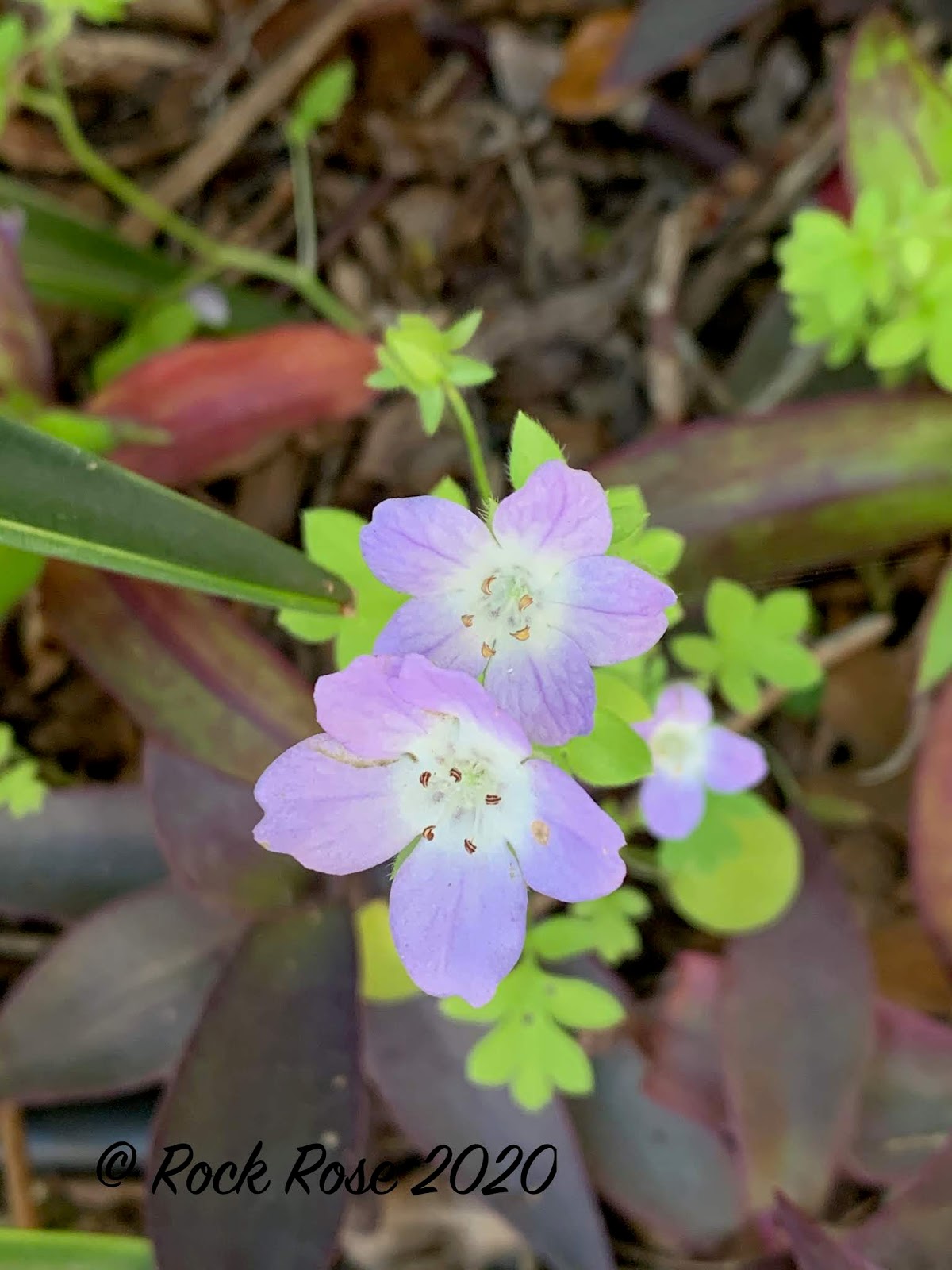
Baby blue-eyes, Nemophila phacelioides. I only have a little patch of shade and that's where they grow.

Everyone else may be able to grow the spiderwort, Tradescantia sp with ease. For me it is a rare event.


What's that I see through the shower window? It's the first blooms of the Anacacho orchid tree, Bauhinea lunarioides.


And the cross vine, Bignonia capreolata. has found tis way 20' from the mother plant.


And I have a mental block on what this plant is called. Help me out will you, please? Update. Thanks to Lyn for the id of Pavonia lasiopetala if I remember the species name correctly.


And wood sorrel, Oxalis.sp. For some it is a weed, for me I am happy to have just a few flowers in this shady corner.


Oh! How I love that morning, spring-time stroll around the garden. There will be more tomorrow, I'm sure.

Monday, April 8, 2019

FOR A BRIEF SHINING MOMENT

Over the years I have become more and more interested in cactus and succulents and have amassed quite a collection. I see a trend towards this easier kind of gardening in my future. I love the structure of all of them, even those that are the least attractive to look at, and it is many of these that put on the most stunning floral display every year.
On a particularly rainy Sunday it was wonderful to look back at some of my cactus that have flowered in the last two weeks. The first is the ladyfinger cactus, Echinocereus pentalophus. 


I have several of these in pots which spent the winter in the greenhouse where the dry conditions and cool temperatures made for a spectacular blooming over a period of 4 weeks. Not all the flowers opened at once although on this plant 10 blooms appeared at the same time. Whereas many cactus flowers are ephemeral these last for at least 4 days, opening in the late morning and closing by evening. Although we are slightly out of its range in zone 8b I have succeeded in growing in the ground in well-draining gravelly soil.


The claret cup cactus, Echinocereus triglochidiatus, however, is completely hardy in our area and I have several stands in the front courtyard garden. Their petals are quite stiff which means the blooms can last for over a week. The hummingbird is a regular visitor for nectar.


Some of the mammilaria species pop out a few flowers during the winter when located in a sunny window.


But their main blooming time is spring when the crowns bear tiara-like rings of booms which are similarly long lasting.


We have a number of nurseries which sell cactus and even the big box stores have some nice specimens. As always is is necessary to do ones own research about the hardiness of species as often labels are inaccurate. Surprisingly Walmart had a great cactus selection this year and the thing I loved was that each were labeled with the the genus and species names in detail. So often small cactus come with no labeling. They were a welcome addition to my cactus theatre.


Saturday, March 30, 2019

THE SLOW SUCCESSION

This week we hosted a large group of visitors from the Garden Clubs of America. As usual there had been fretting for several weeks about how the garden was going to look, what would be blooming and what wouldn't. You know the gardeners' cry, "You should have been here last week, or even this morning." I do try hard not to say that any more. Timing seems to be all important when a garden tour is on the books. Constant checking the weather report and temperatures. If only I could say, "come over today" That may be the only kind of garden tour in our future.
Of course the bluebonnets were blooming beautifully as well as the mallows, freesias, iris,


Globe mallow


and lots of other unusual things like kale and cabbage....gone to flower in our strange Spring, but left for the pollinators.

Flowers of Napa cabbage
Lovely clumps of fragrant narcissus 'cheerfulness'


and clumps of native wild alliums looking at home between the rocks.


And Texas yellow star, Lindheimera texana, which has established itself in a dry corner of the garden.


And because this was an afternoon tour even the Gilia rigidula was on show. Growing on top of the retaining wall between the secret garden and the English garden where it is much easier to appreciate than if it was growing low down on the ground. You are not likely to see this for sale unless in a specialist nursery. I found mine on the property and moved it to this spot.


But days later some of these plants are fading and others making an appearance. The warm sun this week and the claret cup cactus, Echinocereus triglochidiatus started to bloom.


And another round of the ladyfinger cactus, Echinocereus pentalophus.


and more and more blooms opening every day on the Lady Banks rose , Rosa banksia 'lutea'


And last evening as I strolled around the garden, I noticed the blue eyed grass,  Sisyrinchium was blooming. My Monday visitors missed seeing these.


I am now asking myself if my next garden visitors will see them. Will they last another 8 days. But of course there will be something else in bloom. The poppies and penstemons for sure and maybe the mallows will keep going for another week. The skullcaps and blackfoot daisies should be coming into their own. Yes. Spring and early summer are a succession of plants that bloom, fade and are replaced by others, so what am I fretting about? Just my nature.