My Blog List

Showing posts with label lace cactus. Show all posts

Tuesday, May 2, 2017

CELEBRATE NATIONAL WILDFLOWER WEEK, May 1-7

Do you have wildflowers growing in your garden? I do. Let's see what is blooming out there this week as we celebrate National Wildflower Week.

I'll begin with Colorado Venus' looking-glass, Triodanis coloradoƫnsis. (A)What a lovely name.


And where did it come from because I have never seen it before? It came inside a hole in a rock I brought into the garden when I redid the dry creek along the garage wall.


The plant is annual so I shall watch carefully for the seed pods ripening. I would like to have more next year.
A final blooming of the lace cactus, Echinocereus reichenbachii.(P) Even after the blooms die it remains a tidy addition in the rock-scape.


And the blousy Engelmann's daisy, Engelmannia peristenia, (P) opening with new flowers every day from a winter rosette of leaves.


The pathways in the vegetable garden are crowded with blanket flowers, Giallardia pulchella. (A) Goldfinches feast on their seeds but always leave plenty to bloom next year.


And Mexican bush sage, Salvia leucantha,(P) blooming months ahead of schedule this year. Will it bloom again in the fall as the hummingbirds begin their long winter flight to SouthAmerica?


The trailing wine cup, Callirhoƫ involucrata, (P) spilling over the dry-stone wall. Always everyone's favorite when they visit the Wildflower Center.


The flowers on the Texas prickly pear may only last for a day but they may leave behind some nice fruits. These fruits, call tuna, ripen to a burgundy red and can be used to make jelly.


Wooly stemodia, Stemodia lanata, (P) makes a good ground cover and is deer resistant.


It has tiny blue flowers.


Our native Lantana, Lantana horrida (P) is also deer resistant and blooms through the hottest months of the year with little water.


Purple skullcap,  Scutellaria wrightii,(P)  can be pruned into a tidy clump and blooms all summer.


Echinacea, Echinacea purpurea, (P) a summer bloomer and another favorite of the birds when it goes to seed.


The Blackfoot daisy, Melapodium leucanthum, (P) another deer proof summer bloomer.


The columbines are among the earliest of spring flowering plants. here the Hinckley's yellow columbine, Aquilegia hinkleyana, (P).


and the more delicate smaller flowered Aquilegia canadensis,(P)


Damianita, Chrysactinia mexicana,(A)is both drought and deer tolerant but does best when given occasional waterings.
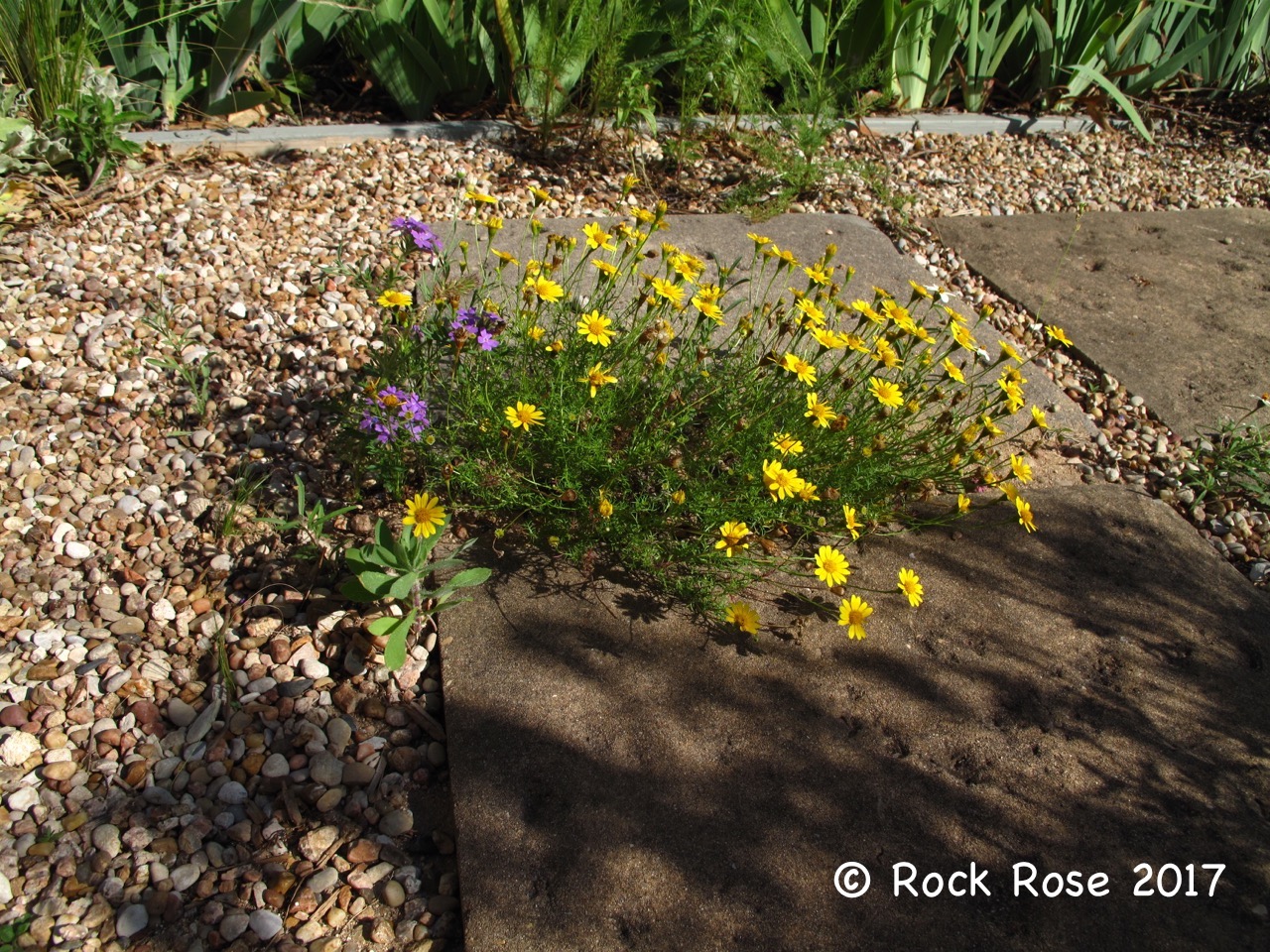

All these plants are blooming in my west Austin, rocky landscape, with minimum watering.

If you would like to learn more about wildflowers for you area you can get information on the Ladybird Johnson Wildflower Center website. There are all kinds of programs going on this week in Celebration of National Wildflower week.

Sunday, January 22, 2017

MULTIPLICATION IS THE NAME OF THE GAME

Once in a while something good comes out of an accident in the garden. About 8 years ago I stepped backwards right onto a single lace cactus, Echinocereus reichenbachii, smashing it into the ground. Imagine how sick I was at the time. Never fear. Cactus are tough. It divided itself into 3.


Then this mamillaria. Workmen knocked the pot off the wall smashing the top off the cactus. I dried off the broken top and repotted it and left the broken one to heal. That broken one has healed over and has now made a whole new family.


An unwary boot trampled this agave into the ground. It, too, has produced a new family. I am not sure this one is a good thing.


I have often wondered what makes the barrel cactus suddenly start producing multiples on top of itself. Like this one I saw in Arizona. It is quite obvious that the top of the plant has been subjected to some damage in the past. It has made a new top and lots of babies around the sides.


Cactus can take a lot of abuse but sometimes an accident turns out to be a happy event.


Monday, April 11, 2016

IT'S BEEN A HARD DAY'S WORK

And I was working like a dog!


Live oak leaves, live oak catkins, live oak sprouts. It's that time of year. When a live oak tree drops its leaves it is amazing the weight and volume. Cans full of the things. I see people in the neighborhoods with their oak leaves stacked in brown bags at the road sides. Fortunately for us we have plenty of room to dispose of them otherwise.
But the job of cleaning up in a dry creek is not an easy one. There was a time 20 years ago when I would not have entertained owning a leaf blower. Now, I couldn't do without one. Leaf removal took all morning followed by an hour of kneeling down clipping off the oak sprouts.
There was one bonus to this work. The flowering of my lace cactus , Echinocereus reichenbachii, right before my eyes.


As a cloudy morning turned to sunny skies the flowers opened all at once. To think I might have missed it.


Then I shoveled fresh gravel into the bare areas alongside the dry creek and took a few photos. And as that old Beetles song goes-Tonight I'll be sleeping like a log.

Monday, April 28, 2014

THOSE LITTLE BEAUTIES

You wait all year and suddenly they arrive. Sometimes it is just for a fleeting moment and you find you have missed the show. But not today.


The Ladyfinger cactus, Echinocereus pentalophus opened the first of her blooms today. I was so lucky to pick this up at a garage sale a couple of years ago. I had to repot it because it was in very heavy wet soil and as I took it out the whole thing fell apart. However, cactus are more forgiving of mistreatment than many plants and recovery didn't take long.


The crown of blooms on this mammillaria sp. is reminiscent of a little tiara. It is also in a pot and protected during the winter. It blooms for days.


Another potted, yellow flowering mammillaria. This one blooms year round.


Then there are my cactus in the ground. The hardy lace cactus, Echinocereus reichenbachii. It is outside the walls in the front.


And this one, about to open. It is growing in a spot where someone removed a large stand of prickly pear cactus years ago. A much better substitute. It is growing on almost bare rock and is so happy I am reluctant to move it, although I would like to have it in my inside rockery.
The garden has already had a wonderful show of Claret cup cactus, whose blooms last much longer than other cactus. It will be next year before they bloom again.

Monday, April 15, 2013

GARDEN BLOGGERS' BLOOM DAY, APRIL 2013

It is the height of spring in Central Texas. The garden is a sea of poppies from the orange California poppies Eschscholzia californica...


To the common corn poppy, Papaver rhoeas.


Pink poppies, the seeds given to me by a friend.


And one white California poppy this year.


I could easily have missed the flowering of my lace cactus, Echinocereus reichenbacchii. Typically her blooms open well into the afternoon when the sun reaches that part of the garden. I just noticed that flush of pink as I was getting ready to come inside.


It now meant another half hour with the camera checking all my lace cactus. They were all blooming.


The ones in the front driveway area among the bluebonnets.


And the ones up on the top wild area. They looks so fat and happy. The pistil in the center of one was moving. Deep inside the flower a bee was wallowing among the stamens.


When he emerged pollen was flying everywhere.

Here are a few of the flowers that are blooming in the sunken garden.


Ruby crystal grass, Melinis nervigumis, with Damianita, Chrysactinia mexicana.


Dahlberg daisy, Thymophylla tenuiloba,


Blackfoot daisy, Melampodium leucacnthum. with blue eyd grass, Sisyrinchium pruinosum.


More blue eyed grass with sedum.


The sunken garden.


Square bud primrose, Calylophus berlandieri.


Scarlet penstemon, Penstemon triflorus.

Anacacho orchid tree, Bauhinia lunarioides.

Wednesday, April 13, 2011

PINK PROFUSION

It is the moment in the gardening year I look forward to with great anticipation.. The brief moment in time when the lace cactus, Echinocereus reichenbachii, flowers. Never in all the years have so many flowers opened at the same time.

There have been occasions in the past when I missed the flowering because this clump is growing outside the walls in the granite area that was once a parking area. Yesterday, however, as I drove in down the driveway it was impossible to miss the mass of pink. I rushed into the house and grabbed the camera.

Monday, May 17, 2010

SNAKES ALIVE!

This morning I was talking to my neighbor about a coral snake that had been seen in another neighbors garden. As I walked through the gate there was this Eastern Black-Neck Garter snake. They are fairly common around here but this is by far the largest I have seen. A few minutes later I came across another snake, this time in the garage. It was much smaller and possibly a juvenile garter snake. I wonder if it had anything to do with a little frog I saw hopping in the garage the other night. It is one of their favorite foods. Yes, it's that time. Warm enough for snakes and tarantulas and scorpions. I need to make sure I don't leave the door open. Not that closed doors stops the scorpions. I killed one in the living room the other night.

The first flowers opened on the ice plant I started from seed. It is Delosperma floribunda 'stardust' The color isn't quite as vibrant as I had hoped for but it should do well planted in one of the spaces in the sunken garden. The pelleted seeds arrived in a tiny capsule and I had little hope that they would germinate. They did and I have six plants.

I almost missed this group of lace cactus. I was busy removing bluebonnet seeds in the front granite area. It was hiding underneath bluebonnets and zexmania.

The flowers at the top of the now 7' stalk on the Manfreda sileri, finally started to open. Not very interesting I'm afraid.

Now here's a horn worm with a difference. Anyone have an id on him. He's busy eating the Missouri primrose leaves and looks as though he is about to burst. Caterpillars in general seem to be quite drawn to the leaves of the primrose including the pink evening primrose. The furry caterpillars have stripped all the leaves from those plants leaving only the seeds! Smart move on nature's part. I did finally break down and spray the tomatoes with bt. There were just too many hornworms this year.

Finally we watched a young mud dauber emerge from the adobe nest by the kitchen door. He ran up and down the wall drying out his wings and finally made his first attempt at flight. Just a short one, but long enough to know he needed to dry out some more. I think we can finally remove it from the wall.