My Blog List

Showing posts with label iris. Show all posts

Sunday, June 13, 2021

WHO WOULD WIN

I often ask myself when I am out in the garden, "Who would win if I just let the garden take care of itself." Would it become a mono-culture or would every year bring a different winner. I think maybe the latter and I say this because I often say, "It's been a really great year for such and such a plant" I think mother nature gives every plant a chance.

This year the cone flowers, Echinacea purpurea, would take the prize.

They were busy preparing for this year last year when they set hundreds of seeds-which, of course, I allowed to remain.  And I am not really sorry because I think they just look marvelous. I wish they would last a little longer although I suppose the idea is to let something else take center stage. They have even muscloed their way into the English garden. Of course as often happens they are right by the stepping stone instead of in the more open spaces.

And who among this group would take over. Mulleins, gopher plants, blanket flowers or wine cups. Each one of them would vie for top dog position in the garden.

Naturally the weather plays a big part on what will bloom successfully in each season. We had a relatively dry winter  and then all hell let lose with one of the deepest freezes, in fact the deepest freeze I have experienced while living in Texas. It wiped out a number of plants, in particular the larger ones. Maybe some of them were ready to go. I had a gorgeous Pride of Barbados that had volunteered in the small strip between sunken garden and pool. Over a period of 5 years, despite dying back to the ground every winter, its girth increased with every year. 


It was really too big for the space but that deep freeze did something I couldn't bring myself to do and that was remove it. But the good news is it left behind some offspring. One a little further along and one in the middle of the sunken garden. Maybe they will be too young to flower this year but I am excited that in the future they will. And in a prior year one grew between two rocks on the other side of the sunken garden. Maybe it was sheltered between those rocks and that was why it survived or maybe the covering of ice and snow helped insulate it. It does seem to be the smaller plants that survived.


Let's look at Monarda 'Peter's Purple' Is there a more successful spreader than this plant? It isn't that it seeds but that it sends its underground runners out in all directions to make new plants. One year it managed to successfully invade the yellow iris. How charming, I thought, when the iris finish here comes the bee balm. That is until the iris failed to bloom the following year, completely crowded out by bee balm. Then the bee balm decided to move out and this year the iris bloomed with a mighty vigor chasing the bee balm in its relentless spread.The bee balm is so adored by all manner of flying insects and hummingbirds too that I don;t have much of a problem letting it go on its merry way. 

My beautiful Philippine violets, Barleria cristata,  took a big hit. The two along the edge of the pathway(volunteers) in the Sunken garden are slowly making their way back but the big one has split itself into four plants leaving a gaping hole in the center. It is a perfect place to add a pot and it so happens that last winter an arm broke off the plumeria, which I potted up and is growing. 

 One plant that is not permitted in the back gardens is the Engelmann daisy, Engelmannia peristenia. I can remember when I bought 3 small 4" plants at the Wildflower Center sale. "Oh! you'll have plenty of those" someone said. Now I have more than even I could have imagined and I constantly pull them out-not an easy propositions as they send down a big successful taproot. That is why they do so well in dry gardens . But they are beautiful when in bloom in the early morning. By afternoon their yellow petals have curve under. They do give the garden a somewhat wild appearance.

 And that was before the American beautyberry, Callicarpa americana, and the liatris, Liatris spicata.  started to move in. I think the latter might be the most freely seeding plant in Texas. At least in my garden. It does add gorgeous color in the later months of the year. 

But of course I am not going to let any one of these plants the chance to take over. I leave that to the next gardener who lives here.


Tuesday, April 27, 2021

SPRING IN THE SUNKEN GARDEN

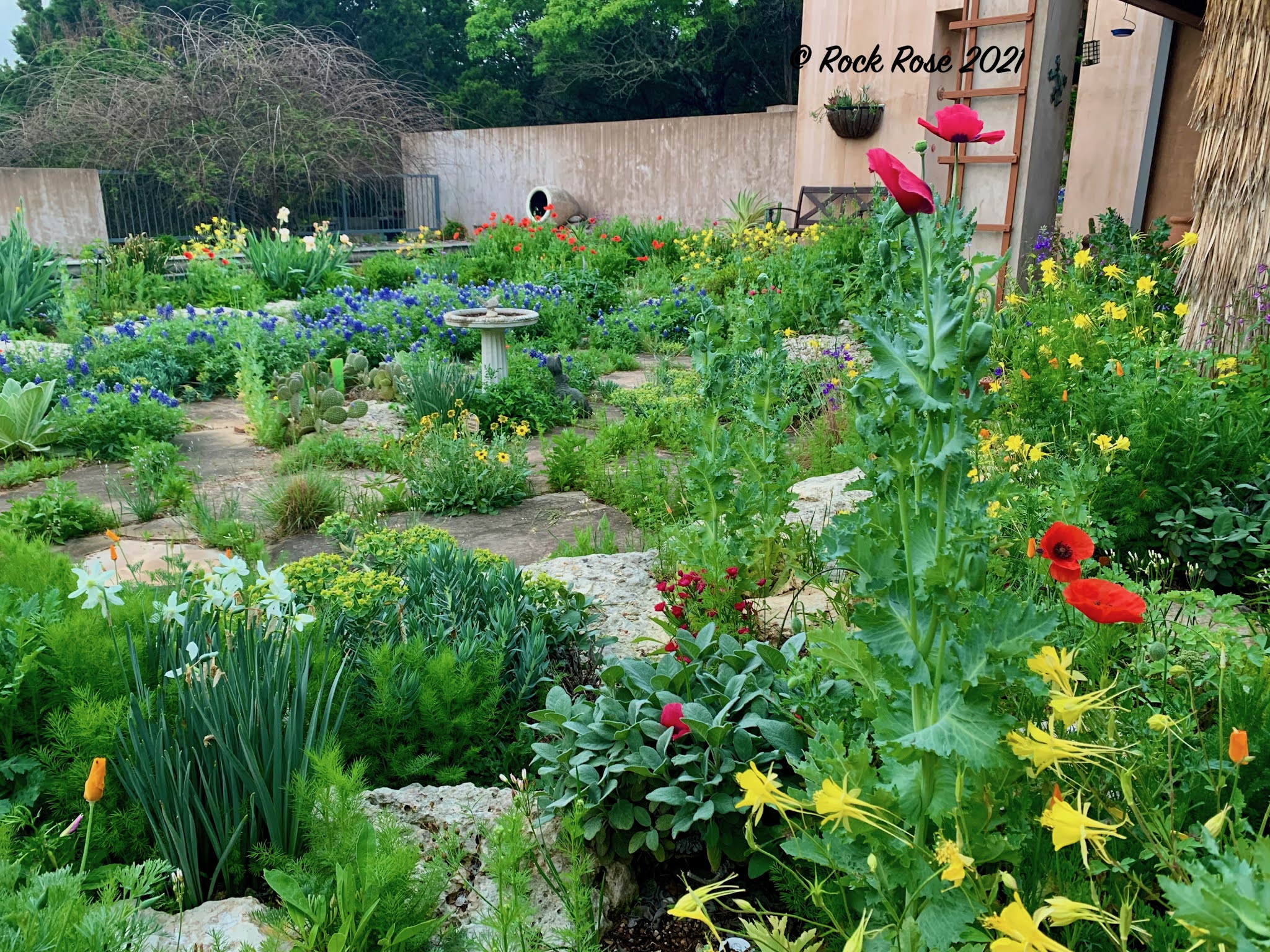
 The area between the house and the pool was a blank canvas and perfect to create a sunken garden. The inspiration was partly inspired by the many sunken gardens I have visited in England, my grandfather's garden where I spent my teenage years and the sunken courtyard at the Lady Bird Johnson Wildflower Center. Many of the rocks dug up during the building of the house were saved in order to create a foundation wall around the sunken area. The floor is Arizona sandstone over decomposed granite. I'm sure the builder was happy not to have to cart those rocks away. Nature has done much of the planting and I am happy for that although it does create considerable work keeping it under control. But, both David and I delight in all the blooms that appear-as if from nowhere. The scene changes from week to week and from year to year. Spring is the most floriferous time.

The only step down is along the front and even here it requires some agility as a Gulf Coast penstemon, Penstemon tennuis, has seeded right in the middle of the two stones. How could I possibly pull it when it was so happy there. I love this penstemon but it is prone to root aphids, placed there by ants who farm its honeydew. They are not easy to control and will kill the plant.

A few plants have been with me since the beginning and one is the chocolate daisy, Berlandiera lyrata

Compact in the early weeks it does eventually become rather rangy. It has only seeded in one other place and I suspect this is because I usually cut it back part way through the season and the new seed heads may not have time to mature. 

Mullein, may be considered a weed by many but I love its beautiful form over the winter before sending up a tall flower spike with yellow flowers. It is also a favorite of the bees. Many may seed but only a few will be chosen. This was a lucky one on the lower level.


In early spring bluebonnets can really take over and I'm afraid this year I have let rather too many and some of the plants growing beneath have suffered. A single bluebonnet plant can spread to cover 3' and is better suited to a meadow setting.


Hinckley's yellow columbine. Here there and everywhere as usual.


 It is always interesting to watch how plants grow and move. A large cluster of bee balm was gradually evicted by this yellow iris, so that now there are only a few plants left. Time for the iris to be divided and passed along nd maybe the bee balm will move back in.


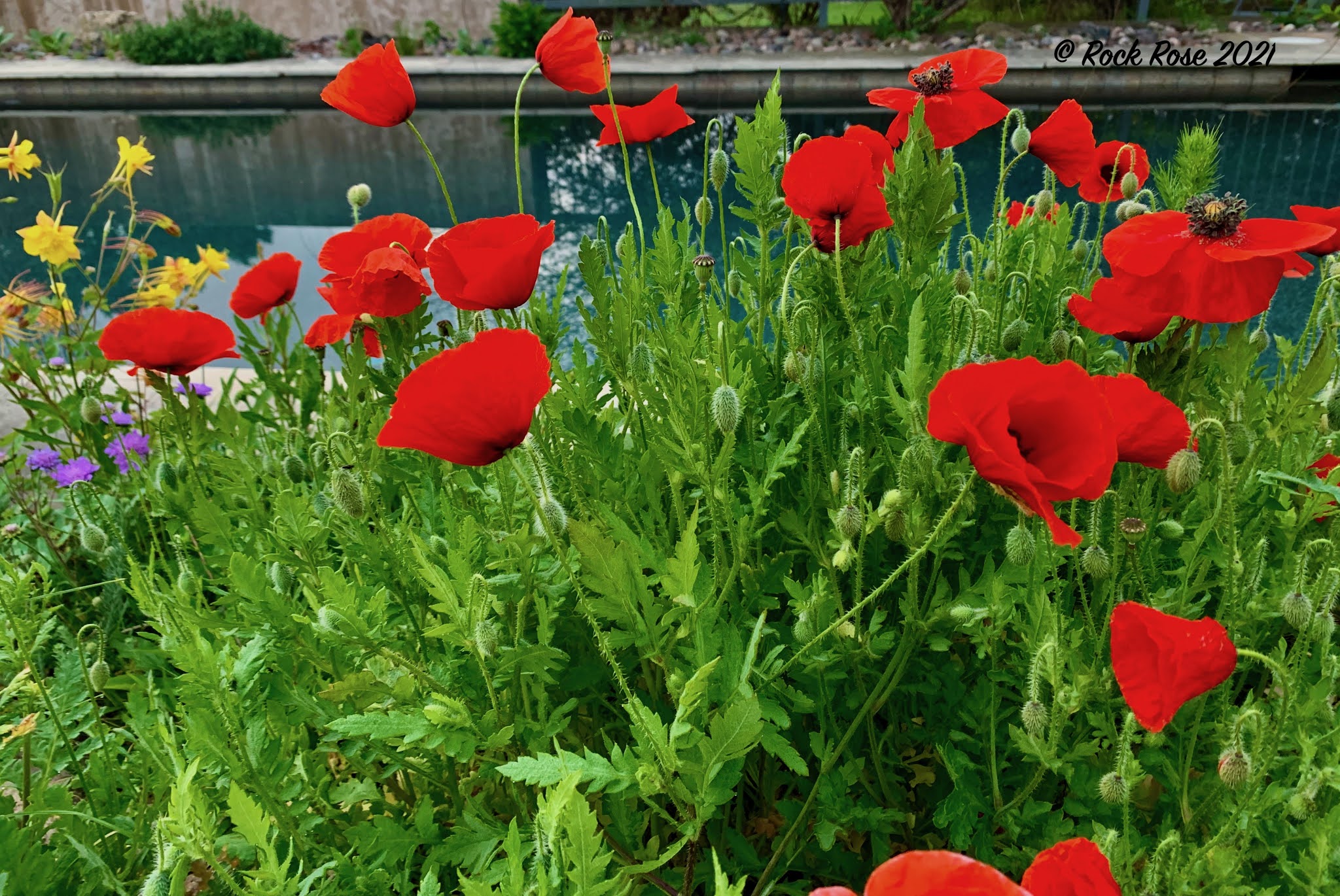
 I always let the corn poppies grow wherever they wish. Easy to pull out and something will always take their place later.


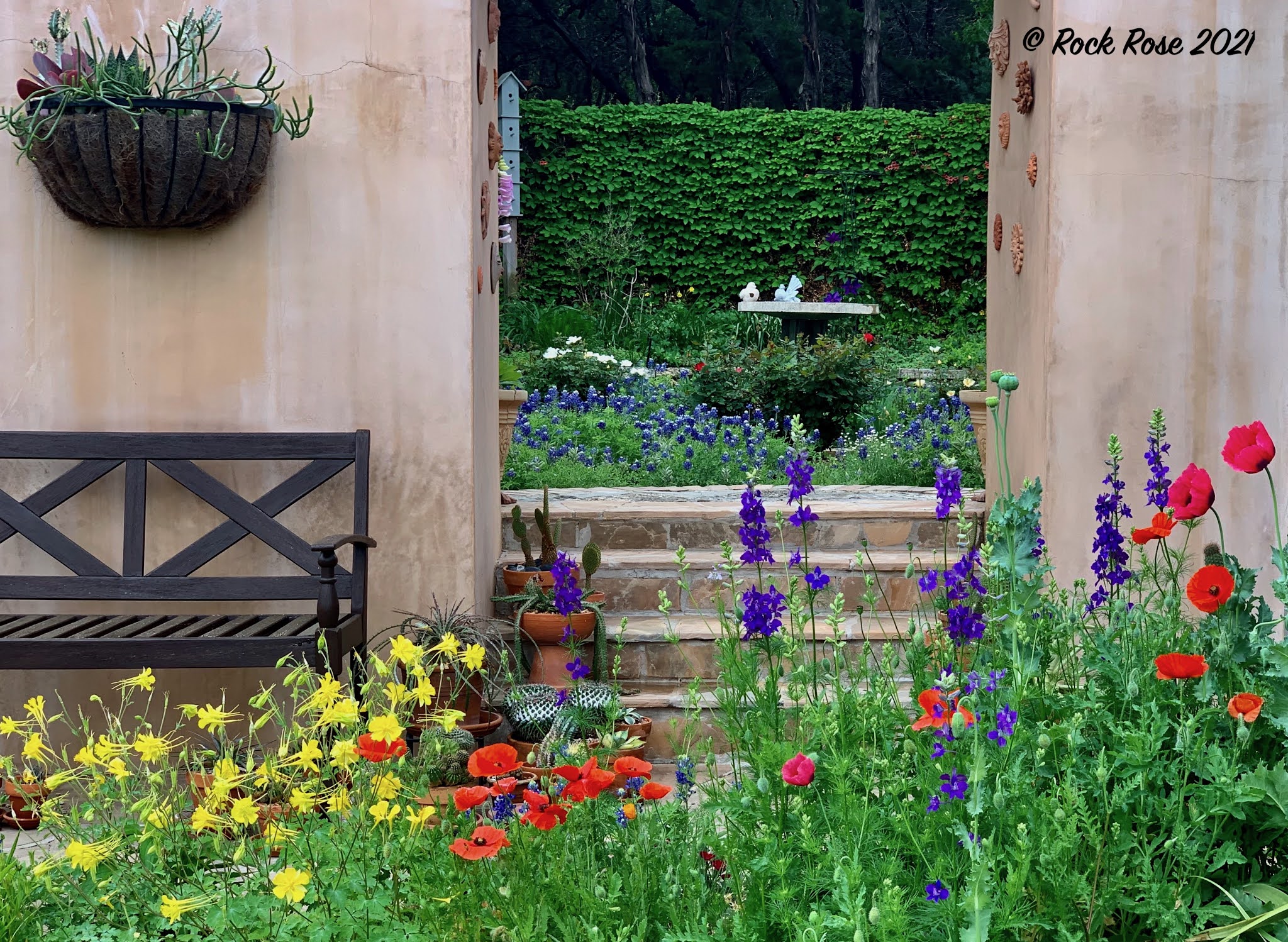
One of my favorite views is standing in the sunken garden and looking up to the Sun and Moon Archway. A mix of columbine, larkspur and poppies.
 

The gopher plant, Euphorbia rigida, has flowered and gone to seed. Some of the longer leaves have been removed to leave a small cluster of seed heads for seed saving. Nigella hides the leaves of the faded daffodils above the  mealy blue sage and larkspur.
 

Late April and the wine cups begin to bloom and spread, and spread and spread! Frequent trims will keep them in order. 

There will be a few plants missing this year and they will be missed. Two beautiful Pride of Barbados were lost to the freeze. The seed had appeared from nowhere and we had several years of their summer blooms. There is however, a very small one growing between two of the ledgestones and possibly in a more favorable place. 


It's time to get out there and remove some of the more boisterous residents in the sunken garden.

Sunday, March 17, 2019

EARLY SPRING BLOOMS

Our mild winter has been kind to many of my flowering blooms, although I have to admit I did protect the freesias during some recent nights when the temperatures fell in to the 20s. The same with some of the iris because they were in bud.


The purple iris were a passalong and came without a name which is often the case in my garden. The pretty little narcissus alongside this clump is also without a name, much to my regret.


Another passalong iris, known only as Peach, lives up to its name. It smells of peaches.


The naturalizing species tulips, or lady tulips, Tulipa clusiana, have not disappointed this year. Some years ago I read that the seed were not viable and I would pick off the seed heads after flowering. Then I discovered that the seed pots were attractive in themselves and allowed the seed to fall. Now there are many new plants forming.

Tulipa clusiana Lady Jane

Tulipa clusiana, Lady Jane with petals closed
Tulipa clusiana var. chrysantha, has yellow petals with red markings on the underside.


The species tulips, Tulipa humilis, Persian pearl was planted several years ago. It bloomed the first year and then nothing for 2 years. Now once again it is going to bloom. This is one of the shortest stemmed tulips, just a few inches tall.


I took the upper photo this morning and this one when the petals opened up when the sun came out.


All these tulips are perfect for the rock garden where they will receive good drainage.

The freesias have been magnificent, whether in pot or in the ground. They did receive addition protection from freezes but worth every cover I brought in and out.


And the same with pots of anemones.


I just wish they would all last just a little longer.

Friday, April 4, 2014

A TURN UP FOR THE BOOKS

I wonder if anyone is familiar with the expression, A turn up for the books. It was one I heard family say when they had an unexpected piece of good fortune. I just had one.


So here is mine. This chocolate daisy, Berlandiera lyrata. After 8 years of growing this plant it finally had a baby. I had watched the seedling over the past few weeks but wasn't completely sure about its identity until I saw the characteristic flower bud forming. Many times in the past I have seen similar leaves and they have all turned out to be blanket flowers.
It has settled itself in very close to mother, between one of the pavers in the vegetable garden, and has topped the mother plant to produce the first flower of the season.


I do have one other chocolate daisy in the sunken garden. It is back again this year opening multiple buds over the last few days. But for all its years of living there it has never once produced a baby.


It seems to favor this spot among pavers where its roots are protected. At the Wildflower Center  chocolate daisies grow to be 3' tall but this one never gets much larger than this. It usually gets one cut back during the summer resulting in a further flush of blooms later in the season.


I year ago in October I planted this red veined sorrel in the herb garden. As soon as any leaves grew they would be eaten, probably by those decollate snails. I have made a concerted effort to reduce their numbers and suddenly leaves started to poke through the soil. After our terrible winter it is hard to believe that the plant had survived. Both plants have returned and hopefully will have a better year.


This may look like a regular bearded iris but it is a dwarf variety. It stands only 6" high. I picked this up in Boise at a Saturday market 3 years ago. It is the first time it has bloomed or rather the first time I have seen it bloom. Almost smothered by yarrow leaves I just caught a glimpse of it as I walked by. I think a more prominent location next year.
A real turn up for the books.

Friday, March 28, 2014

LET THE IRIS SHOW BEGIN

If you had visited my garden 7 years ago there wouldn't have been a iris in sight. Now my garden has 4 different kinds and when the iris bloom I realize what I had been missing all those years.


All my iris are pass-a-longs from garden friends. This one came form Annie at The Transplantable Rose. Not only is this iris a beauty but it has a delicious peach fragrance.


My second iris came from Linda Hutson's garden. This is a phenomenal grower and has to be divided every two years for fear of it taking over the garden. For that reason it has been shared many times among my gardening friends.


But here is the strange thing. Last year I divided the clump closest to the house replanting some of the new rhizomes in the same place. This year the first one has opened in a much deeper color. What has happened here. I did a little investigating and found several gardeners having the same experience. and yet there are those who say this is impossible. They believe that the new colored iris was already there but had not yet reached bloom time. I suppose that is the most likely reason.


I will mark the plant when it finished flowering so that I can keep my eye on it, maybe moving it to its own location. away from the others. For now I will enjoy it.


My white cemetery iris, Iris albicans,  is planted out in deer territory.
I have one more iris and the buds are ready to open. It spent 2 years in my vegetable garden but was relocated this past fall. It seems to have enjoyed the move because it is flowering much earlier this year. 

Wednesday, March 6, 2013

ON A MARCH MORNING


This group of iris close to the house is now in full bloom. They have benefitted from some extra care and attention in the form of water.


The first blooms on our native columbine, Aquilegia chrysantha var. Hinkleyana.


In the English garden the Carolina jessamine, Gelsemium sempervirens above the hand-me-down dovecote that one graced Pam Penick's garden. Thank you Pam.


Species tulip, Tulipa clusiana Cynthia. These naturalizing tulip are so tough I wonder why I don't have more of them.


Clusters of Ipheion. I need more of these too.


Clumps of my favorite alyssum in the gravel paths.


And the true flowers on the gopher plant. Little dots of red.


That special time of year has begun; the time when every day brings a new bloom.