My Blog List

Showing posts with label salvia. Show all posts

Tuesday, May 2, 2017

CELEBRATE NATIONAL WILDFLOWER WEEK, May 1-7

Do you have wildflowers growing in your garden? I do. Let's see what is blooming out there this week as we celebrate National Wildflower Week.

I'll begin with Colorado Venus' looking-glass, Triodanis coloradoƫnsis. (A)What a lovely name.


And where did it come from because I have never seen it before? It came inside a hole in a rock I brought into the garden when I redid the dry creek along the garage wall.


The plant is annual so I shall watch carefully for the seed pods ripening. I would like to have more next year.
A final blooming of the lace cactus, Echinocereus reichenbachii.(P) Even after the blooms die it remains a tidy addition in the rock-scape.


And the blousy Engelmann's daisy, Engelmannia peristenia, (P) opening with new flowers every day from a winter rosette of leaves.


The pathways in the vegetable garden are crowded with blanket flowers, Giallardia pulchella. (A) Goldfinches feast on their seeds but always leave plenty to bloom next year.


And Mexican bush sage, Salvia leucantha,(P) blooming months ahead of schedule this year. Will it bloom again in the fall as the hummingbirds begin their long winter flight to SouthAmerica?


The trailing wine cup, Callirhoƫ involucrata, (P) spilling over the dry-stone wall. Always everyone's favorite when they visit the Wildflower Center.


The flowers on the Texas prickly pear may only last for a day but they may leave behind some nice fruits. These fruits, call tuna, ripen to a burgundy red and can be used to make jelly.


Wooly stemodia, Stemodia lanata, (P) makes a good ground cover and is deer resistant.


It has tiny blue flowers.


Our native Lantana, Lantana horrida (P) is also deer resistant and blooms through the hottest months of the year with little water.


Purple skullcap,  Scutellaria wrightii,(P)  can be pruned into a tidy clump and blooms all summer.


Echinacea, Echinacea purpurea, (P) a summer bloomer and another favorite of the birds when it goes to seed.


The Blackfoot daisy, Melapodium leucanthum, (P) another deer proof summer bloomer.


The columbines are among the earliest of spring flowering plants. here the Hinckley's yellow columbine, Aquilegia hinkleyana, (P).


and the more delicate smaller flowered Aquilegia canadensis,(P)


Damianita, Chrysactinia mexicana,(A)is both drought and deer tolerant but does best when given occasional waterings.
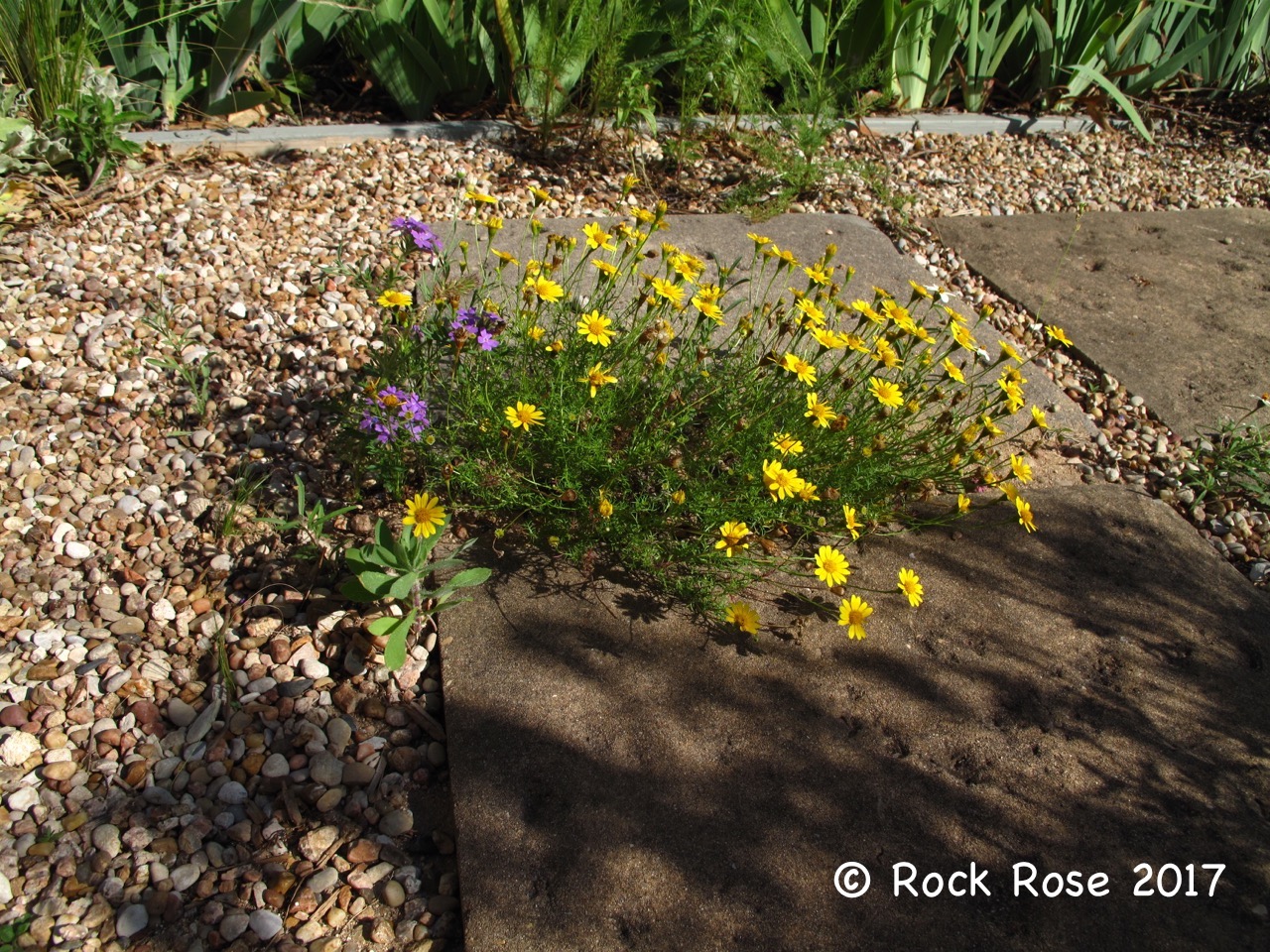

All these plants are blooming in my west Austin, rocky landscape, with minimum watering.

If you would like to learn more about wildflowers for you area you can get information on the Ladybird Johnson Wildflower Center website. There are all kinds of programs going on this week in Celebration of National Wildflower week.

Sunday, November 15, 2015

GARDEN BLOGGERS' BLOOM DAY November 2015

Some much needed rain has brought many flowers out of hibernation in time for May Dreams November Bloom Day.

Rosa Felicia

Roses a re booming again and a cluster of blooms on the musk rose Felicia has me stopping to inhale her wonderful fragrance.

Not nearly so fragrant is Molineux, but with more of a tea rose fragrance, a new addition this fall.

Rosa Monineux


Called pink crystal by some and ruby crystal by others I am beginning to understand why. Pink seed heads in the spring and with the cooler weather a much deeper ruby-colored seed heads.

Melinus nerviglumis
Other flowers have a greater depth of color with the cooler nights. Mealy blue sage, Salvia farinaceae.


Salvia leucantha blooms were quick to fade during the long warm dry days of October, but the rain bought a flush of new flowers.


The first flowers on the rosemary.


Still plenty of color from the narrow leaf zinnias, Zinnia linearis. Soo I will be collecting their sees for next year.


Society garlic, Tulbaghia violacea


And the generous seeding common orange cosmos, Cosmos sulphureus.


Clouds of pink and white gaura, Gaura lindheimeri


A cluster of blooms, with Dicliptera the main player.


We are winding down for the winter but signs of spring are already popping up all over the garden.

Monday, June 30, 2014

AH! THE SALVIAS

Where would our gardens be without the genus Salvia; annuals, biennials, perennials, herbaceous and woody shrubs; all the colors of the rainbow. These dependable plants are of immense value in the Texas garden where several mechanisms help them through the tough Texas summers.


Above is one of my salvias not commonly seen in Austin gardens. Salvia clevelandii, is native to California and Baja where it grows as a short lived perennial. It is more difficult to grow here because it prefers a dry summer with less humidity. I grow it for its fragrance. In the early morning it perfumes the air and, at other times, I can barely walk by without brushing it with my hands and bringing its exquisite scent to my nose.


I grow the common culinary sage, Salvia officinalis for cooking. If you haven't tried fried sage leaves then you are missing out on a treat. Fry the leaves in butter until crisp and serve over ravioli with lemon butter or other non-tomato pastas. This sage blooms for long periods in the early summer after which it can be cut back to make new growth. The bees love it.


Salvia officinalis 'Berggarten', has a more rounded leaf and downy grey leaves. It too can be used for cooking but also adds beauty to any garden. Unlike the common sage it does not produce flowers. It has the tendency to travel as stems touch the ground and put down new roots. The older part may eventually become woody and die back.


There are several smaller leaved sages, among them the yellow, Salvia officinalis 'Icterina' and purple leaf Salvia officinalis 'Purpurascens', grown more for ornamental purposes.


But the main stays of the Texas garden have to be the blooming sages. The Salvia greggii which come in white, red, pink and purple.


And Salvia microphylla 'hot lips' These are always a favorite of the hummingbirds. I probably have more Salvia greggii in my garden than any other plant. That is because they seed freely. The plant is sometimes called autumn sage but this is really a misnomer as it flowers throughout the summer and autumn. Shearing the plant partway through the long summer will bring on a new flush of flowers.


I shall have to wait a little longer for the Salvia leucantha, to bloom. Outside my vegetable garden it grows in a good base of decomposed gravel. It receives no additional water, makes a delightfully shaped bush and is completely deer proof. Winter frost results in it dying back down to the ground but it is extremely hardy. It will spread by underground stems which make for plenty of plants to share with other gardeners. This one is seen blooming in my garden in September. It has both the purple flower and calyx. Another variety has the white flower and purple calyx.


Another fall bloomer is Salvia madrensis, sometimes called forsythia sage for its long arching stems and yellow flowers.

 It is slow to come back from die back in the winter but over the summer it builds up to reach a height of over 5' by fall. It has unusual square stems with a ridge at each corner of the stem, which make it easy to identify. In my garden it is planted under the Lady Banks' rose which probably helps it survive some of the lowest winter temperatures.


One of my salvias is becoming a little pest and I am rapidly removing it from my garden. Salvia farinacea, mealy cup sage. Best allowed to grow in the wild.

                                                                TO SALVIA

                                               In these times of fashionable rages
                                               Let us honor enduring sages.
                                               Known to cure, to mend, to ease;
                                               Companions to cooks; splendid teas.
                                               Hundreds of species our world adorn,
                                               Richly diverse in flower and form.
                                               Hail to Salvia, that scented salvation,
                                               Worthy of study and our admiration.

                                                                                            - Andy Doty


Do you grow Salvia in your garden? Please share your successes.

Tuesday, October 18, 2011

TEXAS NATIVE PLANT WEEK OCT. 16th. -22nd. WHAT TO GROW.

What better time to celebrate Native Plant Week in Texas. Now is the time gardeners are thinking about replacing and adding plants to their fall garden. After such a devastating hot, dry summer natives rule the roost.


Each day 5 natives plants and trees have been chosen and today my namesake rock rose, Pavonia lasiopetala, is one of the chosen. I think the original plant in my garden came from a seed. Since then it has appeared each year in various parts of the garden. It blooms all summer and like many, comes into full glory in the fall. Pretty pink flowers open every day. The foliage is always green, seemingly no bugs or diseases. Carefree as you come.


My garden lends itself towards plants seeding themselves, so most of the time they just appear. I don't do anything nor can take credit for much of this. I do pull seeds and scatter them in other places because nature doesn't always put them in the right place.


Where deer are constant visitors the Lindheimer senna, blackfoot daisy, Melampodium leucanthum, damianita, Damianita chrysactinia, dahlberg daisy, Thymophylla tenuiloba, lantana, copper canyon daisy, Tagetes limonii, fragrant mistflower, Eupatorium havanense, bluebonnets, Lupinus texensis, daisy fleabane, Erigeron annus, Texas sage, Leucophyllum frutescens, rain lilies, Zephyranthes drummondii,   and Salvia leucantha provide color among cactus, agaves, yaupons, vitex, persimmon and oaks.


I am fortunate to be able to garden deer free in many parts of my garden but even here I use a lot of natives in among other adapted plants.


The smaller plants, like daisy fleabane and skull caps make a perfect addition to the sunken rock garden because they remain small and manageable. Even so I they too may need a cut back mid-way through the summer. They will respond by producing a new flush of leaves and flowers.


The purple skull cap, Scutellaria wrightii, is one of my favorites and cross breeding has resulted in several shades of purple and mixtures of purple and white.


Four nerve daisy, Tetraneuris scaposa, is a prolific re-seeder. This one is growing out of a hole in a rock. Quite happily.


Pass along plants, like this flame acanthus, Anisacanthus wrightii, from my friend Bob at Draco gardens, is a winner with the hummingbirds and creates a mass of delicate foliage and flowers by fall. I cut it back hard in the spring to encourage bushiness.


Although the major blooming time for damianita, Chrysactinia mexicana, is spring, a few flowers appear in the fall. Very tolerant of drought conditions and also deer resistant due to its highly aromatic foliage.


Zexmenia, Zexmenia hispida, also deer resistant can be trimmed back to maintain a neat appearance. Even cutting back to the ground doesn't faze this plant.


The little chocolate daisy, Berlandiera lyrata. Why doesn't it reseed? I really wish it would because it is not easy to find.


This year the Salvia leucantha suffered from the lack of rain and relentless heat. It maybe too late for the hummers but is not too late for gardeners to enjoy.
Think native when you go to the nursery this fall. All of our local independent nurseries carry a good selection of plants and seeds to make your garden a native garden.