My Blog List

Showing posts with label calamondin. Show all posts

Monday, December 7, 2020

KALE AND CALAMONDIN

This time of year two wonderful garden crops are ready to bring into the kitchen. In the heat of summer I was anxiously awaiting cooler days and the vegetable garden rewards of our mild winters. I sowed seeds of kale, chard and pak choi in 4" pots in my laundry room moving them to the potting shed and under lights when they had a few leaves. This gives them a head start and a better chance of surviving the ravages of the decollate snail and pill bug decimation. I chose the curly kale because we like the slightly bitter taste. Not only do they have a high germination rate but they stay viable for a number of years. 


The packet I used was packed for 2017. The leaves are now of a good size for picking with 6 leaves enough for a meal for the two of us. I find kale much easier and more worthwhile to grow than spinach. If you are going to grow kale it pays to find some good recipes. Yesterday morning, in a chapter on winter greens, in a 2006 edition of Bon Appetit magazine, I found the following recipe. 

Other than the fact I did not have the more exotic mushrooms (I used baby bellas) I had all the other ingredients to hand including the thyme which I also grow.

It looks exactly like the photo in the magazine and was absolutely delicious. A definite keeper. We had it for dinner but it would make a really great special lunch dish too.


Later on in the day I went into the garage to make the first picking of calamondin fruit. The plants were wheeled into the garage a week ago because of an impending freeze. We were far more sensible this year keeping the pots on the driveway all summer and then using various wheeled carts to bring them in. They are now permanently on a variety of carts for the winter so we can easily transport in and out. 

When we lived in Hong Kong we saw hundreds of these trees at Chinese New Year. They are given as gifts and represent good luck and wealth. The Chinese word for the tree is very similar to the word for wealth. But they are more than just decorative trees they make the most delicious marmalade.
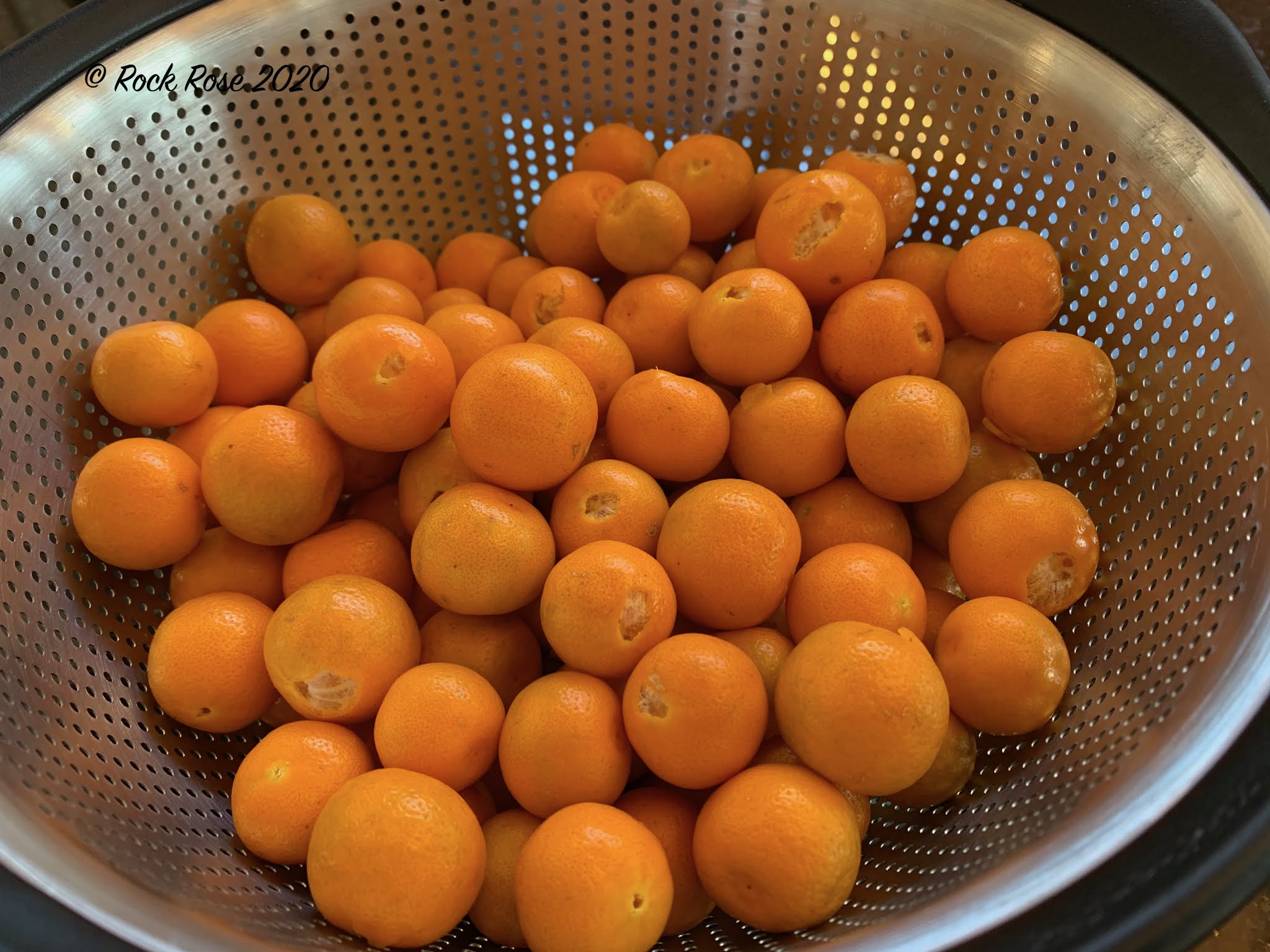
Making this marmalade is a real labor of love but so worth it for the absolutely delicious sweet/tart combination of flavors which we love on our toast at breakfast. And there is absolutely no waste as every scrap of the fruit is used, even the pips! Here's how to use your calamondins.

Cut the oranges in half.

Squeeze each half, to remove all the pips and juice, into a sieve over a a bowl. Then slice all the fruit peels thinly and add to the juice. Tie the pips in a muslin bag. For each cup of fruit add 3/4cup water into a large non-reactive pan tying the muslin bag so it is in the mix. Boil for 20 minutes. Cool and leave overnight in the fridge to allow the pectin to develop.

Measure the fruit again and for each cup add one cup of sugar. No pectin needed.

I like to use the spoon drop method for testing readiness but you can also use a cold plate or even the candy thermometer to jelly set, 220°

Pour into sterilized jars. No need to can. First batch completed. Lids popped and a good set achieved.

So incredibly delicious on my morning toast.


Saturday, November 21, 2020

GARDENING IN NOVEMBER

 November is a busy time in the garden. Winter vegetables need to be tended and direct sowing of seeds. And there are seeds to be saved from summer bloomers. November finds my counters littered with saved plastic boxes filled with dried seed heads waiting for a little finger work. Tender plants are already in the greenhouse safe from expected frosts-although so far we have been fortunate. Apart from a few nights of temperatures in the high 30s we are now having Indian summer which is a lot nicer than a Texas summer. Warm dry days and cooler nights. The plants are loving it.

There are many years when the Copper Canyon daisy, Tagetes lemmonii, never gets to bloom. It can be so late that an early frost nips it in the bud. This year, however, it is spectacular.

The same is true of the Gomphrena 'grapes' Because it is a late bloomer it rarely get chance to bloom. In the end I gave the original plant away, but it had left behind some seedlings in the gravel, which I left, and this year the plants are blooming beautifully. They grew like spindles all summer and then about a month ago they started to produce flower heads. Maybe I will try to transplant into a place at the back of the border where they can mingle in among other plants including Verbena bonariensis. It is best grown where it can grow through other plants. 

Ajania pacifica, is another good fall bloomer. It is quite the spreader but easy to pull and performs well in a rock garden setting. 

But it is seed collecting time for many of the fading summer bloomers including the globe gomphrenas, pink and purple although not entirely necessary as they usually naturalize-sometimes a little too vigorously. Gomphrena 'fireworks' gives off a curry smell in the fall. The first year I grew the plant I remember thinking that one of my neighbors was busy making an Indian dinner! Since then it has shown up everywhere although none seems to have escaped the garden. It has a big tap root which often results in it overwintering. All the gomphrenas leave a lot of mess behind when the petals start to fall. Confetti time.

I have so many blanket flower and verbena seedlings that I have to move some of them to places where I would like them. Not in the pathway, although alyssum and daisy fleabane can stay. I will probably pull out the Mexican feather grass that is growing alongside it. 

I have already transplanted a few Larkspur from the vegetable beds to the sunken garden. I just have to make sure that the snails don't eat the seedlings before they are big enough to stand on their own two feet.What's going on in your garden?

Fruit is ripening on the citrus but it will be a few more weeks before I pick the kumquats and the calamondin to make marmalade. Lots of work but so worth the end result. We are terribly finicky about our marmalade and like the sweet/tangy taste when made from these little fruits. 

Kumquat

Calamondin

Improved Meyer lemon

I'm having one of the best winter vegetable garden seasons in quite a while. Already harvested pak choi, chard, peas and beets broccoli and carrots are well on the way to a good harvest. 

It's not often we get a successful pea harvest in the fall unless we protect the crop from frosts. This year, so far, no frost but then no rain either.

This variety is Cascadia which I have the best success with in spring. It produces tender posts that can be eaten at all stages from snap to full pod. They remain crisp and stringless. 

I don't know what I would do without my garden as it has kept me busy during these difficult stay-at-home days. 


Saturday, October 21, 2017

PLANTS BEGIN TO SIGNAL WINTER IS ON THE WAY

My garden is beginning to signal that winter is on the way. Sometimes it seems as though it is never going to arrive  and when it does happen is is usually overnight with our first good frost. But there are subtle changes in the garden. The plants look more colorful because of cooler days and nights.


Among the whites and oranges of the narrow leaf daisies a new flower begins to bloom.


It is the Mexican mint marigold, Tagetes lucida.  The leaves make a good substitute for French tarragon, which cannot withstand our hot summers, and is therefore often called Spanish tarragon. This herbaceous perennial dies back during the winter but and spring and summer the plant is green, before bursting into flower in October. It flowers only where winter comes late to the garden.


Another late bloomer is the Philippine violet, Barleria sp. Pest free and seemingly no diseases it also dies back during winter but has been a reliable returner even giving me a few new plants from seed.


The orange cosmos, Cosmos sulphureus, has been in non-stop bloom throughout the summer. It is both heat, drought and pest resistant. I threw a few seeds into this bed less that a month ago and they are now flowering.


The citrus fruit are starting to ripen. The bitter Calamondin, which I make into marmalade. No other marmalade comes close to the tangy orange flavor of this fruit. Not even the Seville marmalade.


The Meyer lemon. The fruits aren't quite so big this year. Maybe because of our dry summer.


Rusty seedheads appearing on the dwarf papyrus, Cyperus papyrus.


Plants spill over the low wall completely covering the pathways. The last to flower will be the Copper Canyon daisy, Tagetes lemmonii.


There are changes among the succulents too.

Echeveria Devotion, Hana Bay flowerswith its velvety leaves takes on more color with the cooler nights. When I bought it it was like this and then lost most of its color during the summer. I am so happy to see it back again. It should enjoy being in the potting shed for the winter.


Kalanchoe thrysifola, the flapjack or paddle plant is also coloring up with the cooler nights. I am on the lookout for its cousin K. luciae, which gives more brilliant color during winter.


It is also the bloom season and several are starting to send up a boom stalk. The plant is monocarpic so these plants will die after flowering but leave plenty of pups behind.


Euphorbia lactea cristata form. Possibly Grey( white) ghost with cresting.


Today the heat and humidity are back again.

Tuesday, June 20, 2017

HEADY FRAGRANCE ON HUMID DAYS

Twice this morning I was surprised by a new heady fragrance in the air and I think I know why. At 9:30am even though the thermometer said 82° it felt like 93° and that humidity is picking up the fragrance.


After many weeks without appreciable rain, 4 weeks ago we had over an inch. It seemed to wake everything up. We have moved into summer mode with daily temperatures in the high 90s and insufferable humidity. I'm sure it never used to be like this. Houston maybe but not Austin.

I can only bear to be outside for a short period of time before drowning in sweat. Very early I was out in the front courtyard, which has had little supplemental irrigation. The day lilies were going into a serious decline with brown withered leaves. A little hand watering was in order. That was when I noticed a fragrance and turning to look I realized it must be coming from the summer phlox, Phlox paniculata 'John Fanick'. I bent down to sniff and sure enough that was the source. I must get more of this plant next year.


A short time later I was crossing the driveway when another blast of fragrance hit me. There is only one plant blooming out there and that is the retama, Parkinsonia aculeate, which is in magnificent flower. The sound of bees along with that fragrance shouted 'Summer'.


In the vegetable garden I feel like I am in California with the fragrance of citrus. A long dry period followed by rain seems to have triggered a second bloom.
The same with the Meyer lemon. I could never have too many of those so I am hoping this will mean a bountiful crop. I hope it isn't too warm out there for the bees.


Calamondin orange tree with new blooms. I'm hoping for another marmalade making day in the winter.


Lots of plants have responded to the rain. The Texas sage, day lilies, California poppies and iris are all flowering for the second time. I'm wondering what the rest of the year holds in store for us all.

Saturday, December 31, 2016

FINAL POST OF THE YEAR 2016

There is just time to get one quick post in before we roll into 2017. I wonder what kind of gardening year it will be? Hot, cold, wet, dry? I little or a lot of each I imagine and sometimes when unexpected. Rather like the freeze we had while I was away 2 weeks ago. A low in the 20s brought quite a lot of destruction to the garden. Then, mother nature threw in a few 80ยบ days just for good measure. Fortunately most of the potted plants were safe in the greenhouse, potting shed, garage or house.


The garden is looking pretty sad but in the house the plant of the moment is this Sansevieria parva, Kenyan hyacinth. So named because the fragrance is similar to that of the hyacinth. Thanks Julie Marcus for the passalong. Just as you said the fragrance is quite amazing, especially in the evening.


The calamondin orange trees are still bearing fruit. I have already made two batches of marmalade and will make more early in January. Hopefully enough to last the whole year.


The calamondins are one of the hardiest citrus but I don't plan to risk their lives. They are in pots and spend the winter in the house, which they tolerate well.

Already there are there signs that 2017 is on the way.

Gulf coast penstemon

HAPPY NEW GARDENING YEAR, everyone.


Wednesday, December 30, 2015

TO PICK OR NOT TO PICK

My little calamondin orange tree, Calamondin X Citrofortunella mitis, never fails to produce a winter crop of delightful small fruit and is the only one of my potted citrus favored with a place in the house over the winter. It can do no wrong. In spring the air is perfumed by its flowers, the foliage stays bright green throughout the year and the fruits are perfectly formed spheres of orange. Native to China the calamondin was introduced to North America around 1900. It is one of the hardiest of the citrus and will withstand temperatures down to 20ยบ It is perfect for container culture.


This year, unlike my other citrus, the tree overcame a battering from hail in late spring which removed all citrus flowers. Lemons and limes called it quits but the calamondin produced another flush of blooms to delight us once again during cold winter days.


A little research led me to a recipe for calamondin orange marmalade. Being of English heritage we grew up eating marmalade on our breakfast toast, and still do. Not the sweet orange marmalade that is sold here but marmalade made from bitter Seville oranges grown in Spain. Calamondin fruits are very tart so maybe marmalade made from them would be more similar to that made from Seville oranges. I decided to give it a try.


First of all I had to overcome the urge to just leave the fruits on the tree. Maybe I could start by making a couple of jars just to make sure I liked the end product. I found the easiest way to deal with the fruit is to cut the fruit in half, remove the pips and squeeze the juice into a glass measuring jug. There is very little pith so the whole fruit can be used.


Just a quick pinch between the fingers and remove any stray pips, then cut the remaining peel with pulp into fine strips.


I tied the pips in a muslin bag as I had seen my mother do when she was making jams. It is supposed to be a source of pectin.


Then it all went into the pan along with ¾ cup of water for every cup of peel and juice. Boiled down for about 15 minutes and then into the fridge overnight to develop the pectin needed for jelling.
Next morning I measured the contents and added some more water, 1cup of sugar for every cup fruit and boiled down until the jelly stage was reached at 220ยบ I also like to test putting a small amount on a very cold plate to see if it wrinkles when a finger is drawn across. I potted up but not before I had a little taste. Good and tart-perfect.


You can be sure as that all the other little oranges will get the same treatment next week. For now we will enjoy the little tree with its winter bounty for a few more days.