Two weeks ago we had friends visiting from Denver. We were so excited to show them our wonderful desert home but disappointed that the lack of rain this year was making the desert look very drab and dowdy. Usually the desert behind our house is a sea of yellow, at this time of year, with flowering brittle bush, Encelia farinosa. This year their leaves are brown and dried up living up to their name. I wish our friends had come a couple of weeks later, as following a brief shower and a cold front passing through, all the trees burst into bloom. Maybe the shower and drop in pressure had nothing to do with it and the flowering had more to do with daylight hours and the natural cycle of blooming. The Palo verde, mesquite and acacia are now putting on a magnificent show. Just driving down the road with the trees in flower and the backdrop of the mountains is the most magnificent sight.


This is the Palo Verde, Parkinsonia x Desert Museum, in our front garden. Regrettably this tree was overwatered by the previous occupants and has grown very large. We have had to do some canopy pruning as well as root pruning as the roots were bringing up our driveway in several places. We were also fearful of them making their way into our sewers system. But for all these negatives we love the tree for the filtered shade it provides for the plantings beneath its canopy. It is the sterile hybrid of three palo verde species, P. aculeata, P. microphyllum and P. florida. Its attributes are that it is thornless, fast growing, drought tolerant and attracts many pollinators.
When the flowers drop the ground is a carpet of yellow
Below is another common spring bloomer, the mesquite, Prosopsis sp. producing long pods later in the season. These are a favorite of the javelina and can also be ground to make a flour as the Hohokam lived did many years ago. For all their messy nature the trees both stabilize and being a legume, improve the soil.
Above the sweet acacia, Vachellia farnesiana, The desert trees and shrubs are competing for who is the most fragrant.
Other shrubs like the hop bush, Dodonaea viscose, are also blooming. These reseed quite readily and I have a couple which seeded in a perfect place among the rocks and which I intend to keep. Yesterday, I collected the papery winged fruits, with the intention of sowing some behind the house in what we now call the hinterland.
This tree loves dry rocky slopes so will be quite at home.
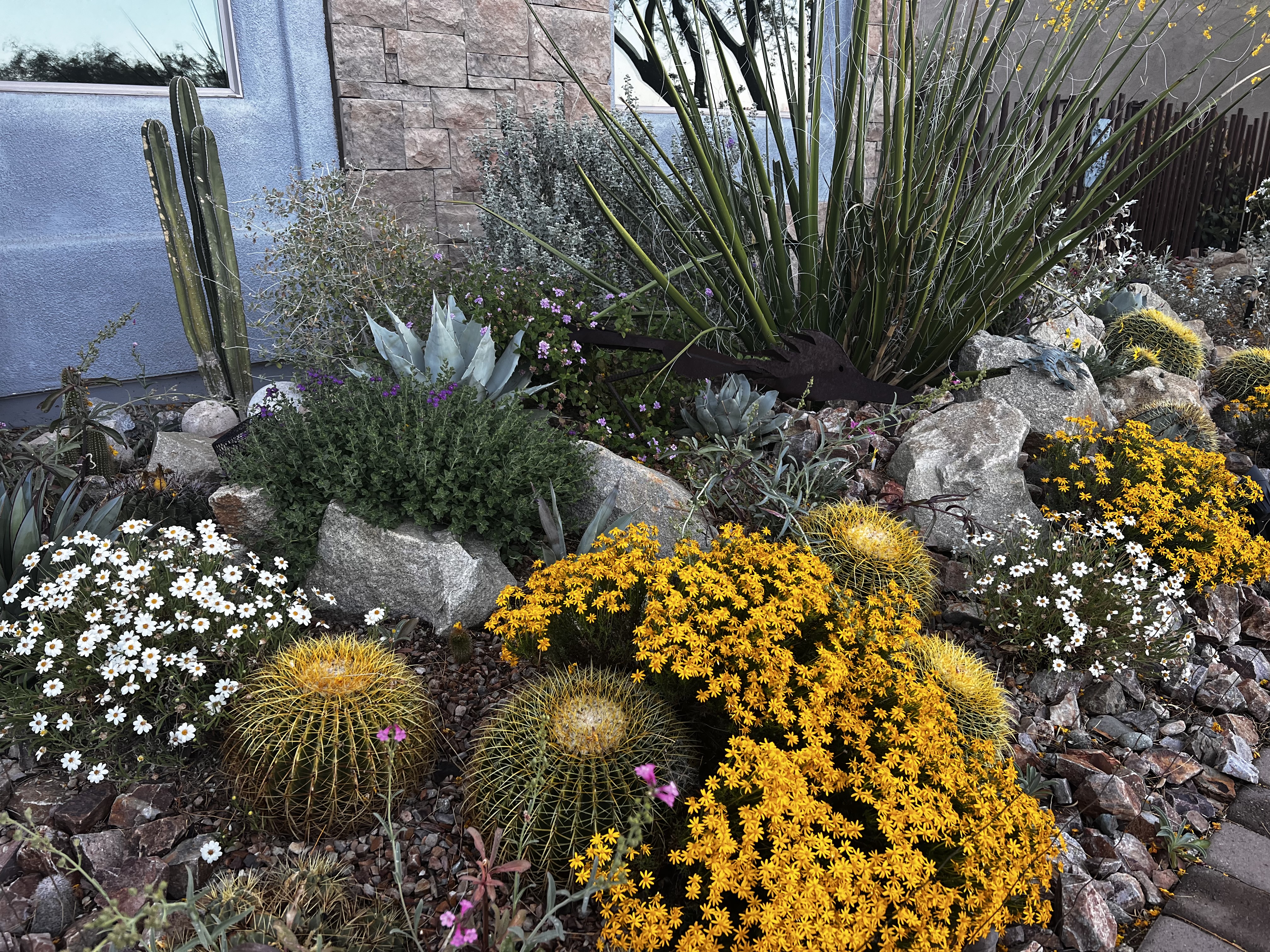
In my limited space areas damianita, Chrysactinia mexicana, is very much at home in fast draining desert soils. It is extremely tolerant of heat and drought. If I had one complaint is that the yellow color is just a shade too bright. It germinates quickly from seed but bringing it to even childhood even under controlled conditions is very challenging. The wiry roots are thin and easily damaged. I have had success with only one plant. It makes thousands of seeds but never produces seedlings naturally.
In truth I think I prefer the gently sprawling nature of the yellow evening primrose, Oenothera primiveris. It is planted along the edge of the walkway between two rosemary bushes.
evening primrose
The first of the prickly pear blooms are opening.
The barrel cactus make up for having the smallest of blooms by making a bold statement with their structure.
Flowers on the Blue barrel cactus, Ferocactus glaucescens
The blooms are barely noticeable on the golden barrels, Echinocactus grusonii, but they leave behind dry prickly pods with small black seeds. I don't know what the conditions are for seedlings to grow but I never find any. The quail are very good foragers.
Next time I'll introduce you to the saguaro. There is much of interest to share.