My Blog List

Showing posts with label bee balm. Show all posts

Thursday, June 17, 2021

OUR WILDFLOWER MEADOW

I don't even have enough time to deal with everything in my inside gardens and outside gardens without venturing onto the septic field. But about 4 years go I decided I really wanted to have that wildflower meadow I should have had 21 years ago. That was when I bought a Texas wildflower and grass meadow mix from Native American seed. It was to go in the tank when they sprayed the cover on the septic field. When I came over the next day there sat the 2 bags by the garage, unopened. There was nothing in their spray tank but left over Bermuda which is what began to take hold within weeks. We tried to get rid of it and then put down our seed but it was to no avail. Weeds came and in the end David just decided to mow. It looked fine. Still I had that hankering to have the meadow. Five years ago David began mowing and collecting, the idea being to reduce the fertility of the soil. No more mulch mowing. I scattered left over bluebonnet seeds from the garden as well as blanket flowers. 


Bluebonnets are now gone, but a year ago native bee balm, Monarda citriodora,  started to grow and has really increased in numbers this year. I am so happy to have the purple one because at the top of the lot, near the road there are some white ones. This is hands dwon my favorite after the bluebonnet whihc is good because they don't share the same season.

And they are not called bee balm for nothing.


While I control the pink evening primrose, Oenothera speciosa, in my inside gardens, I am more than happy for it to spread outside.

 And prairie verbena, Glandularia bipinnatifida,  is a welcome plant.

Coreopsis, Coreopsis tinctoria, has started to bloom. Small plants at the moment but I am hoping next year their see will spread just as it does along the roadsides.

And this rather unusual one has popped up.

Tall vervain

Surprisingly the blanket flowers, Gaillardia grandiflora,  struggle to survive as the they seem to be a favorite of the deer.

The first year we made a path alongside the septic field we had an amazing showing of Mexican hats, Ratibida columnifera. They were all different shades of yellow and brown. Some solid some mixed colors. Maybe the conditions were just perfect, never to be repeated. But one or two this year. All the yellow variety. 

Horse herb or straggler daisy, Calyptocarpus vialis, soveres much of the shady area of the field but is nmaking headroads into the center. Maybe due to long days of rain and cloud. I think it will go dormant now we are well into summer temperatures. 

And it is no surprise that our native lantana, Lantana urticoides. I will be watching out for the pink variety  Lantana camara, which is invasive. 

This year finds me very happy about how the wildflower meadow is coming along. And we haven't had to mow yet. That will be done in the fall.

Friday, May 15, 2020

FRIDAY FLOWERS

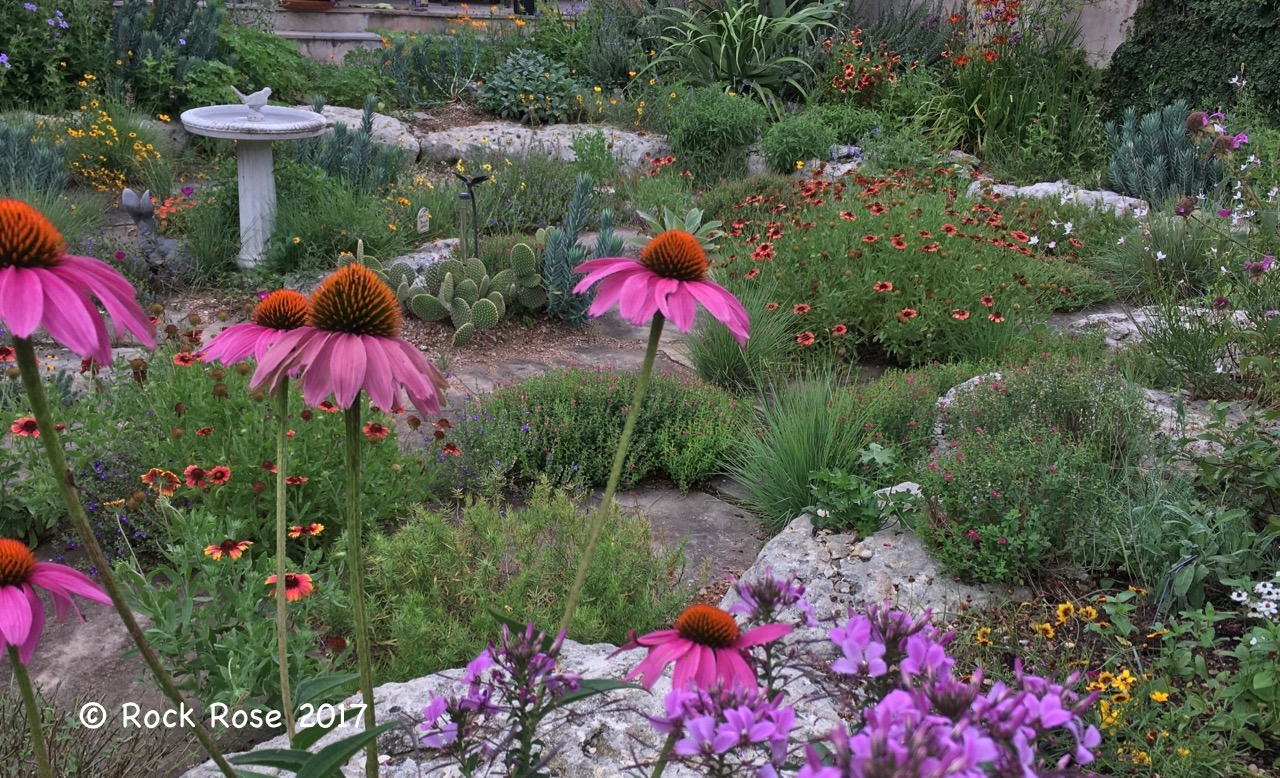
I never expected my sunken garden and its surrounds to be a wildflower meadow but it seems that is exactly what I have. Does that disappoint me? Not really although I would love the wildflower meadow to be outside the main garden. But I love the profusion of blooms that greets me every morning when I step outside the door. Each new flower aiming beat the heat and fulfill its destiny-seeds.


And those seeds, wherever they fall, will create next year's garden. The coneflowers, Echinacea purpurea, are beginning to bloom alongside the gaura, Gaura lindheimeri. I have two varieties one pink and one white which seed around the garden and once they start blooming they bloom all summer long. And hidden among them I see the new leaves of the Mexican Bird of Paradise. It will be many weeks before that plant begins to bloom.


I didn't pull out as many of the mulleins as I said I would but they will not be long in the garden as they will soon enter into their rather messy phase. How I wish we could get the perennial kind that I see in English gardens. This one is my favorite although it is taking up more than its share of the sunken area.


Blue flax, Linum lewisii, with it long arching branches.


And scarlet flax, Linum rubrum, native to North Africa but naturalized in the USA. Always there is a plan to have more but always just a few develop.


Seen here with coreopsis and California poppies.


I grew this achillea from seed 2 years ago. It was supposed to be a much darker color. Sometimes the seeds will surprise you.


And also this foxglove, Digitalis purpurea,  which has taken it three years to flower.


On a rather humid morning the chocolate flowers, Berlandiera lyrata, filled the air with its delicious fragrance. They can't help but draw attention to themselves.


Bee balm, Monarda 'Peter's Purple' enjoys far too much success in this garden to the point of crowding out other plants, including the iris it has surrounded.


And under the shade of the Yucca rostrata the shrimp plant, Justicia brandegeeana has been blooming for several months.


 And a surprise shrimp plant which suddenly appeared has been identified as the native Montell bractspike, Yeatesia platystegia,


And finally Brazilian verbena, Verbena bonariensis with prickly pear.


 I rely heavily on the sunken garden to seed itself so never know what will be growing there from year to year. Unfortunately last year I lost all but one pink skullcap and all the purple skullcap which had been a staple in this garden for nearly 15 years but gardeners learn to move on and like Wilkins Micawber I rely on the fact that "Something will turn up" and it usually does.
Have a great weekend.

Thursday, May 24, 2018

A GARDENER MUST DO THIS EVERY DAY

Every morning, before the heat of the day sets in, I take a stroll around the gardens. Most times I am carrying a cup of tea and not infrequently I put it down, pull out my phone and take a  photograph of a particularly pleasing view. Early morning is the best time which captures plants refreshed by cooler night temperatures.

View from the vegetable garden over the wall into the pool garden
The Monarda 'Peters Purple' and the tall spires of mullein, in the sunken garden, just looked perfect this morning.
I have no control over where the mullein place themselves. In fact I tried to transplant one this year and it didn't like the place I put it. But these just add a little drama to the back corner of the garden. Gone is the sadness of losing the Rosa Zepherine drouhin rose that once sprawled over the wall.


This spring we removed much of the planting along the back of the pool and replaced it with Mexican river rocks. I only left a few grasses and echinacea. On my morning walk I made a note that the wall looks a little stark. Maybe a taller grass behind the rock or maybe a mullein will plant itself there. I am definitely much happier to have the rock rather than the bare soil and I like the variety of colors in the rock.


Just a few more weeks to enjoy all 'this' in the herb garden. Soon it will be time to remove the parsley and cilantro gone to seed, and the seed heads of nigella.


And the Confederate rose agave clump, on the center pedestal, with the mother plant sending up a flower stalk. I will probably have to redo the whole pot because the mother plant is going to leave a big hole. Will the youngsters stay in there or will I have to make a completely new planting?


Two things took me by surprise in the herb garden. The flowering of the dill. Rather like parsley it makes a pretty umbel worthy of a place in any garden.


And an unusual variation in the color of Coreopsis tinctoria. Among all the yellows a beautiful burgundy. Now if that isn't a reason not to pull out all those seedlings. You never know which will be a surprise. I must remember to collect seeds.


I like this clump of self-sown echinacea in the English garden. If only it bloomed all summer!


But I need to remove this pink self sown lantana nearby. It just gets too big and requires too many cut backs during the summer.


This walk around the garden is not just a pleasure but an important part of noting changes you need to make. What works and what doesn't. Now on with the day's work


Friday, June 9, 2017

THE JUNE GARDEN

One thing that always surprises me, and more so this year because we had such an early spring, is how much is still blooming in the June garden. Our recents rains have probably helped extend the life of some plants, like the California poppies, which make a great companion for the Bee Balm, Peter's purple.


And when I thought the white one on the edge of the pool looked ready to pack it in for the year it decided to bloom again. Admittedly not quite as perfect and the flowers are smaller, but it still has a few days of bloom left before I cut it back.


This nameless day lily, a plant rescue, is the last of the day lilies to bloom. A parsley plant, going to seed, adds a fine backdrop.


The sunken garden is due for a big tidy, which involves cutting back the skullcaps, chocolate daisies, and blanket flowers to keep them blooming.


The same applies to the gaura which seems want to take over.


I have struggled to grow cleome in the past but this year seems to be the year for it to do well. I wish I had bought more than just the one.


I am thrilled with the hanging basket that I purchased this year. It was in a smaller basket and when the wind knocked to the ground breaking one of the plastic hangers, I was forced to repot it in a larger basket, in which I used baby diapers line the bottom! I pruned it back and it has now made up for lost time.
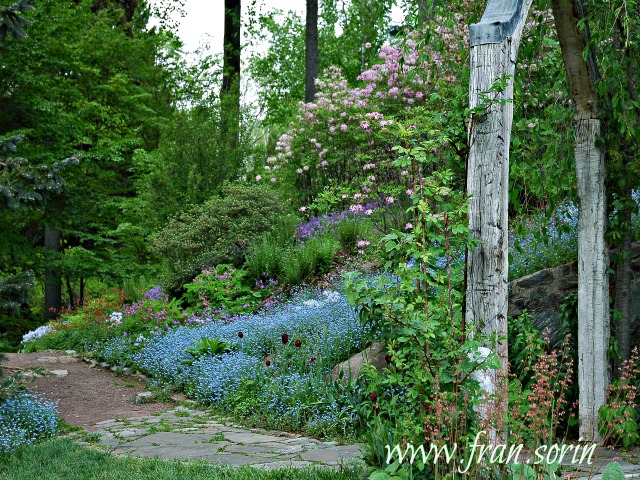

It hangs outside the kitchen window where I can admire it.


 In the front garden now that the spring bloomers have faded, there is just the odd pop of color from a flowering cactus.


Or the peach brugmansia which opened up a whole new display of flowers today.


What a show!


For a little respite from all this color I just have to take a walk outside the gate. There everything is green and serene.


Monday, May 15, 2017

GARDEN BLOGGERS' BLOOM DAY, MAY 2017

It has been a while since I posted on bloom day. Suddenly it was upon me and I had no time to gather the photos.

Surely the opening photograph for this month's Bloom day post has to be the Monarda 'Peter's Purple' He's certainly King of the garden at the moment.


And Queen of the May garden is the blanket flower, Gaillardia pulchella. Not so easy negotiating the pathways at the moment.


And we have a princess too,  Clematis texensis 'Princess Diana'. What a beauty she is. Just a few weeks ago there was no sign of growth and I was sure I had lost the plant over the winter. In less than a month she has grown to almost cover the trellis.


So many bloomers. The spineless prickly pear, with two different blooms on the same plant.


I wonder why that is?


And all the day lilies.


All but the tiny orange one without names.
Echinacea purpurea, just coming into bloom.


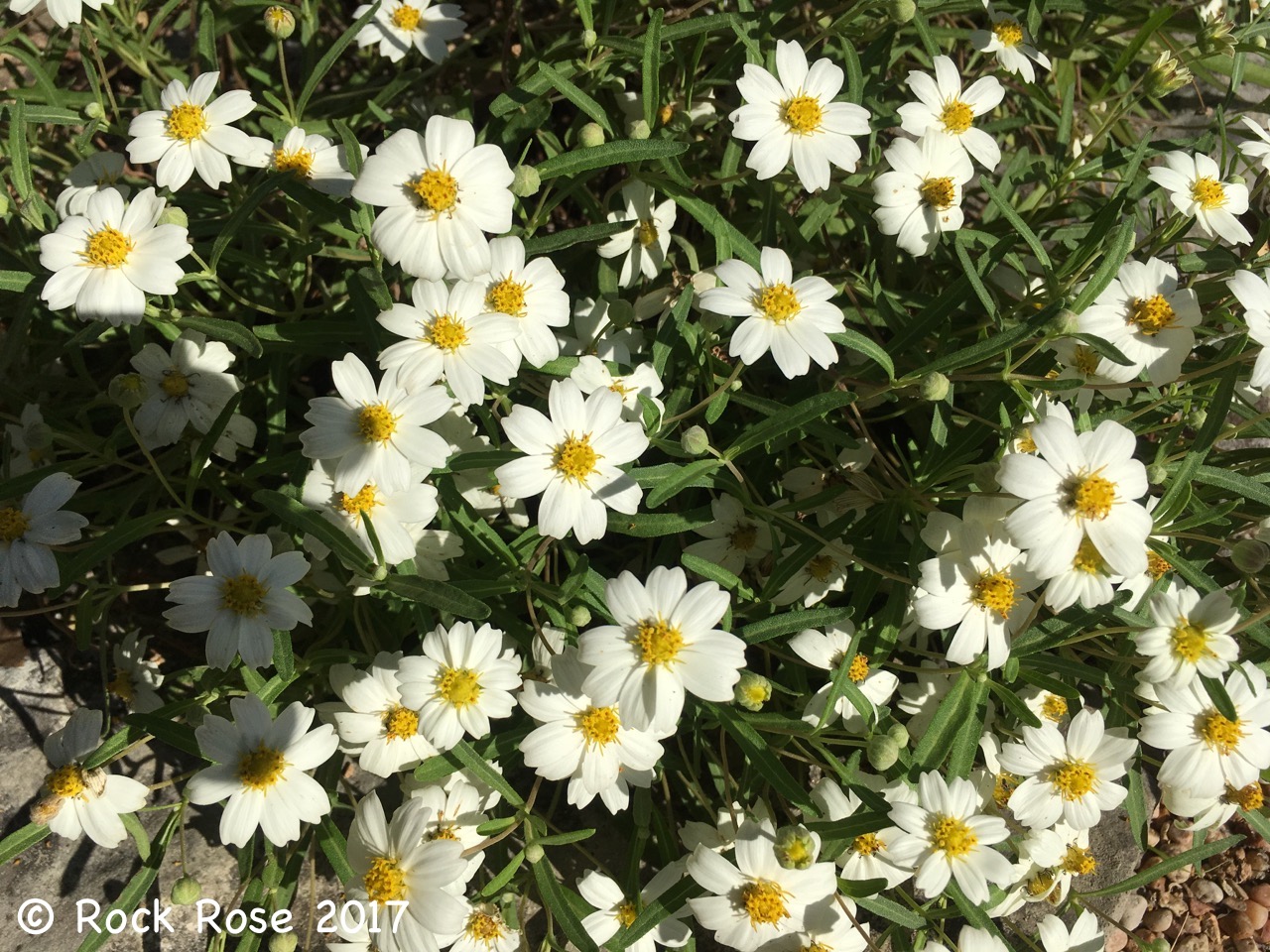
The larkspurs, love-in-a-mist and poppies have finished already but blackfoot daisies, Melampodium leucanthum,  still keep going.


Among the other natives, the purple skullcap, Scutellaria wrightii.


Which pairs well in a rock garden setting with the square bud primrose, Calylophus berlandieri, and pink skullcaps.


Square bud primrose with ruby crystal grasses

Pink skull cap seeded in the dry creek
Scabiosa back for the third year. A rescue plant.


And Texas betony, Stachys coccinea, not a showy plant but the hummingbirds love it.


Another native, horsemint, Monarda citriodora.


The native chocolate daisy, Berlandiera lyrata, with its delicious chocolate fragrance.


And for the first time in a while success with Cleome.


These are just a few of the flowers that are blooming in my rocky Texas garden in mid May.

Thank you Carol at Maydreams gardens for hosting Bloom day. Find out what is growing in other gardens this May Bloom Day.