It is often said that mother nature is no gardener but today I will sing her praises as I share with you some of the things she gets right. Just look how she planted this mullein , Verbascum thapsus, in my English garden. It's as though she thought the expanses of gravel needed just a little dressing up. How about a few bluebonnets sprinkled here and there and a grass or two. Isn't that better?
And another fine specimen at the bottom of the vegetable garden steps. What is not to love about those beautiful sage-colored velvety leaves.
I will admit that she tries to have me grow more than I actually need and I am choosy. They must meet a certain criteria if they are to stay, like a nice even rosette of leaves with few blemishes.
Mullein were introduced into he USA in the 1700s and are pretty widespread throughout the country. They also appear on the invasive list although I rarely see more than a few scattered around where I live. In the 80s we hiked with a Navaho guide into the ruins of Betatakin, and she told us that Native Americans used the leaves as baby diapers. In Texas it is known as cowboy toilet paper. As a biennial it reaches the rosette stage during the first year of its cycle and then sends up a tall flower stalk with pretty yellow flowers. Although, some time in Texas it achieves both stages within a year.
There is no better place to see her handiwork than in my sunken garden. Toadflax, Nuttallanthus texanus, is everywhere this year and one special clump has me won over that this is a worthwhile plant to have in the cottage garden, particularly if you can get it to seed en masse.
There are so many plants in this area that have self seeded, poppies, mealy blue sage, Brazos penstemon, columbine, grasses, skullcaps and even the delicious chocolate daisy. I never know from one year to the next what will be where, but rest assured, they will be there.
A visitor to the garden this past weekend commented to David, out of my earshot, that there didn't seem to be very many vegetables in my vegetable garden. I could have put him straight about the change-over season, when winter crops such as kale, cabbage, broccoli and peas reach the end their lives, to be replaced by the summer vegetables. So far I had only planted some tomatoes and peppers. But he did have a point as many of my beds are filled with those same poppies as grow in the sunken garden.
And then there are the cilantros and parsley plants which I allow to go to seed every year and repay me by filling in the beds with new plants each winter.
I rather like the way she planted the pink primrose at the corner of one of the vegetable beds. Most would rip this plant out immediately because it does have a tendency to spread everywhere. I'm that different kind of gardener.
and this blanket flower in the pathway between vegetable beds.
In the front courtyard I will have to take some action against the numbers of liatris that are showing up everywhere. I tried to gather the seed in the fall but much escaped and is now seeding heavily in the gravel. Most of them will be removed but this is one of the lucky ones which, in a previous year, found a permanent home.
But I am truly excited to see many seedlings of this little plant, Colorado Venus' Looking Glass, Triodanis coloradoënsis. Two years ago the flower showed up in a hole in a rock I had brought in from another area of the lot, and is now starting to spread itself around the garden. It is a member of the bluebell family and endemic to the Hill Country fo Central Texas. A delicate little beauty which I am sure to blog about when it starts blooming in a few weeks. A perfect little rock garden plant.
All thanks to Mother Nature.
Showing posts with label liatris. Show all posts
Saturday, April 13, 2019
Sunday, September 9, 2018
RAIN, RAIN AND EVEN MORE RAIN
The problem with rain in Texas is that more often than not it doesn't know when to start, and then often when it does it doesn't know when to stop.
After an endlessly hot, dry summer, and very little in the way of rain since May 4th, it began to rain this past week. The result of a slow moving frontal boundary sitting right on top of south central Texas. First ½" in the rain gauge. That's not enough we shout, so a little more, up to 1"now, then 2½" and now it just won't stop. It has been raining throughout the night and coming down at a pretty constant pace. It has brought some good things with it of course. The oxblood lilies, Rhodophiala bifida, were the first arrivals pushing their naked heads up through the soil.
Along with the native white rain lilies, Cooperia pedunculata. As hard as I try I can never get them to form a clump like the hybrid variety, despite collecting their seeds and planting together. When you see them blooming along the roadsides they are similarly spaced out instead of clumping. They just seem to pop up in all the unexpected places, especially the pathways of my vegetable garden.
Almost overnight the gayfeather Liatris spicata, began to bloom.
In profusion but not as profusely as in prior years. Usually the flowers develop all the way down the stem but lack fo rainfall seems to have reduced the numbers of flowers.
They are a rather weedy plant, their seeds popping up everywhere. They form a large bulb which is easily dug up in the winter and relocated. This year I have a clump flowering in the granite area out front but others planted in the rocky hillside have failed to produce any flowers. So far no deer have munched the flower heads.
What color goes well with purple? For me it has to be the yellow of the Lindheimer senna, Senna lindheimeriana. Their favorite spot is in the wet weather creek.
But also out in the granite areas. I am spreading their seed onto the hillside which we cleared this spring. This plant is just too easy to grow. It seeds itself, it stays green through the heat and drought and no bugs eat it. And no deer browsing either.
I hope the water lilies are enjoying the day.
There is no outside gardening to be done today, just inside seed cleaning in preparation for the fall planting.
Thank you Laura of Wills Family Acres for the seeds of native Eryngo, Eryngium leavenworhtii. I shall be planting them directly in the ground as they need winter cooling.
and rudbeckia from my own garden.
Will they be the same as the ones that showed up this past year? I hope so.
The rain is a blessing and will make fall planting a lot easier but I think I would like a break now.
After an endlessly hot, dry summer, and very little in the way of rain since May 4th, it began to rain this past week. The result of a slow moving frontal boundary sitting right on top of south central Texas. First ½" in the rain gauge. That's not enough we shout, so a little more, up to 1"now, then 2½" and now it just won't stop. It has been raining throughout the night and coming down at a pretty constant pace. It has brought some good things with it of course. The oxblood lilies, Rhodophiala bifida, were the first arrivals pushing their naked heads up through the soil.
Along with the native white rain lilies, Cooperia pedunculata. As hard as I try I can never get them to form a clump like the hybrid variety, despite collecting their seeds and planting together. When you see them blooming along the roadsides they are similarly spaced out instead of clumping. They just seem to pop up in all the unexpected places, especially the pathways of my vegetable garden.
Almost overnight the gayfeather Liatris spicata, began to bloom.
In profusion but not as profusely as in prior years. Usually the flowers develop all the way down the stem but lack fo rainfall seems to have reduced the numbers of flowers.
They are a rather weedy plant, their seeds popping up everywhere. They form a large bulb which is easily dug up in the winter and relocated. This year I have a clump flowering in the granite area out front but others planted in the rocky hillside have failed to produce any flowers. So far no deer have munched the flower heads.
What color goes well with purple? For me it has to be the yellow of the Lindheimer senna, Senna lindheimeriana. Their favorite spot is in the wet weather creek.
But also out in the granite areas. I am spreading their seed onto the hillside which we cleared this spring. This plant is just too easy to grow. It seeds itself, it stays green through the heat and drought and no bugs eat it. And no deer browsing either.
I hope the water lilies are enjoying the day.
There is no outside gardening to be done today, just inside seed cleaning in preparation for the fall planting.
Thank you Laura of Wills Family Acres for the seeds of native Eryngo, Eryngium leavenworhtii. I shall be planting them directly in the ground as they need winter cooling.
and rudbeckia from my own garden.
Will they be the same as the ones that showed up this past year? I hope so.
The rain is a blessing and will make fall planting a lot easier but I think I would like a break now.
Labels:
liatris,
Lindheimer senna,
Rudbeckia hirta,
Water lily
Saturday, June 16, 2018
THERE'S A DRAGON IN THE GARDEN
There's a dragon in the garden and he's breathing his fiery breath over my plants.
The dragon was a chance find at an estate sale and as things are at the moment I thought he deserved a place over here.
Can it just be a 6 weeks ago that I was lamenting that 3" downpour on the day of the Fling visit to my garden. Since then we have been completely dry. While other gardeners were recently blessed with another 3" downpour, the storm passed to the north and left nothing here. My stock tanks are empty. This summer is wearing thin-wait a minute it isn't even summer yet. High nineties have been the order of the day for weeks now with a few 100s thrown in. The second flush of flowers, Monarda, Echinacea, Rudbeckia, day lilies have all had a pitifully short season this year. I'm sure I am partly to blame because the soil is poor and drip irrigation has minimal impact when it is so dry.
Who needs flowers anyway? Rocks look pretty good.
and there are plenty of the tough green plants.
The Liatris doesn't seem to need any additional water. In some places it is growing out of the rocks. It is growing everywhere in the front courtyard, having seeded freely, and will bloom with incredible purple spires in the fall........or will that be sooner this year.
Everything has gone quiet in the front courtyard. But that's OK. Less work for me.
Thank goodness for some very tough plants out in the front. These are the plants that manage without additional water although they may not look their absolute best.
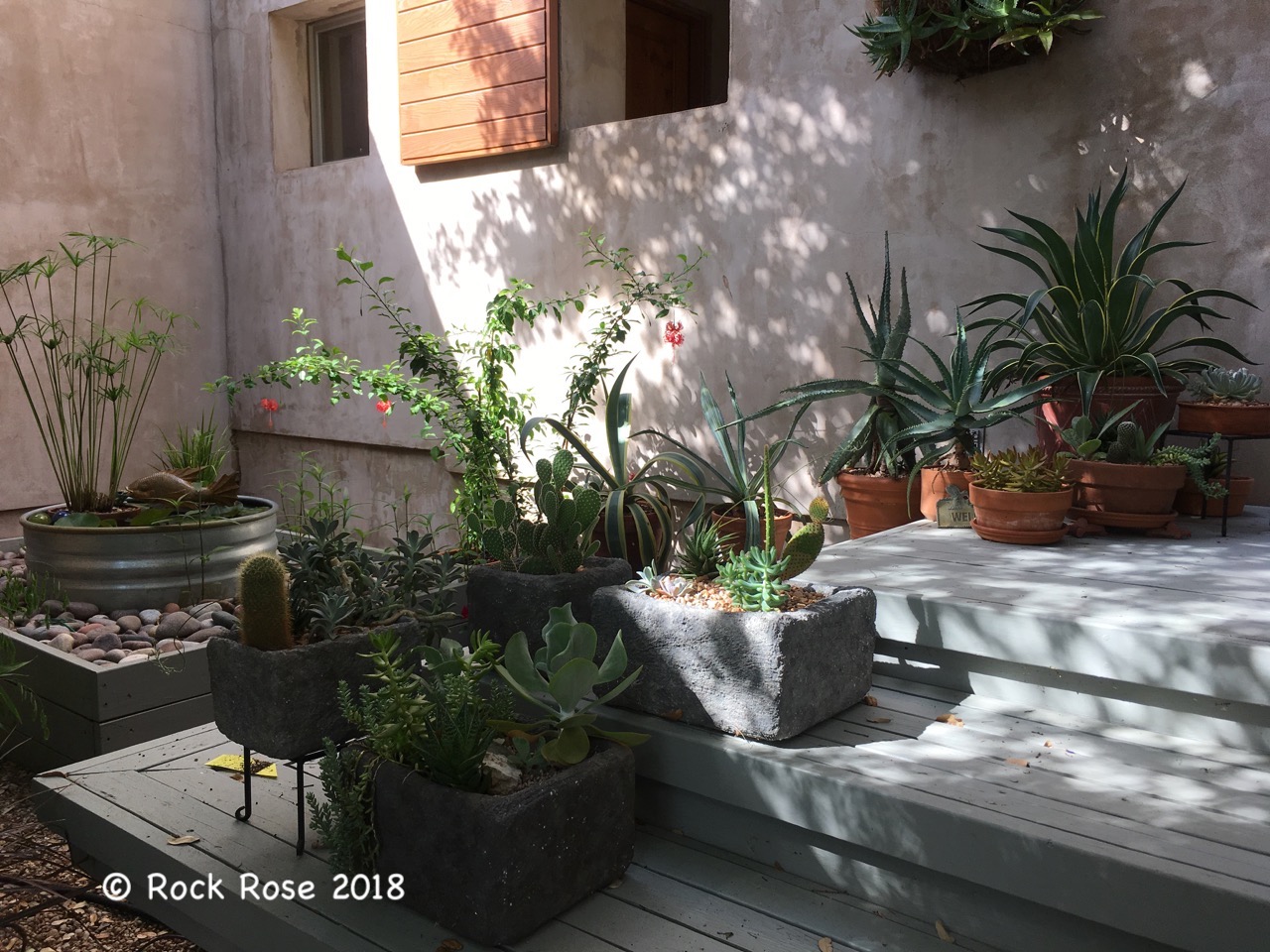
And I have moved a few plants into the only shade I have in the side entry courtyard. Even cactus and succulents need a break and I shall be ready for one myself soon.
I have added a battery powered drip irrigation system in here for the summer to water a few plants that need a daily water when I can't be there to do it.
Including the asparagus fern by the garage door. Even the fish have moved into the shade.
There is rain in the forecast for this next week but then we know how that goes.
![]() |
Can it just be a 6 weeks ago that I was lamenting that 3" downpour on the day of the Fling visit to my garden. Since then we have been completely dry. While other gardeners were recently blessed with another 3" downpour, the storm passed to the north and left nothing here. My stock tanks are empty. This summer is wearing thin-wait a minute it isn't even summer yet. High nineties have been the order of the day for weeks now with a few 100s thrown in. The second flush of flowers, Monarda, Echinacea, Rudbeckia, day lilies have all had a pitifully short season this year. I'm sure I am partly to blame because the soil is poor and drip irrigation has minimal impact when it is so dry.
Who needs flowers anyway? Rocks look pretty good.
and there are plenty of the tough green plants.
The Liatris doesn't seem to need any additional water. In some places it is growing out of the rocks. It is growing everywhere in the front courtyard, having seeded freely, and will bloom with incredible purple spires in the fall........or will that be sooner this year.
Everything has gone quiet in the front courtyard. But that's OK. Less work for me.
Thank goodness for some very tough plants out in the front. These are the plants that manage without additional water although they may not look their absolute best.
And I have moved a few plants into the only shade I have in the side entry courtyard. Even cactus and succulents need a break and I shall be ready for one myself soon.
I have added a battery powered drip irrigation system in here for the summer to water a few plants that need a daily water when I can't be there to do it.
Including the asparagus fern by the garage door. Even the fish have moved into the shade.
There is rain in the forecast for this next week but then we know how that goes.
Sunday, September 17, 2017
THE SEPTEMBER GARDEN
When hurricane Harvey slammed into the Texas coast, 200 miles away, it brought some much needed rain to Central Texas. Along with that we saw a significant drop in daytime temperatures but more importantly night time temperatures in the low 60s. Warm days and cool nights. For a few days it was like being in California. The plants showed an immediate response; the sickly yellow leaves greened up and the flowers colors brightened. It was glorious but not to last. Still, for those brief few days I enjoyed every moment in the garden.
Sometimes I think fall is better than spring. Everything in the garden has become more blousy. There is barely a scrap of earth or gravel to be seen.
I never know from one year to the next how this will look or which flowers will be present-except there will always be plenty of rock roses.
The Salvia leucantha I have been planning to move for years is still there. The hummingbirds are very adept at flying in through the window in the high wall that separates the gardens.
A week ago there was but one bloom on the butterfly pea, Clitoria ternatea. Now there are many. The blackfoot daisy, Melampodium leucanthum, continues to spread across the step.
Ruby crystal grass, Melinis nerviglumis, is flowering. There will be plenty of those again next year.
Globe amaranth, Gomphrena haggeana, 'Strawberry fields' is everywhere.
As are the purple and pink varieties growing in the pathway of the vegetable garden.
The spider zinnia will eventually be evicted from its home in the vegetable bed but I will save the seeds for next year.
In the sunken garden it grew where the white California poppy once grew.
In the sunken garden there are gomhrena, pink and purple skullcaps, aura, mealy blue sage, white Salvia greggii, and an errant member of the cucumber family which came in on the compost.
As well as zexmenia, Wedelia texana, chocolate daisy, Berlandiera lyrata, and returning alyssum.
But the absolute show stoppers of the moment are the liatris in the front courtyard. Purple is definitely the color of the moment.
Last year I removed many of the bulbs and planted them outside the walls. It seems that every seed germinates but they are silent all summer until their bloom time in the fall.
Phlox paniculata John Fanick, After the first flowering I pruned it back and here it is again. Smells wonderful.
Trailing Snapdragon vine, Asarina procumbens is a native of Mexico but seems to do well here as an annual.
Tradescantia sillamontana with its cobweb leaves and pretty pink flowers, easily grown from cuttings.
In the spring I bought a hanging basket because it looked simply gorgeous. I repotted it into a larger basket with baby diapers in the bottom. It was an impulse buy. It has been watered all summer on a drip system twice a day, and received an occasional fertilize. I have cut it back completely about 3 times. It took a beating on one side during the hurricane but is recovering.
The mandevilla vine is into its second year. I cut it down and put it in the potting shed last winter. It dried out and went dormant but started to come back after a good spring soaking. I will try to keep it for another year.
It is wonderful to see so much color back in the garden and there is still the Philippine violet yet to bloom. Soon it will be fall and these icky-sticky days will be a thing of the past!
Sometimes I think fall is better than spring. Everything in the garden has become more blousy. There is barely a scrap of earth or gravel to be seen.
I never know from one year to the next how this will look or which flowers will be present-except there will always be plenty of rock roses.
The Salvia leucantha I have been planning to move for years is still there. The hummingbirds are very adept at flying in through the window in the high wall that separates the gardens.
A week ago there was but one bloom on the butterfly pea, Clitoria ternatea. Now there are many. The blackfoot daisy, Melampodium leucanthum, continues to spread across the step.
Ruby crystal grass, Melinis nerviglumis, is flowering. There will be plenty of those again next year.
Globe amaranth, Gomphrena haggeana, 'Strawberry fields' is everywhere.
As are the purple and pink varieties growing in the pathway of the vegetable garden.
The spider zinnia will eventually be evicted from its home in the vegetable bed but I will save the seeds for next year.
In the sunken garden it grew where the white California poppy once grew.
In the sunken garden there are gomhrena, pink and purple skullcaps, aura, mealy blue sage, white Salvia greggii, and an errant member of the cucumber family which came in on the compost.
As well as zexmenia, Wedelia texana, chocolate daisy, Berlandiera lyrata, and returning alyssum.
But the absolute show stoppers of the moment are the liatris in the front courtyard. Purple is definitely the color of the moment.
Last year I removed many of the bulbs and planted them outside the walls. It seems that every seed germinates but they are silent all summer until their bloom time in the fall.
Phlox paniculata John Fanick, After the first flowering I pruned it back and here it is again. Smells wonderful.
Trailing Snapdragon vine, Asarina procumbens is a native of Mexico but seems to do well here as an annual.
Tradescantia sillamontana with its cobweb leaves and pretty pink flowers, easily grown from cuttings.
In the spring I bought a hanging basket because it looked simply gorgeous. I repotted it into a larger basket with baby diapers in the bottom. It was an impulse buy. It has been watered all summer on a drip system twice a day, and received an occasional fertilize. I have cut it back completely about 3 times. It took a beating on one side during the hurricane but is recovering.
The mandevilla vine is into its second year. I cut it down and put it in the potting shed last winter. It dried out and went dormant but started to come back after a good spring soaking. I will try to keep it for another year.
It is wonderful to see so much color back in the garden and there is still the Philippine violet yet to bloom. Soon it will be fall and these icky-sticky days will be a thing of the past!
Subscribe to:
Posts (Atom)