My Blog List

Showing posts with label California poppies. Show all posts

Wednesday, March 18, 2026

WHAT WINTER!

 Talk to a snowbird and they will tell you " We can't believe the weather. It has been so wonderful" Talk to a gardener and he or she may have a different story. Yes! we have had endless sunny days with short bouts of rain.  But this is January, February and March. This is when we enjoy some cooler days in the 60s. Not this year. Early on in the month we had two spells in the 80s and last week 90. The promise of a fabulous wildflower season faded along with the delicate blooms. Here are my pretty California poppies which I cast along the driveway. They came from a small packet of wildflower seeds I picked up at our local library seedbank. I had no idea what was in the packet so was delighted when these poppies grew. Their blooms are more delicate than those in the packets of seeds you can buy and only flower for a few days.

What does no winter do to our desert plants? The Texas olive did not lose its leaves and is already in full flower. The flowering spoilt only by leaves that were shredded by the hail event. I keep going around pulling off the old leaves. The only positive here is the reduction of the clean-up required when they all fall. Why did someone not tell me rocks were a problem under Texas Olives. 


A familiar waft of fragrance on the air in early February was the Texas Mountain laurel. With such a mild fall and winter an influx of the Genista moth caterpillars, which resulted in all the new growth being decimated means very few flowers. The trees themselves look very ratty and I am pondering whether to remove one of the 4 trees I have. The problem is they form a screen from next doors driveway. It almost seems like sacrilege to pull out such a  large tree (I saw one in a large pot at the nursery and it was $385) but it wouldn't be the first. I believe the prior occupants grew them as bushes which their landscapers regularly pruned so they never saw any blooms.  


Just a waft of fragrance is a positive this year because it won't  be competing with the fragrance on the pink jasmine, Jasminum polyanthum , which I much prefer. Their petals fade very quickly when the temperatures are in the high 80s so I don't expect its bloom to last much longer. When I open the patio doors in the guest bedroom the fragrance fills the whole house. 


And what is going on with the Photinia fraseri x 'Red Robin' The rapid unchecked growth of the new stems is a sure sign that it is far too comfortable. I have 3 of these plants that remain in a clump in the front garden. While this plant is not suitable for all climates and soils it seems to do very well inthe desert. No bugs or diseases as yet. I do have to cut it back every year or it will reach over 8" without a trim. One in the back garden I have trained into multi tree-form. There wasn't one perfect trunk for this experiment so I have allowed 3 to grow. 


Bougainvillea has always entered a  dormant period in prior years losing all its leaves. Not his year. It took a beating from the hail but promptly put out new growth and is now flowering. And this was the year I was going to get in there and give it some training to improve its structure. I really would like it to grow against the wall.


The pomegranate tree, Punica granatum, only lost a few of its leaves and quickly added more and even a few pomegranate flowers. I shall be eagerly watching to see which are male flowers and which are female (hermaphrodite). Most of the flowers were males last year so we only harvested 3 good pomegranates. Maybe year 4 will prove to be a bonus year with more females. It is easy to spot the difference as the females have a more bulls base and the males smaller. Male flowers tend to drop off fairly quickly. 


 The calamondin tree bloomed and set fruit all through the winter and is now putting on new growth but no new blooms. We had a nice crop of grapefruit and the tree is putting out new growth but no blooms. This Oro Blanco variety is one of the most sought-after of grapefruit varieties for its pale green, sweet flesh which lacks the sharp bitter taste of some grapefruit. It is a cross between a pommelo and white grapefruit and therefore has a thick skin. The lack of flowers may be caused by too much fertilizer or too much water. 


The Philippine violet, Barleria cristata, has not entered dormancy and still has all its leaves. I even noticed a small purple bud at the end of one branch. Planted in a rather shady spot underneath a Texas Mountain Laurel it is reaching across the fence to which I have tied it. I believe I was successful in striking a cutting in the fall which I will plant in a more favorable position. 


The Anacacho orchid tree, Anacacho lunarioides,  bloomed on the top branches several weeks ago and now the lower branches. It looks rather strange with the green spiky seed pods on the top. It is my "apple tree blossom" of the desert. 


Who knows what the year will hold in store. This week the temperatures will hit 105 before settling back down into the 80s. But the heat will have done its damage frying delicate spring blooms. It is far too early to be having summer. I fear the saguaro will not flower this year. We shall have to wait and see.


Tuesday, April 23, 2019

WHO IS ON THE STAGE THIS WEEK

The most dominant flowers of the last 4 weeks have been the bluebonnets, columbines and Indian paintbrush. They are now busy setting seed for next year while a whole new range of plants take over, primarily the yellows. Our roadsides are quite stunning with their yellow composites mixed in with blanket flowers.

My garden is not so shabby either.

Square bud primrose, Calylophus barlandieri, nestled in among rocks and gravel.


Engelmann's daisy, Engelmannia peristenia. I remember when I bought this at the Wildflower Center sale some years ago someone said they would be everywhere, and they are.


But so far, only in the from Courtyard garden where I pull those that are in the wrong places. I am hoping to get them to move outside the walls at the front. The question is always, will I be around at seed collection time.


Four nerve daisy, Tetraneuris scaposa,


Damianita, Chrysactinia mexicana.


Threadleaf coreopsis, Coreopsis verticillata, swaying around on two foot high thin stems.


And California poppy, Eschscholzia californica, a vigorous self seeder.


These are all native to Texas but there are a few more yellows enjoying the stage. The native Coreopsis tinctoria is a few weeks away from flowering but other tall and short coreopsis are flowering.


And the silver leaf gazania, Gazania tomentosa, perfectly at home in a bed of gravel.


And in the English Garden the many petaled, fragrant  Rosa 'Molineux' named by David Austin for the football stadium of his favorite soccer team, Wolverhampton Wanderers.


And finally the large yellow named bearded iris which is a favorite because blooms after my other iris have finished blooming.


Will the yellow flowers please take a bow.

Saturday, March 23, 2019

ITS ALWAYS ABOUT NEXT YEAR

I can't tell you how many times I have said "Next Year" It is the nature of gardening that we are often looking to the next year. Just this morning I was saying those very words.


I love to grow things from seeds and those that can be sown directly in the ground are my favorite. Last fall I purchased a packet of California poppy seeds. Not that I need any more of those self- seeding orange poppies. But this packet was different. California poppy,  Eschscholzia caespitosa dwarf Sometimes called the Tufted poppy or Foothill poppy it is native to the Chaparral community of plants from Oregon through California to Baja California.


Always on the lookout for dwarf plants for my rock gardens I thought I would give them a try.  I noticed some rather spindly looking shoots some weeks ago doubting that they would amount to much. We have been so dry that I decided they were not doing well because of the lack of rain, so I watered them. They responded by growing and flowering in the space of two weeks with lovely bright yellow blooms. They are only 6" tall, perfect for a spot between the rocks. I wish now I had sowed the whole packet instead of putting a few seeds in 3 areas. A big Next Year for these little poppies.

Sometimes illustrations on seed packets disappoint, but not this one.


Alas, another packet of seeds disappointed me this year. Double Click Blend, Cosmos. I grew these same flowers last year and they had gorgeous, frilly blooms. This year among the 20 seeds in the packet not one of them is frilled. In fact several are plain run-of-the-mill cosmos. It is too late for me to grow them again this year so it will be another case of hoping for better luck Next Year.

We spent the morning moving the citrus into position in the potager and the plants that are staged at the ziggurat steps. Or rather I directed as David did the lifting, carrying and placing. Those citrus pots are heavy and some of the other plants are vicious, particularly Aloe marlothii. Honestly, I felt terribly guilty asking him to do a job that someone of our age shouldn't be doing. I made him a promise that he will never have to move the Aloe marlothii again. It will either survive or die in that spot. I don't think it is ever going to reach its full potential which is to flower with gorgeous orange blooms. Possibly because it spends the winter in the garage which is not  place to induce winter blooming.


Always an unplanned combination of plants is likely to bring a Next Year moment, but how often is it repeated? And what of those beautiful red flax flowers. Last year I said more Next Year and I have exactly 2 clumps of them. The seed packets sitting idle in the laundry room. But once again I can say Next Year and hope it will be. The years are slipping away!
Our septic filed is another Next Year dream. For years I tried to grow wildflowers but none ever came. In an attempt to reduce the fertility of the soil we started gathering the grass when mowing and directed our sprinkler heads into the wooded area. And after 2 years it seems to be working. There are many clumps of bluebonnets several blanket flowers and I can just visualize that Next Year it will be a wildflower meadow, and if not next year then the next year.

Friday, June 9, 2017

THE JUNE GARDEN

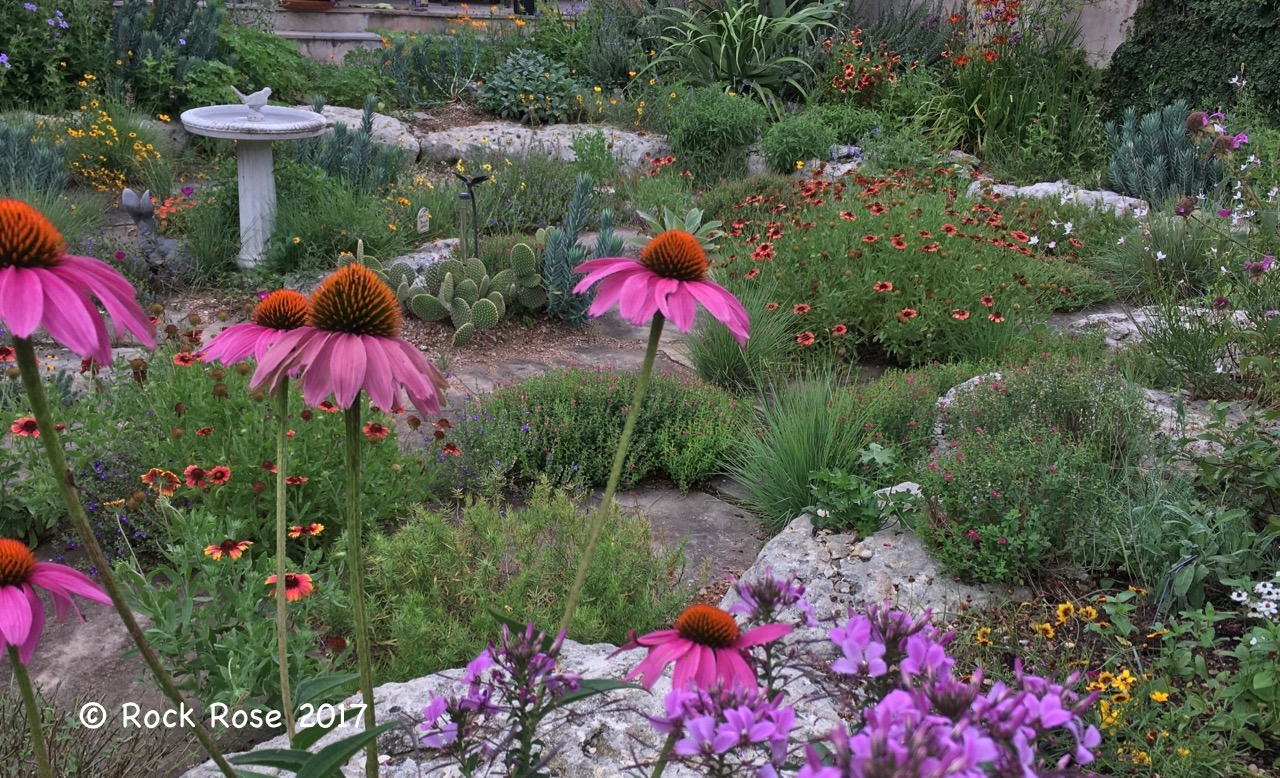
One thing that always surprises me, and more so this year because we had such an early spring, is how much is still blooming in the June garden. Our recents rains have probably helped extend the life of some plants, like the California poppies, which make a great companion for the Bee Balm, Peter's purple.


And when I thought the white one on the edge of the pool looked ready to pack it in for the year it decided to bloom again. Admittedly not quite as perfect and the flowers are smaller, but it still has a few days of bloom left before I cut it back.


This nameless day lily, a plant rescue, is the last of the day lilies to bloom. A parsley plant, going to seed, adds a fine backdrop.


The sunken garden is due for a big tidy, which involves cutting back the skullcaps, chocolate daisies, and blanket flowers to keep them blooming.


The same applies to the gaura which seems want to take over.


I have struggled to grow cleome in the past but this year seems to be the year for it to do well. I wish I had bought more than just the one.


I am thrilled with the hanging basket that I purchased this year. It was in a smaller basket and when the wind knocked to the ground breaking one of the plastic hangers, I was forced to repot it in a larger basket, in which I used baby diapers line the bottom! I pruned it back and it has now made up for lost time.


It hangs outside the kitchen window where I can admire it.


 In the front garden now that the spring bloomers have faded, there is just the odd pop of color from a flowering cactus.


Or the peach brugmansia which opened up a whole new display of flowers today.


What a show!


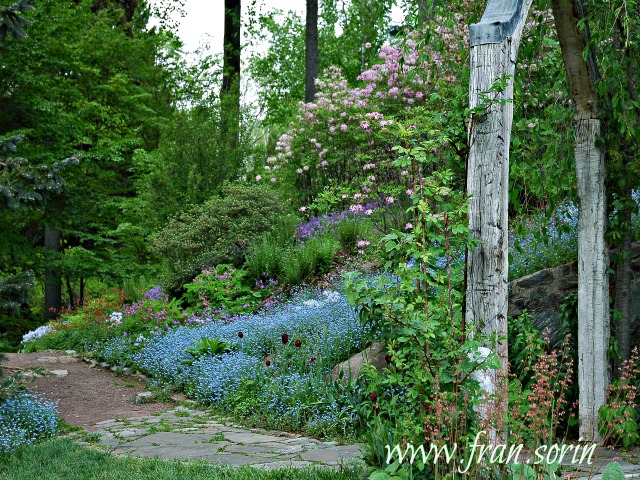
For a little respite from all this color I just have to take a walk outside the gate. There everything is green and serene.


Saturday, April 1, 2017

A POPPYLICIOUS MOMENT

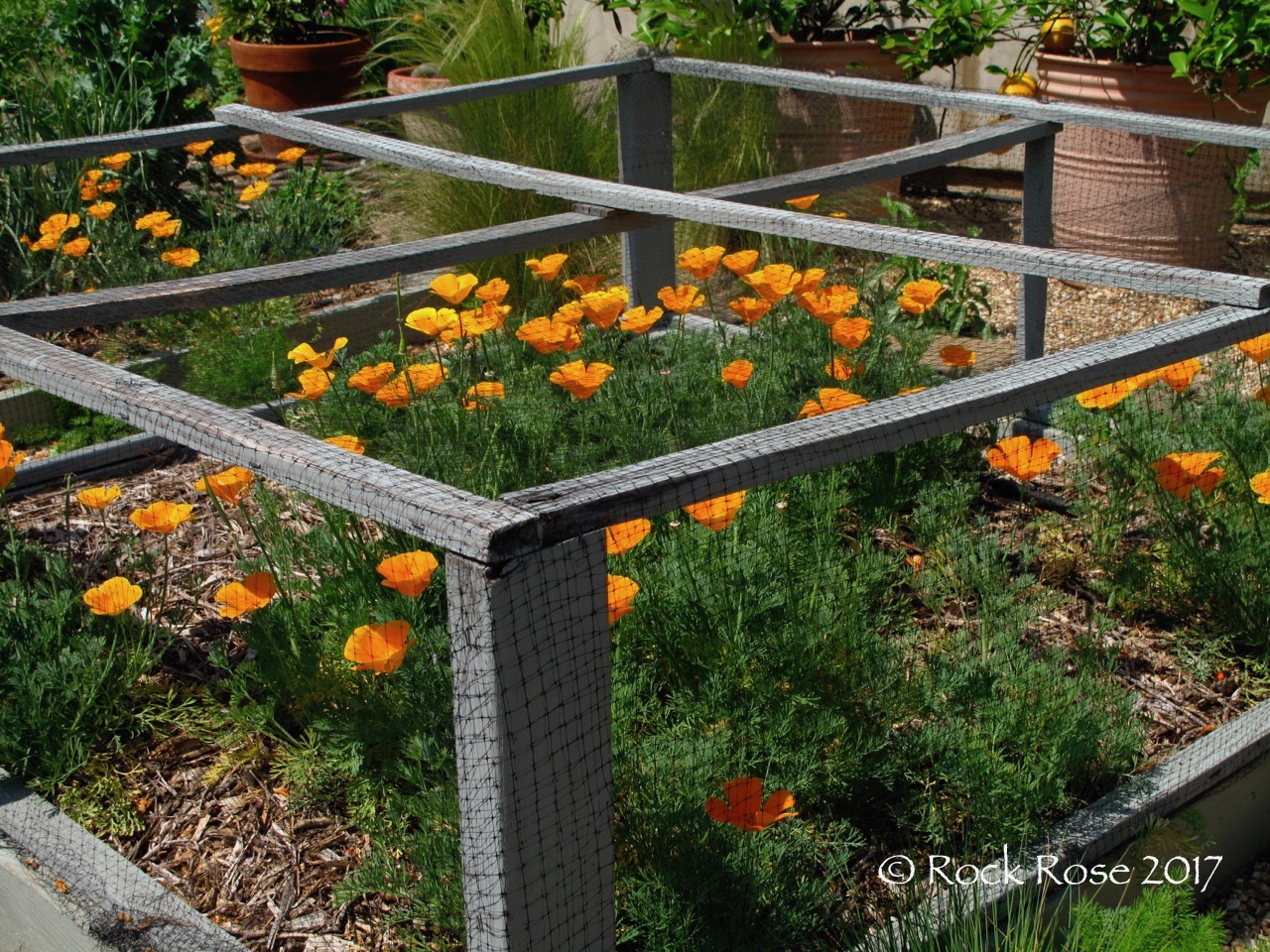
California is not alone in its display of poppies. Look at this clump of California poppies, Eschscholtzia californica, growing in the upper level of my sunken garden. It is probably a seedling of the variety 'white linen' which I purchased many years ago. It still pops up occasionally.


Last year there was a small clump of white poppies in the corner, this year there are even more. It wouldn't be fair to say that I like the white one better than the orange one, but the fact is the orange one seeds with abandon, the white one rarely.
Here they re growing in a fallow bed in the vegetable garden. I shall need that bed soon to plant beans.


But there are plenty more growing in other places, which if I leave, will be enough to insure a fresh crop next year. It will just be a matter of trying to collect the seeds before the seed capsules open.


If you haven't realized already I am very tolerant of plants seeding themselves. So there are always plenty of corn poppies, Papaver rhoeas,  flowering in competition with the California poppies.


And more intruders in the vegetable garden.


But where are the Lauren's Grape poppy I seeded this year. I have tried to grow that variety several times and have always failed.

Sunday, March 19, 2017

THE GREENING OF THE SUNKEN GARDEN

David commented on a marked change in the sunken garden following rain and warm temperatures. If I don't get around to doing some culling we won't even know the sunken garden is there. But what would I do without all my little self seeders.


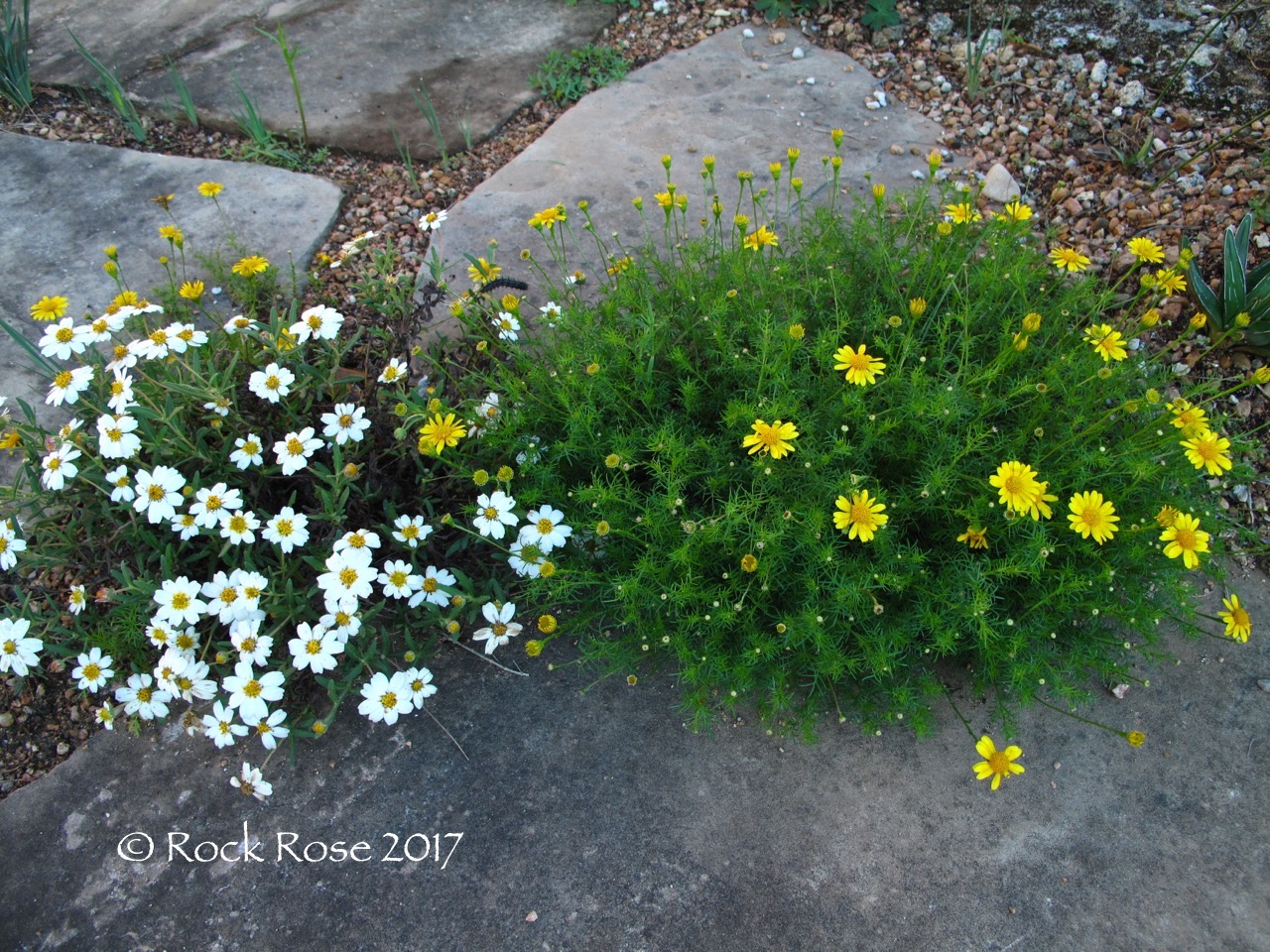
The blackfoot daisies,  Melampodium leucanthum, and the dahlberg daisies, Thymophylla tenuiloba.


The Indian blanket flowers, Gaillardia pulchella,   and the sedum, Sedum potosinum.


the gopher plant, Euphorbia rigida. I didn't really want it down below in the sunken area but here it will stay.


The blue eyed grass, Sisyrinchium angustifolium.


The chocolate daisy, Berlandiera lyrata. This one has been here for years enjoying a cool root run under the sandstone pavers.


The California poppies. I am so glad this white one is back again this year. Eschscholzia californica.


But there are plenty of orange ones too.


And the first of the corn poppies, Papaver rhoeas.


There are a few seeders who can be a little annoying. The false garlic, Nothoscordum bivalve, with the white flowers and yellow centers and wild onion, Allium canadense, with pale purple flowers. Both are pretty but are the devil at seeding themselves and once the bulb forms they are not so easy to root out as the bulb works its way deep into the soil. This year I struck a deal with them. They can flower but they can't set seed!


We may not be able to grow those lovely pom-pom alliums but we have our own and I love the flowers.

Nothoscordum bivalve


Allium canadense
They make a pretty addition to a rock garden. All these plants seed freely in the sunken area of the garden. Because the specs between the pavers are less than 1" it would be difficult to plant without self sowing plants.