My Blog List

Showing posts with label barrel cactus. Show all posts

Saturday, August 23, 2025

THE SHROUDED GARDEN

 It's summer in the desert and that means intense heat and little in the way of gardening. Each morning, and I am usually up by 5:30am, I open the patio doors and step outside to sample the temperature. On a good morning the temperature will be around the 70 degree mark. Maybe a little lower and there will be a slight breeze. I must make the choice between going for a walk and doing some gardening. All must be done by 9am.We make the most of these early morning hours. 


I have come to love this time of day, whether doing a few chores outside, taking a walk or eating breakfast on the patio.


This is the first summer we have been here at this time so it is somewhat of a novelty. We should have left in mid June, with our trailer, to head up to the cool mountain air of Idaho. Unfortunately a routine breast MRI ( I have been having them every year since having cancer treatment in my right breast 5 years ago) detected something suspicious. It was a new cancer. I was once again on the roller coaster ride of multiple tests and there were more serious decisions to be made. I saw our summer travel plans fly out the window. When I met with the surgeon I was pretty sure that this time it would be a full mastectomy and all I could say was " How quickly can you do this?" And so mid June I had a mastectomy. I have recovered well and I think I was very lucky in that I had no pain and did not lose any arm movement at all and continued pretty much as normal. Except for not really being able to do any gardening or lifting anything over 5lb. Try and tell that to yourself when lifting doesn't elicit any pain. You may think that this was perfect timing to be mostly in doors. But we have had a very difficult winter with no winter rain. Couple that with a poor monsoon last year and some excessively hot days and things have not played out well in the garden and I was powerless to do anything. I am seeing more and more failure and am making plans for some changes as soon as fall arrives ( October at the earliest) We are praying for a summer monsoon to help out. 


No-one would doubt that this part of the Sonoran desert is not a beautiful place but if you were to look around and assess which plants are native and do well here without irrigation you would find a limited palate. Plenty of small trees, all with their small leaves ideally suited to desert heat, and they do put on a magnificent show in the spring, and a number of cactus including the saguaro, lots of fishhook barrel cactus, a sprinkling of echinocereus and small mammillaria, a few yuccas prickly pear, ocotillo and the very successful cholla. The mammillaria are quick to respond to a little sprinkle and lowering of temperatures. 


But few of the cactus you may come across at the local cactus nursery will you seen the wild desert landscape. And we certainly have plenty of the finest in the country. When I visit Bach's cactus nursery I ask them which cactus can survive everything that the desert has to throw at it. They show me a small table of plants both summer and winter hardy. That said there are some additional plants that do well here and add some variety to the home landscape particularly as many have a drip irrigation system. I can't say that I have ever seen this bunny ear cactus, Opuntia microdasys,  growing wild ( native to Northern Mexico) but it is beyond happy in the summer garden. Nor is it eaten by critters. It is best suited to an outdoor planting where the gardener can keep well away from it. I once walked out of my old greenhouse with a pot of this plant and the door swung to and the cactus promptly hit me in the face leaving behind thousands of tiny glochids. 

This euphorbia, Moroccan mound, Euphorbia resinefera, is also a success story. Slow growing but also unlikely to be eaten by critters. Not always easy to find at a reasonable price because it takes so long to grow to a decent size. 


One trick that the growers do is to put three smaller ones in a larger pot. When you come to plant they simply fall apart. The best way to overcome that is to dig the hole, cut the bottom out of the pot, slip the plant in and cut away the rest of the pot. You need a strong utility knife to cut through the plastic but this is the way  I have seen the landscapers plant their big pots and cactus in particular.  

When I began writing this in late June I had no idea if we would ever get away this summer. We did, making the journey up to the Wood River valley in Idaho where we were able to spend 4 lovely weeks on our favorite campsite. 


We hiked, 


visited museums, gardens, watched the birds ands animals visiting our campsite, enjoyed the summer symphony, the arts festival, farmers markets and I felt my former self coming back. On our last weekend I pushed myself up 1300' at 9000' on the Norton Lakes trail to Smokey Lake. Then it was time for the 3 day journey back to our own valley. 

But I dreaded what I would find when I got home. The hoped-for monsoon rains had been sparse and never in our area and they are so desperately needed-especially after the dry winter. I scouted the vegetation as we approached home and noticed the ocotillo were in full leaf. That was a good sign as ocotillo will drop their leaves in drought and as soon as it rains they will leaf out again, doing this multiple times in a year. There had been rain at our house because I could see flowers on the Texas sage had bloomed and withered. Those plants that had made it through dry June and July were springing back to life. I had lost several plants in pots........some had been eaten. There were plenty of holes at the base of plants where small desert critters had sought coolness. And now another rain this week has really brightened up the desert with trees and bushes coming to life. 

                                                         barrel cactus are blooming

Everything has taken a big drink. Will it be enough to see the desert through the rest of the summer remains to be seen. And there is still a lot of summer left. 

Saturday, April 26, 2025

YELLOW IS THE COLOR OF THE MOMENT

Two weeks ago we had friends visiting from Denver. We were so excited to show them our wonderful desert home but disappointed that the lack of rain this year was making the desert look very drab and dowdy.  Usually the desert behind our house is a sea of yellow, at this time of year, with flowering brittle bush, Encelia farinosa. This year their leaves are brown and dried up living up to their name. I wish our friends had come a couple of weeks later, as following a brief shower and a cold front passing through, all the trees burst into bloom. Maybe the shower and drop in pressure had nothing to do with it and the flowering had more to do with daylight hours and the natural cycle of blooming. The Palo verde, mesquite and acacia are now putting on a magnificent show. Just driving down the road with the trees in flower and the backdrop of the mountains is the most magnificent sight. 


This is the  Palo Verde, Parkinsonia x Desert Museum, in our front garden. Regrettably this tree was overwatered by the previous occupants and has grown very large. We have had to do some canopy pruning as well as root pruning as the roots were bringing up our driveway in several places. We were also fearful of them making their way into our sewers system. But for all these negatives we love the tree for the filtered shade it provides for the plantings beneath its canopy. It is the sterile hybrid of three palo verde species, P. aculeata, P. microphyllum and P. florida. Its attributes are that it is thornless, fast growing, drought tolerant and attracts many pollinators.

When the flowers drop the ground is a carpet of yellow  


Below is another common spring bloomer, the mesquite, Prosopsis sp.  producing long pods later in the season. These are a favorite of the javelina and can also be ground to make a flour as the Hohokam  lived did many years ago. For all their messy nature the trees both stabilize and being a legume, improve the soil.


Above the sweet acacia, Vachellia farnesiana, The desert trees and shrubs are competing for who is the most fragrant. 
Other shrubs like the hop bush, Dodonaea viscose, are also blooming. These reseed quite readily and I have a couple which seeded in a perfect place among the rocks and which I intend to keep. Yesterday, I collected the papery winged fruits, with the intention of sowing some behind the house in what we now call the hinterland. 


This tree loves dry rocky slopes so will be quite at home. 

In my limited space areas damianita,  Chrysactinia mexicana, is very much at home in fast draining desert soils. It is extremely tolerant of heat and drought. If I had one complaint is that the yellow color is just a shade too bright. It germinates quickly from seed but bringing it to even childhood even under controlled conditions is very challenging. The wiry roots are thin and easily damaged. I have had success with only one plant. It makes thousands of seeds but never produces seedlings naturally. 


In truth I think I prefer the gently sprawling nature of the yellow evening primrose, Oenothera primiveris. It is planted along the edge of the walkway between two rosemary bushes. 

evening primrose


The first of the prickly pear blooms are opening. 


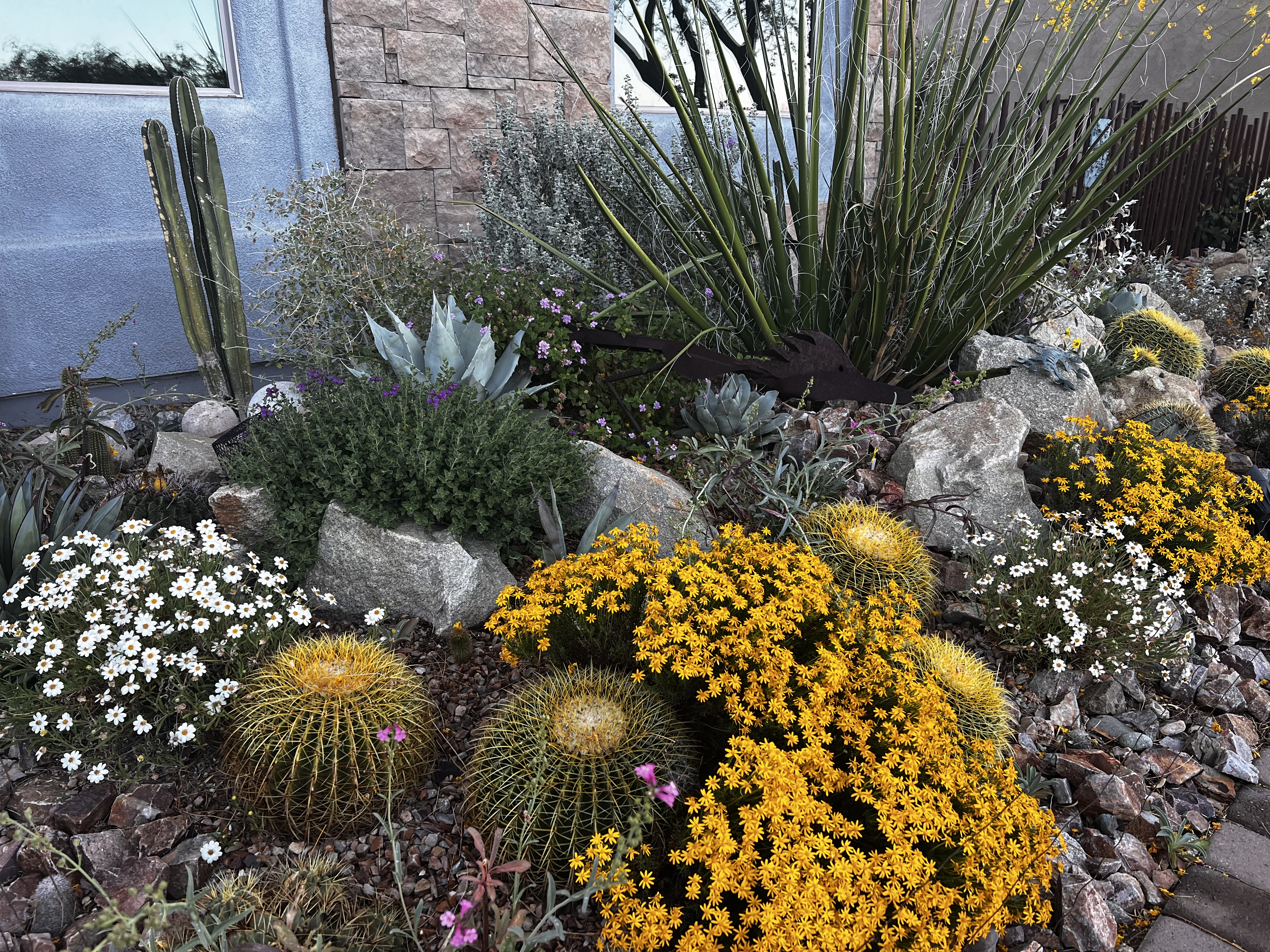
The barrel cactus make up for having the smallest of blooms by making a bold statement with their structure. 


Flowers on the Blue barrel cactus, Ferocactus glaucescens


The blooms are barely noticeable on the golden barrels, Echinocactus grusonii, but they leave behind dry prickly pods with small black seeds. I don't know what the conditions are for seedlings to grow but I never find any. The quail are very good foragers.


Next time I'll introduce you to the saguaro. There is much of interest to share.

Sunday, April 3, 2022

ADDING MORE ROCKS AND NEW PLANTS

It is characteristic of me to be working in more than one place at the same time. A few weeks ago I turned by attention to the front of the house, abandoning some of the others areas I had been working on. The whole front needs a revamp which includes removing plants that have grown too big for the area. A huge A. weberi and two baja ruellia, Ruellia peninsularis. Baja ruellia, is a great plant, but when squeezed up against a wall and in poor soil with no attention but chopping they don't do well. No sooner do I say to David, this one is going and those two as well, than he is out there with his saws and choppers. It's a two day job.

We have garbage pick up twice a week and this is our way of disposal. It's a full bin every week.

There is also a giant hesperalo, Hesperaloe funifera, which David does not like which will remain for the time being. Purely a well established structural plant for now. And one Agave weberi at the back.


And a photinia, Photinia x fraseri, which will also remain for the time being. They add some height and winter structure, I am still thinking about what to put there. Maybe a desert willow. For all the bad press the photinia received in Austin, it seems to thrive here and no one would disagree with how wonderful the new growth looks in the spring. I read that it can be trained into a small tree so I will take a look at this one and see if that is an option.

It also does well as cut branches in the house. It is now blooming although as someone said the blooms have an unpleasant smell. 

So with a good area now cleaned out I turned my attention to adding more rocks adding 12 more to the front. We have found a good local supply of both larger granite rocks and the Coronado brown rip rap that are used for erosion control. Monsoon season demands this. To bad we no longer have a truck  but we are managing with car loads for now. We will eventually rent a trailer in order to bring in some of the smaller rock to use as a ground cover. I redid all the edge rock adding more around the sides. 

Then planting began. I added the 3 barrel cactus I brought with me and purchased 3 Agave 'blue glow,' one A. parryi, a damianita, Chrysactinia mexicana,  and a chocolate daisy, Berlandiera lyrata. The A. blue glow is a cross between A. attenuata and A. ocahui. It is prized for its blue green floiage with red and yellow margins and its compact size. I will see how well they do in this location, which is west facing. I removed a sad clump of claret cup cactus, Echinocereus triglochidiatus,  that were rotting due to too much moisture. I am trying to rejuvenate the parts that still showed life but am not too hopeful. 

I am on the hunt for a Whales tongue agave, A.ovatifolia, but as yet have not come across any.


 I also found a home for the concrete balls I made for my Austin garden.

A nice specimen of the blue barrel cactus, Ferocactus glaucescens, is starting to bloom. It reminds me of the crown of thorns starfish.

The area at the back is where the clean outs are for our sewer line and for now I have just added a germander, Teucrium fruticans "Azure Blue' 


I see lots of plants growing in gardens that I would love to have but it is a matter of  balance between seasonal bloomers, structural plants and plants to carry the garden through the hottest months of the year. And we shall be gone for a few weeks this summer as we drive up to Madison, Wisconsin to attend he Garden Bloggers Fling. Click here for details.

Will you be there? I hope so.


Saturday, April 8, 2017

STILL ON A CACTUS ROLL

I am well known for my inability to turn away an orphan plant. I even go searching for them. Our local Lowes has a reduced table and if I am in the area I always stop in to take a look. In the past I have found some very nice plants on that table and I get satisfaction for restoring them to good health. However, if this week I was thinking about reducing the number of potted plants I have,  all thoughts were out of my head today when I espied these cactus on the $1 table.


 Three Golden Barrel cactus, Echinocereus grusonii, and three Old man of the Andes, Oreocereus trollii. Sometimes when you buy small cactus there is no identification other that 'cactus'. These were identified but their main identification was 'cactus strawflower'. Maybe you can guess what that meant. Each one of these plants had had a strawflower hot glued to the top. All that remained was a withered flower and a goop of glue. If people weren't buying them when the strawflower was looking good, no-one was going to buy them now. Enter, ME. I had to perform painful surgery when I got home. Painful for the two us as I removed the final hardened glue with a pair of tweezers receiving a few stabs for my troubles.


Unfortunately some slight damage and loss of spines to one of the areoles. You may notice that these young barrels look quite different from the older ones. It will be some time before they take on the more ribbed effect.


Now they are all cleaned up and I hunted to find pots for them. I potted the Old Man of the Andes in a single pot and individual pots for the barrel cactus.


 Now find a suitable place for them.

Sunday, April 2, 2017

MY NEXT HOBBY

I'm pretty sure that my next hobby is on the near horizon. After all, much as I love to spend every waking hour outdoors, I can't go on for much longer tending this huge and ever expanding garden. Just yesterday, when we visited Zilker gardens, David was contemplating terracing our hillside. "And where are you going to get the rocks from? Down the hill?  !!!" He who said he was never moving another rock.


No! My new hobby will not be quilting. But it will be collecting the inspiration for this quilt, which was on the silent auction table yesterday. Cactus should go quite nicely on a small patio, balcony or even indoors in a bright window. That time will come.
Even though I didn't make any purchases at the Austin Cactus and Succulent Show, yesterday, I was still interested to see what exotics might be in my future.


Maybe I will have to invest in some nicer pots. And I shall definitely have to think more about display.


Not that I haven't already amassed quite a collection one way or another! For instance, this barrel cactus came from a concrete drainage ditch in Ahwatukee, Arizona. We were out walking our son's dogs in the neighborhood and I spotted this cactus right in the center of the drainage ditch. Until I went down to take a look I thought it was actually growing out of the crack but discovered it was loose and clearly had been washed down during a rain storm. The only thing I had to hold it was a clean doggy poop bag which I opened and made into a sling.


Then a broken pad on this unknown prickly pear. Beavertail?Opuntia basilaris, 


And then there is our very own cactus wren. Our Carolina wren has made a nest on the cactus theater.


Sunday, January 22, 2017

MULTIPLICATION IS THE NAME OF THE GAME

Once in a while something good comes out of an accident in the garden. About 8 years ago I stepped backwards right onto a single lace cactus, Echinocereus reichenbachii, smashing it into the ground. Imagine how sick I was at the time. Never fear. Cactus are tough. It divided itself into 3.


Then this mamillaria. Workmen knocked the pot off the wall smashing the top off the cactus. I dried off the broken top and repotted it and left the broken one to heal. That broken one has healed over and has now made a whole new family.


An unwary boot trampled this agave into the ground. It, too, has produced a new family. I am not sure this one is a good thing.


I have often wondered what makes the barrel cactus suddenly start producing multiples on top of itself. Like this one I saw in Arizona. It is quite obvious that the top of the plant has been subjected to some damage in the past. It has made a new top and lots of babies around the sides.


Cactus can take a lot of abuse but sometimes an accident turns out to be a happy event.