My Blog List

Showing posts with label Gazanias. Show all posts

Friday, April 24, 2020

THE ENGLISH GARDEN...NOT EXACTLY

I named the English garden for the dry stone wall I created. A reminder of my childhood in the north of England where drystone walls were created to divide farmers' fields. I quickly discovered when we started building the house that there was a wealth of perfect stone at my fingertips. Flat pieces of stone suitable for building stone walls without any mortar. I began saving them and shortly after we moved in the house I began the project.


The wall creates a raised bed which follows the curved wall which encloses the garden. This was really necessary if I wanted to grow anything.
I love to capture the sun just as it peaks through the archway in the morning.


It lights up the Mexican feather grasses.


Not all English gardens are cottage gardens with lawns. In England there are many gravel gardens and gardens planted in the Mediterranean style, and although I didn't imagine this at the time, it is the way the garden developed and it made sense to eliminate lawns completely. It would have been so much work getting a lawnmower in here and so much more water to keep it looking good. Instead I decided on gravel and I am really happy with the way it looks most of the time.
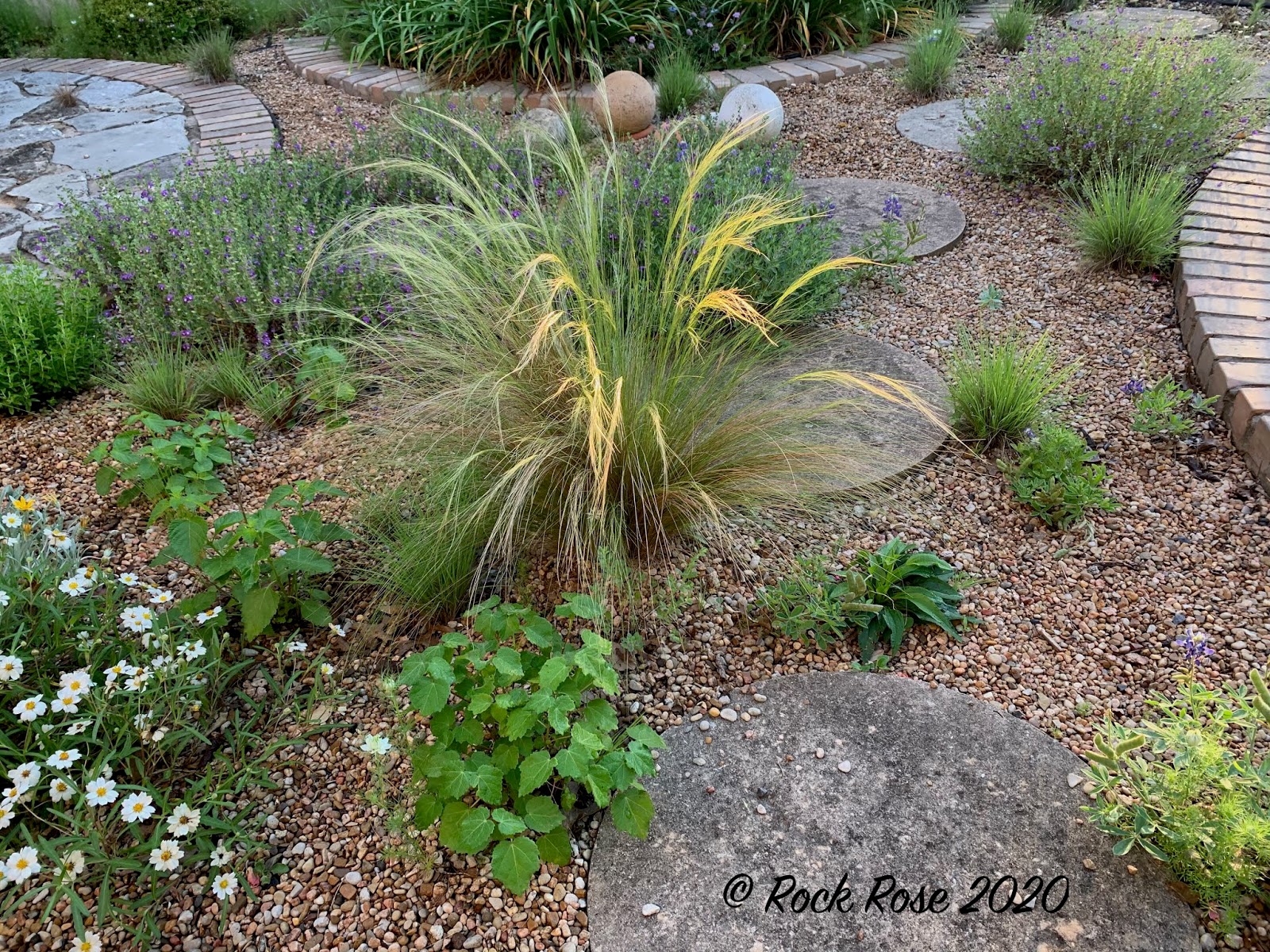

In my usual style a majority of the plants growing in the gravel have self-seeded and although it is work to keep it under control when it is at its best it looks great.
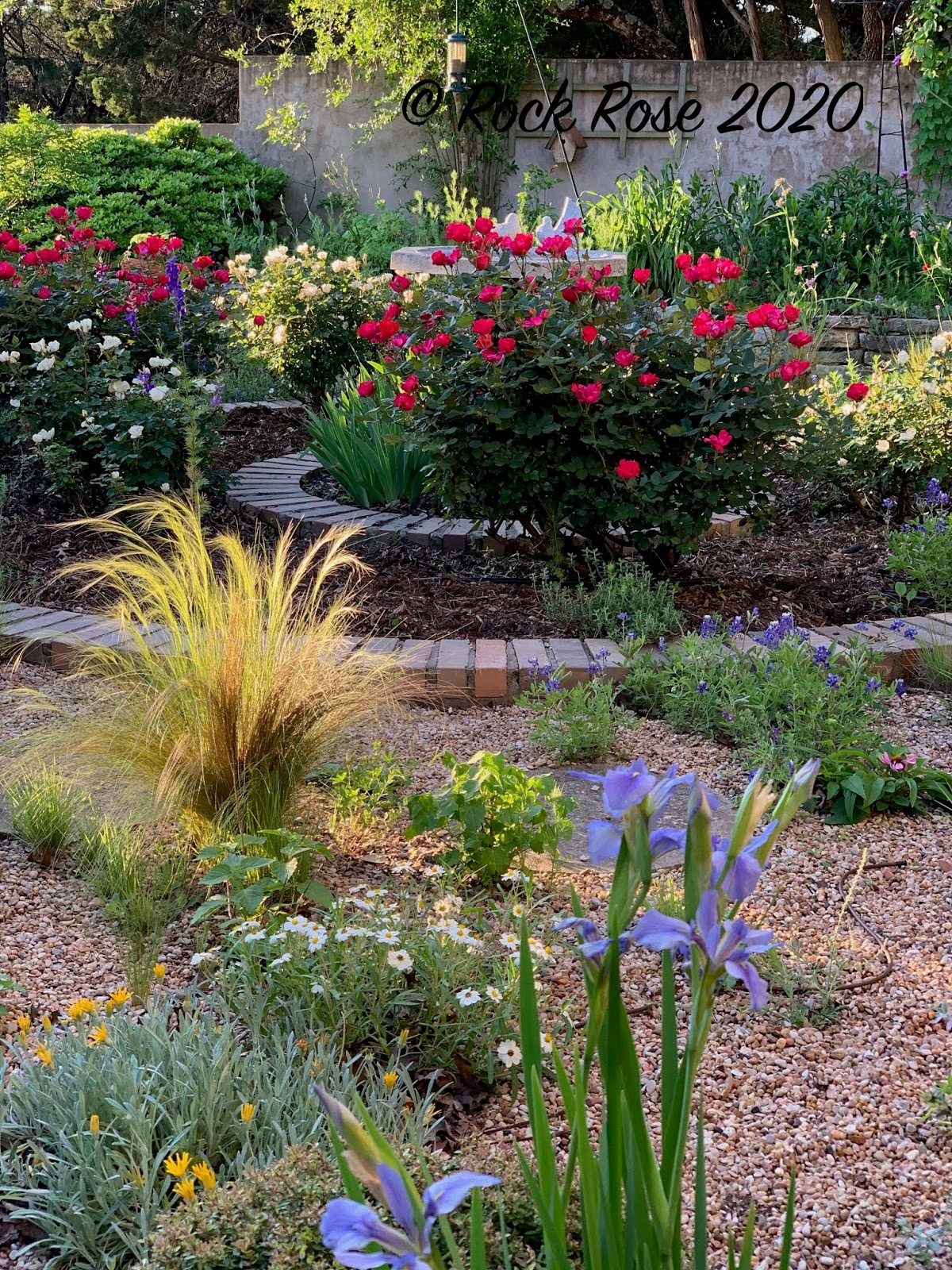

I confess I did plant the silver leaf gazania last year and it survived the winter.


A few days ago the gazania was looking wonderful and then with the heat yesterday and today it just started to wilt. Maybe the underlying soil was just too wet from all the rain we have had this spring.
One of my favorite flowers which have had wonderful success are the skullcaps-particularly the native Wright's skullcap, Scutellaria wrightii. It is one of the few plants that will last all through the year and with an early spring trim will stay in a mounding shape. When I prune off old growth I walk around sprinkling the seed into other areas. That and the Blackfoot daisy, Melampodium leucanthum, require no irrigation.


An English garden should have roses and yes there are a few of these but I could be doing so much better. I originally planted 3 knockout roses around the birdbath in memory of my mother and a friend who died of breast cancer. Then added 3 white ones in between. Unfortunately one of the red ones died and I have been planning to replace it for several years. Yes, with just another knockout rose but quite honestly they are fuss free-so far. No bugs, no blackspot and as long as they don't get rose rosette disease they will stay. And if that happens I will switch to salvias.


But my other roses are not doing so well. So far this year Felicia has had blackspot and thrips but still still she has managed to provide me with wonderful fragrance when I have been working outside.
My idea was to replicate the pillar roses I had seen at Mottisfont, but then I am afraid I don't have their expertise. It's not too late to give them a big trim back because Felicia is a reliable repeat bloomer through the season.


But my big failure has been in that raised bed I created. I never put any thought into the planting and just put plants in there willy nilly. Mostly passalongs. The shasta daisies have almost taken over one section and the pale pavonias are crowding out other plants with their scrappy stems reaching for the sun. One side gets more sun than the other and the vines on the wall have moved into the beds. It is my plan to overhaul the whole bed or in the very least move some plants out of there. But that has been in the plan for a few years so we will see how far I get this year.
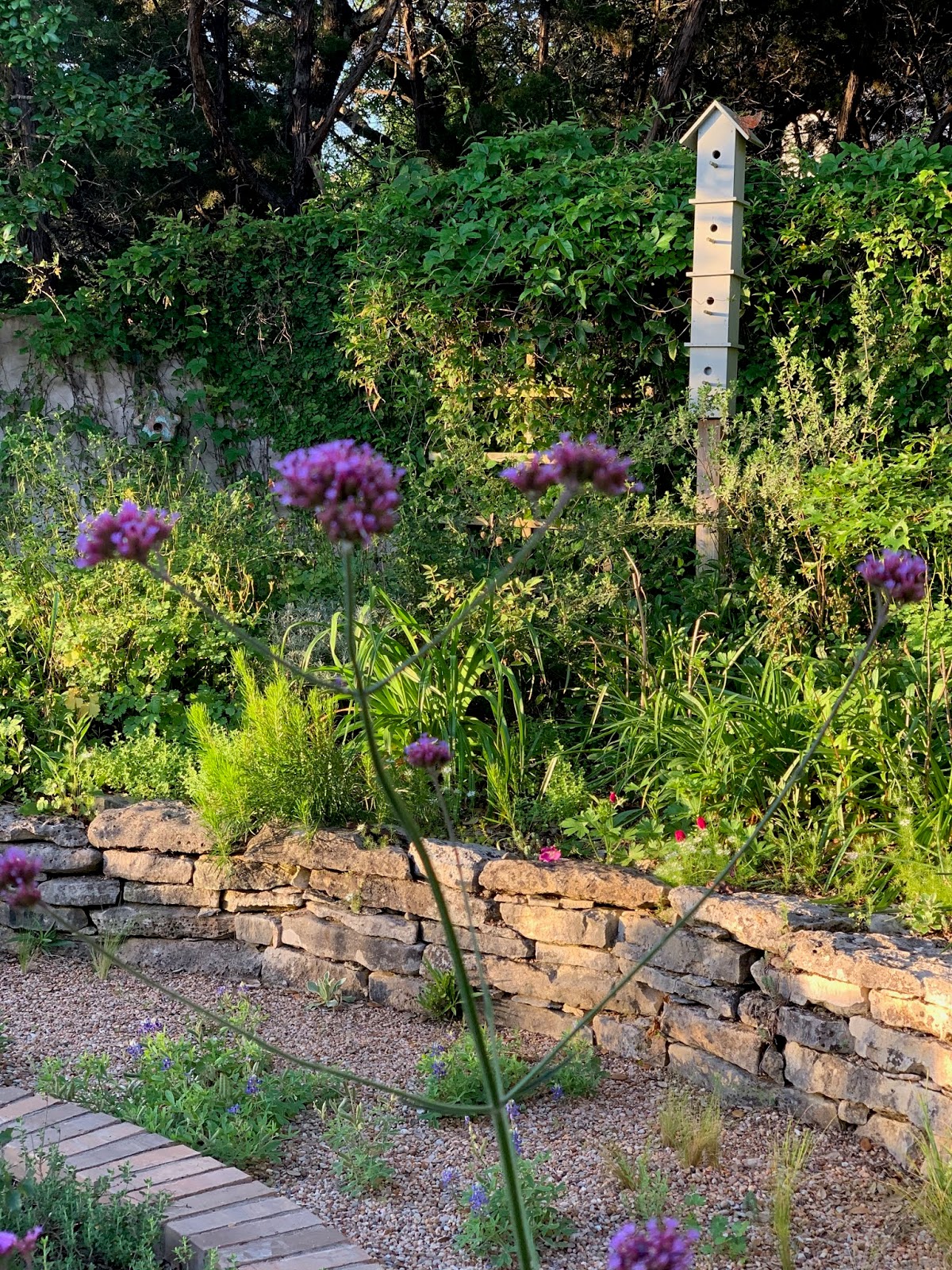


The garden is always a work in progress.

Tuesday, April 23, 2019

WHO IS ON THE STAGE THIS WEEK

The most dominant flowers of the last 4 weeks have been the bluebonnets, columbines and Indian paintbrush. They are now busy setting seed for next year while a whole new range of plants take over, primarily the yellows. Our roadsides are quite stunning with their yellow composites mixed in with blanket flowers.

My garden is not so shabby either.

Square bud primrose, Calylophus barlandieri, nestled in among rocks and gravel.


Engelmann's daisy, Engelmannia peristenia. I remember when I bought this at the Wildflower Center sale some years ago someone said they would be everywhere, and they are.


But so far, only in the from Courtyard garden where I pull those that are in the wrong places. I am hoping to get them to move outside the walls at the front. The question is always, will I be around at seed collection time.


Four nerve daisy, Tetraneuris scaposa,


Damianita, Chrysactinia mexicana.


Threadleaf coreopsis, Coreopsis verticillata, swaying around on two foot high thin stems.


And California poppy, Eschscholzia californica, a vigorous self seeder.


These are all native to Texas but there are a few more yellows enjoying the stage. The native Coreopsis tinctoria is a few weeks away from flowering but other tall and short coreopsis are flowering.


And the silver leaf gazania, Gazania tomentosa, perfectly at home in a bed of gravel.


And in the English Garden the many petaled, fragrant  Rosa 'Molineux' named by David Austin for the football stadium of his favorite soccer team, Wolverhampton Wanderers.


And finally the large yellow named bearded iris which is a favorite because blooms after my other iris have finished blooming.


Will the yellow flowers please take a bow.

Saturday, April 6, 2013

BE CAREFUL WHERE YOU WALK

If I have said this once I have said it a thousand times. Is it any wonder. And what happened to the resolution that I would keep the pathways cleared this year?


I can't help that the rose Zephirine drouhin happened to start growing right at the top of the ramp. We can't use this entrance any more. Even without the rose the bluebonnets bar entry at the bottom. This ramp was supposed to make it easy to get the wheelbarrow up into the garden!


And do be careful as you go round this corner, please.


I wouldn't even try to walk this way.


Or this.


It's getting tough to get to the water barrels.


And those bluebonnets are taking over in the English garden once again.


And soon you will have to jump over the trailing wine cup. Ah, well. Maybe next year.

Friday, March 15, 2013

GARDEN BLOGGERS' BLOOM DAY, MARCH 2013

It is the most amazing March bloom day.


Our mild winter and wonderfully warm days have brought an early spring to Austin. After a very dry winter an inch of rain fell last week and the plants responded with immediate growth. So much is blooming.


it is a special year when the pink jasmine, Jasminum polyanthum, flowers. Frequently zapped by frost but not this year. It is planted in a sheltered south corner of the house.


Bluebonnets.


A lone freesia planted many years ago.


Gazanias from last year.


Native blue gilia, Gilia rigidula. See how it adores the inhospitable limey soils.


The cross vine, Bignonia capreolata, on the gate.


Indian hawthorne, Raphiolepis indica.


Blackfoot daisy, Melampodium leucanthum.


Wright's purple skullcap, Scutellaria wrightii.


Blanket flowers, Gaillardia pulchella, in the path.


Clusters of sweet alyssum, Lobularia maritima. Watch out for the harlequin bug!


Trusses of Lady Banks' rose, Rosa banksia 'lutea'.


Closed for the evening, Tulipa clusiana, Lady Jane. See the flower buds on the Claret cup cactus? Can't wait for that showing.
What's blooming in your garden this March? You can join many of your fellow gardeners at Maydreams gardens. Thanks, Carol, for hosting.

Friday, February 24, 2012

SUMMER YESTERDAY, WINTER TODAY

Yesterday the mercury on the thermometer registered 90°


Daffodils bloomed alongside gazanias.


 As the temperature climbed the first California poppy of the season unfurled its delicate petals.


By afternoon a clump were in bloom.


And more gazanias opened with their companion alyssum.


The Texas Mountain Laurel opened its blooms which immediately began to fade in the heat.


The dwarf iris, Iris reticulata, bloomed in the sunken garden.


The viburnum 'spring bouquet' flowers  changed from pink to white.


And tiny daffodils in the sunken garden bloomed amongst the columbine leaves.

Today is a different day. During the night a chilly wind blew in and this morning it is still there with the temperature hovering at 45° We are forecast a cold night tonight. I may have to return some of my plants to their winter quarters.
The little calamondin tree has blown over and oranges are scattered on the ground.


California poppies and gazanias are closed this morning. It is too unpleasant to work outside. It's just another day in the roller coaster ride of Texas weather.