My Blog List

Showing posts with label blackfoot daisies. Show all posts

Monday, September 29, 2025

WHAT’S NEW IN THE GARDEN.

 What's been going on in the garden. That is what I was thinking when we returned from another 3 week trip. My eyes eagerly scanned the front bed as we pulled up the driveway. It looked as though monsoon rains had been kind. The damianita, Blackfoot daisy and skullcaps were flowering. And no damage from javelina due to having left the dog fencing across the driveway. ( No letter from the HOA as yet)


Damianita Chrysactinia mexicana.


Blackfoot daisy, Melampodium leucanthum


Arizona Purple skullcap,Scutellaia potosina. with damianita


And then my eye caught a newcomer. What was this? My first thought was Arizona poppy, Kallstroemia grandiflora. A plant I had heard about but had never come across. A search for Arizona poppy confirmed this. Where had it come from? Maybe turned over  from deep in the soil when David had run a new sprinkler line. It is a rather rangy plant and would suit an open desert setting better than the narrow place in which it has inserted itself. Despite being called a poppy it is not in the poppy family but can mimic the look of the spring flowering California poppy. It may take several years to germinate because of a hard seed coat and usually springs up after monsoon rain. It is right on cue. 


Arizona poppy,  Kallstroemia grandiflora


And along the driveway the tree I love in summer but despair of all through the winter and early part of the year. All is forgiven! Those gorgeous white blooms on the Texas Olive, Cordia boissieri


One thing I try to do is to remove the fruits before they fall to the ground where they germinate. This year there are so many I will have to do a little weeding. I am now familiar with the first leaves which are nothing like the secondary leaves. 


 Along the side of the house the smaller leaved olive, Cordia parvifolia. The cordia are the desert blooms of the monsoon season. 


The first planted pomegranate tree has, this year, 6 pomegranates, the largest of which I have protected inside a bag. The others are quite small. As yet they are unblemished and I have no idea if they are ripe. I remember the same with my fabulous pomegranate tree in Austin but it was easy to sacrifice one each week to check for ripeness, there were so many.  It was usually later in the year. 


And the bougainvillea just coming into flower after the rain and moderation in temperature. 


So far so good. Then I noticed my prize prickly pear cactus had the starts of a cochineal infestation. From just a couple of pads this had grown quickly.


A little work with the toothbrush and the pads are as good as new. 


The back and sides of the house receive more visits from desert wildlife and they had been busy. One small agave eaten down to a nub. A spineless prickly pear just about annihilated. The pereskia had lost its drip line along with all its leaves. I'm not sure it will make a comeback. Death by rat and drought.


There were holes dug in the ground-the grub hunters were on the prowl. My neighbor has raccoons playing on her roof at night and using a corner of the roof as a toilet. They have professionals trying to trap them. Their wildlife camera spotted a skunk passing through last night. Another grub hunter. Was it the skunk that had ripped out two plants in order to root for grubs? But the worst of all happened last night when leaf cutter ants removed every single leaf from a Tecoma plant. It appears as though they had more cutters than gatherers and choppers, with hundreds of cut leaves beneath the plant and chopped pieces left along the pathway. This all done under cover of darkness. I could follow the trail of the few stragglers heading for home. It crossed my garden and up the wall into next door's garden. From there they crossed and climbed up and over the back wall of the property and down into the desert where the vegetation is too thick to track them to their nest. It is the most devastating thing to have happened yet and it makes me feel the closest I have ever felt to giving up gardening. "Get over it" say Tucson gardeners, who have had similar visits and  hope the plant makes a recovery. We are due to leave again next week for the last camping trip of the year so I imagine in a month's time I will be doing the same inspection. 

Friday, May 3, 2024

MY DESERT GARDEN COMES TO LIFE

Spring is a wonderful time for all gardeners but particularly so for desert gardeners. It is the season of spectacular bloom brought on by winter rains. I have taken advantage of that by adding many blooming plants to my garden to complement the cactus and succulents. Some are perennial and some are annuals like this scarlet flax Linum grandiflorum rubrum. Annuals like to seed themselves along the edge of the paths where they driven by rain. Not always the best place.

Flax are dotted all over the front garden among rocks and cactus. I have always favored growing from seed and finally had success with damianita, Chrysactinia mexicana. This one I grew from seed planted 2 years ago. If I'm not careful it will be crowded out by these penstemon seedlings and a desert marigold. Despite the enormous numbers of seed they produce I have only ever found one growing naturally in my garden. No doubt the fault of the hungry quail who frequent the garden.

Damianita, blackfoot daisy and skullcaps are perfect low-growing perennials for the desert rock garden although not easy to come by. I did manage to find 2 purple skullcaps but unless they are in bloom they are sometimes miss-labeled and turn out to be the more common pink variety. Despite the many flowers and seeds produced it is very difficult to get these three to self-seed.


I'm trying to maintain a good balance of flowers and succulents for the quieter time of year when the cactus are center stage.

The damianita will  need to be sheared back soon so they can bloom again when and if the monsoon rains come. 


Just coming into bloom is the chocolate daisy, Berlandiera lyrata. I bought one plant 2 years ago and have been able to grow several more plants from seed over the winter. It has always performed well throughout the year opening new flowers every day. It is a morning bloomer, closing its petals by noon. It's chocolaty fragrance cannot be missed when walking around the garden. 

 This is one of three hedgehog cactus, Echinocereus triglochidiatus, I inherited,  which has bloomed successfully each year.  Their location is not ideal as they receive sun only in the later parts of the day. A place in a more open spot would probably result in a more spectacular bloom. I have allowed this native cudweed to remain. I love its silvery soft leaves which are the closest we would get to growing lambs ears in the desert. Some call it pearly everlasting as the flowers do well when cut and dried. 

My desert marigold,  Baileya multiradiata, has become so successful that it threatens to overgrow the driveway. I think it must be getting too much water. It reseeds quite readily where the layers of rock are not too deep or too large.

Spring is a very yellow time of year in the desert and I think I may just have a little too much of it. Between the brittle bush, damianita and the desert marigold I need to find a happier balance. Brittle bush is a wonderful desert plant which also reseeds heavily. I think it is underused as a native plant filling the roadsides with its yellow and dusky sage colored leaves. 


Seeds of blanket flowers grown from seed last year have been immensely successful. They are acting as though they are perennial. Last year they bloomed all summer long. You couldn't ask more of a plant in this desert climate.

 And there are frequent pop-ups in the spring of native wildflowers like the verbenas.

                                                         Verbena gooddingii

                                                              Moss verbena, Verbena tenuisecta

 The mix of colorful annual, perennials, cactus and succulents is a joy to behold on my early morning stroll around the garden. And it is always early.  Spring and summer in the Sonoran desert is a time to get up early to enjoy the cool mornings. The sun rises early and we must make the most of the best part of the day. Now we are in our dry summer with no rains expected until the monsoons arrive in July. Fingers crossed we will get good rains this summer.

Sunday, August 27, 2023

HOME FROM THE HILLS

After 6 weeks away you can imagine I was a little nervous about how my garden would look. The summer monsoon had not materialized and temperatures had been unseasonably hot. Tales from the DBG in Phoenix told us of the saguaro suffocating in the unusually high night-time temperatures. We are a little higher in Oro Valley (3000') which makes us cooler by about 8° More than my fingers were crossed when we pulled into the driveway. But I had to wait until morning because it was already dark too late to walk around. We had arrived home to a strong thunderstorm and temperatures in the 70s so next morning I was delighted to find the front garden looking very good.

The bougainvillea on the front walkway had a few blooms. Just enough to brighten the wall. 

 It looks as though a bird has been busy making a nest. For now it is just a platform of twigs and may even have been abandoned. Possibly a thrasher or cactus wren. Our comings and goings may be too much for it.


The chocolate daisy, Berlandiera lyrata, opens up with new flowers every morning, so I was happy to see it was still putting on a show. It is getting a little lanky and could do with a prune but is now the right time? Like most I am not happy to cut off a good bloom.

And the blanket flower, Gaillardia pulchella, still going strong. It was blooming when we left six weeks ago.


Other native plants likes the skullcap, Scutellaria potosina ssp platyphylla add a splash of purple in front of the young Whale's tongue agave, Agave ovatifolia. Despite all the structural plants I am not happy to do without a little color.

Along with the bright white of the blackfoot daisy, Melampodium leucanthum. 


So many of these plants are a reminder of my Austin garden, although there the barrel cactus were in pots. I regret now that I didn't bring the larger ones. I think I could have pulled them out of their pots and brought them bare root.

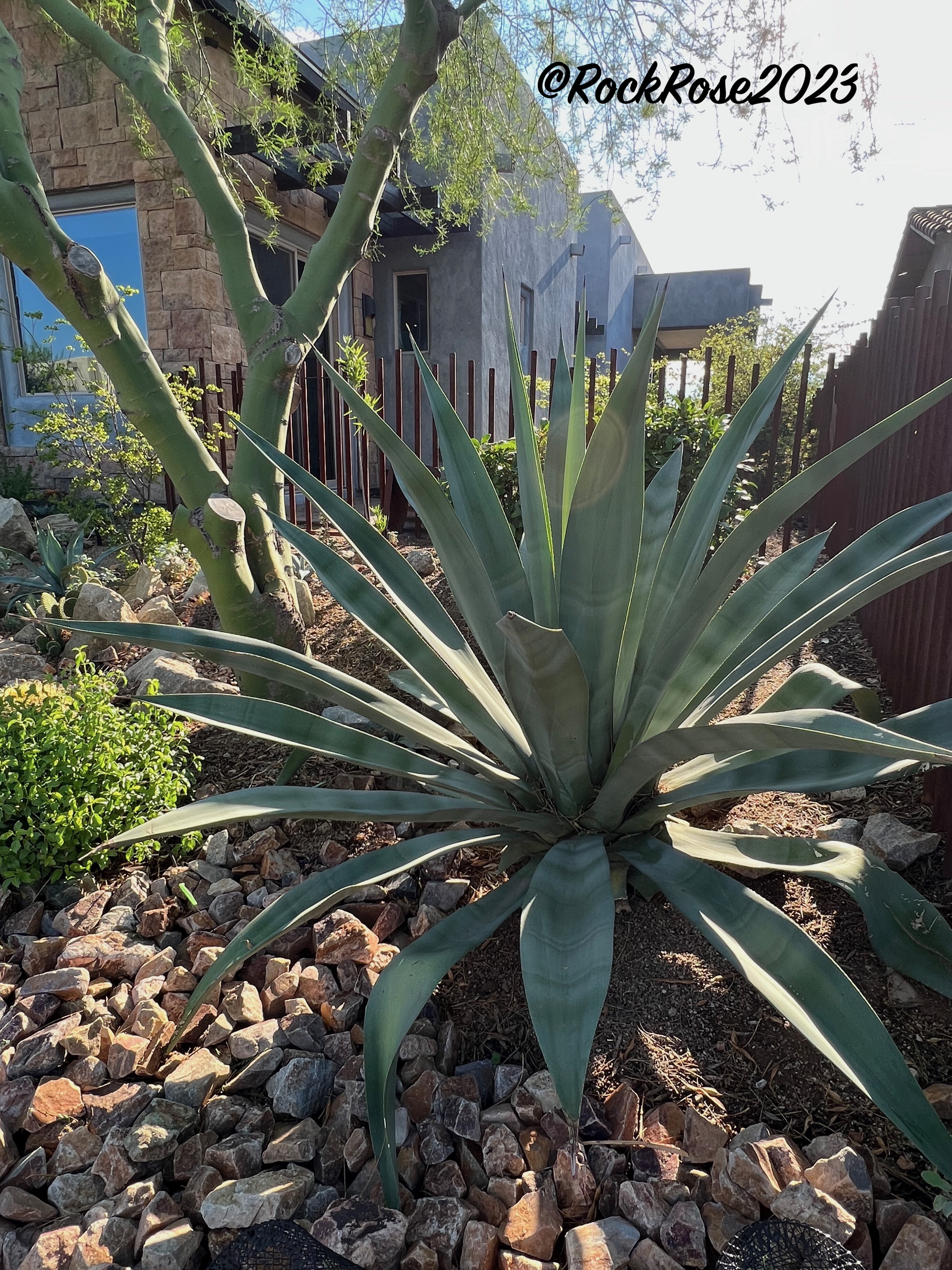
There are only a few large agave remaining. This one is on the corner beneath the palo verde. But wherever we took out the Agave weberi new pups are springing up. I am potting some of them up to plant out behind the house. There is good value to be had out of these large structural agave and I find I miss them. For the first time ever I have started to protect them from the weevil by using the systemic Imidacloprid around the base.

 Another very spiny agave guards the edge of the driveway and is forever in risk of being run over. It is a slow grower but it puzzles me why they would have planted it so close to the edge. It has produced only one pup which I relocated.

I am really quite fond of the brittle bush, Encelia farinosa, which blooms in the spring with masses of yellow flowers. It reseeds around the garden and I leave some of them to grow into small bushes.


One of the plants I was most concerned about was the Meyer lemon tree. It had lived in a large pot for 12 years, providing us with tens of lemons every year. We brought it with us and last year planted it in the ground. It looked good during the winter and produced many blooms but it wasn't happy and by May almost all its leaves had turned yellow and dropped off. I full expected it to be dead and was already planning to put in a new one this winter. Amazingly extra watering and some summer showers had brought it back to life and there is new growth.I will always give any sign of life in a plant a chance so it remains to be seen whether I will be replacing this after all.

Also down the side of the house the grapefruit tree is looking great and the 6 grapefruit are getting bigger. They have about 4-5 months to grow to full size and ripen.

It is my potted plants that suffered the most and many died. The lime tree had fallen over along with the plumerias. I must try to get the lime in the ground although the Mexican lime is one of the least hardy of the citrus. I may just have to give up in the plumeria. A large jade plant had completely rotted away. I don't know if it was the heat or lack of water but there was no9thing left of it. Of my herb and vegetable raised planters only the basil, sage, chive and peppers survived. David had put in a new water line to water them from beneath but I think they were getting too much water being on every day. This was really due to there being mixed water need plants on the same circuit. There is a lesson to be learnt here, although I think I have had the same lesson many times before. A constant presence in the garden is the only answer.

 Another storm blew through and was the trigger for all the Mammillaria grahamii to bloom. They have certainly put on a big show-a show always worth waiting for. 


One of the benefits of living in an arboreal desert.

Monday, May 3, 2021

RIGHT PLANT WRONG PLACE, BLUEBONNET PURGE.

I couldn't help but smile when I read this. They are talking about bluebonnets, our Texas State flower.

"While it may be a myth that picking the beautiful blue flowers is illegal, conservation is crucial to preserving these delicate native plants"

Delicate native plants indeed! Not where I live. And I do believe the Ladybird Johnson Wildflower Center would agree with me on that. That is why they are smart to make a dedicated bluebonnet patch within their garden because otherwise the plant would just take over the whole garden.


That is exactly what happened in all of my inside gardens. I am asking myself why did I let this happen again because I have learnt from experience that if I let them grow in here I will spend hours pulling them after they are spent.  Not to mention the poor plants which struggle to grow beneath them and how it impedes walking through the garden. For the last three days I have pulled hundred, piling them in various places under the trees. If they ripen, all well and good, if not then I still have hundreds more whose seed I can collect for places where I want them to grow. It was imperative to remove them before the rain came....and it di. 4.2" over three soggy days.

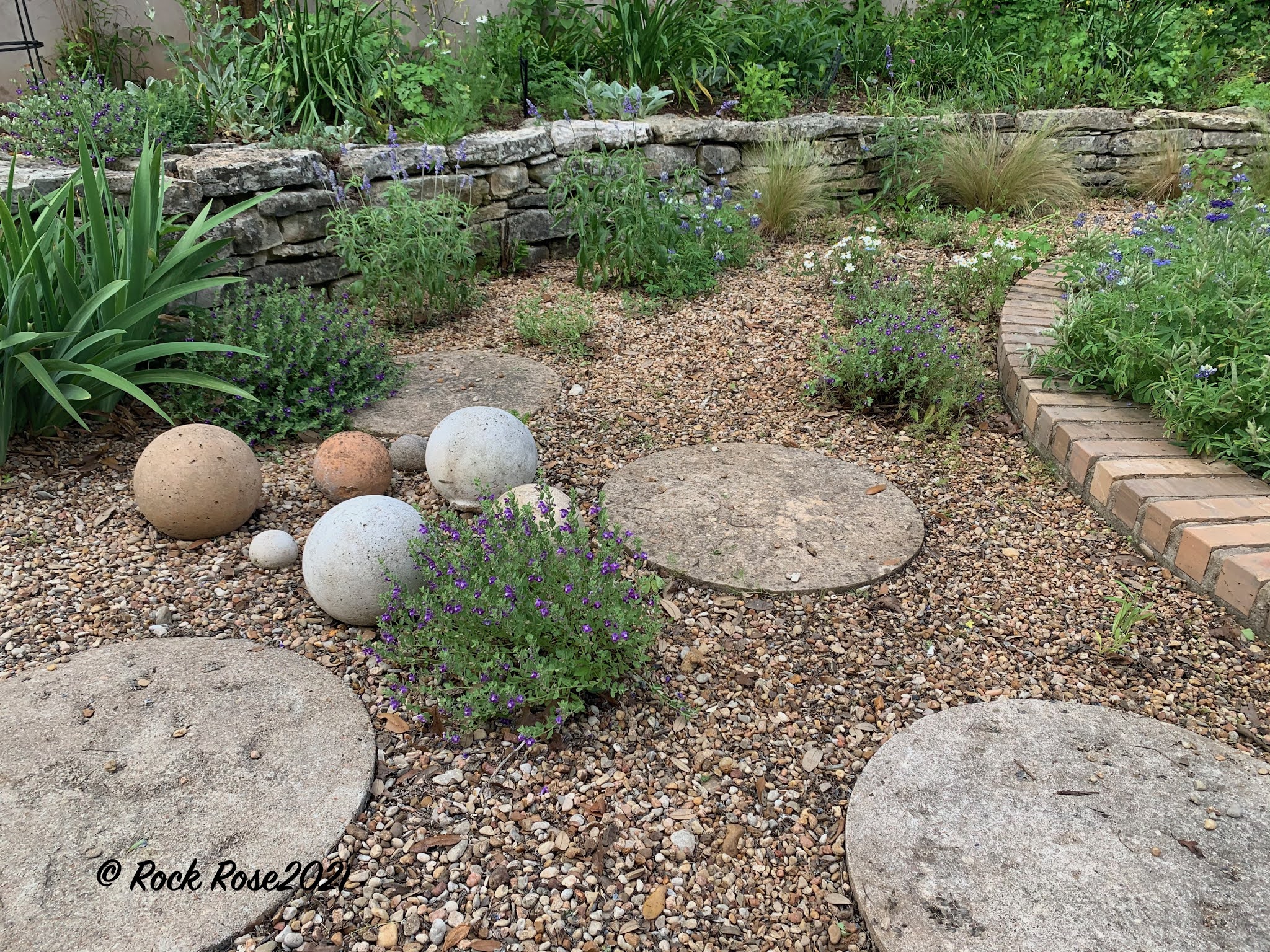
Ah! The other plants in the gravel can breathe again. The skullcaps, Scutellaria sp.blackfoot dasies, Melampodium leucanthum, mealy blue sage. Salvia farinacea. These much more mannerly plants who will only occupy a small area. I am more than happy to have them brighten up the larger expanses of gravel.

An occasional ruby crystal grass or Mexican feather grass. 


My absolute favorite fro this gravel garden is the purple skullcap, Scutellaria wrightii, I prune it to a more rounded shape in the spring and scatter the seeds around in the fall.

The other players permitted to remain in this garden are ruby crystal grass, Melinus nerviglumis, Mexican feather grass, Nasella tennuisima and a modest amount of love-in-a-mist Nigella damascena.


I will remind myself next year that this is the look I prefer and certainly saves days of work.