My Blog List

Showing posts with label evening primprose. Show all posts

Saturday, April 26, 2025

YELLOW IS THE COLOR OF THE MOMENT

Two weeks ago we had friends visiting from Denver. We were so excited to show them our wonderful desert home but disappointed that the lack of rain this year was making the desert look very drab and dowdy.  Usually the desert behind our house is a sea of yellow, at this time of year, with flowering brittle bush, Encelia farinosa. This year their leaves are brown and dried up living up to their name. I wish our friends had come a couple of weeks later, as following a brief shower and a cold front passing through, all the trees burst into bloom. Maybe the shower and drop in pressure had nothing to do with it and the flowering had more to do with daylight hours and the natural cycle of blooming. The Palo verde, mesquite and acacia are now putting on a magnificent show. Just driving down the road with the trees in flower and the backdrop of the mountains is the most magnificent sight. 


This is the  Palo Verde, Parkinsonia x Desert Museum, in our front garden. Regrettably this tree was overwatered by the previous occupants and has grown very large. We have had to do some canopy pruning as well as root pruning as the roots were bringing up our driveway in several places. We were also fearful of them making their way into our sewers system. But for all these negatives we love the tree for the filtered shade it provides for the plantings beneath its canopy. It is the sterile hybrid of three palo verde species, P. aculeata, P. microphyllum and P. florida. Its attributes are that it is thornless, fast growing, drought tolerant and attracts many pollinators.

When the flowers drop the ground is a carpet of yellow  


Below is another common spring bloomer, the mesquite, Prosopsis sp.  producing long pods later in the season. These are a favorite of the javelina and can also be ground to make a flour as the Hohokam  lived did many years ago. For all their messy nature the trees both stabilize and being a legume, improve the soil.


Above the sweet acacia, Vachellia farnesiana, The desert trees and shrubs are competing for who is the most fragrant. 
Other shrubs like the hop bush, Dodonaea viscose, are also blooming. These reseed quite readily and I have a couple which seeded in a perfect place among the rocks and which I intend to keep. Yesterday, I collected the papery winged fruits, with the intention of sowing some behind the house in what we now call the hinterland. 


This tree loves dry rocky slopes so will be quite at home. 

In my limited space areas damianita,  Chrysactinia mexicana, is very much at home in fast draining desert soils. It is extremely tolerant of heat and drought. If I had one complaint is that the yellow color is just a shade too bright. It germinates quickly from seed but bringing it to even childhood even under controlled conditions is very challenging. The wiry roots are thin and easily damaged. I have had success with only one plant. It makes thousands of seeds but never produces seedlings naturally. 


In truth I think I prefer the gently sprawling nature of the yellow evening primrose, Oenothera primiveris. It is planted along the edge of the walkway between two rosemary bushes. 

evening primrose


The first of the prickly pear blooms are opening. 


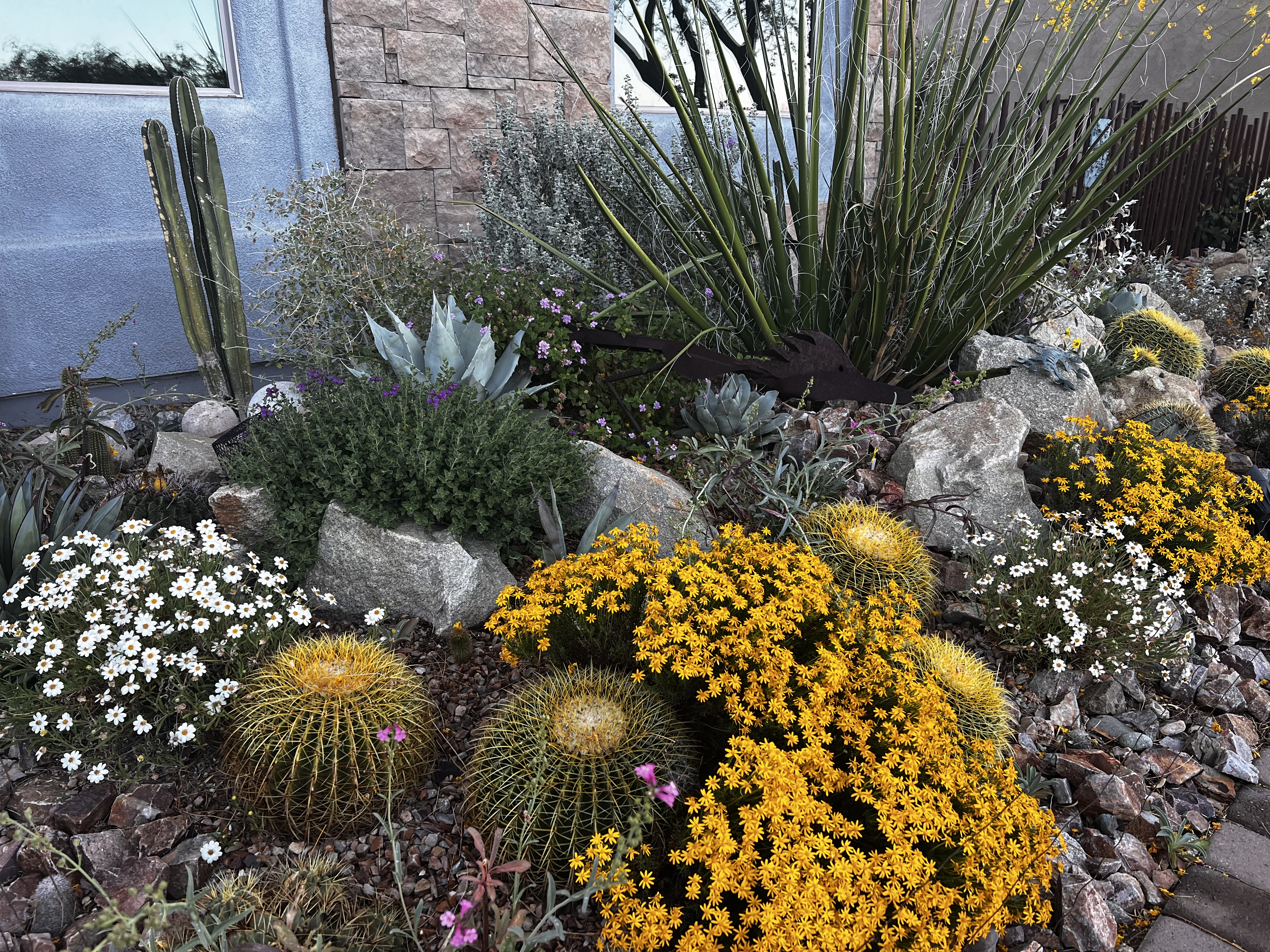
The barrel cactus make up for having the smallest of blooms by making a bold statement with their structure. 


Flowers on the Blue barrel cactus, Ferocactus glaucescens


The blooms are barely noticeable on the golden barrels, Echinocactus grusonii, but they leave behind dry prickly pods with small black seeds. I don't know what the conditions are for seedlings to grow but I never find any. The quail are very good foragers.


Next time I'll introduce you to the saguaro. There is much of interest to share.

Thursday, June 17, 2021

OUR WILDFLOWER MEADOW

I don't even have enough time to deal with everything in my inside gardens and outside gardens without venturing onto the septic field. But about 4 years go I decided I really wanted to have that wildflower meadow I should have had 21 years ago. That was when I bought a Texas wildflower and grass meadow mix from Native American seed. It was to go in the tank when they sprayed the cover on the septic field. When I came over the next day there sat the 2 bags by the garage, unopened. There was nothing in their spray tank but left over Bermuda which is what began to take hold within weeks. We tried to get rid of it and then put down our seed but it was to no avail. Weeds came and in the end David just decided to mow. It looked fine. Still I had that hankering to have the meadow. Five years ago David began mowing and collecting, the idea being to reduce the fertility of the soil. No more mulch mowing. I scattered left over bluebonnet seeds from the garden as well as blanket flowers. 


Bluebonnets are now gone, but a year ago native bee balm, Monarda citriodora,  started to grow and has really increased in numbers this year. I am so happy to have the purple one because at the top of the lot, near the road there are some white ones. This is hands dwon my favorite after the bluebonnet whihc is good because they don't share the same season.

And they are not called bee balm for nothing.


While I control the pink evening primrose, Oenothera speciosa, in my inside gardens, I am more than happy for it to spread outside.

 And prairie verbena, Glandularia bipinnatifida,  is a welcome plant.

Coreopsis, Coreopsis tinctoria, has started to bloom. Small plants at the moment but I am hoping next year their see will spread just as it does along the roadsides.

And this rather unusual one has popped up.

Tall vervain

Surprisingly the blanket flowers, Gaillardia grandiflora,  struggle to survive as the they seem to be a favorite of the deer.

The first year we made a path alongside the septic field we had an amazing showing of Mexican hats, Ratibida columnifera. They were all different shades of yellow and brown. Some solid some mixed colors. Maybe the conditions were just perfect, never to be repeated. But one or two this year. All the yellow variety. 

Horse herb or straggler daisy, Calyptocarpus vialis, soveres much of the shady area of the field but is nmaking headroads into the center. Maybe due to long days of rain and cloud. I think it will go dormant now we are well into summer temperatures. 

And it is no surprise that our native lantana, Lantana urticoides. I will be watching out for the pink variety  Lantana camara, which is invasive. 

This year finds me very happy about how the wildflower meadow is coming along. And we haven't had to mow yet. That will be done in the fall.

Saturday, April 13, 2019

I COULDN'T DO IT WITHOUT HER

It is often said that mother nature is no gardener but today I will sing her praises as I share with you some of the things she gets right. Just look how she planted this mullein , Verbascum thapsus, in my English garden. It's as though she thought the expanses of gravel needed just a little dressing up. How about a few bluebonnets sprinkled here and there and a grass or two. Isn't that better?


And another fine specimen at the bottom of the vegetable garden steps. What is not to love about those beautiful sage-colored velvety leaves.


I will admit that she tries to have me grow more than I actually need and I am choosy. They must meet a certain criteria if they are to stay, like a  nice even rosette of leaves with few blemishes.
Mullein were introduced into he USA in the 1700s and are pretty widespread throughout the country. They also appear on the invasive list although I rarely see more than a few scattered around where I live. In the 80s we hiked with a Navaho guide into the ruins of Betatakin, and she told us that Native Americans used the leaves as baby diapers. In Texas it is known as cowboy toilet paper. As a biennial it reaches the rosette stage during the first year of its cycle and then sends up a tall flower stalk with pretty yellow flowers. Although, some time in Texas it achieves both stages within a year.


There is no better place to see her handiwork than in my sunken garden. Toadflax, Nuttallanthus texanus, is everywhere this year and one special clump has me won over that this is a worthwhile plant to have in the cottage garden, particularly if you can get it to seed en masse.


There are so many plants in this area that have self seeded, poppies, mealy blue sage, Brazos penstemon, columbine, grasses, skullcaps and even the delicious chocolate daisy. I never know from one year to the next what will be where, but rest assured, they will be there.


A visitor to the garden this past weekend commented to David, out of my earshot, that there didn't seem to be very many vegetables in my vegetable garden. I could have put him straight about the change-over season, when winter crops such as kale, cabbage, broccoli and peas reach the end their lives, to be replaced by the summer vegetables. So far I had only planted some tomatoes and peppers. But he did have a point as many of my beds are filled with those same poppies as grow in the sunken garden.


And then there are the cilantros and parsley plants which I allow to go to seed every year and repay me by filling in the beds with new plants each winter.


I rather like the way she planted the pink primrose at the corner of one of the vegetable beds. Most would rip this plant out immediately because it does have a tendency to spread everywhere. I'm that different kind of gardener.


and this blanket flower in the pathway between vegetable beds.


In the front courtyard I will have to take some action against the numbers of liatris that are showing up everywhere. I tried to gather the seed in the fall but much escaped and is now seeding heavily in the gravel. Most of them will be removed but this is one of the lucky ones which, in a previous year, found a permanent home.


But I am truly excited to see many seedlings of this little plant, Colorado Venus' Looking Glass, Triodanis coloradoënsis. Two years ago the flower showed up in a hole in a rock I had brought in from another area of the lot, and is now starting to spread itself around the garden. It is a member of the bluebell family and endemic to the Hill Country fo Central Texas. A delicate little beauty which I am sure to blog about when it starts blooming in a few weeks. A perfect little rock garden plant.


All thanks to Mother Nature.