My Blog List

Showing posts with label English garden. Show all posts

Monday, May 3, 2021

RIGHT PLANT WRONG PLACE, BLUEBONNET PURGE.

I couldn't help but smile when I read this. They are talking about bluebonnets, our Texas State flower.

"While it may be a myth that picking the beautiful blue flowers is illegal, conservation is crucial to preserving these delicate native plants"

Delicate native plants indeed! Not where I live. And I do believe the Ladybird Johnson Wildflower Center would agree with me on that. That is why they are smart to make a dedicated bluebonnet patch within their garden because otherwise the plant would just take over the whole garden.


That is exactly what happened in all of my inside gardens. I am asking myself why did I let this happen again because I have learnt from experience that if I let them grow in here I will spend hours pulling them after they are spent.  Not to mention the poor plants which struggle to grow beneath them and how it impedes walking through the garden. For the last three days I have pulled hundred, piling them in various places under the trees. If they ripen, all well and good, if not then I still have hundreds more whose seed I can collect for places where I want them to grow. It was imperative to remove them before the rain came....and it di. 4.2" over three soggy days.

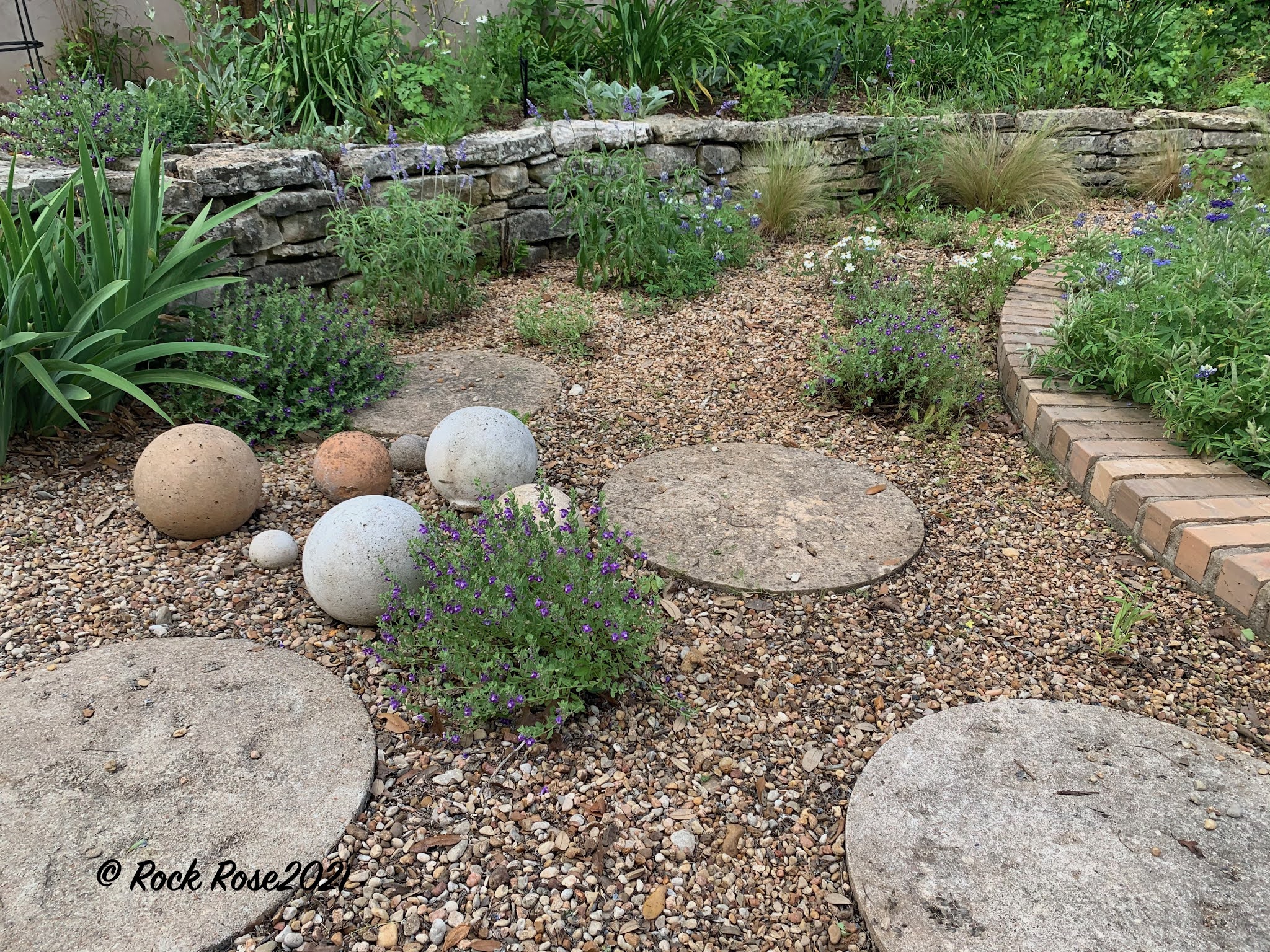
Ah! The other plants in the gravel can breathe again. The skullcaps, Scutellaria sp.blackfoot dasies, Melampodium leucanthum, mealy blue sage. Salvia farinacea. These much more mannerly plants who will only occupy a small area. I am more than happy to have them brighten up the larger expanses of gravel.

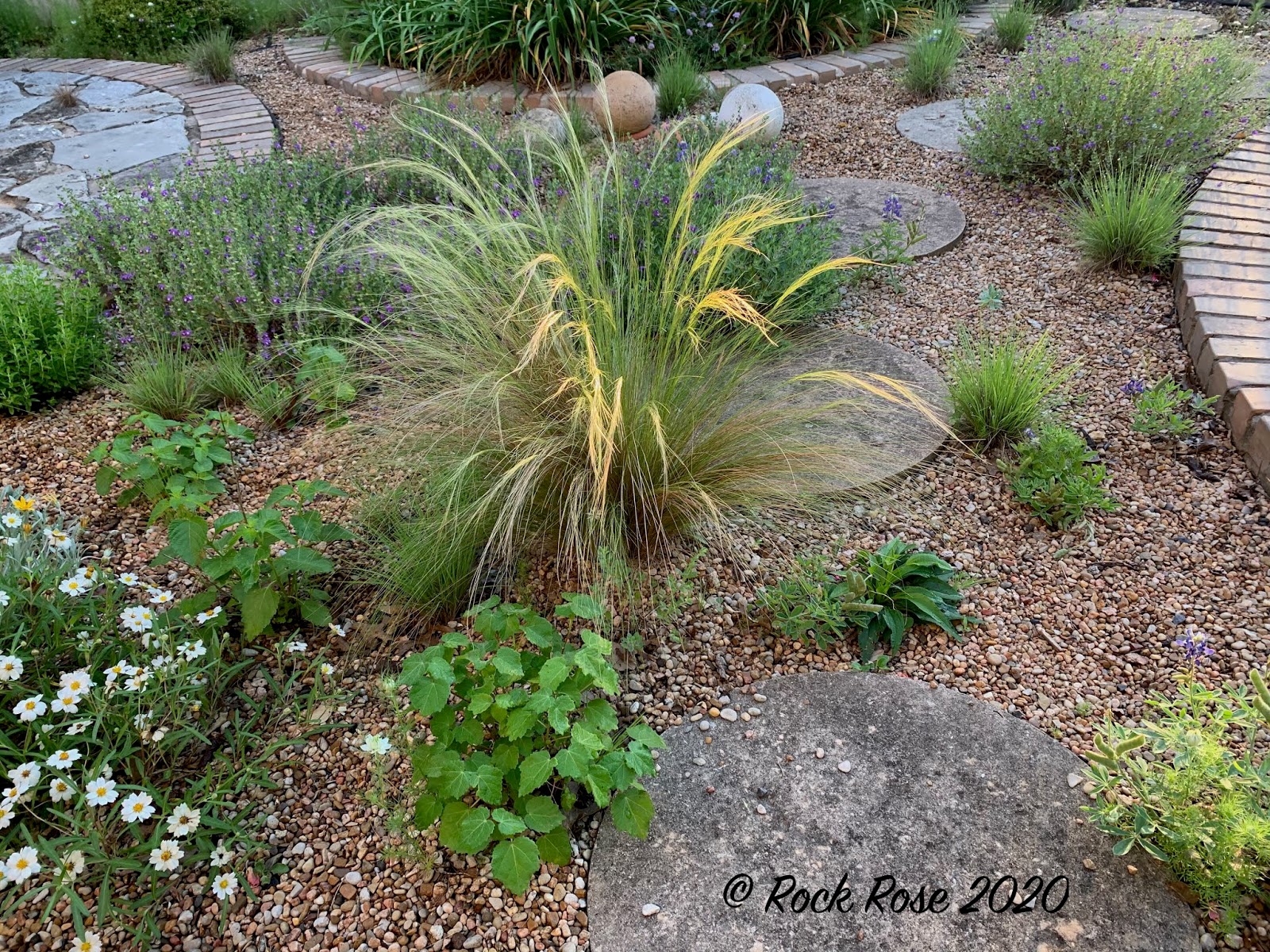
An occasional ruby crystal grass or Mexican feather grass. 


My absolute favorite fro this gravel garden is the purple skullcap, Scutellaria wrightii, I prune it to a more rounded shape in the spring and scatter the seeds around in the fall.

The other players permitted to remain in this garden are ruby crystal grass, Melinus nerviglumis, Mexican feather grass, Nasella tennuisima and a modest amount of love-in-a-mist Nigella damascena.


I will remind myself next year that this is the look I prefer and certainly saves days of work.


Friday, April 24, 2020

THE ENGLISH GARDEN...NOT EXACTLY

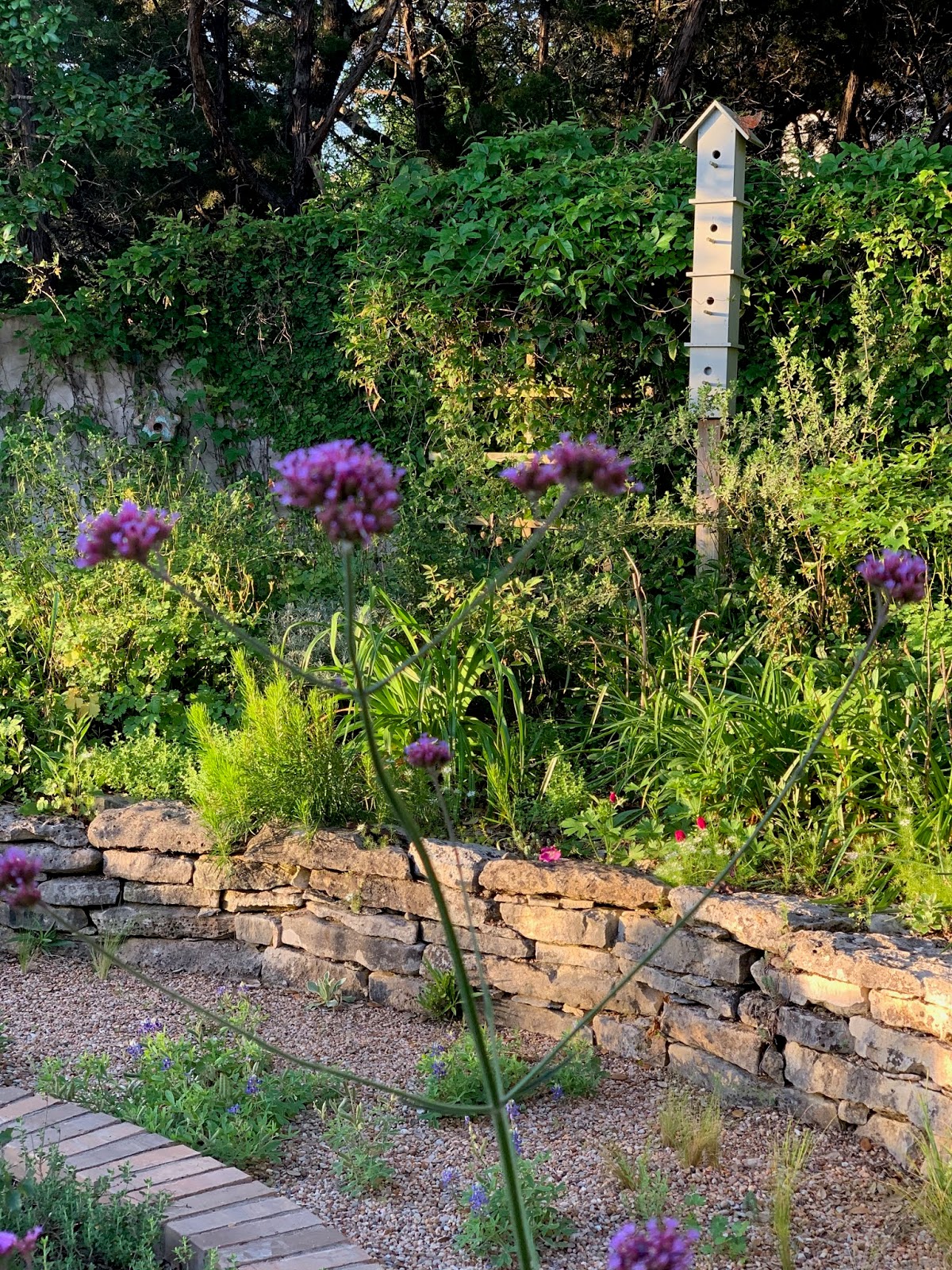
I named the English garden for the dry stone wall I created. A reminder of my childhood in the north of England where drystone walls were created to divide farmers' fields. I quickly discovered when we started building the house that there was a wealth of perfect stone at my fingertips. Flat pieces of stone suitable for building stone walls without any mortar. I began saving them and shortly after we moved in the house I began the project.


The wall creates a raised bed which follows the curved wall which encloses the garden. This was really necessary if I wanted to grow anything.
I love to capture the sun just as it peaks through the archway in the morning.


It lights up the Mexican feather grasses.


Not all English gardens are cottage gardens with lawns. In England there are many gravel gardens and gardens planted in the Mediterranean style, and although I didn't imagine this at the time, it is the way the garden developed and it made sense to eliminate lawns completely. It would have been so much work getting a lawnmower in here and so much more water to keep it looking good. Instead I decided on gravel and I am really happy with the way it looks most of the time.


In my usual style a majority of the plants growing in the gravel have self-seeded and although it is work to keep it under control when it is at its best it looks great.


I confess I did plant the silver leaf gazania last year and it survived the winter.


A few days ago the gazania was looking wonderful and then with the heat yesterday and today it just started to wilt. Maybe the underlying soil was just too wet from all the rain we have had this spring.
One of my favorite flowers which have had wonderful success are the skullcaps-particularly the native Wright's skullcap, Scutellaria wrightii. It is one of the few plants that will last all through the year and with an early spring trim will stay in a mounding shape. When I prune off old growth I walk around sprinkling the seed into other areas. That and the Blackfoot daisy, Melampodium leucanthum, require no irrigation.


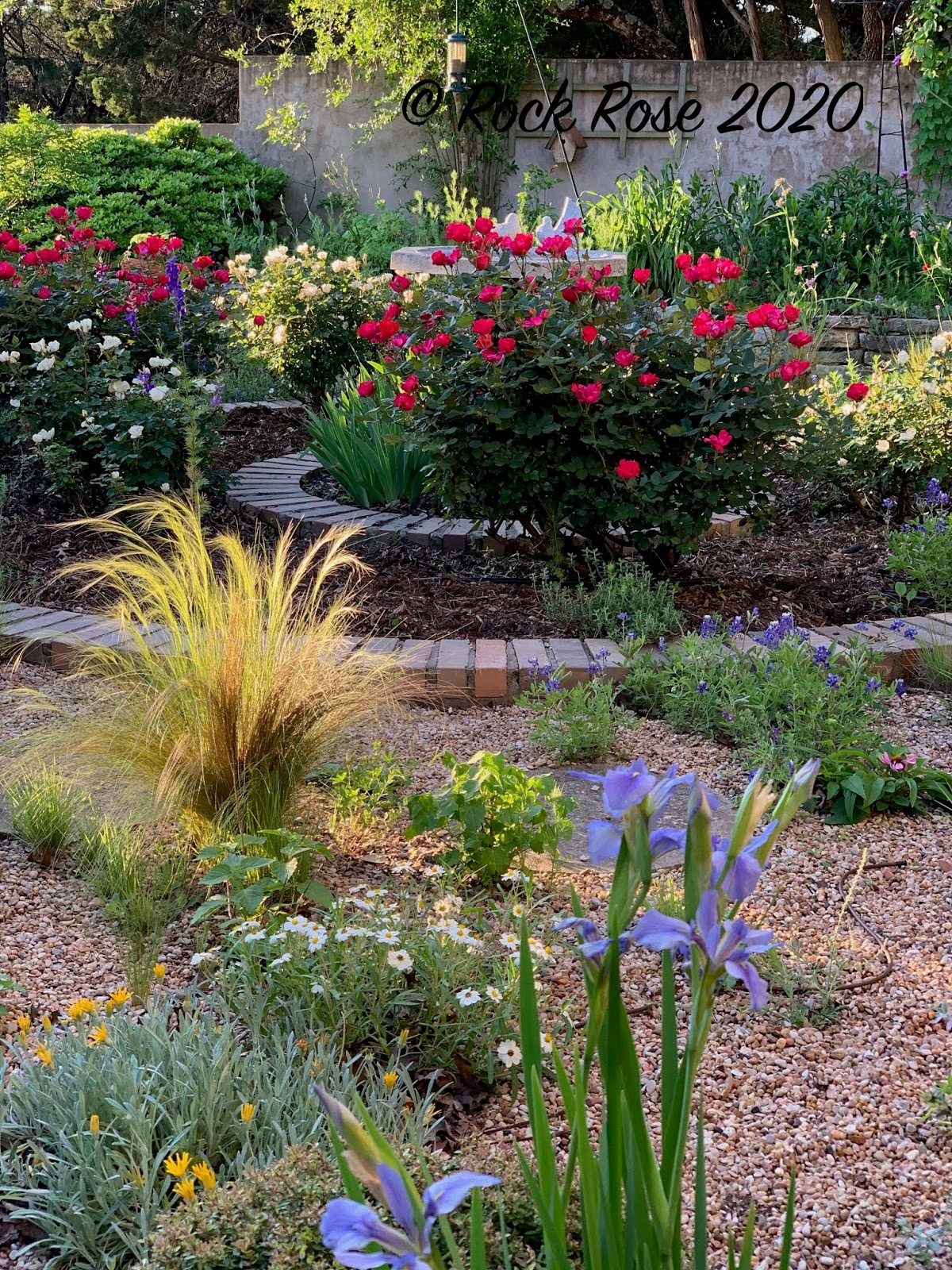
An English garden should have roses and yes there are a few of these but I could be doing so much better. I originally planted 3 knockout roses around the birdbath in memory of my mother and a friend who died of breast cancer. Then added 3 white ones in between. Unfortunately one of the red ones died and I have been planning to replace it for several years. Yes, with just another knockout rose but quite honestly they are fuss free-so far. No bugs, no blackspot and as long as they don't get rose rosette disease they will stay. And if that happens I will switch to salvias.


But my other roses are not doing so well. So far this year Felicia has had blackspot and thrips but still still she has managed to provide me with wonderful fragrance when I have been working outside.
My idea was to replicate the pillar roses I had seen at Mottisfont, but then I am afraid I don't have their expertise. It's not too late to give them a big trim back because Felicia is a reliable repeat bloomer through the season.


But my big failure has been in that raised bed I created. I never put any thought into the planting and just put plants in there willy nilly. Mostly passalongs. The shasta daisies have almost taken over one section and the pale pavonias are crowding out other plants with their scrappy stems reaching for the sun. One side gets more sun than the other and the vines on the wall have moved into the beds. It is my plan to overhaul the whole bed or in the very least move some plants out of there. But that has been in the plan for a few years so we will see how far I get this year.


The garden is always a work in progress.

Wednesday, November 22, 2017

HOW PAST AND PRESENT INFLUENCE YOUR GARDEN STYLE

I watched a program on you tube today. Carol Klein talking about rock gardens in England. More than anything I found their history interesting because the town where I grew up, in England, had these fabulous rock gardens along the promenade. They were built inside the naturally occurring sand hills that ran along the shoreline.


Not only rock gardens but ponds, waterfalls and stepping stones to climb over.

And in the park there were some fabulous rock structures with bridges and places to climb. Such a fabulous place for children to play. The original bridge was not made to last and was replaced with something more suitable by the time I came along. Our family made frequent visits to both these places and I got to run around, climb and explore.


And my grandparents, who built their house and garden in the 1930s, also had a beautiful rockery. But all that stone for these structures had to be transported to our sandy coast from other parts of Lancashire and Yorkshire, where there were abundant areas of limestone and limestone pavements. Fortunately the time came when someone put a stop to the pillaging of these natural areas and rock gardens went out of fashion.

Fast forward to 1994, Austin, Texas.

This is the first place I have lived where I had a rock quarry in my garden. Our garden is situated on the Edward's plateau, created millions of years ago, from an area once covered by shallow seas. A vast bedrock of limestone sits beneath us. Much of the rock has been fractured by earth movements and water creating some beautiful if not heavy chunks of rock. At our first house, built in 1994, and barely a stone's throw from where we live now, I was excited to be able to to recreate some of those memories from my childhood. The land behind the house rose steadily and to help with run off from Texas deluges we cleared an area behind the house and then hit rock.  It was hard graft taking out tree stumps( David borrowed a come along from someone at work! only in Texas) and when we couldn't remove some of the large rocks we just incorporated them into a rockery.


At one end we hit ledge stone so we decided to make wide steps to access the upper level where we planted buffalo grass. We also created a little patio. I'm glad I took these photos because I had completely forgotten how it looked. When we sold the house the new people put in a pool at the top. I wonder if they kept our rock work?


And so to this house, which we built in 2000, because it was going to be my last chance to have a flat lot with gardens protected from deer. I had some idea about courtyards and herbaceous borders. Clearly I had forgotten about what was beneath my feet, which would make it impossible without raised beds.
 With our garden being one of the gardens on the Garden Bloggers' Fling next May I thought to give our future visitors a little background to my garden style, aided and abetted by my dear husband, David, without whom much of this would never have happened.

Garden no1, The English Garden
Clearly spurred on by the success at our previous house I collected every flat rock that ever appeared when we were building this house. I was down here every day making a monumental pile at the back of the lot. I know the builder thought I was crazy. (Little did I know what was yet to come.) It was a  project dear to my heart. To create a dry stone wall, so prevalent in northern England, which would follow the curve of the existing garden wall.

The builder leaves the scene
It was an easy decision to make because what else could you do to make a raised bed but to follow the wall. With the name Wallwork in my family history surely it came easy. It did, however, come with a trapped finger and hours of pain after bleeding under the nail. And if you have ever had that happen you know what has to be done! I really loved building that wall and was inspired by those Lancashire dry stone walls to call this garden the English Garden.
My one regret is that I have never managed to get those beautiful crevice flowers that you see cascading from English garden walls. I refer to the campanulas.


But one thing led to another. More circles; circles of brick infilled with stone to make a patio, and circles of stone to enclose a bird bath and roses, and half circles on brick and inlaid stone to form landing areas from the house and archway. We were lucky to find a pallet of bricks in the perfect color at the Habitat for Humanity re-store. David built the brick surrounds, and together we cemented and mortared the stones. Not a job I will forget. I then suggested some circular stepping stones would break up the expanses of gravel. David used various molds to make the stones filling them to within 2" of the top with sand and pouring concrete on the top. To make the stones look more natural I would imprint them using various rough rocks. Sometimes I was out there in the dark.


This patio is a favorite place to have breakfast in the summer, sheltered, as it is, from the rising sun.


And in keeping with all those circles a few homemade hypertufa balls and glass balls from defunct outdoor lighting break up the expanse of gravel.


Lots of plants self sow in the gravel. Bluebonnets, larkspur, nigella in the spring and narrow leaf zinnias and gomphrenas in the fall.


All this rock clearly went to our heads because next David decided turn his hand to building a retaining wall where there had once been an ugly slope. You can just see the wall through the gate below.


No rock was too big for him to haul uphill from our "quarry" He estimates he moved several tons of rock. This area, outside our garden walls links the small Secret Garden with the English Garden. It is open to deer with no irrigation so a restricted planting.


And on garden does lead to another. Through the archway the sunken garden awaits our visitors.


I hope you will come back to read all about the rocks in there.

Sunday, September 17, 2017

THE SEPTEMBER GARDEN

When hurricane Harvey slammed into the Texas coast, 200 miles away, it brought some much needed rain to Central Texas. Along with that we saw a significant drop in daytime temperatures but more importantly night time temperatures in the low 60s. Warm days and cool nights. For a few days it was like being in California. The plants showed an immediate response; the sickly yellow leaves greened up and the flowers colors brightened. It was glorious but not to last. Still, for those brief few days I enjoyed every moment in the garden.
Sometimes I think fall is better than spring. Everything in the garden has become more blousy. There is barely a scrap of earth or gravel to be seen.


I never know from one year to the next how this will look or which flowers will be present-except there will always be plenty of rock roses.


The Salvia leucantha I have been planning to move for years is still there. The hummingbirds are very adept at flying in through the window in the high wall that separates the gardens.


A week ago there was but one bloom on the butterfly pea, Clitoria ternatea. Now there are many. The blackfoot daisy, Melampodium leucanthum, continues to spread across the step.


Ruby crystal grass, Melinis nerviglumis, is flowering. There will be plenty of those again next year.


  Globe amaranth, Gomphrena haggeana, 'Strawberry fields' is everywhere.


As are the purple and pink varieties growing in the pathway of the vegetable garden.


The spider zinnia will eventually be evicted from its home in the vegetable bed but I will save the seeds for next year.


In the sunken garden it grew where the white California poppy once grew.


In the sunken garden there are gomhrena, pink and purple skullcaps, aura, mealy blue sage, white Salvia greggii, and an errant member of the cucumber family which came in on the compost.


As well as zexmenia, Wedelia texana,  chocolate daisy, Berlandiera lyrata,  and returning alyssum.


But the absolute show stoppers of the moment are the liatris in the front courtyard. Purple is definitely the color of the moment.


Last year I removed many of the bulbs and planted them outside the walls. It seems that every seed germinates but they are silent all summer until their bloom time in the fall.


Phlox paniculata John Fanick, After the first flowering I pruned it back and here it is again. Smells wonderful.


Trailing Snapdragon vine, Asarina procumbens is a native of Mexico but seems to do well here as an annual.


Tradescantia sillamontana with its cobweb leaves and pretty pink flowers, easily grown from cuttings.


In the spring I bought a hanging basket because it looked simply gorgeous. I repotted it into a larger basket with baby diapers in the bottom. It was an impulse buy. It has been watered all summer on a drip system twice a day, and received an occasional fertilize. I have cut it back completely about 3 times. It took a beating on one side during the hurricane but is recovering.


The mandevilla vine is into its second year. I cut it down and put it in the potting shed last winter. It dried out and went dormant but started to come back after a good spring soaking. I will try to keep it for another year.


It is wonderful to see so much color back in the garden and there is still the Philippine violet yet to bloom. Soon it will be fall and these icky-sticky days will be a thing of the past!