My Blog List

Showing posts with label Anole. Show all posts

Thursday, October 3, 2019

WE ARE NOT GOING TO WAIT

With only a modest sign of an end to our long, hot, dry summer, it is a surprise to find some of our fall bloomers still blooming more or less on time. The biggest surprise of all is the first-time blooming of my Lycoris aurea, the golden spider lily.


Five years ago I purchased 3 bulbs at an end of season sale.This is the first year that they have bloomed. The Lycoris family seem to be incredibly fickle when it comes to their willingness to bloom. I did a little research and it appears that a period of dry heat encourages blooms. We have had on 1/2" rain in three months and above normal temperatures through September.  It will be interesting to see if other gardeners share this same success this year.
The Lycoris radiata, red spider lily, while more of a consistent bloomer, had seven blooms this year. I think that is a record.


Of course the Oxblood lilies were not going to be left behind. In fact they were the first to bloom after a scant 1/2" rain. There must some other trigger too because they have had some water from irrigation this summer but there was no sign of life until a few days after the rain. Day length and possibly barometric pressure is my guess. g.
Unfortunately daytime highs were still in the triple digits so the blooms didn't last very long.


The Philippine violet is one plant that every southern garden should have. After winter dormancy, in which it dies back to the ground, it spends the whole summer putting on several feet of beautiful green growth, and begins flowering in October. The original plant has seeded in several places including at the foot of the dry-stone wall in the English garden. I know it is pointless trying to remove it so I will just let it stay. Flowering on this one is a little ahead of the other ones.


I have two that seeded along the edges of the patio in the sunken garden. They have been growing there for many years, disappearing over winter and returning to bloom in the fall.


I have had little success trying to move other seedlings although I have one more new seedling which I will try to move over winter.
This morning I watched an anole on the plant licking something from the leaves. I wonder if it was a small amount of water or even some substance exuded from the leaves.


Talking of which...  the amazingly fast growing candlestick plant, Senna alata, began growing in one of my vegetable beds at the beginning of August. It is about to bloom and the ants are busy helping it along. Ants always mean sweet stuff and the nectary glands on the edges of the petals exude sugar which the ants are busy farming. They do the same thing on peony flowers. No harm done in this case except for the fact that the ants are in this bed.


It's time for the Japanese anemones to bloom with their never-quite-perfect flowers.


Large arching branches of the bush clover, Lespediza will soon be covered with pretty pea blooms.


So the fall season is not all lost just as long as we don't go straight into winter. I know some gardeners in the North did so this week.

Monday, May 22, 2017

WALK YOUR GARDEN EVERY DAY

Let's look at the really rewarding part of gardening; the walking around and taking in what you have achieved and then those, somewhat rare for me, moments, just sitting and enjoying the sights smells and sheer loveliness of nature.

On Thursday, I went out, camera in hand, to see if there was anything new. Wow! The Echinopsis was blooming. Three gorgeous pink flowers on what I believe is Anastasia. Isn't she gorgeous? It is a fleeting flowering with the buds opening during the night and closing by lunchtime. Their job over.


I can't tell you the number of times I have missed that fleeting moment, but not this particular day. Thank goodness I walked around in the morning because I could so easily have missed the open flowers. You can see another bud between the two flowers and that one opened on Friday. One of the withered flowers is visible to the right.


I don't know if there are night-time visitors. Maybe they don't exist here because this is not the natural habitat for the Echinopsis which comes from South America. The only visitor I have ever seen is a tiny bee and he was there again today rolling in the pollen. In fact there were two of them.


That was not the only cactus to be blooming on Thursday. Along the outside edge of the walls I found another cactus in bloom. This one is the Nipple cactus, Coryphantha sulcata, a Texas native. The flowers last a little longer, usually a couple of days. I'm happy to say that the rains last summer have prompted number of babies to pop up around the base although it will be years before ti forms a good sized clump.


There was another surprise in the front Bluebonnet( currently bluebonnet less ) meadow.


A single stem of standing cypress, Ipomopsis rubra. Where did that come from? It was right next to the clump of lace cactus and I had never noticed its feathery foliage before. The one standing cypress I did have in this bed, and which I had been watching for weeks, had had its top nipped off. Deer!!! I must think about getting some seeds to plant in this area in the hope of more flowers.


I was surprised to see the first Mexican hats, Ratibida columnifera, blooming. I wonder how many different colors of flower will show up this year?


That prompted me to go up to the top meadow and see if there were any more colors. A little disappointing this year.


But I did observe all this activity on the milkweed pod.


I left them to it and walked down the culvert where I saw these tiny beauties.Mountain pink, Centaurium beyrichii, and the tiny yellow, ubiquitous daisy. I must try to collect seeds from the mountain pink because I think I have a place for it inside the garden.


And returning through the gate there was the anole waiting for a photograph.


Even if you don't take your camera with you take a walk around your garden every day. You may find some surprises.

Saturday, November 19, 2016

THE END IS NIGH

Our long summer will end this weekend with a frost.


By Monday there will be no flowers draping over the open greenhouse door. It has been the latest bloom on the cross vine in my memory.
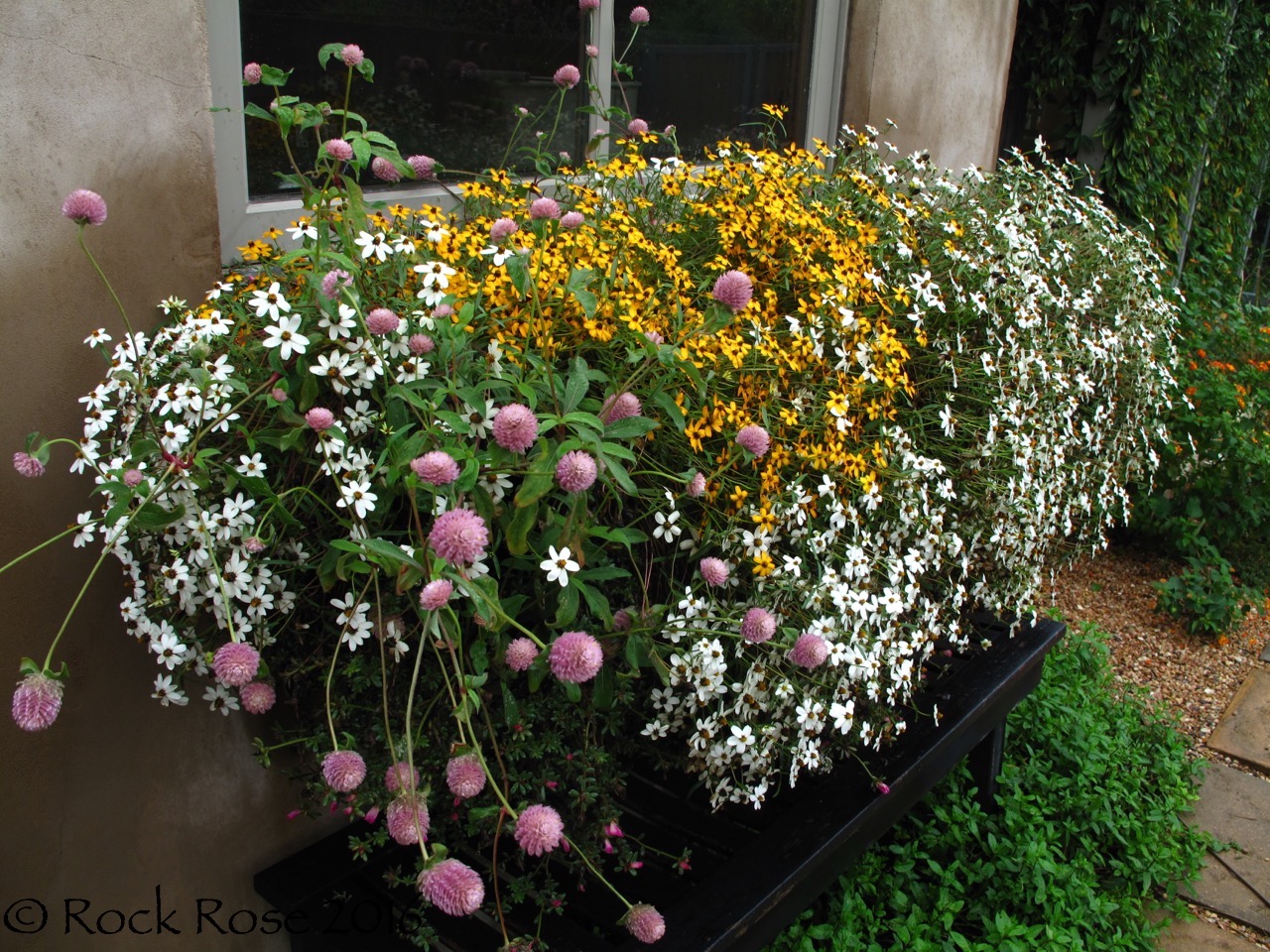
The window box against the potting shed will be replaced by a box of winter annuals patiently waiting in the wings.


Seeds will be collected from the narrow leaf zinnias that have performed through the hot summer.


All the cactus and succulents and citrus have left their summer homes for the potting shed greenhouse and house.


The anole is wondering what the heck is going on. All his favorite plants have disappeared.


The two large plumerias are inside the house.

And what will become of my lovely papaya tree.Too big to try to cover it will undoubtedly be a shriveled mess by morning. I might try putting a fan underneath it to keep the frost from settling but it will only be a temporary stay. But let me think about that some more.


Only a crazy gardener would try to protect such a plant.


I am praying that a papaya will not seed itself in my garden next year. I'm getting too old for these kind of antics.

Monday, October 14, 2013

NO GARDENING TODAY

A day without gardening is like a day without....sunshine. Neither of those today as a strong rain system hovers over Central Texas. It did bring us much needed rain yesterday, in fact too much for many, as creeks overflowed, houses flooded and ACL was cancelled. My rain gauge flowed over at 6" so I have no idea exactly how much we had but we estimate from a filled bucket it was closer to 9" About 3 miles away they had 12" Today brought another inch.


This is Barton Creek at the bridge on Lost Creek Blvd a mile from our house. Before they built the bridge this flooded roadway was the only way across. We used to call these fords in England. As a child it was always so exciting to cross a ford. In Texas crossings like this are a death trap when we get heavy rains. Lives are lost.


We have never seen this before. Along our road water was pouring out of the ground at the base of the cutting, in two places. I had often wondered if animals lived in these holes in the rock. If they did then they probably got the ride of their life. It is typical of this terrain to have sink holes into which water flows during heavy rains. It found a way out here. But that was yesterday. It is still raining today and I did a couple of garden related things.


The first was to frame and hang this little print of a clasping coneflower, Dracopsis amplexicaulis. At the Wildflower Center last week, in the volunteer room, they were giving away folders of prints given to them by a local bank. I am sure you know how it is when it comes to framing prints. It costs a fortune, but then I am not really fussy about the frames and 50c with the mat certainly was too good to pass up. I have four prints so I will be on the lookout for 3 more!

The second job was to bring the cactus and succulents under shelter. More rain is forecast for tomorrow and I fear for their wellbeing.


And these two little chaps will be very happy that their plant is being taken under cover. This one looks distinctly under the weather.


Sunday, April 7, 2013

LINGERING AFTER LUNCH

One of the delights of having lunch outside is enjoying the garden. You couldn't possibly go back to work immediately after eating so why not linger a while and enjoy.


I have never been a great fan of Texas betony, Stachys coccinea, but I think it pairs quite nicely with this little groupling of artichoke agave, Agave parryi var. truncata,  Zexmenia, Wedelia texana, and purple skullcap, Scutellaria wrightii. I watched a hummingbird visit the other afternoon. It was busy visiting all the red flowers including this Claret cup cactus, Echinocereus triglochidiatus.


I just want it to keep on flowering but I fear the end of next week all the flowers will have faded. For now I think it is outright gorgeous. Behind the cactus are the seed heads of the Tulipa clusiana. I am told they are sterile and while I would normally snip them off they do have an interesting stripe.


Looking back towards the house is the Whale's tongue agave, A. ovatifolia, and the water feature and all kinds of self seeded Texas natives, including blackfoot daisy, Melampodium leucanthum, and four nerve daisy, Tetraneuris scaposa. Their blooms are a favorite because they keep on coming.


And a long shot of the garden looking back to the lunch spot.


A quick trip to the outside to look at the bluebonnets and it's back to work!


And a nod to this brown anole sunning himself on the cactus pad. Does he look a little old to you?


Friday, May 25, 2012

DANGER IN THE GARDEN

Show me a gardener that hasn't had an accident in the garden. Danger abounds for every one of us and that includes the critters that live in our gardens.


Do you think this anole was stalking? Or was he just sunbathing on the roof of the bee house. See the solitary bee hovering in front of the wood. He was busy building his nest in one of these holes and was clearly bothered by the anole. He did eventually move inside.
There we two lizard rescues in the garden this week. The first came from a lizard caught up n the netting I was using to train the snapdragon vine. I just happened to be cleaning up there when I saw him. It took me 5 minutes of cutting to unentangle him. The netting was so tightened around his neck it took some careful work to extricate him. Then I removed the netting which just about destroyed the plant. It was looking less than healthy so it was no great loss. Later I went back to check on the spot where I had left the lizard; he was gone.


The second rescue was a near drowning of this blue tailed skink. I scooped him out of the air conditioning drain bucket into which he had mysteriously fallen. He was stunned enough that I could rush into the house to get the camera. A few minute later he scurried away under the AC. I see many skinks but never a blue one. He has the lines on his head only so possibly he is a juvenile.
Then it was my turn. Working under the Spanish bayonet yucca I felt a stab and then a trickle down my face. Scalps do bleed!
Two vultures were circling overhead and when one landed on the parapet wall above me I decided it was time to go inside and mop up.


Thursday, November 17, 2011

BE CAREFUL WHO YOU BRING INSIDE FOR THE WINTER

There are always a few lucky plants who get to spend the winter inside the house. Partly because the extra greenery is nice to have inside and partly because both potting shed and greenhouse will be full up again this year. Most of the ones which come inside will not require any water over the winter. If we are away for a period of time then plants which require more water will go in the potting shed where the humidity levels are higher.


Close inspection of plants is a necessity. After all, there are probably hitch hikers down there among the leaves. It's not unusual for me to bring lizards into the house. I was carrying in a sanseverai last year and as I walked down the hallway to the place where it was going to spend the winter I discovered an anole pressed up against the long leaves. I did a quick turnaround. Yesterday while moving this aloe plant a few feet out popped another anole. Such darling little critters. He must have just molted becasue you can see the old skin on his tail.


I brought some cactus inside but had to find new trays for them because on two of them the preying mantis had laid its egg case. I don't want a repeat of trying to catch all the little mantids as happened one year when the mantis laid its eggs on one of the branches on the lemon tree.
Make sure you check out your plants for hitch hikers.