My Blog List

Showing posts with label kale. Show all posts

Monday, December 7, 2020

KALE AND CALAMONDIN

This time of year two wonderful garden crops are ready to bring into the kitchen. In the heat of summer I was anxiously awaiting cooler days and the vegetable garden rewards of our mild winters. I sowed seeds of kale, chard and pak choi in 4" pots in my laundry room moving them to the potting shed and under lights when they had a few leaves. This gives them a head start and a better chance of surviving the ravages of the decollate snail and pill bug decimation. I chose the curly kale because we like the slightly bitter taste. Not only do they have a high germination rate but they stay viable for a number of years. 


The packet I used was packed for 2017. The leaves are now of a good size for picking with 6 leaves enough for a meal for the two of us. I find kale much easier and more worthwhile to grow than spinach. If you are going to grow kale it pays to find some good recipes. Yesterday morning, in a chapter on winter greens, in a 2006 edition of Bon Appetit magazine, I found the following recipe. 

Other than the fact I did not have the more exotic mushrooms (I used baby bellas) I had all the other ingredients to hand including the thyme which I also grow.

It looks exactly like the photo in the magazine and was absolutely delicious. A definite keeper. We had it for dinner but it would make a really great special lunch dish too.


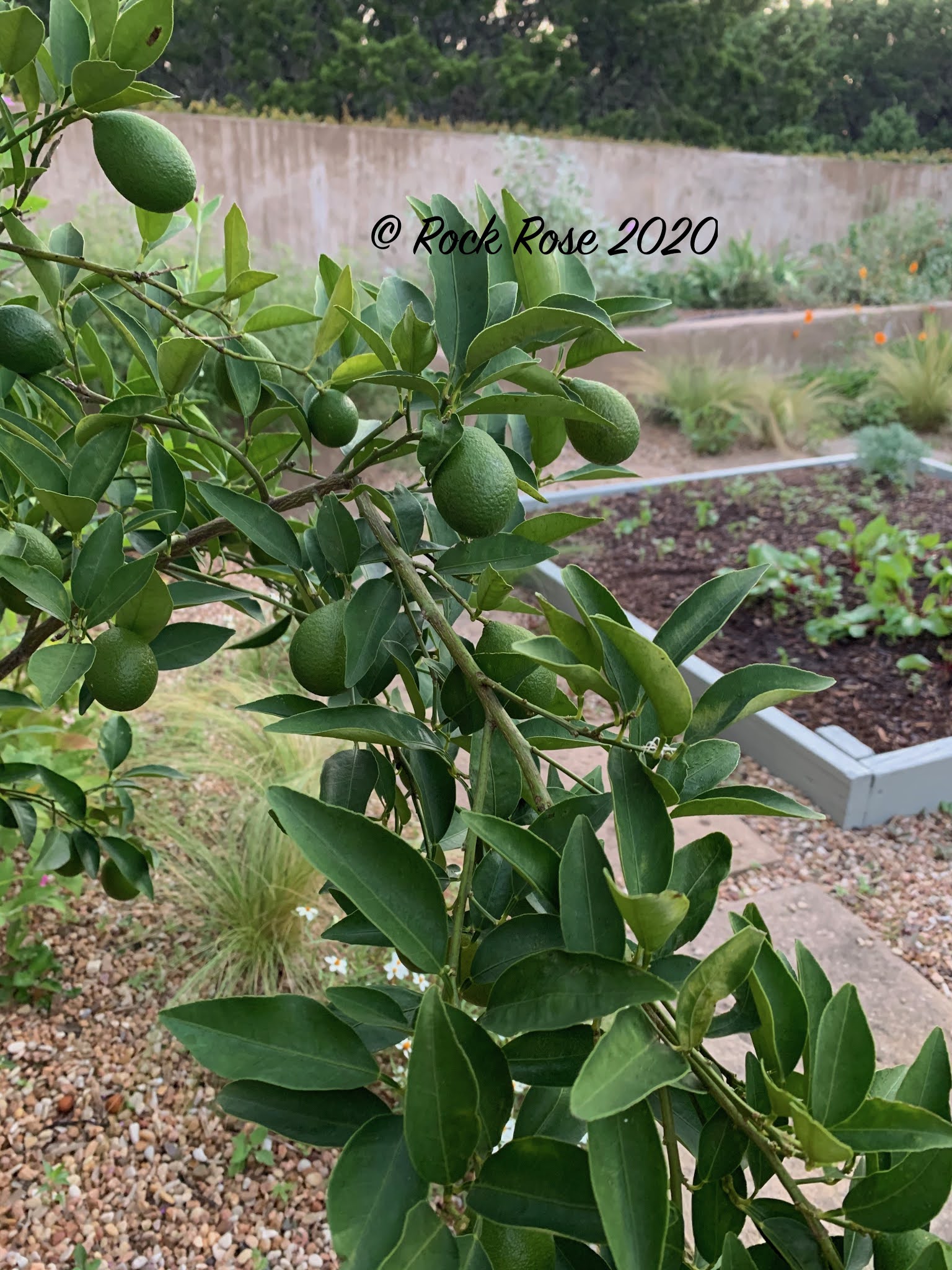
Later on in the day I went into the garage to make the first picking of calamondin fruit. The plants were wheeled into the garage a week ago because of an impending freeze. We were far more sensible this year keeping the pots on the driveway all summer and then using various wheeled carts to bring them in. They are now permanently on a variety of carts for the winter so we can easily transport in and out. 

When we lived in Hong Kong we saw hundreds of these trees at Chinese New Year. They are given as gifts and represent good luck and wealth. The Chinese word for the tree is very similar to the word for wealth. But they are more than just decorative trees they make the most delicious marmalade.
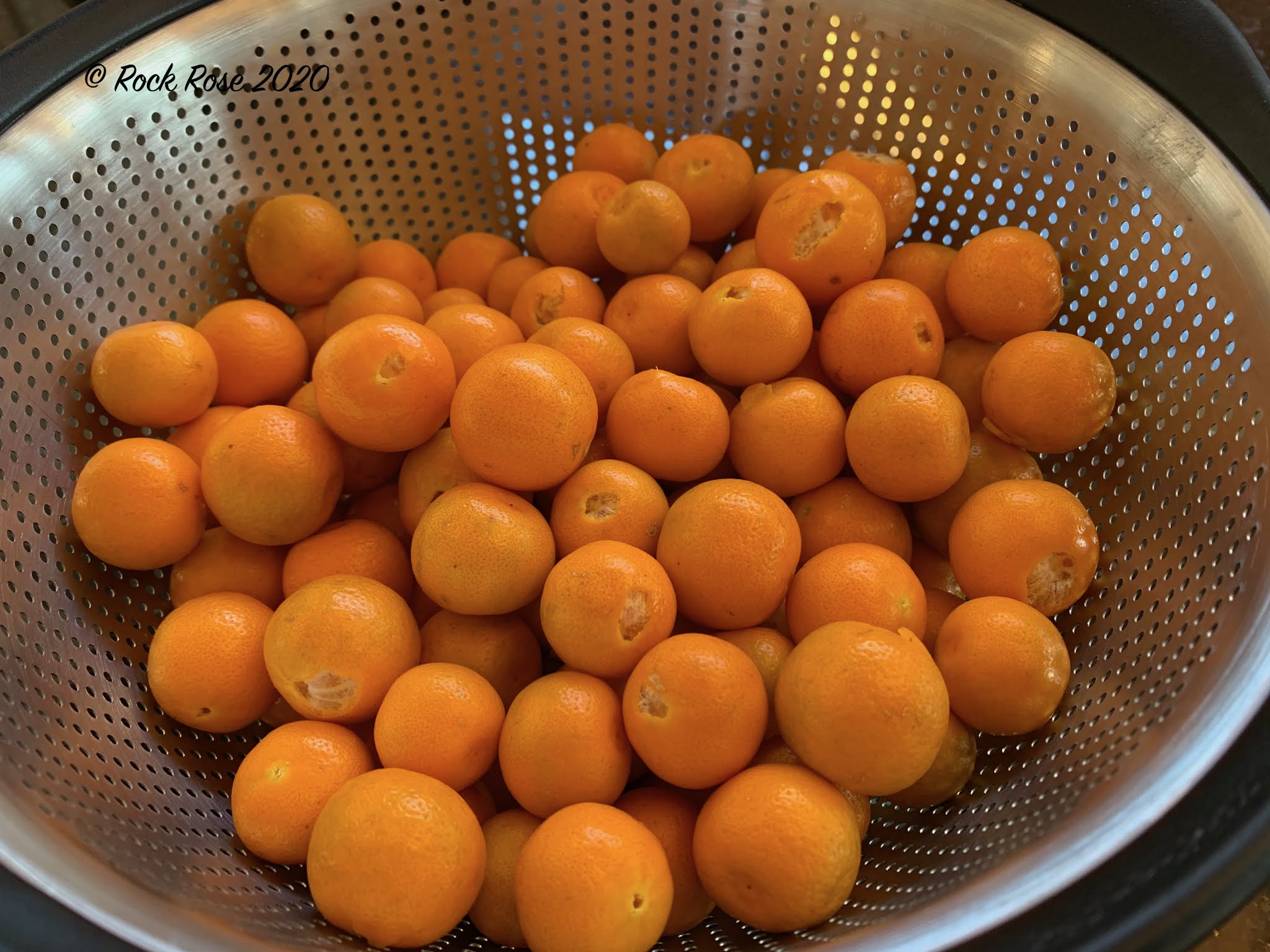
Making this marmalade is a real labor of love but so worth it for the absolutely delicious sweet/tart combination of flavors which we love on our toast at breakfast. And there is absolutely no waste as every scrap of the fruit is used, even the pips! Here's how to use your calamondins.

Cut the oranges in half.

Squeeze each half, to remove all the pips and juice, into a sieve over a a bowl. Then slice all the fruit peels thinly and add to the juice. Tie the pips in a muslin bag. For each cup of fruit add 3/4cup water into a large non-reactive pan tying the muslin bag so it is in the mix. Boil for 20 minutes. Cool and leave overnight in the fridge to allow the pectin to develop.

Measure the fruit again and for each cup add one cup of sugar. No pectin needed.

I like to use the spoon drop method for testing readiness but you can also use a cold plate or even the candy thermometer to jelly set, 220°

Pour into sterilized jars. No need to can. First batch completed. Lids popped and a good set achieved.

So incredibly delicious on my morning toast.


Wednesday, October 14, 2020

FALL IN THE VEGETABLE GARDEN


 Over the last few weeks I have concentrated some of my gardening time( just an hour or so a day is still all I can manage) on preparing the vegetable and herb garden for the fall/winter growing season. Arguably the variety of crops that can be grown successfully over winter far out-number those grown during the spring/summer season, although some of the fall plants will mature during the early spring.

 Before I could even begin to prepare the beds I had to first remove much of what had been growing in the pathways all summer. This included the many grasses, blanket flowers, gomphrena, pink, purple, strawberry and 'Fireworks." I am always torn between having flowers spilling over the pavers and the neat and tidy look of having nothing to impede moving around when working out there. When I clean everything out in the fall I know this is the look I like but then when they all start growing in the spring I like that too. How to balance this with the hours spent removing them is the challenge at this stage in my life.

Even now I have left a few to enjoy the last of their blooms.

Then I had to tackle the beds themselves, removing the layer of cedar mulch that had been been on there for 2 years saving it to either mulch another area of the garden or return to the beds after planting. Each bed got one bag of new 'garden soil' purchased from a big box store. 


We decided that because our gardens are so difficult to access that it was more economical on the body to move them by the bag. Plus we no longer have a truck to transport bulk material. 


 Weeks ago I started some winter vegetables inside, under grow lights.  I find they stand a better chance against snails and caterpillars if they are a decent size when planted outside. 

broccoli, baby pak choi, kale


             red cabbage, parsley

Beets and carrots were sown directly in the ground. They are now up and growing well. One of my weaknesses is my inability to pinch out plants but with the beets as soon as they are big enough to add to the salad bowl. I promise I will!


Kale, pak choi, broccoli and cabbage are now all big enough to go into the ground.


I have a few packets of seeds including Napa cabbage, lettuce and radish which I will direct sow over the next few weeks. 

Peas are struggling with the heat. I probably planted a little early. 


We kept the citrus trees out on the driveway this year, mainly for ease of transport into the garage during periods of freezing temperatures. All that is except the smaller kumquat and the orange. The kumquat was a rescue citrus and it was a few years before I even knew what it was. Last year was the first fruiting which has increased this year. It makes great marmalade.

I see the beginnings of ripening on one of the fruits.


The orange tree has not done so well. One last chance to improve itself!

Wednesday, January 1, 2020

HERALDING IN A NEW YEAR AND A NEW DECADE

In the words of Dickens "It was the best of times, it was the worst of times" That sums up my feelings about 2019. We had exciting travel, wonderful visits with family and friends but a ghastly 4 months of chemotherapy. Then on December 17th my final round of Big Chemo. It can only get better from now on and into 2020.

I even managed to do a little gardening on my good days. I have a good winter vegetable garden with lots of broccoli, chard, kale and pak choi. The broccoli is almost ready to pick-a lot earlier this year than other years.


The pak choi is full and juicy and was often on the menu over the holidays.


The red cabbage are starting to form heads,


The cardoon that grew in one of the beds last year is back again. It will take up the whole of this one bed but worth it for the striking flower heads.


I am not without having made a New Year resolution for 2020. I will keep the pathways clear in the vegetable garden. It won't be easy as already hundreds of Ca poppies are sprouting, along with blanket flowers and feather grasses. Well! maybe just one or two will get to stay!
Next week begins part two of my treatment as I head to surgery. Fingers crossed.

Friday, September 29, 2017

MY WORST ENEMY HAS ARRIVED

It was just a matter of time before we were finally blessed with a good rainfall. In all a total of 3.8" fell over a period of two days. I'm expecting the arrival of plenty of weed seedlings as well as bluebonnets and other spring annuals over the next week. But the one thing I have been dreading is the awakening of the snails after their long summer nap. They have arrived and they are hungry, and not for brown vegetation. They want fresh greens. How perfect was their timing to coincide with the young tender chard and kale leaves, as well as emerging seedlings.
Maybe other gardeners don't bother much about the slugs and snails in their garden. It depends mainly on what you are growing as to whether you will notice their feeding habits. They love vegetables, so those tender seedlings are first and foremost on their menu. But they also love the flowers of the blackfoot daisies as well as seedlings of larkspur and many other annuals-but not nigella (love-in-a-mist). If I sow some seeds directly in the ground I will never see a single plant, so if you ever wonder why a packet of seeds never germinates the snail may be your culprit. The only defense is to cull their numbers dramatically.


I have been out hand picking and have already done away with hundreds. It worries me a little that a new snail has appeared this year... this tiny round one. I am not sure yet if they are just babies but they are more difficult to spot in the gravel and I am not going to let them multiply into great numbers.
The more common ones for me are the decollate snails. When they first appear their shells are complete but wear and tear breaks off the tip.


In the gravel they try to bury themselves but that broken off tips is easy to spot.

 
They gather in large numbers underneath the blackfoot daisies and can shred the flowers overnight.


There are many suggestions for dealing with slugs and snails. Hand picking takes time but is well rewarded. Small containers of beer partly buried in the ground works well. Empty grapefruit halves turned upside down and left overnight will bring them running as well as the pill bugs. Carrot peelings placed under the shelter of a plant will attract them but you have to remember to remove the snails in the early morning before they return to their shelter.
Using baits is the easy way. Sluggo or Sluggo Plus, both certified for use in organic gardens, work really well. The Plus formula also eliminates other pests such as earwigs, pill bugs, army worms and cutworms. But I prefer not to wipe out everything in the garden just to control their numbers we have a reasonable balance.
On to the next pest of the moment. Caterpillars on my vegetables. These little devils have been making lacework out of my curly kale. I have been feeding them to the little fish in my stock tank pond. Talk about piraƱa activity when I drop them in.


I could spray with Bt but that involves making it up. Just easier to pick them off.


I didn't even notice the nymphs of the leaf footed bugs on the peppers until I looked at the photograph. You can just see them on the largest pepper. I thought they left with the tomatoes.


Thursday, December 18, 2014

DREAMING OF A GREEN CHRISTMAS

You may be dreaming of a white Christmas or there may be visions of sugar plums dancing through your head. Over here we are thinking of lots of greens. I am having a really super winter vegetable crop year. With only 2 frosty nights and lots of warm sunny days and a sprinkling of rain it must be perfect conditions. I even have peas! The first successful fall planting.

There's lots of this. Napa cabbage.


Although the the first pick doesn't have a very tight head I'm not complaining. You can see what dish I made at the end.


Homegrown broccoli is so tender there is no need to peel the stalks.


And lots more peas in the making.


This particular snap pea is called Cascadia. It is tender at all stages even when the peas have fattened up in the pod. You'll find it at Botanical Interests.


Delicious peppery arugula. Cut and grow back again.


Dinosaur kale, delicious stir-fried in olive oil with garlic.


More peppery mustard greens.


Beds of chard and broccoli.


Multiplying onions, from Bob and Renee. The lemon tree came out of the potting shed today and received a root pruning. We lifted it out of the pot, amended the soil bringing it up to the right level and pruned some of the long straggly roots.


I finally got around to thinning a row of the beets the other day, putting the trimming in a green smoothie.


So this is the salad we had the other night  using the Napa cabbage. It is Asian style with a peanut sauce. You can add whatever you have on hand. I used cauliflower, carrots, radish and bean sprouts. Topped with scallops and shrimp it makes a delicious meal. I have  Renee Studebaker to thank for the recipe, which she shared in the Austin American Statesman years ago. It's one of the reasons I grow Napa Cabbage.


Now to go outside and pick dinner.