My Blog List

Showing posts with label wildflowers. Show all posts

Tuesday, April 9, 2024

THE DESERT BLOOMS

When it rains in the desert at just the right time, the desert becomes a carpet of flowers. These are plants that rely on rainfall to grow, bloom and set seed in a very short period of time before the summer heat arrives.. It doesn't happen every year but this year was a particularly good one and we made the most of it by visiting the places where wildflowers were blooming. We took trips to the Anza Borrego Desert, the Boyce Thompson Arboretum and surrounding areas of Superior and our nearby Catalina State Park and Pima Canyon. We have hiked there multiple times this spring awaiting the desert bloom.

 The Mexican poppy or Gold poppy, Eschscholzia californica ssp mexicana is the most prolific of the annual desert flowers in our area. It is similar to the California poppy except for missing the small green sepal underneath the flowers.


 It appears in shades of gold and yellow and seen here with owl's clover, Castilleja exerta..

 The first time I saw it I thought how much it reminded me of Indian paintbrush and I was correct. It is in the same family.


Cream cups, Platystemum californicus, also blooming alongside the poppies and as the poppy prefers the open, hillside meadow area. Where it finds a happy place it blooms in large swathes opening its petals once the sun shines but remaining closed on cloudy days.

The desert zinnia, Zinnia acerosa, is on my list of seeds to buy. I hope to find a small patch of my garden to plant a wildflower patch. 

This hike is is one of my favorite hikes, the wildflowers just adding an extra layer of joy. The scenery is superb and at this time of the year there is water trickling down the mountain into pools known as bathtub tanks.

Another wildflower blooming prolifically is the scorpion weed, Phacelia distans. It is very showy when found in large numbers.


 Some flowers are prolific along the roadisdes including the Arizona lupin,  mallows and penstemons where they receive just a little more rain. They are different from the Texas bluebonnet in being a little taller, having finer leaves and smaller more upright flowers. 

                                                   Lupin, Lupinus arizonicus


                                                       Mallow  Sphaeralcea ambigua

Desert chicory, Rafinesquia neomexicana, is abundant in washes and on the hillsides and is particularly showy when found in a clump. 


 There are many more wildflowers blooming in the spring and every day when we are out hiking I feel fortunate when I find another new one to add to the list of the many flowers that bloom under the harsh conditions of the desert.

As the gold poppies fade the brittlebush, Encelia farinosa, comes into flower. It is a perennial shrub growing to about 3'. It seeds easily and I don't understand why it isn't used more frequently in the landscape. In our neighborhood of landscaper-tended gardens there is only one. The use of pre-emergent means it never gets to germinate. As you might imagine my garden has many blooming specimens with more showing up every year. It is so plentiful that I can be choosy about where it gets to grow.


But our visit to the Anza Borrego Desert yielded the most prolific of blooming carpets. It was a spur of the moment decision. We packed up the car for an over-nighter along with picnic supplies and headed west towards the Salton Sea. We had been only once before on a Thanksgiving trip in our VW camper in 1981. We had forgotten about the fact that it would be dark by 6 o'clock and with no campfires allowed and no other campers foolish enough to be out there. We ate and had the earliest night ever. And it was cold. We did enjoy hiking the next day and determioned to go back during a better time of the year. It had taken 43 years!

We knew exactly the spot to aim for. Henderson Canyon and were not disappointed.


It was incredibly windy and trying to get the flowers to sit still for a photo was almost impossible. The best spot was to find a larger growing creosote bush and hide behind. We planned to come back the next day.

I was on the lookout for the desert lily, Hesperocallis undulata. If someone on instagram had not mentioned he had found it I would not have known what or where to look, but as we drove along I had my eyes peeled for them. They are mostly found growing alone but I could spot the open lily from the car as we drove along. We had to stop and then walk back. The ones we saw were about 1' tall although I hear that in more favorable conditions they can reach as high as 3'

How could such beauty spring from this cracked earth?

We spent the night in Indio and returned the next morning. The wind had dropped and the fragrance from the field of flowers was incredible. Then we drove to look at the desert sculpture we had heard about stopping first at the Friday market in Borrego Springs. 

                                                                      The serpent or dragon

                                                                        The Spanish priest


                                                                    The gold miner
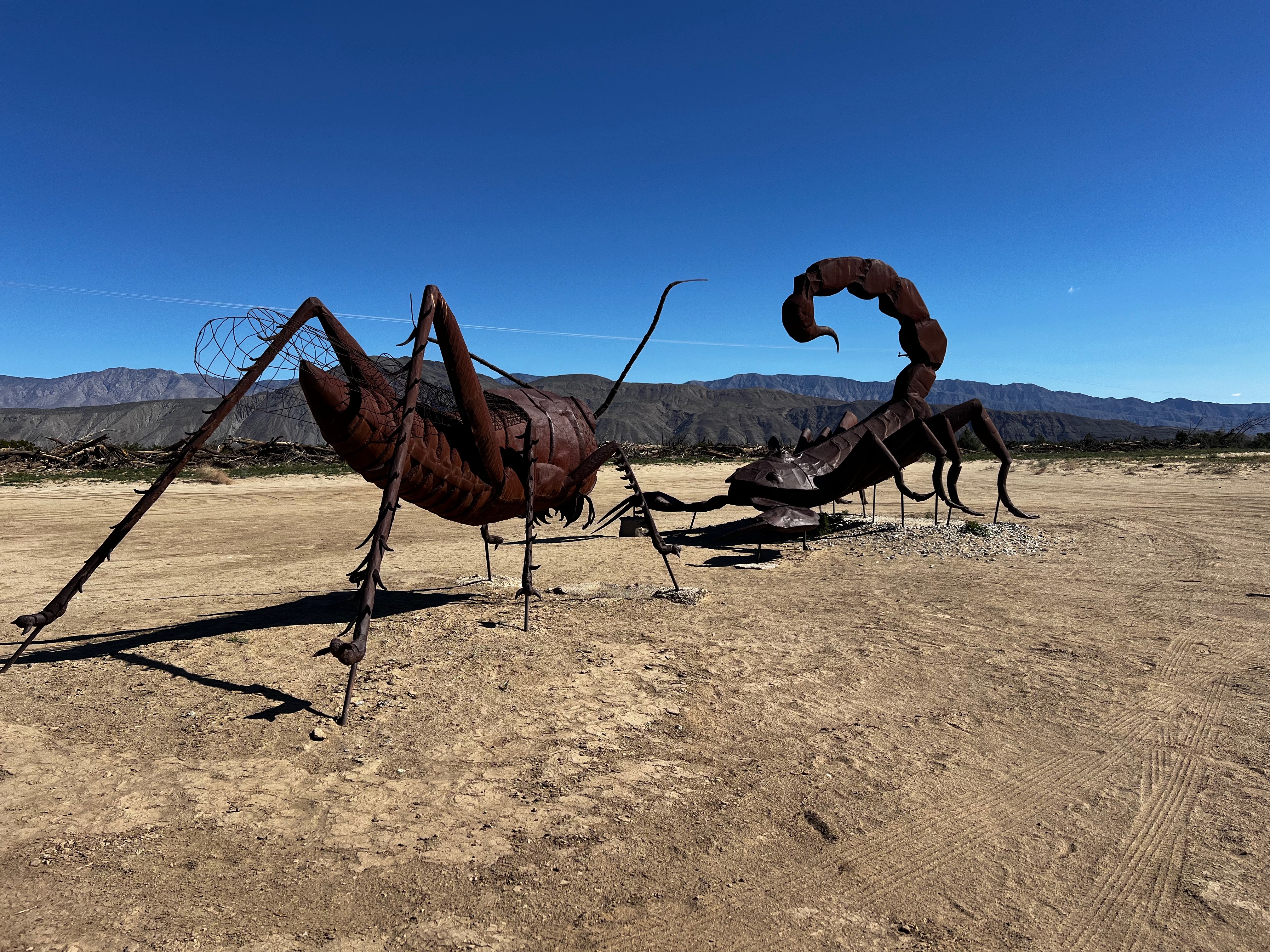
                                                The scorpion and the grasshopper

Over 100 pieces of metal sculpture created by Ricardo Breceda are spread over 1500 acres of undeveloped land. These are just a few of our favorite pieces. They were gifted to the town by the town's benefactor Dennis Avery. All manor of animals; camels, sloths tigers, pigs, sheep, tortoise and the dragon seen above. Also the Spanish explorer Juan Bautista de Anza. 

The Anza Borrego desert is surrounded by BLM land and camping is permitted in many areas. Most of the people who camp here have all terrain vehicles and derive enjoyment from driving the desert trails. Not our cup of tea but we are open to dry camping inside the park where there are one or two designated campsited. It is our plan to return next year and explore more of the hiking trails. 

Because we had a long 6 hour drive home we quickly went over to look at one of the hikes into a slot canyon. We had not planned to hike so had no boots or poles with us. We did a short distance but the going got tough and a 5' drop made us turn back. Next time!


All in all it was worth those long drives there and back.

Thursday, June 17, 2021

OUR WILDFLOWER MEADOW

I don't even have enough time to deal with everything in my inside gardens and outside gardens without venturing onto the septic field. But about 4 years go I decided I really wanted to have that wildflower meadow I should have had 21 years ago. That was when I bought a Texas wildflower and grass meadow mix from Native American seed. It was to go in the tank when they sprayed the cover on the septic field. When I came over the next day there sat the 2 bags by the garage, unopened. There was nothing in their spray tank but left over Bermuda which is what began to take hold within weeks. We tried to get rid of it and then put down our seed but it was to no avail. Weeds came and in the end David just decided to mow. It looked fine. Still I had that hankering to have the meadow. Five years ago David began mowing and collecting, the idea being to reduce the fertility of the soil. No more mulch mowing. I scattered left over bluebonnet seeds from the garden as well as blanket flowers. 


Bluebonnets are now gone, but a year ago native bee balm, Monarda citriodora,  started to grow and has really increased in numbers this year. I am so happy to have the purple one because at the top of the lot, near the road there are some white ones. This is hands dwon my favorite after the bluebonnet whihc is good because they don't share the same season.

And they are not called bee balm for nothing.


While I control the pink evening primrose, Oenothera speciosa, in my inside gardens, I am more than happy for it to spread outside.

 And prairie verbena, Glandularia bipinnatifida,  is a welcome plant.

Coreopsis, Coreopsis tinctoria, has started to bloom. Small plants at the moment but I am hoping next year their see will spread just as it does along the roadsides.

And this rather unusual one has popped up.

Tall vervain

Surprisingly the blanket flowers, Gaillardia grandiflora,  struggle to survive as the they seem to be a favorite of the deer.

The first year we made a path alongside the septic field we had an amazing showing of Mexican hats, Ratibida columnifera. They were all different shades of yellow and brown. Some solid some mixed colors. Maybe the conditions were just perfect, never to be repeated. But one or two this year. All the yellow variety. 

Horse herb or straggler daisy, Calyptocarpus vialis, soveres much of the shady area of the field but is nmaking headroads into the center. Maybe due to long days of rain and cloud. I think it will go dormant now we are well into summer temperatures. 

And it is no surprise that our native lantana, Lantana urticoides. I will be watching out for the pink variety  Lantana camara, which is invasive. 

This year finds me very happy about how the wildflower meadow is coming along. And we haven't had to mow yet. That will be done in the fall.

Saturday, February 15, 2020

YOUR GARDEN STYLE

I have met people who never look back. Maybe it is a function of age but I think mine was triggered by a box of photographs I inherited and by a sudden interest in genealogy. And, as a life-long gardener, I began to realize my younger self might have influenced my style of gardening.


From a very young age I loved wildflowers. You see me here with a bunch of straw at hay making time. At a similar age, on holiday in Devon, I wanted to pick the big white bindweed flowers growing along hedgerow. My father chastised me telling me I must leave them for others to enjoy! Bindweed? I ask you !! And there was the time my parents thought of taking over the lease on a pub in the countryside and I was thrilled to bits because the bank alongside the pub was full of primroses. It never happened... but I know I would have been thoroughly happy living where I could walk the country lanes. Making daisy chains, searching for four leaf clovers, marveling at the tiny flowers of scarlet pimpernel, the cowslips, buttercups, sucking the honey from the purple clover flowers, celandines and marsh marigolds growing in the brook and the seed heads of shepherd's purse. I have plenty of that on my septic field right now.  It was always about the native flowers growing around me.

Fast forward to arriving in Texas in early February1968, just in time for the wildflower season. This time no one telling me not to pick the flowers!


And I am still that lover of wild flowers today and it is reflected in my gardening style. It is a free-for-all cottage garden style.

The sunken garden May 2019
It's why I love the little puffball flowers of Barbara's buttons, Marshallia caespitosa.

April 2019
 The common corn poppy, Papaver rhoeas,  flowering in profusion.

Sunken graden 2019
 And weedy Love-in-a-Mist, Nigella sp.
And a summer flower of the English hedge row. Foxglove Digitalis purpurea,. I have tried growing them from seed with only modest success so I now buy them in 4" pots,early in the year, potting up as they grow larger until I can finally move them into their larger pots. I think they are going to bloom earlier this year as I see a flower spike starting. What color will they be? I have no idea although they say you can tell by looking at the underside of the leaf. If that is the case they will be all white.

February 2020
Front courtyard April 2019

And the delicate blooms of Blue Gilia Gilia rigidula

March 2019

And of course our state flower the Texas bluebonnet.


And it can all become a little unruly after a while and that is why this year some changes are in order.

Herb garden May 2019
 I must endeavor to keep the pathways clear of all but the smallest and tidiest of plants. And that means alyssum, narrow leaf zinnias and possibly the daisy fleabane. Possibly the odd tidy grass and if there is space enough to walk by, the Verbena bonariensis. And I might just allow a few coreopsis and blanket flowers. This is not going to be easy.
For the moment I am excited to look at photographs from last year's spring and to know what is soon to come.

Wednesday, May 6, 2015

WILD FLOWERS ON A WEDNESDAY

The rain last night was like a tonic for my garden. Plants seem to have shot up over night and many native flowers are blooming. Here's a sample of the native plants that are flowering in my garden today.


Sunday, April 8, 2012

THIS WAS WORTH STOPPING FOR

If you are a lover of wild flowers, and let's face it if you live in Texas then you most certainly are, you will understand why I stopped to get a few shots of this scene. I wasn't even out looking for wildflowers.


In fact, I was on my way up to Dallas for Easter and as usual I left Interstate 35 at Elm Mott turning onto the old Dallas road. Enough of that madness on the highway, I would rather drive 50 miles on peaceful country roads, joining the Highway just north of Hillsboro. It breaks the journey and makes the 3+hr drive more tolerable.


There were pleasant roadside scenes of bluebonnets and Indian paintbrush; lots of pink evening primroses and then wow, a stand of penstemons, Penstemon cobaea. It isn't called showy beardtongue for nothing.


But I didn't stop because I was several hundred yards up the road before I realized what I had seen and there was no convenient place  to turnaround. I thought I would stop on the way home, which I did. I had my camera at the ready on the front seat and when I reached the spot there they were looking as wonderful as they had on Friday afternoon.


 It is no secret that my favorite flower is the foxglove and this is our native Texas foxglove. Believe it or not I don't have any in my garden. It is rare to find the plant in the nursery.
The Lady Bird Johnson Wildflower Center plant sale is coming up next weekend and just maybe I will be lucky enough to find a plant there.