My Blog List

Showing posts with label Hypertufa trough. Show all posts

Thursday, May 21, 2020

A FEW SCENES FROM MY MORNING WALK IN THE GARDEN

It's the second thing I do every morning. Number one is put the kettle on to make tea. Number two is to pick up my phone and head out into the garden. What will I see this morning; a new flower, a wilted plant, a lizard scurrying ahead of me on the path or just that special scene that I want to capture in a photo? Here are a few of the scenes that I enjoyed this morning.

The kumquat is blooming and this year, if all the flowers are pollinated, we will have a really wonderful crop for kumquat marmalade.


In the distance is the pedestal with the hypertufa crevice garden. I planted it with little plants that could not survive my summer travels, nor the blasting sun. This year I am hoping for better success with a few things that have seeded there, a feather grass, and one particularly tough succulent I snuck in there last fall. But it is my opinion that the rocks could just stand alone.


As I walk back I realize I need to do a little editing to make walking through here a little easier.


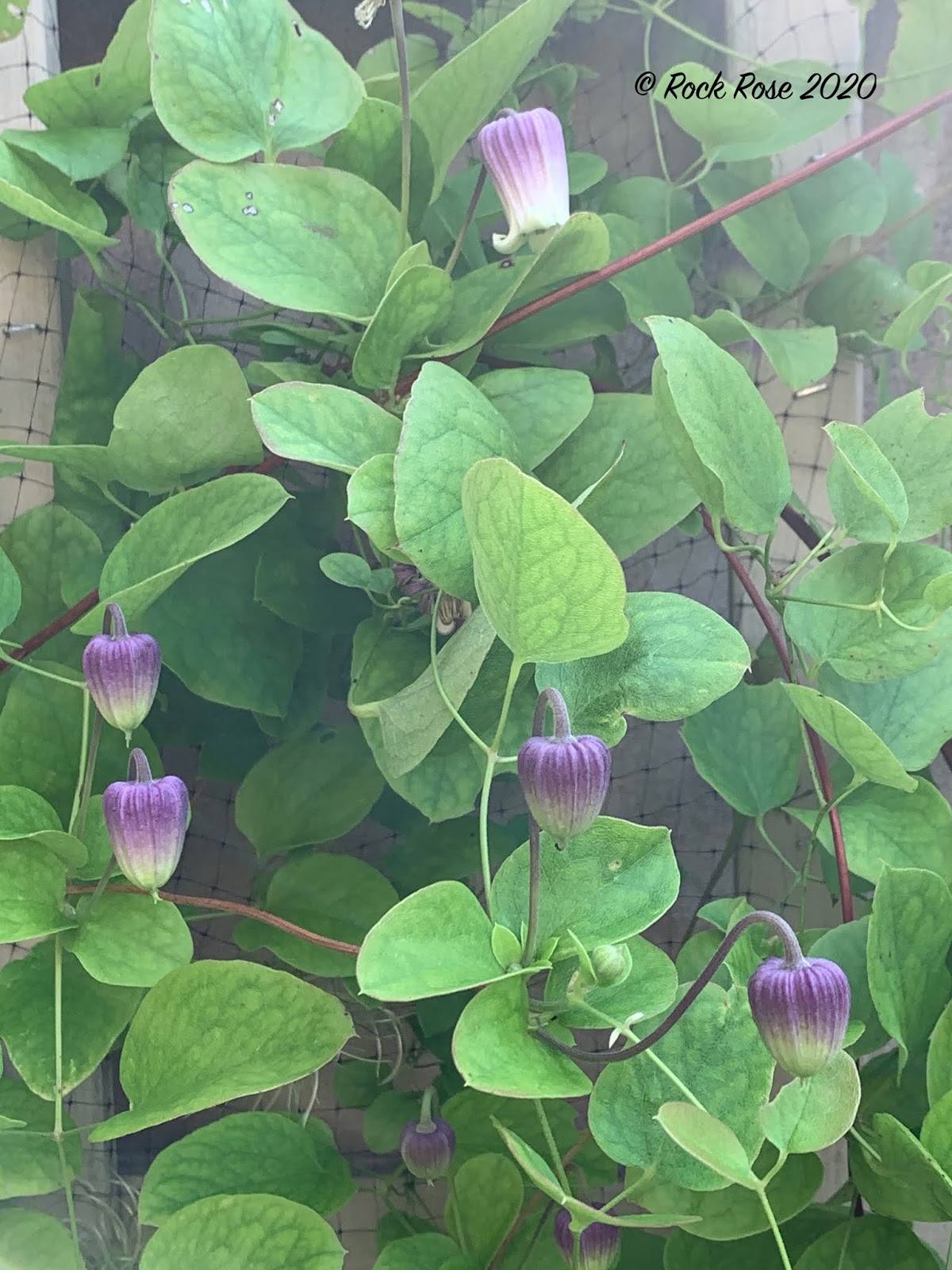
Further along the wall the clematis, Clematis texensis 'Princess Diana', is starting to bloom. There was an anxious moment a few weeks ago when I was sure it was lost but then I noticed small shoots beginning to grow and within weeks she was showing her first buds.


Back up the steps and a nice shot of the prickly pear with the heart leaf skullcap. I have managed to control its spread so that it is confined to this area but it is an ongoing process.


A passalong plant from Bob Beyer when he moved to Florida, the Crown of Thorns Euphorbia milii, blooms constantly.


I love my hypertufa balls in the English garden.


and the hypertufa trough in the Spanish Oak garden. I finally settled on the African false hosta, Drimiopsis maculata, another passalong plant.


Just outside the back door a cow bell, picked up at an estate sale, an aloe and a metal lizard make a perfect trio.


And on the far side of the courtyard garden I check out the Clematis versicolor, Lots of new buds ready to pop open.


At the same time on my walk I see plenty of jobs for the day but for now that early morning cup of tea awaits.

Saturday, August 31, 2019

HALF AN HOUR IN THE GARDEN

Yes, I am still laid up. How long this is going on for is becoming somewhat irritating. On the other hand it is too hot to spend more that an hour out there, which I did early this morning.
I felt a desperate need to run the hose over the sunken garden which has no irrigation. It is looking quite good considering our long spell of triple digit days and no rain. Even the most drought tolerant of plants can struggle under such conditions.  But the tough flowering native cosmos, Gomphrena 'Fireworks' and 'Strawberry fields' Pride of Barbadosn and the green of the Euphorbia are the best for this season.


When we had the late frost this spring and the nurseries were caught out and I was lucky enough to be at Lowes when they were having a "frost sale" Honestly, they were giving plants away for 50c and I couldn't resist buying some plants I would never normally buy-the pelargonium for instance. But it has fared well even in the south-facing garden although a mullein has seeded there and is trying to take over. What to do!


In the herb garden it is the grasses that speak the loudest.


I have moved some of my poly, roughed- up and painted boxes (think of a new word for them) so they get some afternoon shade.


I did the same with the hose in the front garden especially around the grasses which will green up almost instantly when they get water, and was thrilled to find the native poinsettia, Euphorbia cyanthophora,sometimes known as Fire on the Mountain. It would be fun to have both this one and Snow on the Mountain,  Euphorbia marginata,  growing next to each other. Both share the same season of flowering. How easy it is to love some of the Euphorbias and not others.


 These plants were given to me by my friend, Shirley Fox, who gardens south of here in San Antonio, Rock-oak-deer They were pass-a-longs last year when we had the Fling in Austin. Did they survive or seed here? I am not sure. But, I noticed the other day that she had posted something about hers blooming which made me wander over to the spot where I had planted them. What a lovely surprise.

Always a faithful, fall-is-coming, plant, and right on cue for September, October bloom, is the Velvet leaf senna, Senna lindheimeriana. It is a particularly good plant for the front courtyard as it just pops up in the gravel and always looks good. I probably give it just a little too much freedom but with all that August heat and lack of rain I welcome it.


While I was taking the photograph a bee was busy collecting pollen. I'm not positive of his identity so would welcome knowing if he is a wood bee or bumble bee.


Just look at those pollen sacs.


It shows how important it is to have plants flowering even during this heat. These bees need to collect pollen if they and their larvae are to make it through the winter. Ah! Yes. winter.

Monday, June 25, 2018

SOURCING IDEAS FOR THE GARDEN

When I started my first garden in 1973 all the ideas came from my own head. I had a Better Homes and Gardens loose leaf book and that was it. It was very basic. I never thought of looking for gardening books at the library or even buying garden books or magazines. Around 1998 I began visiting a few gardens on my travels and buying garden magazines and books, many of them at charity shops in England. By the year 2000, when we started this garden, I had quite a file of ideas snipped from magazines; garden styles I particularly liked; plants that I thought would do well in Texas. It was time to start incorporating some of these ideas into my new landscape.

The front of our house has 4 square high windows. As I looked from outside up at those windows  I remembered an idea I had seen in Sunset magazine years ago.  I found it in my file.


What could be more perfect than to replicate those high windows on the front wall of the garden. It would just add some permanent interest to the wall which looked particularly bare before there were any plants.


David built the boxes and stained them the same color as the front gates.


But the box of mirrors had 12 pieces and sometime later I decided it might be fun to have some on the inside of the curved wall in the front courtyard. This time we used grey stain. This week I caught sight of the reflection of hesperaloe and American beautyberry in one of the windows.


I have seen mirrors used in gardens before. Hung directly on the wall they add another dimension sometimes creating the illusion of another garden beyond and the mirrors seem to remarkably resistant to damage. Some of mine have had to have the wood replaced because of rot and from time to time I clean off the beak marks of the cardinal and mockingbird who see themselves in the glass. It is hard to find the right size of wood and unless you have a router, and when ours died David had to use two sizes of wood to create the inset for the mirror. It would probably work just as well without the mirror being inset as long as it was well sealed.

Another recent project gleaned from a magazine, and squirreled away in my file, was the sliding shutters in both the side entry garden and the English garden. I was trying to work out how we could add shutters to those openings when flicking through my file I came across this sliding shutter.


Another great Sunset magazine idea. David built the shutters and hung them on sliding barn door hardware. The first one he made was for the opening in the side entry. Wind-driven rain was a problem at the side door. This was the perfect solution. It works. No more wet shoes and doormat.


And one thing led to another. "Wouldn't it be nice to have similar shutters in the English Garden?" I asked him. A similar problem exists there with rain and wind from a different direction. Not only are they functional but they add interest to another very dominating wall. What would Dick Clark be saying about this?


Then there are my little sayings. Remember this one above the side entry? I'll be honest I didn't make this one. I actually bought it for $1 at a garage sale with the intention of stenciling my own saying on there. I hunted for a stencil that was the right size and gave up. In the end I thought the saying wasn't such a bad one after all. But the idea to have some writing on the wall came from a garden I visited in England.


At Snowshill Manor in England there is a passage from Chaucer's Canterbury Tales. Charles Wade might have said that of his own garden and I agree with him.


To make some for myself I found I had to make my own stencils by printing out the letters and cutting them out. One for over the Sun and Moon Archway.


I also saw this idea in a garden shop in England.


And using some wood from the old compost bins I made a similar one to place just by the side entrance.


And those of you who came to the recent Garden Bloggers' Spring Fling might have noticed this one I made to guide you through the front gate and around the side into the other gardens.


I saw this simple theatre at Holehird Gardens, home of the Lakeland Horticultural Society, in the Lake District, England. They have taken the idea of an Auricula Theatre and used it to display miniature hostas. If you want to see an amazing display of auricula theatres then just google the words.


My theatre is for cactus and succulents and replaces a, difficult to water, hayrack planter.


Holehird gardens was another source of one of my garden projects. My trough planter.


But in making this large one I realized just how much material is needed and mine ended up being more shallow and not so thick. And of course alpines are out of the question here so I chose succulents.


And then came some easier planters to make from styrofoam boxes seen on the Hypertufa Gardener They can be made in next to no time and look just as good.


And my largest project of all was my first one and that was the dry stone wall for which the English Garden is named. They abound in the part of the country I grew up and you can see one behind the troughs in the picture from Holehird.
Here's mine.


Then sometimes I have my own ideas as in the stock tank water feature set in a raised bed.


But then recently I saw this idea in a British garden program and filed it away because if my stock tank ever springs a leak, and it will, I will try this idea.


I'm always on the lookout for little things to bring interest into the garden.  I watch gardening programs from England, Australia as well as the US. I watch videos, read magazines, and books and troll Pinterest. There is such a wealth of ideas at our fingertips these days! No one should be short of a source for garden design.

Friday, April 27, 2018

POTS I MADE

Being a lover of everything gardening and having dabbled in many things garden related it seems quite natural that I would eventually have a go at making my own pots. My first attempts involved using the material hypertufa which being a mixture of peat moss, vermiculite and cement makes for much lighter weight of container.
This was one of the first ones I made using the inside of an old plastic planter. It has weathered the years well.


Then I tried my hand at making something that would mimic the English garden troughs that were common in farmyards. They fetch a hefty price in antique and garden shops.


In a fairly shady area of the garden it has weathered to a nice patina with mosses now growing on one side. I think I could pass this off as the real thing.


Next came a larger one. I underestimated the mix so was not able to make it quite as deep as I had hoped.


The texture really looks like stone, but no mosses on this one as it is in full sun.


One of my favorites is the agave bowl on the pedestal in the herb garden. Made using the inside of a well protected copper bowl I have in the house. This photo was from last year.  The mother Confederate rose agave in this planter has decided to flower this year so I couldn't get a good shot of the whole stem. It will be all change in this pot next year.


Lightweight as these pots are they are still pretty heavy when planted up with gravely soil. An even more light weight planter is one made from polystyrene boxes; and a lot easier to make at little cost. A small one  can be made in less than an hour!


A similar texture can be achieved using a wire brush, sealing the surface and craft paint.


And the bigger boxes make great vegetable containers.


One of the boxes I just finished had been waiting in the garage for me to find the time to work on it. No sooner had I finished it than another one appeared-picked up at a garage sale for $1! When will I have time to get that one done. Not this week for sure.