My Blog List

Showing posts with label Venus' Looking glass. Show all posts

Tuesday, May 2, 2017

CELEBRATE NATIONAL WILDFLOWER WEEK, May 1-7

Do you have wildflowers growing in your garden? I do. Let's see what is blooming out there this week as we celebrate National Wildflower Week.

I'll begin with Colorado Venus' looking-glass, Triodanis coloradoënsis. (A)What a lovely name.


And where did it come from because I have never seen it before? It came inside a hole in a rock I brought into the garden when I redid the dry creek along the garage wall.


The plant is annual so I shall watch carefully for the seed pods ripening. I would like to have more next year.
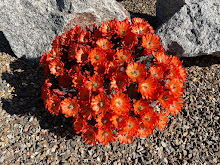
A final blooming of the lace cactus, Echinocereus reichenbachii.(P) Even after the blooms die it remains a tidy addition in the rock-scape.


And the blousy Engelmann's daisy, Engelmannia peristenia, (P) opening with new flowers every day from a winter rosette of leaves.


The pathways in the vegetable garden are crowded with blanket flowers, Giallardia pulchella. (A) Goldfinches feast on their seeds but always leave plenty to bloom next year.


And Mexican bush sage, Salvia leucantha,(P) blooming months ahead of schedule this year. Will it bloom again in the fall as the hummingbirds begin their long winter flight to SouthAmerica?


The trailing wine cup, Callirhoë involucrata, (P) spilling over the dry-stone wall. Always everyone's favorite when they visit the Wildflower Center.


The flowers on the Texas prickly pear may only last for a day but they may leave behind some nice fruits. These fruits, call tuna, ripen to a burgundy red and can be used to make jelly.


Wooly stemodia, Stemodia lanata, (P) makes a good ground cover and is deer resistant.


It has tiny blue flowers.


Our native Lantana, Lantana horrida (P) is also deer resistant and blooms through the hottest months of the year with little water.


Purple skullcap,  Scutellaria wrightii,(P)  can be pruned into a tidy clump and blooms all summer.


Echinacea, Echinacea purpurea, (P) a summer bloomer and another favorite of the birds when it goes to seed.


The Blackfoot daisy, Melapodium leucanthum, (P) another deer proof summer bloomer.


The columbines are among the earliest of spring flowering plants. here the Hinckley's yellow columbine, Aquilegia hinkleyana, (P).


and the more delicate smaller flowered Aquilegia canadensis,(P)


Damianita, Chrysactinia mexicana,(A)is both drought and deer tolerant but does best when given occasional waterings.
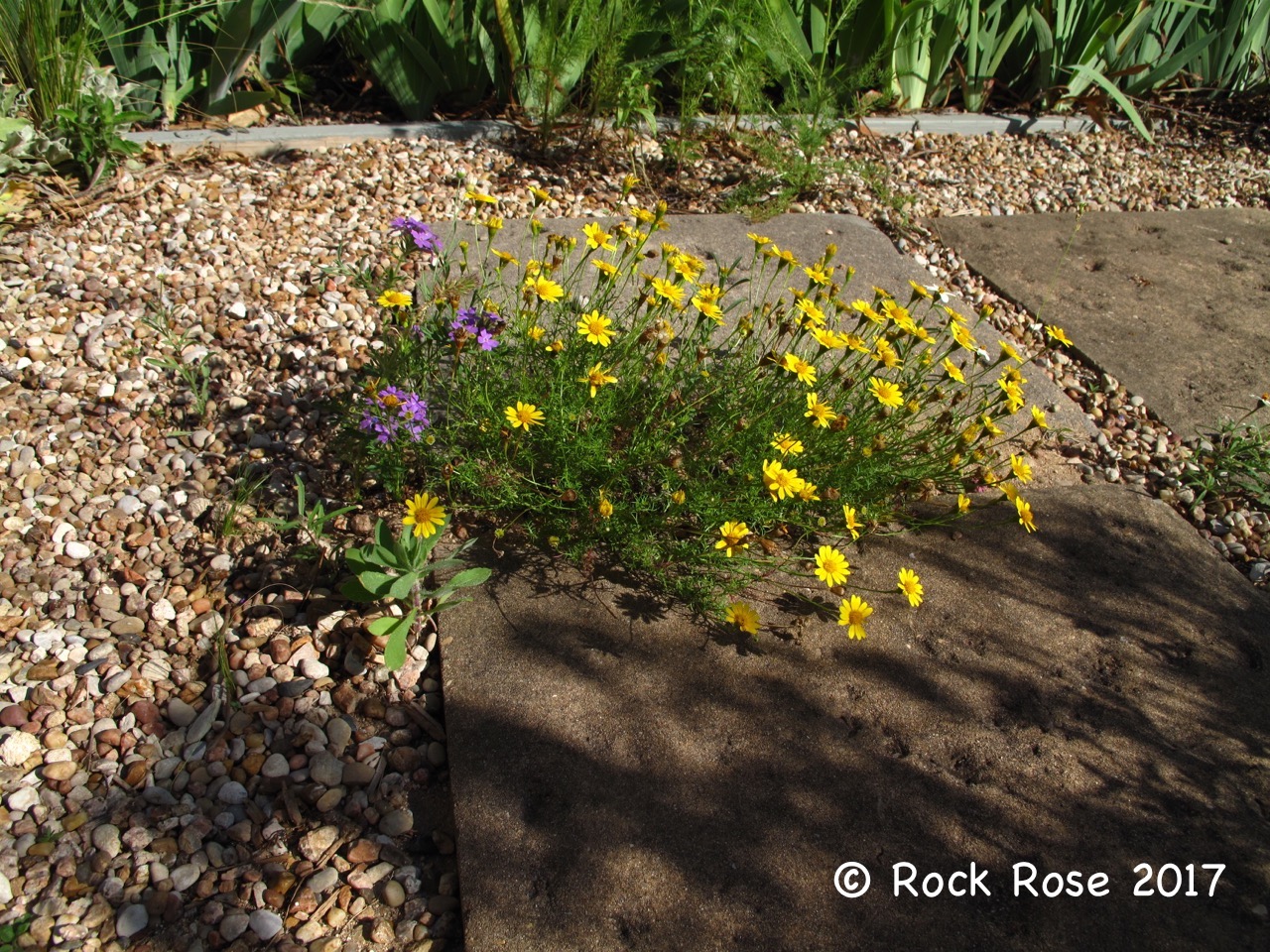

All these plants are blooming in my west Austin, rocky landscape, with minimum watering.

If you would like to learn more about wildflowers for you area you can get information on the Ladybird Johnson Wildflower Center website. There are all kinds of programs going on this week in Celebration of National Wildflower week.

Monday, May 2, 2016

MY GARDEN CELEBRATES NATIONAL WILDFLOWER WEEK MAY 2-8

The week of May 2nd is National Wildflower Week and I am delighted to share some tiny Texas treasures with my readers as well as some of my more boisterous blooms.
I have always had a weakness for the more delicate of our wildflowers so I was happy to see that for the first time the violet wood sorrel,  Oxalis violacea, has appeared in my garden. I'm sure readers are saying they have this plant growing everywhere but for me it is a joy to see this one plant has found a home in my garden. I would be happy to see it growing as a carpet.


It is growing beneath the unnamed clematis which I purchased from the Wildflower Center. It is of the group of clematis that share the name leather flower, possibly Clematis viorna.


 My entry courtyard is full of yellow blooms, Engelmann's daisy, Engelmannia peristenia,  being one flower of the more boisterous.


 I always try to gather up seeds before they fall but  some always escape. They will grow out of rock crevices and in the gravel.


My gravel garden is a perfect place for Zexmenia, Wedelia texana. Another plant whose seeds need controlling.


 The square but primrose, Calylophus berlandieri, is one flower I would be happy to see seed out but it never does.


The purple skull cap,  Scutellaria wrightii, and Blackfoot daisy, Melampodium leucanthum, mass together along the edge of the dry creek.


This same skullcap can be trimmed to form a low mounding plant.


Scutellaria wrightii in the sunken garden
 I just have a few standing wine cups, possibly Callirhoe leiocarpa or C. pedata. The flowers are on a tall leafless stem.


They are quite distinct from the trailing wine cup, Callirhoe involucrata, with its heavy foliage.
 

Another member of the mallow family, rock rose Pavonia lasiopetala,


 I am always on the lookout for plants that form tidy mounds. A chance seedling of gray vervain,Verbena canescens, pruned to form a mound.


 You have to get close up to appreciate its tiny flowers. It seeded in a few places and I have moved the seedlings into other areas.


I took a walk in my meadow today and discovered several delicate blooms. The first the Colorado Venus' Looking-Glass, Triodanis coloradoensis.


and Prairie brazoria, Warnockia scutellarioides.


Now that the bluebonnets and Indian paintbrush have set seed it is the time for the yellow flowers to carpet the meadow.


Antelope horn, Asclepias asperula, in the meadow.


HAPPY NATIONAL WILDLFOWER  WEEK TO ALL MY READERS.


Thursday, April 19, 2012

TOUGH TIMES IN TEXAS

This is how the ground looks outside my garden walls.


Other parts of Texas may have been fortunate to receive rainfall in the last month or so but here none has fallen. It seems we are to have another droughty year.


And yet, even in this inhospitable environment of thin, dry soils and rock plants manage to survive. I have not identified this ground hugging, silvery foliaged plant but en masse it makes for an attractive ground cover. I think it might like a place in my own rock gardens.


A few stands of prickly pear, Opuntia ( unknown species)


and a newly identified wildflower which I believe to be Colorado Venus's Looking Glass, Triodanis coloradoensis. If I am correct then this flower, of the bluebell family,  is endemic to the Hill Country.


I have many wine-cups of the trailing variety, Calliroe involucrata, so it was exciting to find the standing wine-cup, Callirhoe digitata, also enjoying this harsh environment.
I find great reward in finding new plants in the wild.