My Blog List

Showing posts with label cactus.. Show all posts

Thursday, August 6, 2020

AUGUST IN THE GARDEN

When I wrote this past week about working out in the Sunken Garden and the improvements I was about to make my enthusiasm knew no bounds. It was a wonderful feeling. On a hot afternoon I gathered up my rock garden books and leafed through page after page imagining how my new garden was going to look. I made my list. There is still much work to be done before I can ever think about heading out to the nursery for purchases.


The problem is that I have a lot of other gardens that require my immediate attention. I must cut back the remaining lantana and zexmenia as well as removing all the weeds that have sprung up with our recent rains. This is necessary because we have a long season and they will bloom again by late September early October. Then there is the vegetable garden to prepare for planting the winter vegetables. Cucumbers and Melons are finished and need removing as well as the beans and tomatoes. And it is so hot out there that only the early mornings are bearable for working outside.
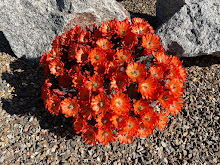
And I must reserve a little time for walking around the garden, not just to see what other things need to be done but also to admire the latest blooms. This week there are new blooms on many of the cactus. A result of our recent rain which brought a brief cool-down.

From top left,

And the mystery plant growing in the gravel in the English garden has revealed its identity.


Of course!  but it is so far away from its family in the Sunken Garden! It is a chocolate daisy, Berlandiera lyrata.


In the fall I will move this to the Sunken Garden where it belongs and I may even be brave enough to remove the errant ones growing in between the pavers in the herb garden. Unfortunately they will not survive as their roots are firmly entrenched underneath the pavers.

Our recent rains have brought us a flurry of rain lilies and although I like the pink and white ones my favorite are the yellow, Zephyranthes citrina. My timely removal of the mealy blue sage that was covering them means they will be get their deserved spotlight in the post-rain garden. I plan to lift them and put them all together in one clump and mark them so I know where they are! Our native white ones seem to have a dislike for growing together in a clump. No matter how hard I try they only ever appear as singles scattered here there and everywhere. Six appeared in various spots in the herb garden this morning.


The job of removing the spent cucumbers from the vegetable garden was thwarted yesterday by finding the plants covered in aphids and ladybirds too. How could I possibly remove them now. it will have to wait a few days. I recall last year having the cardoon covered in aphids and leaving it because the mealy bug destroyers and ladybirds were hard at work. In the end the plant survived and thrived without any intervention from me. Stages of the ladybug from larva(bottom) pupa (top) adult(middle)
I'll leave them until they have finished feasting.
Overnight I decided to remove some of the Gopher plant from the Sunken Garden. I love that plant but it has become too big and untidy for even me to tolerate. There is plenty elsewhere to enjoy in the late winter and early spring but not here. I began by cutting off all the stems-they bled- and tomorrow I will get the pick axe to the root ball. Naturally more rocks are in my plans.

Friday, April 24, 2015

THE BLESSINGS OF HIGH WALLS

First of all I want to thank everyone who sent their commiserations either by writing on my blog, face time or by email.
There is good news from the garden today. As many of you have visited here know, our garden is surrounded by walls. Some of the walls of the houses are very high. The hail storm blew in from the west and those plants in the lee of the walls were miraculously unscathed.


At the front door, protected by a porch overhang and a 20' wall to one side the yellow star jasmine, Trachelospermum asiaticum was untouchedIt is a little different from the Confederate jasmine, although closely related and said to be a little hardier. The center of the flower is tinged with yellow.


On the pool wall the Confederate jasmine, Trachelospermum jasminoides, was similarly spared. Both are now blooming with their heady fragrance.


You can see that the flowers on this one do not have the yellow center.


2 out of 3 isn't so bad. The third one on the potting shed wall wasn't so lucky but knowing how vigorous these plants are I know it will be back again.


I wasn't planning on staining the hail-blasted trellis this year.


The Mock orange, Philadelphus virginalis 'Natchez' is planted on the east side of a 20' wall and was similarily protected. But just 8' away on the other side everything was flattened.


Other plants were saved because they were sheltered by larger plants above them. This little cactus, one of a group, beneath an agave at the foot of the steps from the English garden took no damage. This week it when the sun came out it opened a flower.


And the Lady finger cactus, Echinocereus pentalophus, on the steps was not affected as the hail came through the arch.


More cleaning up for me this weekend. Hope you have a bright and sunny one.

Wednesday, November 26, 2014

THANKSGIVING OR CHRISTMAS?

If you went to the stores at the moment you might be forgiven for not knowing whether we were about to celebrate Thanksgiving or Christmas. After all we have been seeing Christmas trees and hearing carols for some time now. But it seems the nurseries might have it wrong too.


I picked up this plant the other day at my local nursery and it was labeled Christmas cactus. Didn't I remember reading somewhere recently that there were two species of this plant, the Christmas cactus and Thanksgiving cactus?  So I did a little research and came up with this enlightening information.


There are two kinds of this cactus; the Christmas cactus,  Schlumbergera bridgessi, and the Thanksgiving cactus, Schlumbergera truncata. They come in a variety of colors such as red, peach, white and the pink seen here. But it is the Thanksgiving cactus which we normally see for sale around this time of the year as it comes into flower about a month before Christmas. There are two ways to tell the Christmas and Thanksgiving cactus apart. The first is by looking at the flattened stems, the phyllocades, which have 2-4 pointed projections on the Thanksgiving cactus, as opposed to more rounded projections on the Christmas cactus. But an easier way is to look at the anthers on the stamens which are yellow on the Thanksgiving cactus, seen above, and purplish on the Christmas cactus.


But there is yet another holiday cactus called the Easter cactus,  Rhipsalidopsis gaertneri, which is named so because it blooms later in the year. It has the same flattened phyllocades but they are even more rounded. I have this one, seen above, picked up at a moving sale. Last year I noticed it start to bloom in June. I now know why.
The secret to good blooming around the holiday season is to give the plants increasing darkness from September on, and to keep the temperature as close to 68° as possible, with no more than 8-10 daylight hours. Only water when the well draining soil is dry.
So check out your cactus and see which one you have. I can almost guarantee that if you bought it at this time of the year it will be the Thanksgiving cactus. Mine is.

                                                      HAPPY THANKSGIVING

Monday, April 28, 2014

THOSE LITTLE BEAUTIES

You wait all year and suddenly they arrive. Sometimes it is just for a fleeting moment and you find you have missed the show. But not today.


The Ladyfinger cactus, Echinocereus pentalophus opened the first of her blooms today. I was so lucky to pick this up at a garage sale a couple of years ago. I had to repot it because it was in very heavy wet soil and as I took it out the whole thing fell apart. However, cactus are more forgiving of mistreatment than many plants and recovery didn't take long.


The crown of blooms on this mammillaria sp. is reminiscent of a little tiara. It is also in a pot and protected during the winter. It blooms for days.


Another potted, yellow flowering mammillaria. This one blooms year round.


Then there are my cactus in the ground. The hardy lace cactus, Echinocereus reichenbachii. It is outside the walls in the front.


And this one, about to open. It is growing in a spot where someone removed a large stand of prickly pear cactus years ago. A much better substitute. It is growing on almost bare rock and is so happy I am reluctant to move it, although I would like to have it in my inside rockery.
The garden has already had a wonderful show of Claret cup cactus, whose blooms last much longer than other cactus. It will be next year before they bloom again.

Sunday, March 23, 2014

A MOST UNUSUAL GARDEN TOUR

Back in January I had the opportunity to take a most unexpected garden tour. After all, when you go to an airport you expect to sit in the departure lounge and wait; maybe drink a cup of coffee or browse the bookstore. You do not expect to visit a garden. To do so would be a gardener's dream.


But this is Changi Airport, Singapore and they do things differently here. They even print a brochure on all the gardens you can visit. Let's see there are 5 gardens in Terminal 1, where we are waiting for our flight,  and the one I am making a bee line for is the Cactus Garden.


Cactus in Singapore? Where the humidity is shy of 100%. It must be indoors like the welcome air conditioned Dome in Garden on the Bay, which I will post about later.


Amazingly the garden is outside.


I sometimes think that you just can't go wrong when designing with agaves and cactus.


Throw in a few rocks and a few tree ferns and other ancient plants.


Maybe the odd metal sculpture like this saguaro.


Mulch with rocks and overlay with a few mat-forming sedums.


Maybe add some additional protection from the rain.


Add a few sculptures.


Is this like house leeks planted on the roofs of houses in England to ward away evil spirits?


I only had 10 minutes to rush around but if I am ever there again I will make a point of arriving with plenty of time to spare so I can visit all the gardens of Changi. In Terminal 1 additional to the Cactus Garden there is a Sculptural Tree Garden and a Lily Pad garden, Terminal 2 has a Bamboo Garden and a Sunflower Garden. Terminal 3 has a Butterfly Garden and Fern Garden. I won't even mention the pool, movie theatre etc. Who needs Duty Free!

Saturday, March 31, 2012

A DRY CORNER GARDEN

The soap aloe, Aloe saponaria, blooms against the wall of the house. Sometimes it comes as a surprise to find it in bloom.


That's because the pot sits on a large stone outside the garden walls.


There is only one plant in the ground in this area, a small sharkskin agave. The rest are cactus and agave in pots. It is a good spot for them to spend the summer months and adds interest to a rather bare area. The massive drystone wall was built by David to retain the slope that remained after the house was built. I would love to have plants growing from the wall but I think a lush wall planting here would look inappropriate.