My Blog List

Showing posts with label bee house. Show all posts

Saturday, September 3, 2016

A CACTUS THEATRE

Put in the words, "cactus theatre' on Google and you may come up with a restaurant or two and the odd theater. Put in the words Auricula Theatre on Google and up will pop photographs of hundreds of examples of Auricula theatres. In its basic form it would be a bookshelf-like structure mounted on the wall displaying potted auriculas, Primula auricula.
It is one of the stands always seen at the Chelsea Flower Show where, WS Lockyer, wearing his bowler hat, has exhibited his auriculas in theatrical fashion, year after year, taking home many gold medals.


Auriculas, although cold hardy, cannot tolerate excessive heat or moisture. They are the alpine cousins of primroses. Clearly they will never grow in Texas. But after seeing an example of a dwarf hosta theatre at Holehird Gardens this summer ( another plant that won't do well in this part of Texas) I came up with the idea of a Cactus Theatre, and I had just the place for one. The entry way to our front garden.


For several year there has been a hayrack planter on this wall but it really was too small and I had never really had a successful planting of anything. The closest I came was with grandfather's pipe, Callisia fragrans, but that was just a one-off year and the next year when I tried to do the same thing it looked awful. The area is partly shaded by some high beams and the wall protected from the westerly sun. It is the perfect place for cactus and succulents, offering them a little shade but plenty of light.
David and I discussed design, modeling it on the one we had seen at Holehird only changing the overall dimensions to suit our area. We purchased the wood and pots and David did the cutting and assembling. I stained it with the stain we used on the side entry steps, which we already had. The total cost for the project, including pots was under $35. I think it will be a lots easier to take care of.


Many of the plants are ones I had on hand and are succulents. But this weekend is the Austin Cactus and Succulent Show and Sale so I may come home with some special plants for my Cactus Theatre. The cactus below I bought at the Wildflower center sale last year. It is a slow grower not having grown more than a few millimeters in over a year.

Button cactus, Epithelantha micromeris

This was the second of two projects completed this week. The first were several very simple bee houses cut from rounds of oak logs. Drilled to create nesting holes and hung on the wall in the English garden.


Maybe now the bees will stop filling the holes in my umbrella.

Saturday, March 5, 2016

A NEW BEEHOUSE

Following on the success of my last bee house and seeing how brutal our Texas weather can be with outdoor structures I decided it was time for an upgrade. A friend of mine has a bamboo forest in her back garden and last year her son cut much of it down. I was more than happy to take it.


Maybe it is good to cut bamboo when it is green rather than waiting for it to dry out. I tried one piece with the hack saw and decided I would wait. A year later it was ready to be cut and this time I was bringing in the big guns having found cutting with the hack saw was no easier.


Even this saw had trouble, although I decided maybe a smaller toothed saw blade would have worked better. I had quite a bit of sanding to do where the saw didn't make a clean cut. It still took a lot less time than hand cutting. Thanks David.
Here's the box I was planning to use. Another garage sale find. I thought maybe it had been someone's craft project because the wood had been poorly put together, until I saw the Made in China sticker on the bottom. Plus the ivy painting on the side was not my style. A spray can of paint was needed.


With a new paint job and the requisite number of pieces of bamboo cut to size it was time to assemble. It's amazing how easily the pieces fir together and all that is needed in the end are some filler pieces to make sure there is a tight fit.


For variety I added pieces of bark in one section and pine cones and a small clay pot with grasses in another. In the top some broken pieces of clay pot. Plenty of nesting sites for ladybirds and green lacewings as well as solitary bees of all sizes.


Once I am sure that the bamboo is completely tight I will to hang on the wall in the potager. I'm sure the bees will be attracted to all the flowers that are, once again, growing in the pathways and be delighted with their new home.
If you would like to learn more about the bees who will nest in my house then a book that covers everything you need to know about gardening with bees is The Bee-Friendly Garden by Kate Frey and Gretchen Le Buhn.

Friday, May 25, 2012

DANGER IN THE GARDEN

Show me a gardener that hasn't had an accident in the garden. Danger abounds for every one of us and that includes the critters that live in our gardens.


Do you think this anole was stalking? Or was he just sunbathing on the roof of the bee house. See the solitary bee hovering in front of the wood. He was busy building his nest in one of these holes and was clearly bothered by the anole. He did eventually move inside.
There we two lizard rescues in the garden this week. The first came from a lizard caught up n the netting I was using to train the snapdragon vine. I just happened to be cleaning up there when I saw him. It took me 5 minutes of cutting to unentangle him. The netting was so tightened around his neck it took some careful work to extricate him. Then I removed the netting which just about destroyed the plant. It was looking less than healthy so it was no great loss. Later I went back to check on the spot where I had left the lizard; he was gone.


The second rescue was a near drowning of this blue tailed skink. I scooped him out of the air conditioning drain bucket into which he had mysteriously fallen. He was stunned enough that I could rush into the house to get the camera. A few minute later he scurried away under the AC. I see many skinks but never a blue one. He has the lines on his head only so possibly he is a juvenile.
Then it was my turn. Working under the Spanish bayonet yucca I felt a stab and then a trickle down my face. Scalps do bleed!
Two vultures were circling overhead and when one landed on the parapet wall above me I decided it was time to go inside and mop up.


Saturday, October 22, 2011

ANOTHER PROJECT FINISHED!

This was the first of two bee houses David made to order last year. The first and smaller one, I completed and wrote about last fall. I cut and filled the A frame with the cardboard tubes from trouser coat hangers ( the easy bit). They worked well and the apartments were quickly filled.


Here is the original one today. Insects have left their nest, as shown by the holes in the mud sealed entrance, and I really should do a fall clean-up of the empty ones. This time I shall replace them with bamboo.

The second, larger one, lay on the bench in the garage until a couple of weeks ago. When ESP was cutting down some of his bamboo I asked him if he had any to spare, and he did. I was amazed at how thick his bamboo was but nevertheless I cut several pieces to go along with some thinner bamboo I already had, ( that bit took me ages) and I packed the pieces in. Of course the subsequent dry weather loosened the pieces so I had to add some more to tighten the whole structure.


The bamboo certainly looks a lot nicer. This bee house is for our grandson, who turns 6 in November, so I decided to dress it up a little.


I shingled the roof using pieces of bark I found around the wood pile. Then used a couple of strips of cedar bark to dress up the front. ( Hope the golden cheek warbler's don't mind)

Providing a home for pollinating insects is very important to the health of the garden in general. These holes are used by the solitary bees and wasps, insects that feed upon pollen and in so doing pollinate our plants. Sometimes they use mud to fill in the hole and other times leaf cuttings. If you find plants in your garden with round holes cut out of the leaves then you can be sure that you have leaf cutter bees ( Megachile species). They seem to favor beautyberry and roses in my garden.


I have a much larger critter house in the planning stage, (English gardens are full of ideas for such projects). It has been on my 'to do' list for a while and today we picked up a piece of wood at a garage sale perfect for the project. It will serve as a winter home for more than bees. Maybe lizards and hedgehogs. Oh! I forgot no hedgehogs in Texas unless you want to pay $100!

Monday, April 11, 2011

NEW RESIDENTS IN THE GARDEN

This may not be exciting to most but we finally have someone living in the bee house. It happened almost overnight. One minute I was thinking that the house must be placed wrongly and then yesterday I realized some of the holes had been sealed. The question is, who is in there? I'll probably never know. I just hope it isn't another case of the wrong people moving in as in the owl house.

Furthermore, the old mud dauber nest, on the wall by the kitchen door, is also being reused. Several of the openings have been sealed again. I really did mean to take it down. It's beginning to look as though it part of the house!

Thursday, October 14, 2010

AVAILABLE FOR IMMEDIATE OCCUPANCY

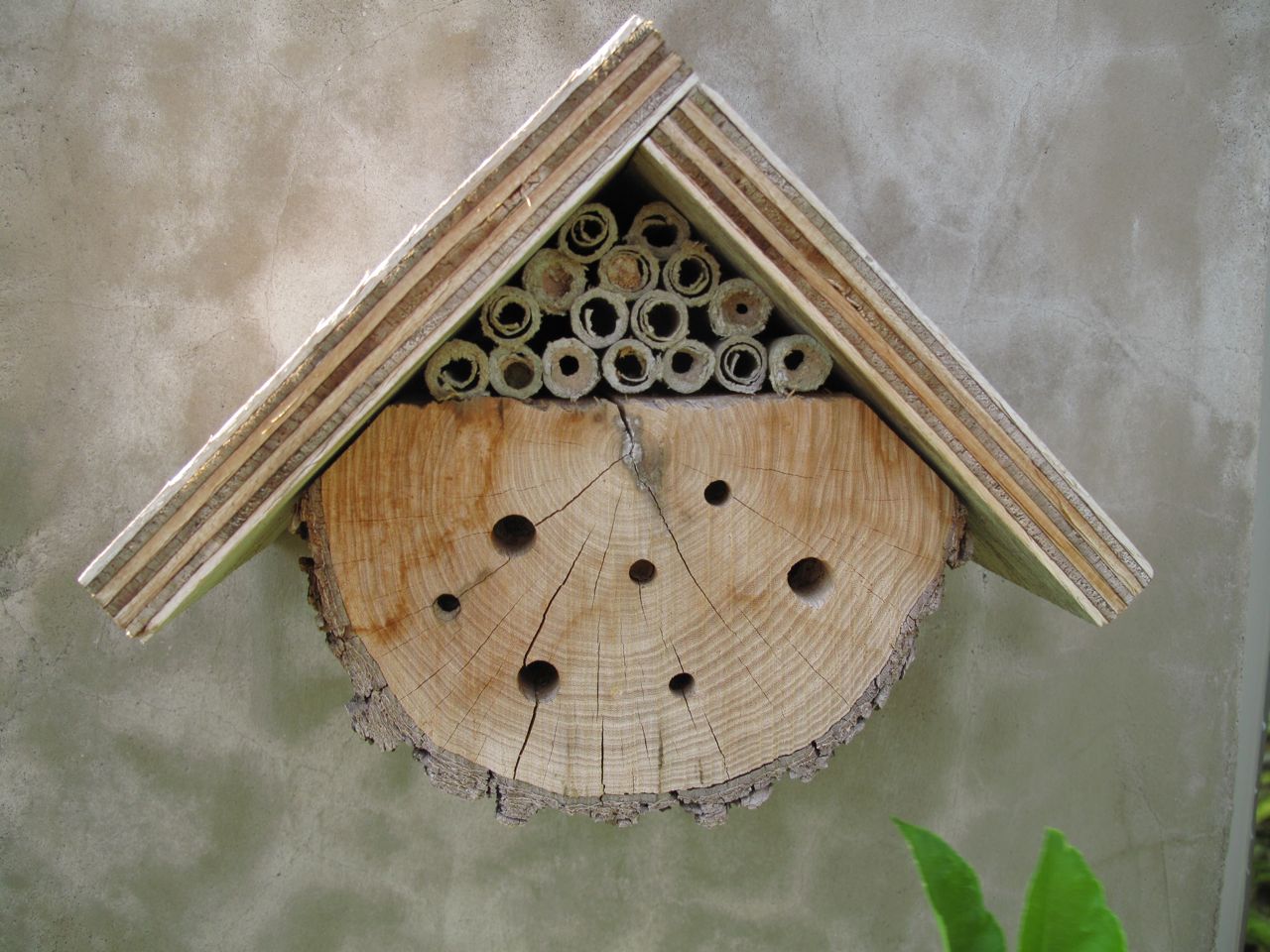
This delightful multistory apartment just came onto the market. This green property, by well known local builder, David, is built with recycled materials including a slice of oak log, plywood and trouser hanger tubes.

Surrounded by flower and vegetable gardens and with south facing views of the Texas hill country, this property would suit all bees of a solitary nature, including leaf cutter and mason bees. No more long commutes to and from your work space. This property provides everything you need within several feet.
For the leaf cutter bees we have American beauty berry available for nest materials.

Mason bees will find plentiful supplies of mud as evidenced by the numerous mud dauber nests attached to our walls!