My Blog List

Showing posts with label dahlberg daisy. Show all posts

Tuesday, May 2, 2017

CELEBRATE NATIONAL WILDFLOWER WEEK, May 1-7

Do you have wildflowers growing in your garden? I do. Let's see what is blooming out there this week as we celebrate National Wildflower Week.

I'll begin with Colorado Venus' looking-glass, Triodanis coloradoƫnsis. (A)What a lovely name.


And where did it come from because I have never seen it before? It came inside a hole in a rock I brought into the garden when I redid the dry creek along the garage wall.


The plant is annual so I shall watch carefully for the seed pods ripening. I would like to have more next year.
A final blooming of the lace cactus, Echinocereus reichenbachii.(P) Even after the blooms die it remains a tidy addition in the rock-scape.


And the blousy Engelmann's daisy, Engelmannia peristenia, (P) opening with new flowers every day from a winter rosette of leaves.


The pathways in the vegetable garden are crowded with blanket flowers, Giallardia pulchella. (A) Goldfinches feast on their seeds but always leave plenty to bloom next year.


And Mexican bush sage, Salvia leucantha,(P) blooming months ahead of schedule this year. Will it bloom again in the fall as the hummingbirds begin their long winter flight to SouthAmerica?


The trailing wine cup, Callirhoƫ involucrata, (P) spilling over the dry-stone wall. Always everyone's favorite when they visit the Wildflower Center.


The flowers on the Texas prickly pear may only last for a day but they may leave behind some nice fruits. These fruits, call tuna, ripen to a burgundy red and can be used to make jelly.


Wooly stemodia, Stemodia lanata, (P) makes a good ground cover and is deer resistant.


It has tiny blue flowers.


Our native Lantana, Lantana horrida (P) is also deer resistant and blooms through the hottest months of the year with little water.


Purple skullcap,  Scutellaria wrightii,(P)  can be pruned into a tidy clump and blooms all summer.


Echinacea, Echinacea purpurea, (P) a summer bloomer and another favorite of the birds when it goes to seed.


The Blackfoot daisy, Melapodium leucanthum, (P) another deer proof summer bloomer.


The columbines are among the earliest of spring flowering plants. here the Hinckley's yellow columbine, Aquilegia hinkleyana, (P).


and the more delicate smaller flowered Aquilegia canadensis,(P)


Damianita, Chrysactinia mexicana,(A)is both drought and deer tolerant but does best when given occasional waterings.
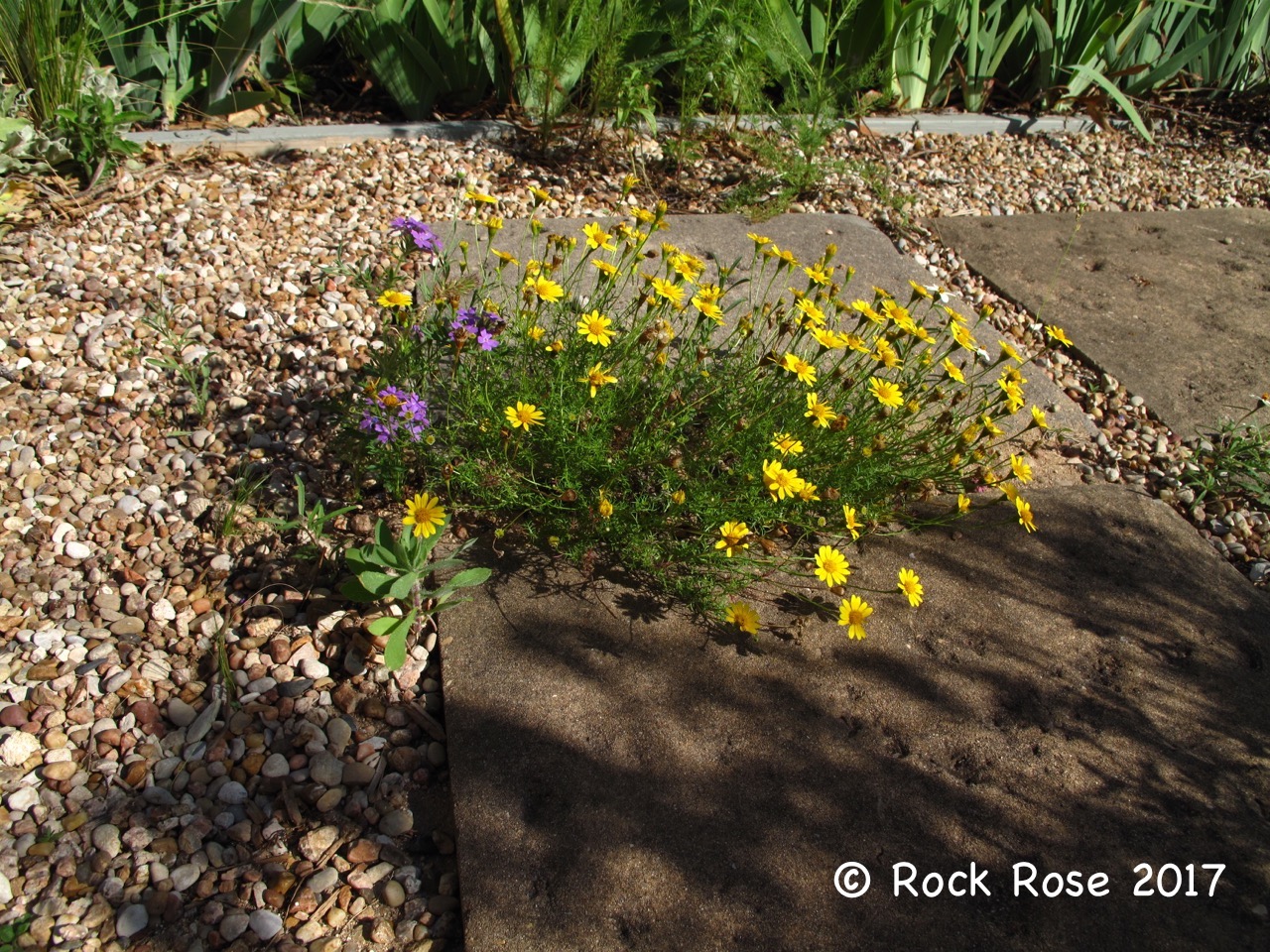

All these plants are blooming in my west Austin, rocky landscape, with minimum watering.

If you would like to learn more about wildflowers for you area you can get information on the Ladybird Johnson Wildflower Center website. There are all kinds of programs going on this week in Celebration of National Wildflower week.

Sunday, March 19, 2017

THE GREENING OF THE SUNKEN GARDEN

David commented on a marked change in the sunken garden following rain and warm temperatures. If I don't get around to doing some culling we won't even know the sunken garden is there. But what would I do without all my little self seeders.


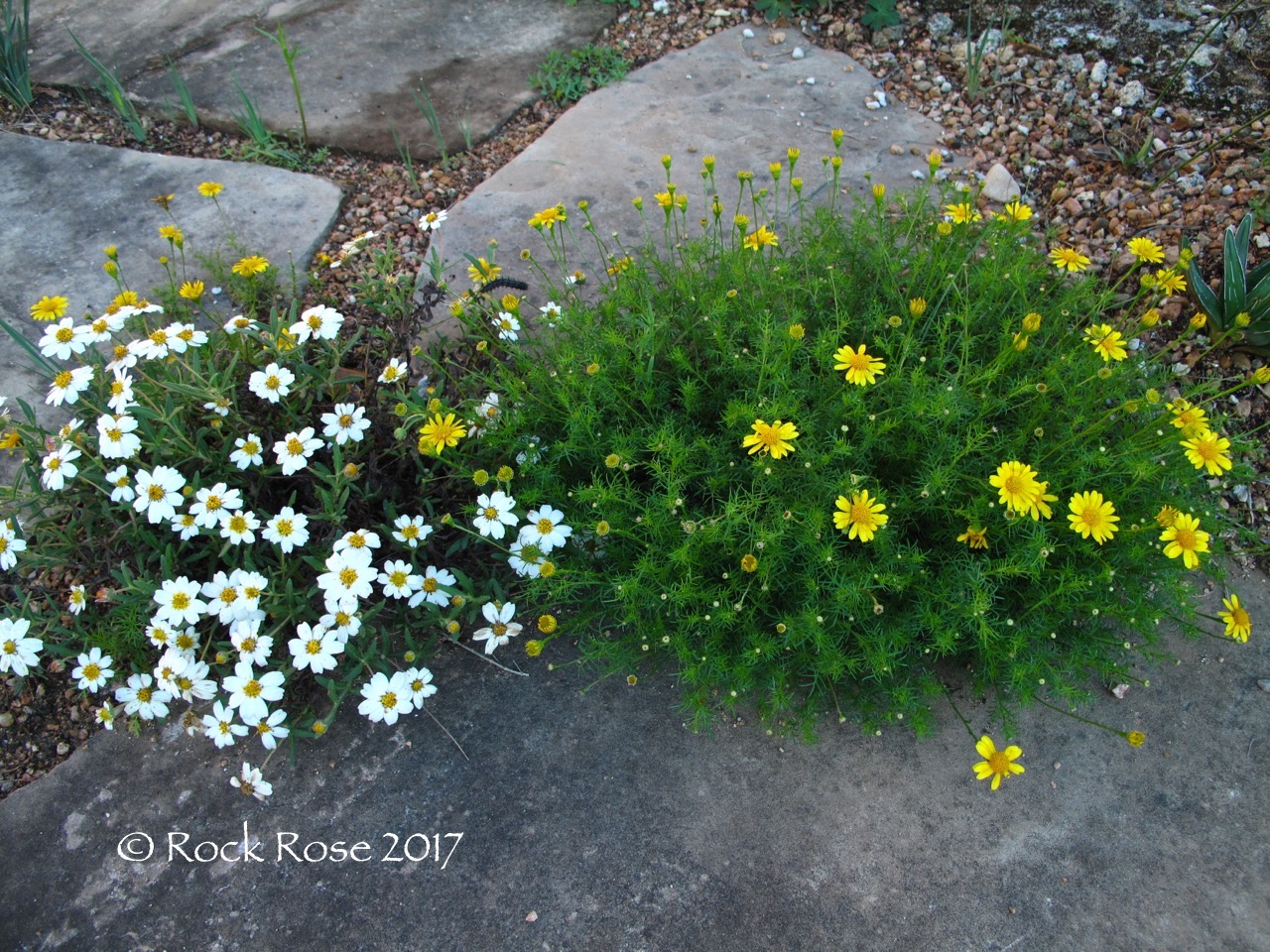
The blackfoot daisies,  Melampodium leucanthum, and the dahlberg daisies, Thymophylla tenuiloba.


The Indian blanket flowers, Gaillardia pulchella,   and the sedum, Sedum potosinum.


the gopher plant, Euphorbia rigida. I didn't really want it down below in the sunken area but here it will stay.


The blue eyed grass, Sisyrinchium angustifolium.


The chocolate daisy, Berlandiera lyrata. This one has been here for years enjoying a cool root run under the sandstone pavers.


The California poppies. I am so glad this white one is back again this year. Eschscholzia californica.


But there are plenty of orange ones too.


And the first of the corn poppies, Papaver rhoeas.


There are a few seeders who can be a little annoying. The false garlic, Nothoscordum bivalve, with the white flowers and yellow centers and wild onion, Allium canadense, with pale purple flowers. Both are pretty but are the devil at seeding themselves and once the bulb forms they are not so easy to root out as the bulb works its way deep into the soil. This year I struck a deal with them. They can flower but they can't set seed!


We may not be able to grow those lovely pom-pom alliums but we have our own and I love the flowers.

Nothoscordum bivalve


Allium canadense
They make a pretty addition to a rock garden. All these plants seed freely in the sunken area of the garden. Because the specs between the pavers are less than 1" it would be difficult to plant without self sowing plants.

Wednesday, October 21, 2015

WE'LL GROW WHERE WE WANT TO GROW

It would appear that most of the time I don't have much say in where plants are going to grow. I would like them in the beds. They would like to grow in the pathways.


This is the scene between two of the beds in the vegetable garden and is played out in may places in the garden. Here's another grouping slap bang in the middle of the two beds. They all want to be in the same place. Mexican feather grass, alyssum, narrow-leaf zinnia, Zinnia linearis, and a gaillardia, Gaillardia pulchella.


My job is to do some weeding out so that we can actually walk through the area. As usual the ruby crystal grass seedlings have been abundant. I must have pulled out over 50.


It is hard to believe that 4 weeks ago there was nothing growing here except the mealy blue sage, Salvia farinacea.  More narrow-leaf zinnia, Zinnia linearis, dahlberg daisy, Dyssodia tenuifolia and gomphrena, Gomphrena globosa.


The one disappointment this year has been the seedling chocolate daisy, which seems determined to co-habit with another seedling gopher plant. You can see the pair here in the lower center of the photo. I am wondering how this is going to play out. Should I make the choice for them?
This is the sunken garden where I rely on plants to self-seed.


Another plant that is in abundance this year is the native frost weed, Verbesina virginica. I saw this being sold as a shade plant at a recent Lady Bird Johnson Wildflower center sale. In my garden it has seeded with abundance this year in full sun. Not only does it put on this floral show in the fall, but when we have a frost it will exude water from the stem which will create  incredible crystal like structures. For now it is a favorite of the bees.


It is always a thrill for me to find a special plant has reseeded. Such is the case with this Philippine violet. It found a spot right along the edge of the path. I hope I can get it out without damage when it loses its leaves.


A similar seedling along the edge of the walkway to the patio was never removed. It is a good job that it dies back every winter because it is now too late to move it. Why do they always choose the edges?


This garden just wouldn't be the same without all the help I get from mother nature.

Sunday, April 28, 2013

A SERIOUSLY GOOD PRUNING

 This week saw the start of the annual seriously good pruning and cutting back days. There will be many more to follow.


This is the walkway down towards the gate at the end of the vegetable garden. Yes, that's mint on the left and the trim back comes at least 3 times a year. For now I was more concerned with getting out the trailing wine cup. It had totally obliterated the path and required a hop, skip and a jump to pass by. It had woven its way up through the seat of the new bench I purchased this year and would soon be in my 'highly successful this year' hayrack planter on the wall. The felt lining did the trick.


This is a hot spot on the wall of the potting shed, facing west and there is no way that even succulents would tolerate such a blast furnace. Soon these plants will have served their time and I will have to think of their replacements. The feather grass, dahlberg daisy and alyssum will stay and likely I will put in some zinnias. For now there are still the stocks to bloom.


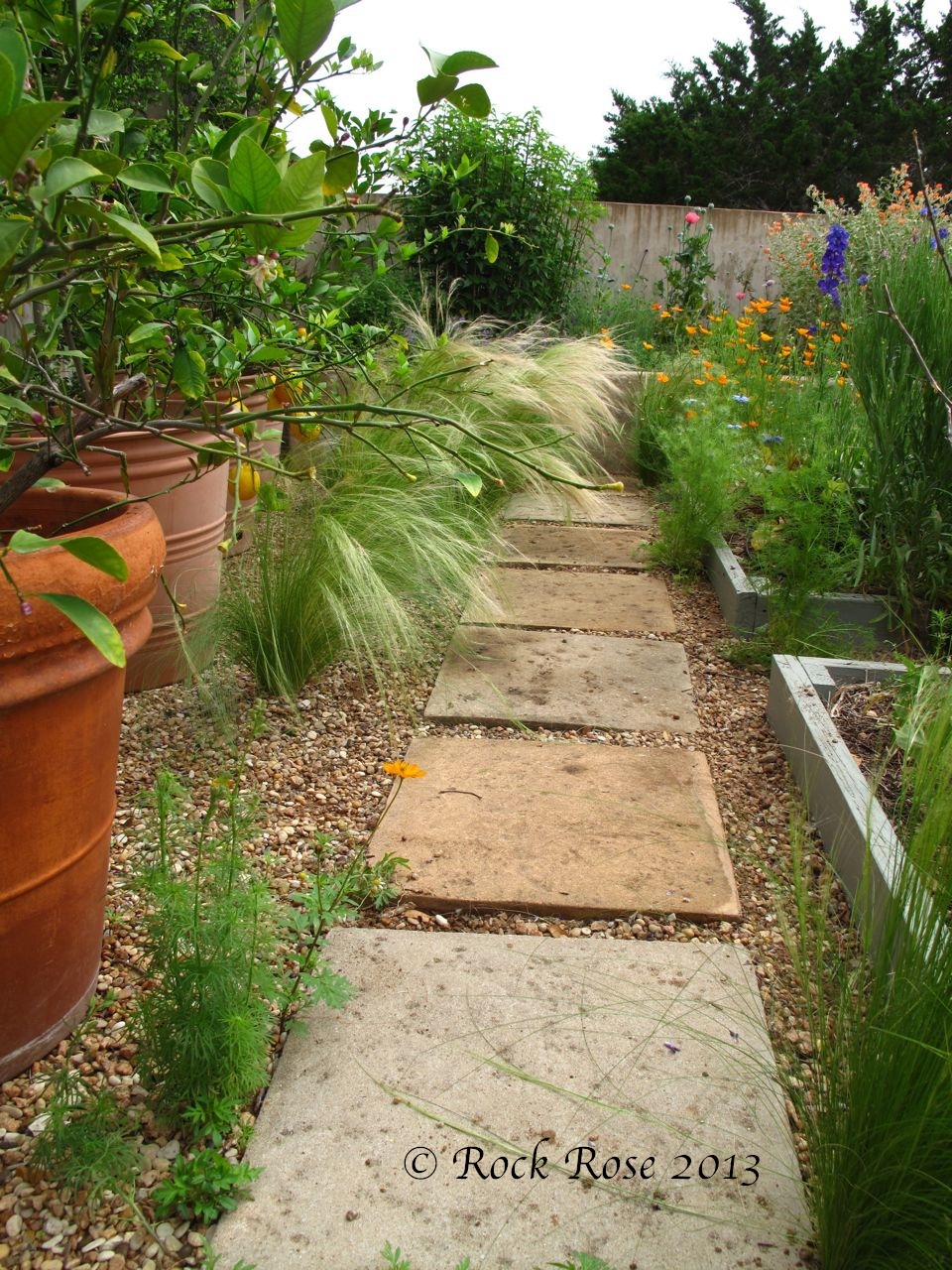
This is the pathway alongside the citrus pots. Once the feather grass, mealy blue sage and California poppies were removed I could now reach the far end of the square beds. Three buckets for the compost pile.


This morning I turned my attention to the beds themselves.


Two rows of gone-to-seed arugula. I thought they looked rather pretty with their back drop of blanket flowers until I spotted a harlequin bug on them. Then I pulled them out. I do not want to face an attack of those bugs this year. I also finally removed the gone-to-seed cilantro, carefully removing the remaining lady bugs and relocating them to an aphid colony on the top of the chocolate chip mangave. Apparently they don't like those dizzying heights and have left. Will have to dunk the top in some insecticidal soap.


Monday, April 15, 2013

GARDEN BLOGGERS' BLOOM DAY, APRIL 2013

It is the height of spring in Central Texas. The garden is a sea of poppies from the orange California poppies Eschscholzia californica...


To the common corn poppy, Papaver rhoeas.


Pink poppies, the seeds given to me by a friend.


And one white California poppy this year.


I could easily have missed the flowering of my lace cactus, Echinocereus reichenbacchii. Typically her blooms open well into the afternoon when the sun reaches that part of the garden. I just noticed that flush of pink as I was getting ready to come inside.


It now meant another half hour with the camera checking all my lace cactus. They were all blooming.


The ones in the front driveway area among the bluebonnets.


And the ones up on the top wild area. They looks so fat and happy. The pistil in the center of one was moving. Deep inside the flower a bee was wallowing among the stamens.


When he emerged pollen was flying everywhere.

Here are a few of the flowers that are blooming in the sunken garden.


Ruby crystal grass, Melinis nervigumis, with Damianita, Chrysactinia mexicana.


Dahlberg daisy, Thymophylla tenuiloba,


Blackfoot daisy, Melampodium leucacnthum. with blue eyd grass, Sisyrinchium pruinosum.


More blue eyed grass with sedum.


The sunken garden.


Square bud primrose, Calylophus berlandieri.


Scarlet penstemon, Penstemon triflorus.

Anacacho orchid tree, Bauhinia lunarioides.