|
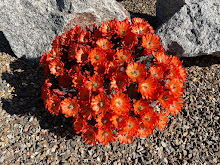
| Scarlet pimpernel, Anagallis arvensis. |

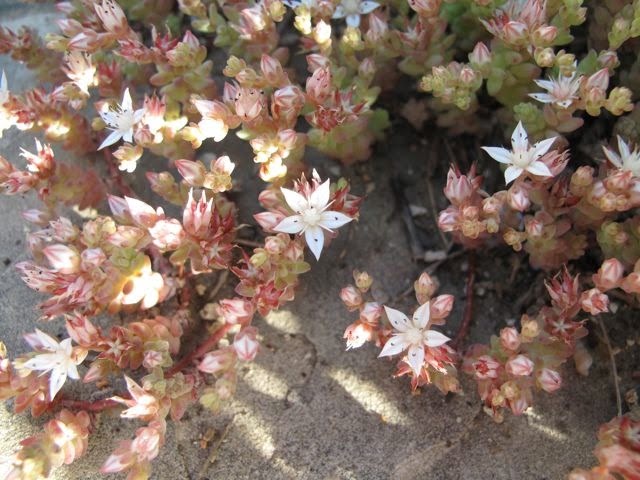
I am still a lover of tiny flowers. These sedums, with their starry flowers found a perfect niche in this broken rock. I purposefully left the gap when the rock broke as it was being brought into the garden.

Sedum potosinum, forms a neat mat of evergreen leaves which burst into bloom in the spring. It is easily propagated by breaking off a small piece and tucking into the soil.

Left unchecked it will spread to cover the ground but can be easily controlled.

Thymes also work well between pavers their roots protected by the stones.

These plants flower at ground level but tiny flowers may go unnoticed unless brought to eye level and one way to do this is plant on top of a retaining wall.

Several years ago I found this little native blue gilia, Gilia rigidula, growing under some cedar trees. I transplanted it to this area where it has spread modestly over the years. It bloomed prolifically a few weeks ago and will bloom again on and off through the rest of the season.


I have not seen this plant at nurseries or even at the Wildflower Center, maybe due to its fragility.
A few bluebonnets bloomed here this year due to the more open nature of the area after the loss of some Spanish oak trees.
And what a lovely surprise to see a bloom stalk on my grandfather's pipe, Callisia fragrans.

The flowers are so complicated I'm not sure if it is compound and whether they are petals, sepals or tepals.

And who can forget the little flowers on the Mammilaria cactus. When I spotted these bright little flowers on my thumb cactus they were barely visible hanging from the fireplace hearth.

I moved it up onto a ledge where its little flowers could be admired.

Do you have tiny treasures in your garden? If not it may just be that they are there but you haven't noticed them.
And what a lovely surprise to see a bloom stalk on my grandfather's pipe, Callisia fragrans.

The flowers are so complicated I'm not sure if it is compound and whether they are petals, sepals or tepals.

And who can forget the little flowers on the Mammilaria cactus. When I spotted these bright little flowers on my thumb cactus they were barely visible hanging from the fireplace hearth.


Do you have tiny treasures in your garden? If not it may just be that they are there but you haven't noticed them.