My Blog List

Showing posts with label Euphorbia. Show all posts

Wednesday, February 10, 2021

A M0RNING IN THE GREENHOUSE

 "I'll just spend a little time in the greenhouse this morning while it is still cold outside" 

That little time turned into a whole day. If only I hadn't let it get so out of hand. I had good intentions when I started to take things inside last fall promising myself that I would keep plenty of space between each pot and nothing on the ground. Suddenly every bit of shelf space was filled, above and below and then the floor started to get crowded out. That pot of dwarf papyrus, the two branches of plumeria, a box of agaves which I had planned to take to Phoenix at Christmas, a bird of paradise I dug out from the edge of the path. Empty pots, pots of soil. No room to move in there. The first job was to move everything outside so I could work on the shelves.

Next was to organize the shelves moving a few things around. There is shade cloth and a cross vine growing over the greenhouse so the only really good sun is at the end. That is where I need to have my winter blooming cactus. Some have already started blooming and some are now making buds. I think they are going to be earlier this year than any before. 


I have several pots of lady finger cactus, Echinocereus pentalophus. All are beginning to make buds. If you aren't familiar with this plant the flowers are the most wonderful Thai-silk pink. But it will be a few weeks yet.

And more and more mammilarias.

I moved this plant up from the lower level and into a more sunny spot when I saw this bloom stalk.

And a euphorbia blooming. You know how tiny their flowers are and if it weren't for the fact that they are yellow you might even miss them.
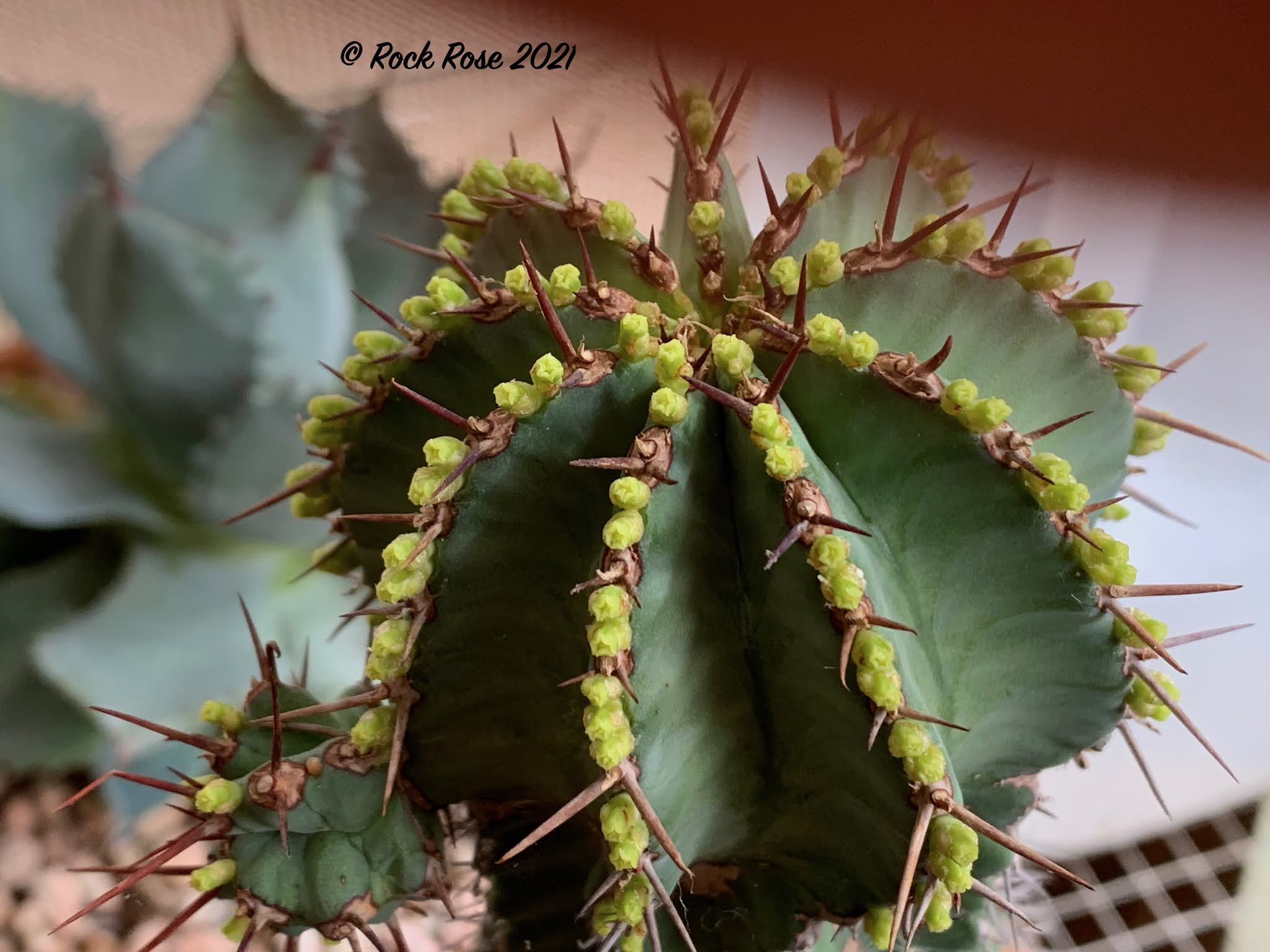

Finding more scale on some cactus I broke off tidying and got the paint brush and alcohol out. I was not expecting to do that but it seemed like a priority.

I was sad to see I had almost missed these sprays for flowers on the copper Sedum nussbaumerianum. I felt rather badly that they had been under appreciated being on the lower shelf. The plant is rather straggly and needs a complete pruning. Not a job for today.

When I got down to moving the last pot which was on the floor by the door I discovered that the ants had come up through the bricks and into the pot. What next! It was the newly potted bird of paradise which I quickly removed and took outside far away from the garden. Then I put the kettle on to boil. I'll make their life unpleasant. 

I only have 3 orchids left and they are in much need of attention. I heard on a gardening program that an orchid needs at least 4 good strong leaves in order to bloom so there is a good chance that this one will soon send out a bloom stalk. One has a small stalk and the other only 3 leaves. Some nurturing is needed. I knew that orchids like to grow in clear pots. Don't they all come that way from the nursery. Their roots like light as they photosynthesize through them. I don't know why I was anxious to put the other two in clay pots even though they were so-called orchid pots. From now on its clear pots for my orchids. 


I have a couple of hanging baskets. The first is the Huernia schneideriana, which spent the summer hanging in the live oak tree, totally under appreciated. It will probably go back there again next year but will need some trimming as eventually the longer stems start to fail. In Arizona I saw this plant creeping along the ground and it will set down roots easily along the length of the stems.  


Finally a quick wash down hoping to make the ants more miserable and the greenhouse is ready to receive many plants that will have to come in during the upcoming inclement weather. 

Now a week later we begin to feel the start of the weather. It is 43° out there and for us bone chilling and damp. Tonight will probably be the first night of 7 nights of freezing temperature with some possibly in the single digits. Freezing rain is also in the forecast followed by snow next week. The heaters are on in the greenhouse and I have brought even the foxgloves inside. I have been nurturing these since they were 4" pots. You can't take the English out of the girl. She has to have her foxgloves. 


It will not be good as the garden is so far ahead. I have already picked daffodils and many of my vegetables that will not take even those low temperatures. Shiver , Shiver! I don't want to think about the possibility of a power failure due to this unusual weather. 

Thursday, May 21, 2020

A FEW SCENES FROM MY MORNING WALK IN THE GARDEN

It's the second thing I do every morning. Number one is put the kettle on to make tea. Number two is to pick up my phone and head out into the garden. What will I see this morning; a new flower, a wilted plant, a lizard scurrying ahead of me on the path or just that special scene that I want to capture in a photo? Here are a few of the scenes that I enjoyed this morning.

The kumquat is blooming and this year, if all the flowers are pollinated, we will have a really wonderful crop for kumquat marmalade.


In the distance is the pedestal with the hypertufa crevice garden. I planted it with little plants that could not survive my summer travels, nor the blasting sun. This year I am hoping for better success with a few things that have seeded there, a feather grass, and one particularly tough succulent I snuck in there last fall. But it is my opinion that the rocks could just stand alone.


As I walk back I realize I need to do a little editing to make walking through here a little easier.


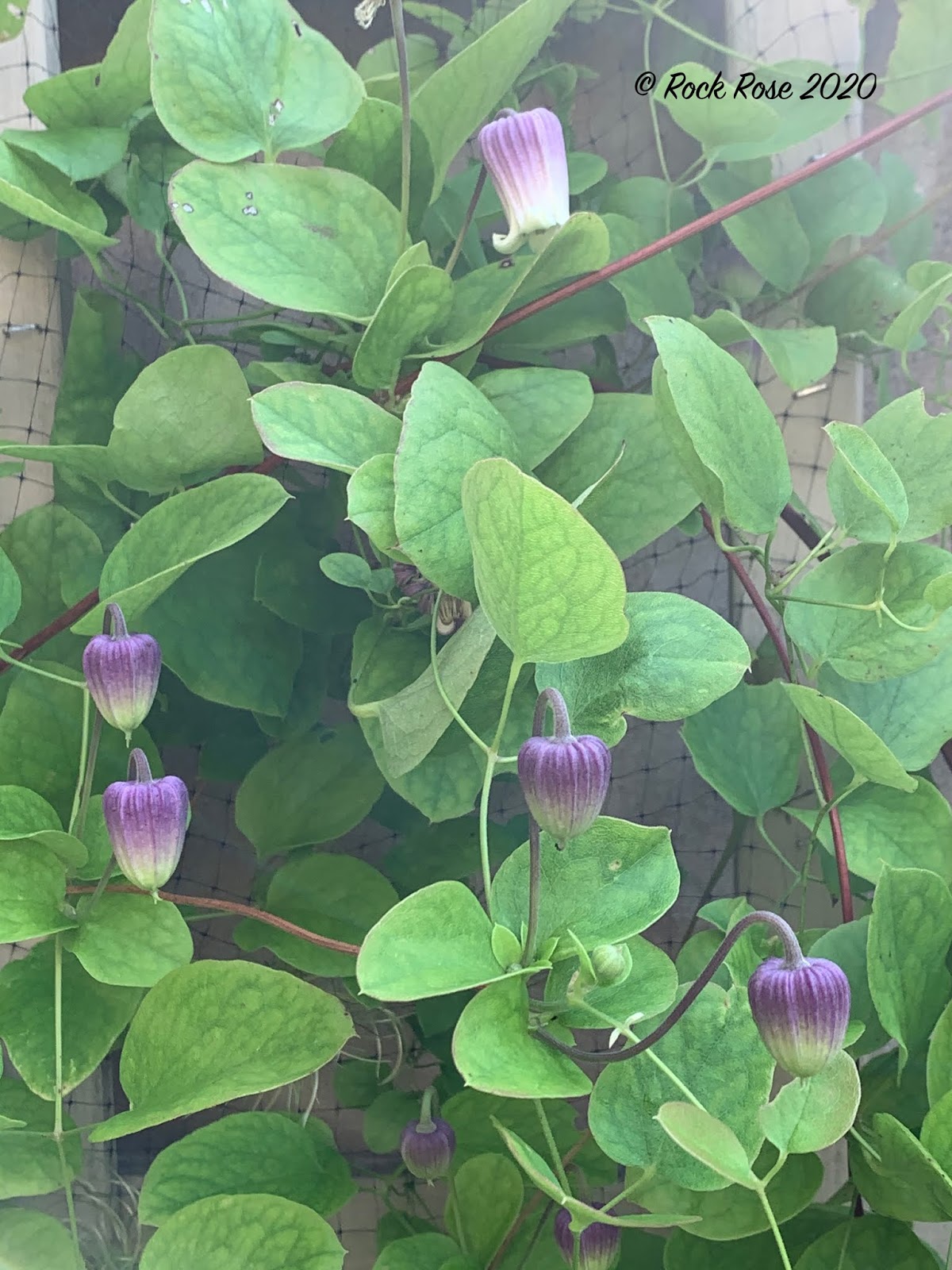
Further along the wall the clematis, Clematis texensis 'Princess Diana', is starting to bloom. There was an anxious moment a few weeks ago when I was sure it was lost but then I noticed small shoots beginning to grow and within weeks she was showing her first buds.


Back up the steps and a nice shot of the prickly pear with the heart leaf skullcap. I have managed to control its spread so that it is confined to this area but it is an ongoing process.


A passalong plant from Bob Beyer when he moved to Florida, the Crown of Thorns Euphorbia milii, blooms constantly.


I love my hypertufa balls in the English garden.


and the hypertufa trough in the Spanish Oak garden. I finally settled on the African false hosta, Drimiopsis maculata, another passalong plant.


Just outside the back door a cow bell, picked up at an estate sale, an aloe and a metal lizard make a perfect trio.


And on the far side of the courtyard garden I check out the Clematis versicolor, Lots of new buds ready to pop open.


At the same time on my walk I see plenty of jobs for the day but for now that early morning cup of tea awaits.

Saturday, February 9, 2019

INDOOR GARDENING

Since moving to Texas, with barely any down time for gardening outdoors, indoor gardening has slipped to a minimum, too difficult to take care of during long periods of travel. But as I look around the house on this rather miserable, chilly day I am surprised by how many plants I do have. Of course they are plants brought inside for the winter but the bonus is many are flowering.

This cane begonia, Begonia 'Matchmaker' is a cutting from a plant that Gardeners' Supply used when filming here two years ago.


I asked them if I could have a leaf from the plant and they generously left me the whole plant. The mother plant is in a large pot which I will prune well when safe enough to leave outside for the summer. I took two stem cuttings from the plant last year and rooted them in water. This is the first one to flower.


The leaves have this characteristic speckled appearance as well as the angel wing shape and their stem resembles bamboo, hence classified as a cane begonia.


Another begonia is Begonia erythrophylla, more commonly named beefsteak. A passalong from Julie Marcus at the Wildflower Center.


By contrast its towers are more delicate. The fallen petals lying on the ground are not unlike the wintry mix we have experienced over the last two days.


On Friday I received another passalong, this Euphorbia milii var. Splendens, Crown of Thorns, from a garden friend who is leaving town. The plant comes from Madagascar.


Like its cousins, the poinsettias, the plant requires a certain amount of dark nights in order to flower.
The flowers are easily recognized as those found on many euphorbias.


The stems are thorny, being adapted for water storage, with the leaves dropping as they age.


The plant requires little care as long as it receives a good amount of sun and sparce rainfall. Sounds like a perfect plant to put outside in a rain-sheltered position in my summer garden.

Sunday, February 25, 2018

LONG LASTING SRING BLOOMER

Gopher plant, Euphorbia rigida, is one of my favorite early spring bloomers. I don't know why it is called gopher plant unless it is because gophers don't eat it... nor do the deer. That would make sense because the milky sap produced by all euphorbias is not only poisonous but can be extremely irritating to the skin of some people. Care should be taken to wear gloves when cutting the stems.


It is a mystery to me why it was given the species name 'rigida' because it is anything but rigid, the stems trailing along the ground like the tentacles of an octopus. It needs  plenty of room to complete its annual growing cycle.


The foliage is a delightful blue green and when the bracts on the tips of the branches begin to turn chartreuse in the early spring they light up the garden.


That change in color is a sign that the plant is about to flower, although you will have to get down close to view the flowers as, like many euphorbias, they are quite discreet. This morning the plants were buzzing with the sound of bees.


I have them growing above my sunken garden where they can trail over the edge but they look just a well where they are allowed to soften the edge of pathways or patios. They also would dress up a large expanse of mulch or decomposed granite. The bonus is that they are drought, heat and cold tolerant but do require good drainage for best performance.


When the flowers fade you can either cut them back living next years new growth or leave them to set seed. They reseed easily.
At the base of the plant is the new growth which will elongate over the summer in preparation for next year's flowering. Strangely this year it looks as though the new leaves at the crown are also going to flower. That may be due to our late fall and seemingly short winter. I hope the plant has enough umph to make new leaves for next year. During hot, dry weather the stems may lose leaves and become bare but it does nothing to detract from the magic of their long-lasting spring show.


I bought one plant originally and the rest are from seed.

Saturday, October 21, 2017

PLANTS BEGIN TO SIGNAL WINTER IS ON THE WAY

My garden is beginning to signal that winter is on the way. Sometimes it seems as though it is never going to arrive  and when it does happen is is usually overnight with our first good frost. But there are subtle changes in the garden. The plants look more colorful because of cooler days and nights.


Among the whites and oranges of the narrow leaf daisies a new flower begins to bloom.


It is the Mexican mint marigold, Tagetes lucida.  The leaves make a good substitute for French tarragon, which cannot withstand our hot summers, and is therefore often called Spanish tarragon. This herbaceous perennial dies back during the winter but and spring and summer the plant is green, before bursting into flower in October. It flowers only where winter comes late to the garden.


Another late bloomer is the Philippine violet, Barleria sp. Pest free and seemingly no diseases it also dies back during winter but has been a reliable returner even giving me a few new plants from seed.


The orange cosmos, Cosmos sulphureus, has been in non-stop bloom throughout the summer. It is both heat, drought and pest resistant. I threw a few seeds into this bed less that a month ago and they are now flowering.


The citrus fruit are starting to ripen. The bitter Calamondin, which I make into marmalade. No other marmalade comes close to the tangy orange flavor of this fruit. Not even the Seville marmalade.


The Meyer lemon. The fruits aren't quite so big this year. Maybe because of our dry summer.


Rusty seedheads appearing on the dwarf papyrus, Cyperus papyrus.


Plants spill over the low wall completely covering the pathways. The last to flower will be the Copper Canyon daisy, Tagetes lemmonii.


There are changes among the succulents too.

Echeveria Devotion, Hana Bay flowerswith its velvety leaves takes on more color with the cooler nights. When I bought it it was like this and then lost most of its color during the summer. I am so happy to see it back again. It should enjoy being in the potting shed for the winter.


Kalanchoe thrysifola, the flapjack or paddle plant is also coloring up with the cooler nights. I am on the lookout for its cousin K. luciae, which gives more brilliant color during winter.


It is also the bloom season and several are starting to send up a boom stalk. The plant is monocarpic so these plants will die after flowering but leave plenty of pups behind.


Euphorbia lactea cristata form. Possibly Grey( white) ghost with cresting.


Today the heat and humidity are back again.