My Blog List

Showing posts with label DRY STONE WALLS. Show all posts

Monday, June 25, 2018

SOURCING IDEAS FOR THE GARDEN

When I started my first garden in 1973 all the ideas came from my own head. I had a Better Homes and Gardens loose leaf book and that was it. It was very basic. I never thought of looking for gardening books at the library or even buying garden books or magazines. Around 1998 I began visiting a few gardens on my travels and buying garden magazines and books, many of them at charity shops in England. By the year 2000, when we started this garden, I had quite a file of ideas snipped from magazines; garden styles I particularly liked; plants that I thought would do well in Texas. It was time to start incorporating some of these ideas into my new landscape.

The front of our house has 4 square high windows. As I looked from outside up at those windows  I remembered an idea I had seen in Sunset magazine years ago.  I found it in my file.


What could be more perfect than to replicate those high windows on the front wall of the garden. It would just add some permanent interest to the wall which looked particularly bare before there were any plants.


David built the boxes and stained them the same color as the front gates.


But the box of mirrors had 12 pieces and sometime later I decided it might be fun to have some on the inside of the curved wall in the front courtyard. This time we used grey stain. This week I caught sight of the reflection of hesperaloe and American beautyberry in one of the windows.


I have seen mirrors used in gardens before. Hung directly on the wall they add another dimension sometimes creating the illusion of another garden beyond and the mirrors seem to remarkably resistant to damage. Some of mine have had to have the wood replaced because of rot and from time to time I clean off the beak marks of the cardinal and mockingbird who see themselves in the glass. It is hard to find the right size of wood and unless you have a router, and when ours died David had to use two sizes of wood to create the inset for the mirror. It would probably work just as well without the mirror being inset as long as it was well sealed.

Another recent project gleaned from a magazine, and squirreled away in my file, was the sliding shutters in both the side entry garden and the English garden. I was trying to work out how we could add shutters to those openings when flicking through my file I came across this sliding shutter.


Another great Sunset magazine idea. David built the shutters and hung them on sliding barn door hardware. The first one he made was for the opening in the side entry. Wind-driven rain was a problem at the side door. This was the perfect solution. It works. No more wet shoes and doormat.


And one thing led to another. "Wouldn't it be nice to have similar shutters in the English Garden?" I asked him. A similar problem exists there with rain and wind from a different direction. Not only are they functional but they add interest to another very dominating wall. What would Dick Clark be saying about this?


Then there are my little sayings. Remember this one above the side entry? I'll be honest I didn't make this one. I actually bought it for $1 at a garage sale with the intention of stenciling my own saying on there. I hunted for a stencil that was the right size and gave up. In the end I thought the saying wasn't such a bad one after all. But the idea to have some writing on the wall came from a garden I visited in England.


At Snowshill Manor in England there is a passage from Chaucer's Canterbury Tales. Charles Wade might have said that of his own garden and I agree with him.


To make some for myself I found I had to make my own stencils by printing out the letters and cutting them out. One for over the Sun and Moon Archway.


I also saw this idea in a garden shop in England.


And using some wood from the old compost bins I made a similar one to place just by the side entrance.


And those of you who came to the recent Garden Bloggers' Spring Fling might have noticed this one I made to guide you through the front gate and around the side into the other gardens.


I saw this simple theatre at Holehird Gardens, home of the Lakeland Horticultural Society, in the Lake District, England. They have taken the idea of an Auricula Theatre and used it to display miniature hostas. If you want to see an amazing display of auricula theatres then just google the words.


My theatre is for cactus and succulents and replaces a, difficult to water, hayrack planter.


Holehird gardens was another source of one of my garden projects. My trough planter.


But in making this large one I realized just how much material is needed and mine ended up being more shallow and not so thick. And of course alpines are out of the question here so I chose succulents.


And then came some easier planters to make from styrofoam boxes seen on the Hypertufa Gardener They can be made in next to no time and look just as good.


And my largest project of all was my first one and that was the dry stone wall for which the English Garden is named. They abound in the part of the country I grew up and you can see one behind the troughs in the picture from Holehird.
Here's mine.


Then sometimes I have my own ideas as in the stock tank water feature set in a raised bed.


But then recently I saw this idea in a British garden program and filed it away because if my stock tank ever springs a leak, and it will, I will try this idea.


I'm always on the lookout for little things to bring interest into the garden.  I watch gardening programs from England, Australia as well as the US. I watch videos, read magazines, and books and troll Pinterest. There is such a wealth of ideas at our fingertips these days! No one should be short of a source for garden design.

Wednesday, November 22, 2017

HOW PAST AND PRESENT INFLUENCE YOUR GARDEN STYLE

I watched a program on you tube today. Carol Klein talking about rock gardens in England. More than anything I found their history interesting because the town where I grew up, in England, had these fabulous rock gardens along the promenade. They were built inside the naturally occurring sand hills that ran along the shoreline.


Not only rock gardens but ponds, waterfalls and stepping stones to climb over.

And in the park there were some fabulous rock structures with bridges and places to climb. Such a fabulous place for children to play. The original bridge was not made to last and was replaced with something more suitable by the time I came along. Our family made frequent visits to both these places and I got to run around, climb and explore.


And my grandparents, who built their house and garden in the 1930s, also had a beautiful rockery. But all that stone for these structures had to be transported to our sandy coast from other parts of Lancashire and Yorkshire, where there were abundant areas of limestone and limestone pavements. Fortunately the time came when someone put a stop to the pillaging of these natural areas and rock gardens went out of fashion.

Fast forward to 1994, Austin, Texas.

This is the first place I have lived where I had a rock quarry in my garden. Our garden is situated on the Edward's plateau, created millions of years ago, from an area once covered by shallow seas. A vast bedrock of limestone sits beneath us. Much of the rock has been fractured by earth movements and water creating some beautiful if not heavy chunks of rock. At our first house, built in 1994, and barely a stone's throw from where we live now, I was excited to be able to to recreate some of those memories from my childhood. The land behind the house rose steadily and to help with run off from Texas deluges we cleared an area behind the house and then hit rock.  It was hard graft taking out tree stumps( David borrowed a come along from someone at work! only in Texas) and when we couldn't remove some of the large rocks we just incorporated them into a rockery.


At one end we hit ledge stone so we decided to make wide steps to access the upper level where we planted buffalo grass. We also created a little patio. I'm glad I took these photos because I had completely forgotten how it looked. When we sold the house the new people put in a pool at the top. I wonder if they kept our rock work?


And so to this house, which we built in 2000, because it was going to be my last chance to have a flat lot with gardens protected from deer. I had some idea about courtyards and herbaceous borders. Clearly I had forgotten about what was beneath my feet, which would make it impossible without raised beds.
 With our garden being one of the gardens on the Garden Bloggers' Fling next May I thought to give our future visitors a little background to my garden style, aided and abetted by my dear husband, David, without whom much of this would never have happened.

Garden no1, The English Garden
Clearly spurred on by the success at our previous house I collected every flat rock that ever appeared when we were building this house. I was down here every day making a monumental pile at the back of the lot. I know the builder thought I was crazy. (Little did I know what was yet to come.) It was a  project dear to my heart. To create a dry stone wall, so prevalent in northern England, which would follow the curve of the existing garden wall.

The builder leaves the scene
It was an easy decision to make because what else could you do to make a raised bed but to follow the wall. With the name Wallwork in my family history surely it came easy. It did, however, come with a trapped finger and hours of pain after bleeding under the nail. And if you have ever had that happen you know what has to be done! I really loved building that wall and was inspired by those Lancashire dry stone walls to call this garden the English Garden.
My one regret is that I have never managed to get those beautiful crevice flowers that you see cascading from English garden walls. I refer to the campanulas.


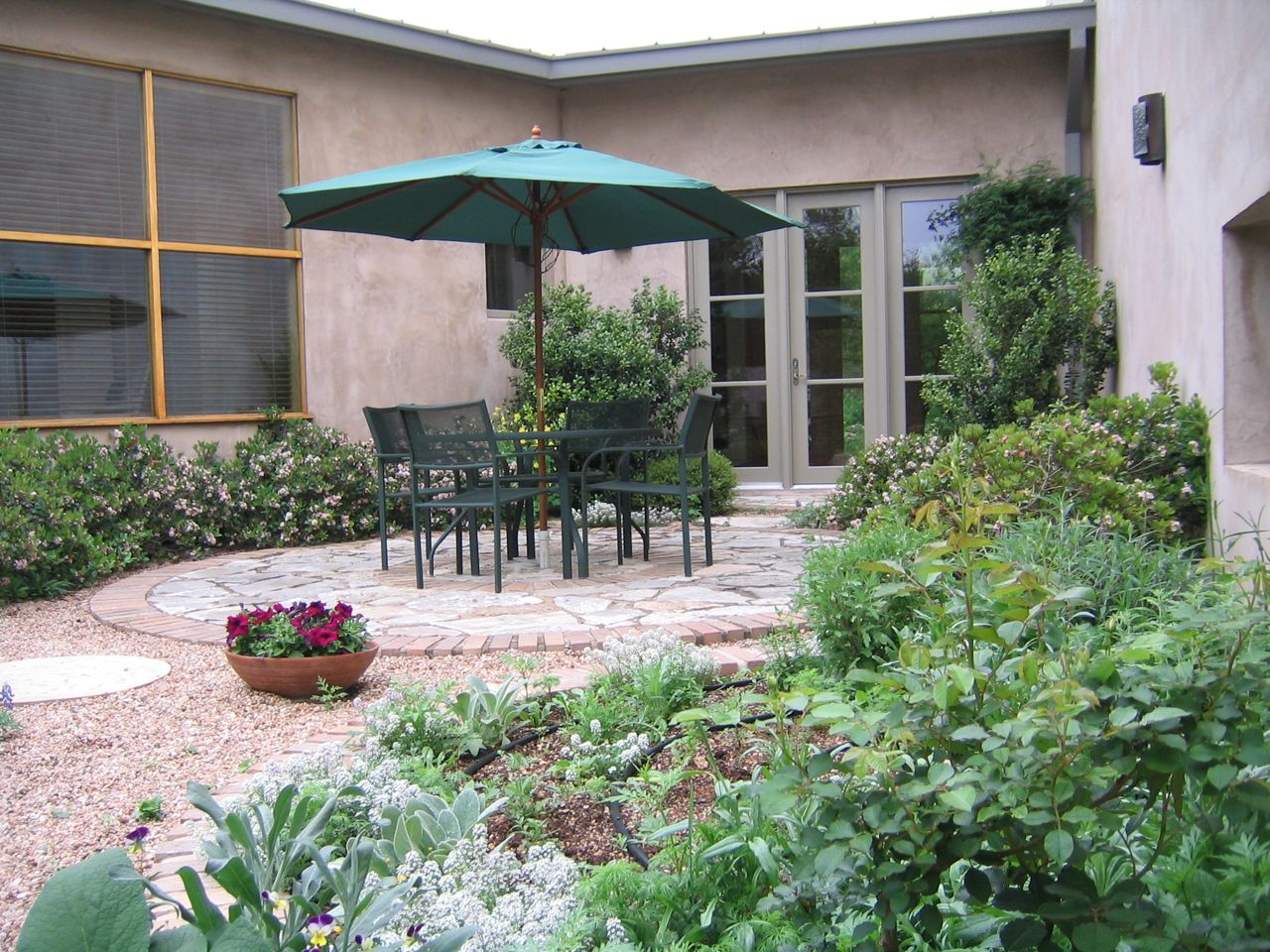
But one thing led to another. More circles; circles of brick infilled with stone to make a patio, and circles of stone to enclose a bird bath and roses, and half circles on brick and inlaid stone to form landing areas from the house and archway. We were lucky to find a pallet of bricks in the perfect color at the Habitat for Humanity re-store. David built the brick surrounds, and together we cemented and mortared the stones. Not a job I will forget. I then suggested some circular stepping stones would break up the expanses of gravel. David used various molds to make the stones filling them to within 2" of the top with sand and pouring concrete on the top. To make the stones look more natural I would imprint them using various rough rocks. Sometimes I was out there in the dark.


This patio is a favorite place to have breakfast in the summer, sheltered, as it is, from the rising sun.


And in keeping with all those circles a few homemade hypertufa balls and glass balls from defunct outdoor lighting break up the expanse of gravel.


Lots of plants self sow in the gravel. Bluebonnets, larkspur, nigella in the spring and narrow leaf zinnias and gomphrenas in the fall.


All this rock clearly went to our heads because next David decided turn his hand to building a retaining wall where there had once been an ugly slope. You can just see the wall through the gate below.


No rock was too big for him to haul uphill from our "quarry" He estimates he moved several tons of rock. This area, outside our garden walls links the small Secret Garden with the English Garden. It is open to deer with no irrigation so a restricted planting.


And on garden does lead to another. Through the archway the sunken garden awaits our visitors.


I hope you will come back to read all about the rocks in there.

Monday, October 12, 2015

ENGLISH GARDEN? REALLY

Yes, it's a little confusing to say the least because in my English garden you will find Carolina jessamine, Japanese anemone, Texas clematis, Mexican feather grass, Australian leatherleaf acacia and of course the Philippine violet which is blooming in my garden as I write.


So why did I call it an English Garden? The dry stone wall. It was the very first thing I did. With so little native soil underpinned by deep rock it really was the only answer to being able to plant. The 2' high wall follows the contour of the concrete garden wall. It took months of stone collecting as the house was being built and hours of labor to put it together. Not to mention some trapped finger nails.
Walls like this, but much higher, were built all over the North of England to fence off the fields after Enclosure. They are a part of my heritage. And to be honest it is one of my favorite gardening jobs.


If truth be known most of the flowers you see growing in the English gardens are not native but brought to England by the great plant collectors of the 18th and 19th centuries. However, I would like my garden to look a little more English and that is one of my ongoing projects.

English gardens are known for their roses so this week I added a new English rose to the garden. It was actually an impulse buy. I kept checking my local nursery to see if they had Rosa 'Felicia' which I needed to replace due to hail damage, but to no avail. Then I spotted this rose, Rosa 'Molineux' and fell in love with her musky tea-rose scent and her peachy yellow bloom. Plus, she is a shrub rose suitable for a pot.


I have the Rock 'n Oaks garden club to thank for the addition of Rosa 'Molineux' following their visit to my garden this spring and their generous gift following the hail damage. I still plan to keep looking for 'Felicia'. She is truly the most wonderfully fragrant, repeat blooming musk rose there ever was! Even with all the stem damage she is putting out the odd bloom in response to some cooler nights


But a little more about Rosa 'Molineux'. She is a David Austin rose, patented in 1994 and named for the Wolverhampton Wanderers Football club which is located close to the David Austin Gardens, in England. Another gardener wrote of her, ' I do not know of another Austin with all the virtues of 'Molineux' This rose has a lot to live up to. Our climate may not be as welcoming as that of England but
she has a nice location on an east facing wall. I will move her up to the house for winter protection.
There are other roses in the garden. A circle of knockout roses around the bird bath....


and lots of rock roses, Pavonia lasiopetala, that seeded themselves in front of the bedroom window. New blooms open up every morning.


We added a couple of trellises this year with a Clematis jackmanii on each. Both were from bare roots . One did better than the other which I may have to replace next year. Another trellis is planned for the opposite wall and I am looking into plans for a wooden pillar on which to grow a pillar roses. I saw this idea at Mottisfont gardens in England. These will be on each side of the archway. If only we could have a rainy day so that I could bury my nose in a few gardening books.

Wednesday, October 9, 2013

I'M A HOARDER AND A DREAMER

I have to admit I'm a garden magazine hoarder. I have magazines dating back to the early 90s. When I get them out it is often as though I am reading a new magazine and I always hope that this time around I will find nothing of interest to me and I will be able to throw the magazine away. Even though my tastes and ideas change over time I usually find something there which requires me to put that magazine  back on the shelf. The other day after lunch I sat down with a 1998 Sunset Garden Guide.


This is a photo of a retaining wall in Scott Spencer's Southern California garden. Oh my! This photo makes my garden soul jump up and down. My friend Pam Penick wrote on her blog recently about reproducing a garden scene from a magazine by substituting plants local to one's own area. What a great idea, which you can read about here.


I have the retaining wall. Isn't it a beauty? David did this retaining wall hauling thousands of pounds of limestone rocks from lower down on our lot.


I think it is magnificent and yet it is lacking something.... I have made excuses; no water, no soil, deer, raccoons, turkeys mice, squirrels. Things have changed recently due to the prolonged Texas drought. We have lost many of the trees and with more sun little Texas sedges are starting to pop up everywhere. The yuccas and opuntia I have planted are doing well producing their first heavy crop of tunas this year. Bluebonnet seedlings are everywhere. With some gentle winter rains we may have a wash of blue next year.


When I visit English gardens I dream of having aubretia and campanulas growing out from between the rocks. Nothing seem to survive life in the dry, drystone wall.
Now after revisiting that wall in California I am inspired to make some improvements. I can have Mexican feather grass and maybe a Weber's agave hanging over the wall. Maybe some euphorbias and of course rock rose. I am going to head out into the garden and pick some seeds to throw among the bluebonnets.

Sunday, November 6, 2011

THOSE WALLS

All who come to visit our garden are impressed by the walls that surround our house. They really are the result of an architect who listened to his client.


Let me quote here something I read recently. In 1220 King Henry III gave these instructions to his bailiff.

'to make round about the garden of our queen two walls, good and high, so that no one may be able to enter, with a becoming and honorable herbary near our fish pond, in which the same queen may be able to amuse herself' 


Now, I am no queen and the idea here was not to keep people out but to keep out deer, and yes I do 'amuse' myself inside these walls, although many would not call it amusement. I don't have a fishpond, although I am so entranced by the tank ponds I see in my fellow blogging gardeners' gardens that I may just have to find a spot for a small one.  In fact I think I may have just the spot!


Maybe Henry was the first to ask for such walls. If he was, then he started something because ever since then people have been building walls around their gardens. They may have used brick, stone, wood fences, tall hedges, but most houses have their 'walled' gardens. Ours may be a little different because they do not delineate the property, as many do, but rather create an oasis within our property.


The land slopes across the property and so the house, which is a single story, was built on three levels. Just a foot between each level. Then a long wall was built out from the where one level drops, with an archway and several 'windows'. This created a garden areas on the higher level, which we call our English garden, and our 'sunken garden' on the lower.
Here is a glimpse of what we had undertaken in asking for walls.


 The walls were there but then it was up to us. You can see what we started with. We sit completely on solid ledge stone although they did bring in a load of 'red death'.


The first project was the short dry stone retaining wall which followed the curve of the wall. I saved every flat rock that was exposed during construction, making a huge pile, from which I built the wall.


This curved wall really set the stage for the rest of the garden. What do you do when you have several angles and a curved wall? The easiest thing is to make everything else circular. The brick came from the Habitat for Humanity re-store. A bargain for a palette of bricks donated by a builder. More flat stones from the property filled in the brick edging. This was a project we worked on together. No plans on paper, just a circle marked out on the ground using string and a stick. I always liked doing jigsaw puzzles.

Spring in the English Garden

David made the circular pavers to complement the other circles and used the left over brick to make bed edging and the bird bath circle.


We eat outside when at all possible and so created multiple places to eat at different times of the year.  Although this wasn't the first project we tackled I really think it was the most rewarding.