My Blog List

Showing posts with label lantana. Show all posts

Thursday, June 17, 2021

OUR WILDFLOWER MEADOW

I don't even have enough time to deal with everything in my inside gardens and outside gardens without venturing onto the septic field. But about 4 years go I decided I really wanted to have that wildflower meadow I should have had 21 years ago. That was when I bought a Texas wildflower and grass meadow mix from Native American seed. It was to go in the tank when they sprayed the cover on the septic field. When I came over the next day there sat the 2 bags by the garage, unopened. There was nothing in their spray tank but left over Bermuda which is what began to take hold within weeks. We tried to get rid of it and then put down our seed but it was to no avail. Weeds came and in the end David just decided to mow. It looked fine. Still I had that hankering to have the meadow. Five years ago David began mowing and collecting, the idea being to reduce the fertility of the soil. No more mulch mowing. I scattered left over bluebonnet seeds from the garden as well as blanket flowers. 


Bluebonnets are now gone, but a year ago native bee balm, Monarda citriodora,  started to grow and has really increased in numbers this year. I am so happy to have the purple one because at the top of the lot, near the road there are some white ones. This is hands dwon my favorite after the bluebonnet whihc is good because they don't share the same season.

And they are not called bee balm for nothing.


While I control the pink evening primrose, Oenothera speciosa, in my inside gardens, I am more than happy for it to spread outside.

 And prairie verbena, Glandularia bipinnatifida,  is a welcome plant.

Coreopsis, Coreopsis tinctoria, has started to bloom. Small plants at the moment but I am hoping next year their see will spread just as it does along the roadsides.

And this rather unusual one has popped up.

Tall vervain

Surprisingly the blanket flowers, Gaillardia grandiflora,  struggle to survive as the they seem to be a favorite of the deer.

The first year we made a path alongside the septic field we had an amazing showing of Mexican hats, Ratibida columnifera. They were all different shades of yellow and brown. Some solid some mixed colors. Maybe the conditions were just perfect, never to be repeated. But one or two this year. All the yellow variety. 

Horse herb or straggler daisy, Calyptocarpus vialis, soveres much of the shady area of the field but is nmaking headroads into the center. Maybe due to long days of rain and cloud. I think it will go dormant now we are well into summer temperatures. 

And it is no surprise that our native lantana, Lantana urticoides. I will be watching out for the pink variety  Lantana camara, which is invasive. 

This year finds me very happy about how the wildflower meadow is coming along. And we haven't had to mow yet. That will be done in the fall.

Wednesday, October 7, 2020

GOODBYE SUMMER, HELLO FALL

At last! Temperatures are moderating and fall is on the way. It is not just the gardener who is celebrating the advent of the new season but the garden plants are too.

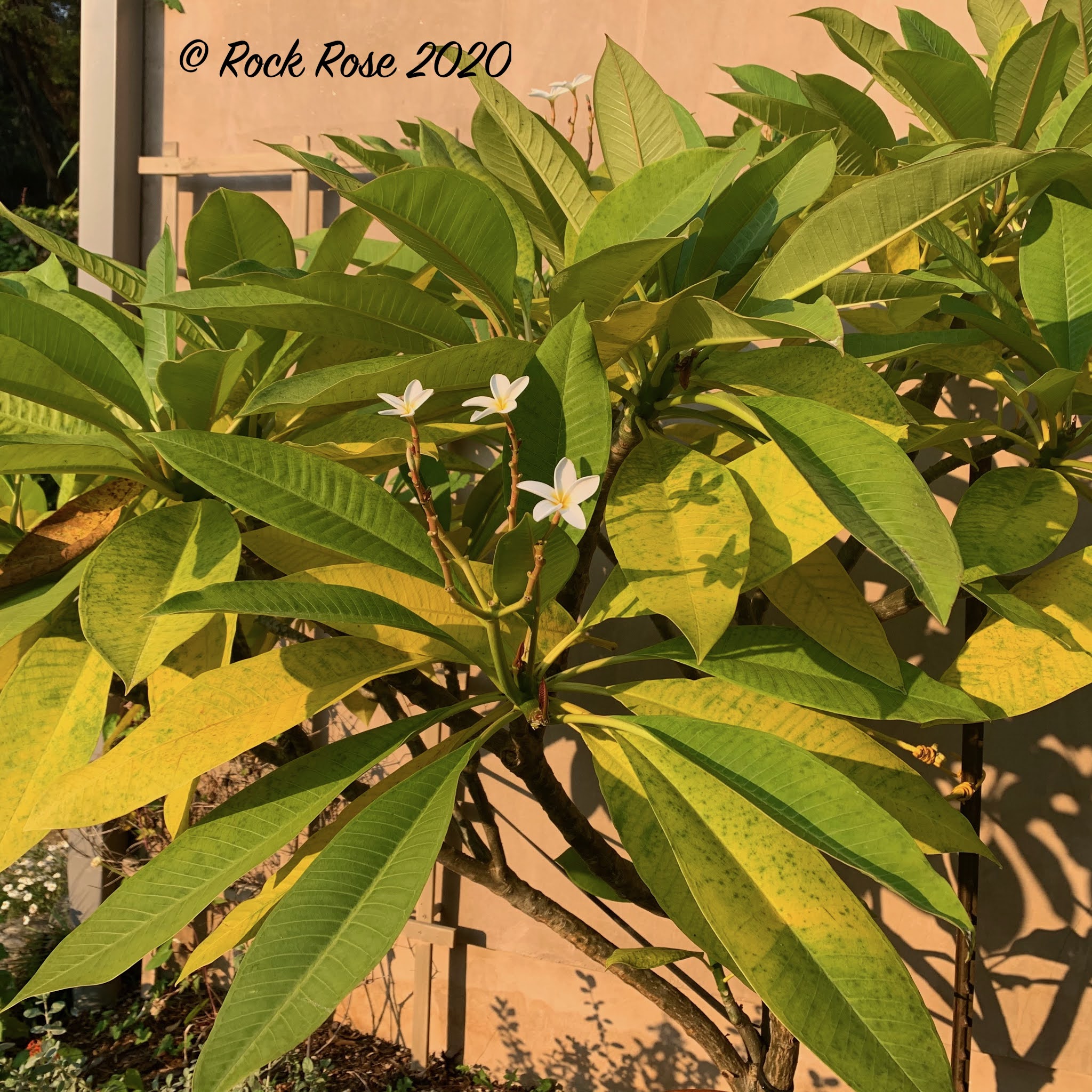
All that is except the plumeria. A few nights of temperatures in the 50s and it is already beginning to cry "I'm out of here" Shortening days mean the plant starts to cut back on food production, the leaves turn yellow as the supply of food is reduced. The leaf forms  an abscission layer and eventually falls off. 

 Every day new leaves fall and soon it will be time to move the plant into the garage. During the winter it will receive no water and will go completely dormant. Because the plants are so large I plan to do some pruning before I move them which will make the job a lot easier. 


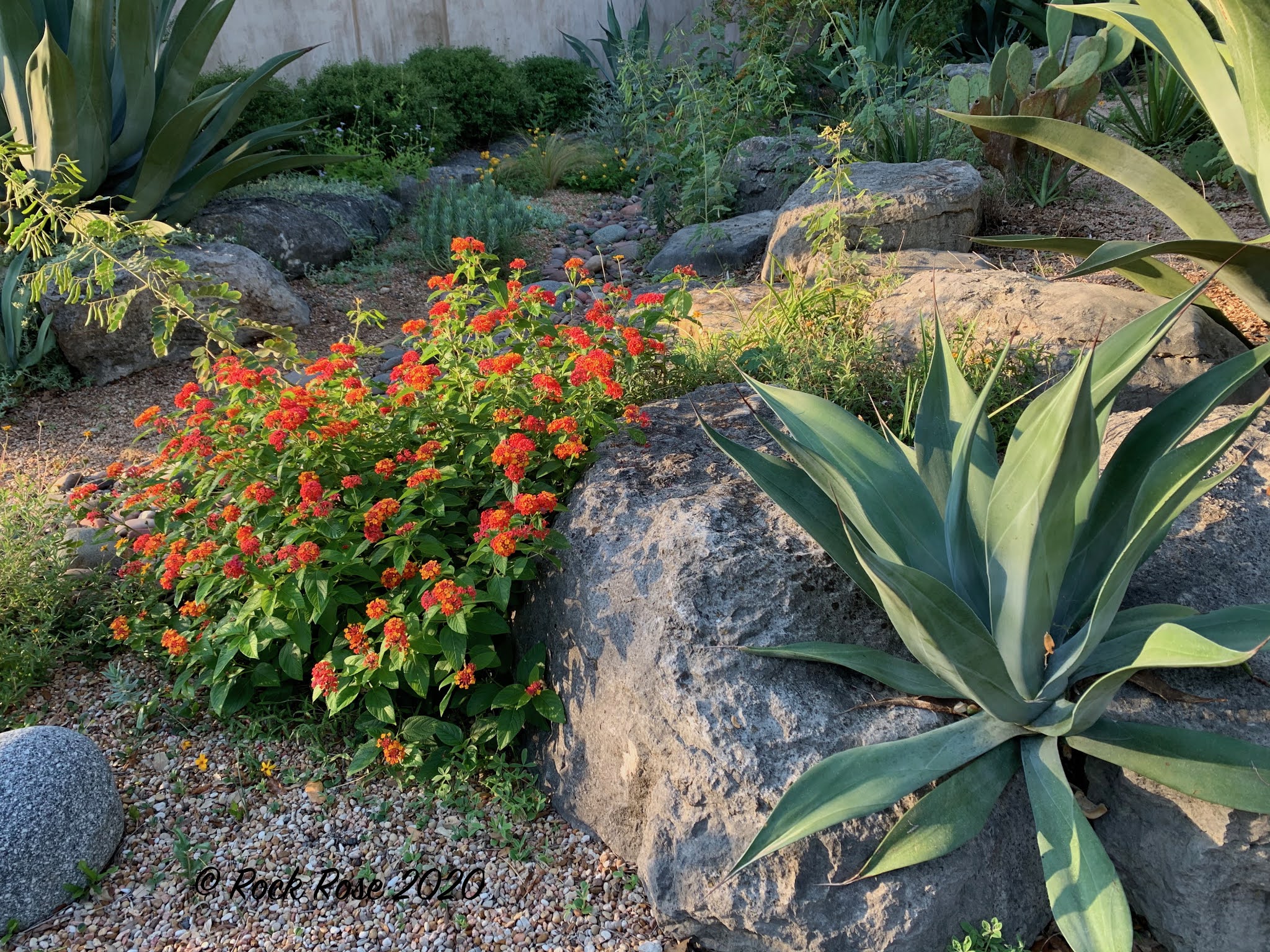
Flower colors become more vibrant as with the native orange lantana, Lantana horrida. And the award winning David Austin rose, Rosa 'Molineaux', blooming again for the first time in months. This shrub rose is a repeat bloomer and named for David Austin's favorite soccer team. 


There are lots of flowers that are repeat blooming such as the Verbena, Verbena bonariensis whose lanky growth was cut back to the ground a few weeks ago.


Another repeat bloomer is the soft leaf yucca, Yucca recurvifolia, which the deer have failed to find. 


It has become quite a free-for-all of flowering plants in the sunken garden with Perovskia, white Salvia greggii, mealy blue sage, Salvia farinacea, frost weed Verbesina virginica, and Mexican bush sage, Salvia leucantha.


 But there are some plants that bloom only in the fall. They wait patiently for the shorter days before they begin to bloom. Notable in my garden is the Philippine violet, Barleria cristata. 


It blooms best when given plenty of sun and is one of my favorite fall bloomers because it attracts neither bugs nor disease. It dies to the ground during a normal winter and shifts a little from its original positions as the center often becomes very woody and dies out. 

And finally the bush clover, Lespedeza thunbergii, waits patiently to bloom in the partly shaded border of the English garden. 


There are lots of short day plants which will bloom over the next few months including chrysanthemums, poinsettias, Christmas cactus. Make sure the later receives at least 15 hours of darkness from now on. 

Happy Fall Y'all.

Tuesday, May 2, 2017

CELEBRATE NATIONAL WILDFLOWER WEEK, May 1-7

Do you have wildflowers growing in your garden? I do. Let's see what is blooming out there this week as we celebrate National Wildflower Week.

I'll begin with Colorado Venus' looking-glass, Triodanis coloradoƫnsis. (A)What a lovely name.


And where did it come from because I have never seen it before? It came inside a hole in a rock I brought into the garden when I redid the dry creek along the garage wall.


The plant is annual so I shall watch carefully for the seed pods ripening. I would like to have more next year.
A final blooming of the lace cactus, Echinocereus reichenbachii.(P) Even after the blooms die it remains a tidy addition in the rock-scape.


And the blousy Engelmann's daisy, Engelmannia peristenia, (P) opening with new flowers every day from a winter rosette of leaves.


The pathways in the vegetable garden are crowded with blanket flowers, Giallardia pulchella. (A) Goldfinches feast on their seeds but always leave plenty to bloom next year.


And Mexican bush sage, Salvia leucantha,(P) blooming months ahead of schedule this year. Will it bloom again in the fall as the hummingbirds begin their long winter flight to SouthAmerica?


The trailing wine cup, Callirhoƫ involucrata, (P) spilling over the dry-stone wall. Always everyone's favorite when they visit the Wildflower Center.


The flowers on the Texas prickly pear may only last for a day but they may leave behind some nice fruits. These fruits, call tuna, ripen to a burgundy red and can be used to make jelly.


Wooly stemodia, Stemodia lanata, (P) makes a good ground cover and is deer resistant.


It has tiny blue flowers.


Our native Lantana, Lantana horrida (P) is also deer resistant and blooms through the hottest months of the year with little water.


Purple skullcap,  Scutellaria wrightii,(P)  can be pruned into a tidy clump and blooms all summer.


Echinacea, Echinacea purpurea, (P) a summer bloomer and another favorite of the birds when it goes to seed.


The Blackfoot daisy, Melapodium leucanthum, (P) another deer proof summer bloomer.


The columbines are among the earliest of spring flowering plants. here the Hinckley's yellow columbine, Aquilegia hinkleyana, (P).


and the more delicate smaller flowered Aquilegia canadensis,(P)


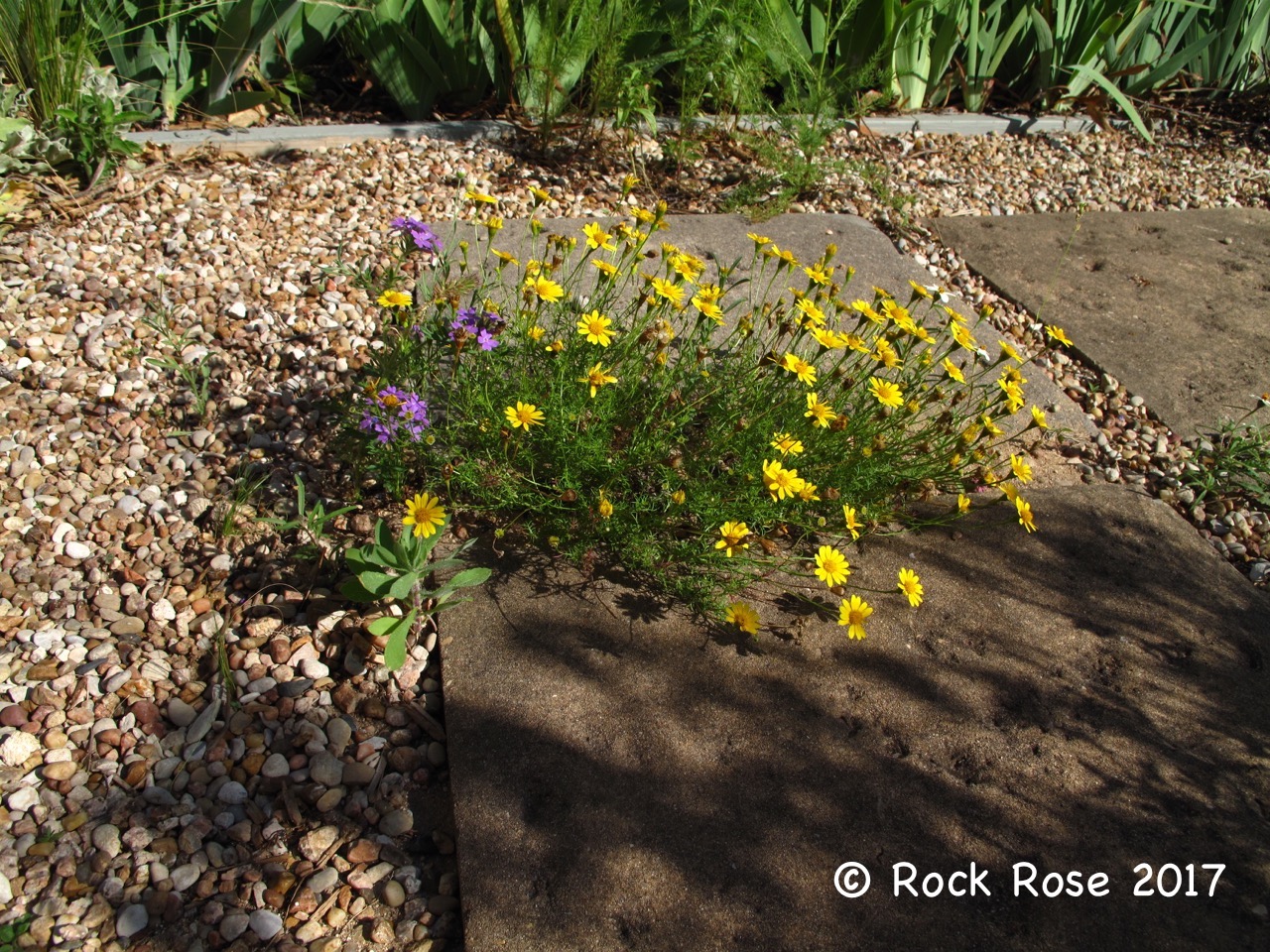
Damianita, Chrysactinia mexicana,(A)is both drought and deer tolerant but does best when given occasional waterings.


All these plants are blooming in my west Austin, rocky landscape, with minimum watering.

If you would like to learn more about wildflowers for you area you can get information on the Ladybird Johnson Wildflower Center website. There are all kinds of programs going on this week in Celebration of National Wildflower week.

Tuesday, September 13, 2016

PLANTS THAT PLANT THEMSELVES

Mine is a garden of self-seeding plants. Not all plant place themselves in places that I would choose, but many do.
In a corner of my front courtyard garden a tree senna, Senna corymbosa, has grown. It couldn't be more perfect. A place for birds to sit before and after visiting the bird bath. It has always been a difficult corner because no sun reaches the corner so the tree has grown out rather than up and there is heavier growth and flowering on the front side.


And the Lindheimer senna, Senna lindheimeriana,  seen here outside the garden walls.


and plenty have seeded inside the front courtyard too.


They are two of my native plants whose flowering brings light into the garden in September.
Native blackfoot daisies, Melanpodium leucanthum are never happier than in the poor gravel of the English garden.


And rock rose, Pavonia lasiopetala,would just like to take over other places in the English garden, if I let it.


 I think I need to encourage it to spread its wings and grow outside with the the zexmenia, Wedelia hispida.


This very fine stemmed and leaved plant is greenthread, Thelesperma filifolium.

 
Zexmenia and thelosperma growing together
I'll be saving seeds from the gomphrena 'strawberry fields' for next year. It has put on an amazing show covering the gravel in one area of the English garden. Last year I had one plant here.


Another gomphrena that has reseeded is Gomphrena globosa 'fireworks' I cut this plant back to the ground a few weeks ago.


And once again the pathways in the vegetable garden are filled with flowery weeds!


I guess I will never change.