My Blog List

Showing posts with label Texas mountain laurel. Show all posts

Wednesday, March 18, 2026

WHAT WINTER!

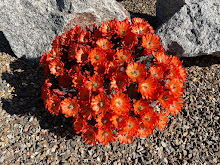
 Talk to a snowbird and they will tell you " We can't believe the weather. It has been so wonderful" Talk to a gardener and he or she may have a different story. Yes! we have had endless sunny days with short bouts of rain.  But this is January, February and March. This is when we enjoy some cooler days in the 60s. Not this year. Early on in the month we had two spells in the 80s and last week 90. The promise of a fabulous wildflower season faded along with the delicate blooms. Here are my pretty California poppies which I cast along the driveway. They came from a small packet of wildflower seeds I picked up at our local library seedbank. I had no idea what was in the packet so was delighted when these poppies grew. Their blooms are more delicate than those in the packets of seeds you can buy and only flower for a few days.

What does no winter do to our desert plants? The Texas olive did not lose its leaves and is already in full flower. The flowering spoilt only by leaves that were shredded by the hail event. I keep going around pulling off the old leaves. The only positive here is the reduction of the clean-up required when they all fall. Why did someone not tell me rocks were a problem under Texas Olives. 


A familiar waft of fragrance on the air in early February was the Texas Mountain laurel. With such a mild fall and winter an influx of the Genista moth caterpillars, which resulted in all the new growth being decimated means very few flowers. The trees themselves look very ratty and I am pondering whether to remove one of the 4 trees I have. The problem is they form a screen from next doors driveway. It almost seems like sacrilege to pull out such a  large tree (I saw one in a large pot at the nursery and it was $385) but it wouldn't be the first. I believe the prior occupants grew them as bushes which their landscapers regularly pruned so they never saw any blooms.  


Just a waft of fragrance is a positive this year because it won't  be competing with the fragrance on the pink jasmine, Jasminum polyanthum , which I much prefer. Their petals fade very quickly when the temperatures are in the high 80s so I don't expect its bloom to last much longer. When I open the patio doors in the guest bedroom the fragrance fills the whole house. 


And what is going on with the Photinia fraseri x 'Red Robin' The rapid unchecked growth of the new stems is a sure sign that it is far too comfortable. I have 3 of these plants that remain in a clump in the front garden. While this plant is not suitable for all climates and soils it seems to do very well inthe desert. No bugs or diseases as yet. I do have to cut it back every year or it will reach over 8" without a trim. One in the back garden I have trained into multi tree-form. There wasn't one perfect trunk for this experiment so I have allowed 3 to grow. 


Bougainvillea has always entered a  dormant period in prior years losing all its leaves. Not his year. It took a beating from the hail but promptly put out new growth and is now flowering. And this was the year I was going to get in there and give it some training to improve its structure. I really would like it to grow against the wall.


The pomegranate tree, Punica granatum, only lost a few of its leaves and quickly added more and even a few pomegranate flowers. I shall be eagerly watching to see which are male flowers and which are female (hermaphrodite). Most of the flowers were males last year so we only harvested 3 good pomegranates. Maybe year 4 will prove to be a bonus year with more females. It is easy to spot the difference as the females have a more bulls base and the males smaller. Male flowers tend to drop off fairly quickly. 


 The calamondin tree bloomed and set fruit all through the winter and is now putting on new growth but no new blooms. We had a nice crop of grapefruit and the tree is putting out new growth but no blooms. This Oro Blanco variety is one of the most sought-after of grapefruit varieties for its pale green, sweet flesh which lacks the sharp bitter taste of some grapefruit. It is a cross between a pommelo and white grapefruit and therefore has a thick skin. The lack of flowers may be caused by too much fertilizer or too much water. 


The Philippine violet, Barleria cristata, has not entered dormancy and still has all its leaves. I even noticed a small purple bud at the end of one branch. Planted in a rather shady spot underneath a Texas Mountain Laurel it is reaching across the fence to which I have tied it. I believe I was successful in striking a cutting in the fall which I will plant in a more favorable position. 


The Anacacho orchid tree, Anacacho lunarioides,  bloomed on the top branches several weeks ago and now the lower branches. It looks rather strange with the green spiky seed pods on the top. It is my "apple tree blossom" of the desert. 


Who knows what the year will hold in store. This week the temperatures will hit 105 before settling back down into the 80s. But the heat will have done its damage frying delicate spring blooms. It is far too early to be having summer. I fear the saguaro will not flower this year. We shall have to wait and see.


Saturday, March 12, 2016

MANY THINGS ARE SENT TO TRY US

Years ago a garden acquaintance was walking around the garden with her husband. "And what's wrong with this plant" he asked, "too much sun? too little sun? too much rain? too little rain?" Of course this is Texas and what else do you expect. You might add to that list, a late frost, hail, devoured by snails, slugs and pill bugs, plants mounded up by fire ants, attacked by aphids, mealy bugs, scale, bagrada bugs, harlequin bugs and leaf footed bugs, tomato horn worms and deer.
My garden has been visited by all of the above and for one second I throw my hands up in the air and say "I'm giving up gardening" It never lasts. Whatever you call it, passion or addiction,  I can't keep my hands out of the soil. And with all that frustrates me about gardening in Texas there is always a reward around the corner.

The agarita, Mahonia trifoliata, never produced a single berry last year because it was hit by hail but this year it is putting on a show and I am hoping this will be a fruitful year.


The hellebore I bought in 2011 and hasn't bloomed once since then is blooming this year. Do you remove the leaves from your hellebore? I read that many gardeners in England do.


Among many orange California poppies I have a white one.


When I picked up , on impulse, a bag of freesias in the fall I had no idea that they would put on such a show. Planted in pots as well as in the ground their strappy broken foliage may not be much but the flowers are heavenly.


Two of my lemon trees and the lime all filled with flowers. But where are the bees? The few I have seen have been on the alyssum although I saw two solitary bees on there yesterday feeding on pollen.


And the ever faithful chocolate daisy, Berlandiera lyrata, is back for its 10th year.


The Aloe X 'David Verity' has produced a successful bloom as a result of our mild winter


And despite the fact that we were away when my Texas mountain laurel, Sophora secundiflora, bloomed. I am so proud that I grew this one from seed.

And when the fire ants start mounding their soil around my succulents I just shrug my shoulders and get on with hosing them off.


 Not that they need any more rain after the 4" we received over the last 3 days.

Saturday, February 11, 2012

ONLY THE MORNING WILL TELL

I will only know tomorrow morning whether I am to see the first bloom of this Texas Mountain Laurel, Sophoraa secundiflora, lovingly grown from seed. Actually all I did was put the seeds in the ground and left it to its own devices.


Now it is a 6' tree and was to bloom for the first time this year. It will now depend upon how cold it gets tonight. Judging by how cold it is out there right now I think it is a pretty good bet that the feeze they are promising for the Hill Country will happen.


The tree is growing in the native areas outside the walls with only the cedar beside it to protect it.


Close by, the Texas agarita, Mahonia trifoliata, also is in full bud.


And buds on the Lady Banks rose. Only tomorrow will tell.