My Blog List

Showing posts with label bougainvillea. Show all posts

Wednesday, March 18, 2026

WHAT WINTER!

 Talk to a snowbird and they will tell you " We can't believe the weather. It has been so wonderful" Talk to a gardener and he or she may have a different story. Yes! we have had endless sunny days with short bouts of rain.  But this is January, February and March. This is when we enjoy some cooler days in the 60s. Not this year. Early on in the month we had two spells in the 80s and last week 90. The promise of a fabulous wildflower season faded along with the delicate blooms. Here are my pretty California poppies which I cast along the driveway. They came from a small packet of wildflower seeds I picked up at our local library seedbank. I had no idea what was in the packet so was delighted when these poppies grew. Their blooms are more delicate than those in the packets of seeds you can buy and only flower for a few days.

What does no winter do to our desert plants? The Texas olive did not lose its leaves and is already in full flower. The flowering spoilt only by leaves that were shredded by the hail event. I keep going around pulling off the old leaves. The only positive here is the reduction of the clean-up required when they all fall. Why did someone not tell me rocks were a problem under Texas Olives. 


A familiar waft of fragrance on the air in early February was the Texas Mountain laurel. With such a mild fall and winter an influx of the Genista moth caterpillars, which resulted in all the new growth being decimated means very few flowers. The trees themselves look very ratty and I am pondering whether to remove one of the 4 trees I have. The problem is they form a screen from next doors driveway. It almost seems like sacrilege to pull out such a  large tree (I saw one in a large pot at the nursery and it was $385) but it wouldn't be the first. I believe the prior occupants grew them as bushes which their landscapers regularly pruned so they never saw any blooms.  


Just a waft of fragrance is a positive this year because it won't  be competing with the fragrance on the pink jasmine, Jasminum polyanthum , which I much prefer. Their petals fade very quickly when the temperatures are in the high 80s so I don't expect its bloom to last much longer. When I open the patio doors in the guest bedroom the fragrance fills the whole house. 


And what is going on with the Photinia fraseri x 'Red Robin' The rapid unchecked growth of the new stems is a sure sign that it is far too comfortable. I have 3 of these plants that remain in a clump in the front garden. While this plant is not suitable for all climates and soils it seems to do very well inthe desert. No bugs or diseases as yet. I do have to cut it back every year or it will reach over 8" without a trim. One in the back garden I have trained into multi tree-form. There wasn't one perfect trunk for this experiment so I have allowed 3 to grow. 


Bougainvillea has always entered a  dormant period in prior years losing all its leaves. Not his year. It took a beating from the hail but promptly put out new growth and is now flowering. And this was the year I was going to get in there and give it some training to improve its structure. I really would like it to grow against the wall.


The pomegranate tree, Punica granatum, only lost a few of its leaves and quickly added more and even a few pomegranate flowers. I shall be eagerly watching to see which are male flowers and which are female (hermaphrodite). Most of the flowers were males last year so we only harvested 3 good pomegranates. Maybe year 4 will prove to be a bonus year with more females. It is easy to spot the difference as the females have a more bulls base and the males smaller. Male flowers tend to drop off fairly quickly. 


 The calamondin tree bloomed and set fruit all through the winter and is now putting on new growth but no new blooms. We had a nice crop of grapefruit and the tree is putting out new growth but no blooms. This Oro Blanco variety is one of the most sought-after of grapefruit varieties for its pale green, sweet flesh which lacks the sharp bitter taste of some grapefruit. It is a cross between a pommelo and white grapefruit and therefore has a thick skin. The lack of flowers may be caused by too much fertilizer or too much water. 


The Philippine violet, Barleria cristata, has not entered dormancy and still has all its leaves. I even noticed a small purple bud at the end of one branch. Planted in a rather shady spot underneath a Texas Mountain Laurel it is reaching across the fence to which I have tied it. I believe I was successful in striking a cutting in the fall which I will plant in a more favorable position. 


The Anacacho orchid tree, Anacacho lunarioides,  bloomed on the top branches several weeks ago and now the lower branches. It looks rather strange with the green spiky seed pods on the top. It is my "apple tree blossom" of the desert. 


Who knows what the year will hold in store. This week the temperatures will hit 105 before settling back down into the 80s. But the heat will have done its damage frying delicate spring blooms. It is far too early to be having summer. I fear the saguaro will not flower this year. We shall have to wait and see.


Monday, September 29, 2025

WHAT’S NEW IN THE GARDEN.

 What's been going on in the garden. That is what I was thinking when we returned from another 3 week trip. My eyes eagerly scanned the front bed as we pulled up the driveway. It looked as though monsoon rains had been kind. The damianita, Blackfoot daisy and skullcaps were flowering. And no damage from javelina due to having left the dog fencing across the driveway. ( No letter from the HOA as yet)


Damianita Chrysactinia mexicana.


Blackfoot daisy, Melampodium leucanthum


Arizona Purple skullcap,Scutellaia potosina. with damianita


And then my eye caught a newcomer. What was this? My first thought was Arizona poppy, Kallstroemia grandiflora. A plant I had heard about but had never come across. A search for Arizona poppy confirmed this. Where had it come from? Maybe turned over  from deep in the soil when David had run a new sprinkler line. It is a rather rangy plant and would suit an open desert setting better than the narrow place in which it has inserted itself. Despite being called a poppy it is not in the poppy family but can mimic the look of the spring flowering California poppy. It may take several years to germinate because of a hard seed coat and usually springs up after monsoon rain. It is right on cue. 


Arizona poppy,  Kallstroemia grandiflora


And along the driveway the tree I love in summer but despair of all through the winter and early part of the year. All is forgiven! Those gorgeous white blooms on the Texas Olive, Cordia boissieri


One thing I try to do is to remove the fruits before they fall to the ground where they germinate. This year there are so many I will have to do a little weeding. I am now familiar with the first leaves which are nothing like the secondary leaves. 


 Along the side of the house the smaller leaved olive, Cordia parvifolia. The cordia are the desert blooms of the monsoon season. 


The first planted pomegranate tree has, this year, 6 pomegranates, the largest of which I have protected inside a bag. The others are quite small. As yet they are unblemished and I have no idea if they are ripe. I remember the same with my fabulous pomegranate tree in Austin but it was easy to sacrifice one each week to check for ripeness, there were so many.  It was usually later in the year. 


And the bougainvillea just coming into flower after the rain and moderation in temperature. 


So far so good. Then I noticed my prize prickly pear cactus had the starts of a cochineal infestation. From just a couple of pads this had grown quickly.


A little work with the toothbrush and the pads are as good as new. 


The back and sides of the house receive more visits from desert wildlife and they had been busy. One small agave eaten down to a nub. A spineless prickly pear just about annihilated. The pereskia had lost its drip line along with all its leaves. I'm not sure it will make a comeback. Death by rat and drought.


There were holes dug in the ground-the grub hunters were on the prowl. My neighbor has raccoons playing on her roof at night and using a corner of the roof as a toilet. They have professionals trying to trap them. Their wildlife camera spotted a skunk passing through last night. Another grub hunter. Was it the skunk that had ripped out two plants in order to root for grubs? But the worst of all happened last night when leaf cutter ants removed every single leaf from a Tecoma plant. It appears as though they had more cutters than gatherers and choppers, with hundreds of cut leaves beneath the plant and chopped pieces left along the pathway. This all done under cover of darkness. I could follow the trail of the few stragglers heading for home. It crossed my garden and up the wall into next door's garden. From there they crossed and climbed up and over the back wall of the property and down into the desert where the vegetation is too thick to track them to their nest. It is the most devastating thing to have happened yet and it makes me feel the closest I have ever felt to giving up gardening. "Get over it" say Tucson gardeners, who have had similar visits and  hope the plant makes a recovery. We are due to leave again next week for the last camping trip of the year so I imagine in a month's time I will be doing the same inspection. 

Sunday, August 27, 2023

HOME FROM THE HILLS

After 6 weeks away you can imagine I was a little nervous about how my garden would look. The summer monsoon had not materialized and temperatures had been unseasonably hot. Tales from the DBG in Phoenix told us of the saguaro suffocating in the unusually high night-time temperatures. We are a little higher in Oro Valley (3000') which makes us cooler by about 8° More than my fingers were crossed when we pulled into the driveway. But I had to wait until morning because it was already dark too late to walk around. We had arrived home to a strong thunderstorm and temperatures in the 70s so next morning I was delighted to find the front garden looking very good.

The bougainvillea on the front walkway had a few blooms. Just enough to brighten the wall. 

 It looks as though a bird has been busy making a nest. For now it is just a platform of twigs and may even have been abandoned. Possibly a thrasher or cactus wren. Our comings and goings may be too much for it.


The chocolate daisy, Berlandiera lyrata, opens up with new flowers every morning, so I was happy to see it was still putting on a show. It is getting a little lanky and could do with a prune but is now the right time? Like most I am not happy to cut off a good bloom.

And the blanket flower, Gaillardia pulchella, still going strong. It was blooming when we left six weeks ago.


Other native plants likes the skullcap, Scutellaria potosina ssp platyphylla add a splash of purple in front of the young Whale's tongue agave, Agave ovatifolia. Despite all the structural plants I am not happy to do without a little color.

Along with the bright white of the blackfoot daisy, Melampodium leucanthum. 


So many of these plants are a reminder of my Austin garden, although there the barrel cactus were in pots. I regret now that I didn't bring the larger ones. I think I could have pulled them out of their pots and brought them bare root.

There are only a few large agave remaining. This one is on the corner beneath the palo verde. But wherever we took out the Agave weberi new pups are springing up. I am potting some of them up to plant out behind the house. There is good value to be had out of these large structural agave and I find I miss them. For the first time ever I have started to protect them from the weevil by using the systemic Imidacloprid around the base.

 Another very spiny agave guards the edge of the driveway and is forever in risk of being run over. It is a slow grower but it puzzles me why they would have planted it so close to the edge. It has produced only one pup which I relocated.

I am really quite fond of the brittle bush, Encelia farinosa, which blooms in the spring with masses of yellow flowers. It reseeds around the garden and I leave some of them to grow into small bushes.


One of the plants I was most concerned about was the Meyer lemon tree. It had lived in a large pot for 12 years, providing us with tens of lemons every year. We brought it with us and last year planted it in the ground. It looked good during the winter and produced many blooms but it wasn't happy and by May almost all its leaves had turned yellow and dropped off. I full expected it to be dead and was already planning to put in a new one this winter. Amazingly extra watering and some summer showers had brought it back to life and there is new growth.I will always give any sign of life in a plant a chance so it remains to be seen whether I will be replacing this after all.
Also down the side of the house the grapefruit tree is looking great and the 6 grapefruit are getting bigger. They have about 4-5 months to grow to full size and ripen.

It is my potted plants that suffered the most and many died. The lime tree had fallen over along with the plumerias. I must try to get the lime in the ground although the Mexican lime is one of the least hardy of the citrus. I may just have to give up in the plumeria. A large jade plant had completely rotted away. I don't know if it was the heat or lack of water but there was no9thing left of it. Of my herb and vegetable raised planters only the basil, sage, chive and peppers survived. David had put in a new water line to water them from beneath but I think they were getting too much water being on every day. This was really due to there being mixed water need plants on the same circuit. There is a lesson to be learnt here, although I think I have had the same lesson many times before. A constant presence in the garden is the only answer.

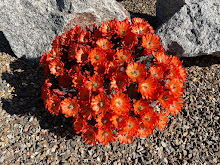
 Another storm blew through and was the trigger for all the Mammillaria grahamii to bloom. They have certainly put on a big show-a show always worth waiting for. 


One of the benefits of living in an arboreal desert.