My Blog List

Showing posts with label square bud primrose. Show all posts

Thursday, May 7, 2020

MAY IN THE SUNKEN GARDEN.

I am often surprised by the continuation of flowering in the sunken garden into May and June. As I remove the spent blooms from early flowering annuals such as Nigella, bluebonnets, poppies and last years blanket flowers there is a whole new cast of characters waiting in the wings, some perennial some annual.


The red in the foreground is the native Rock Penstemon, Penstemon baccharifolius, which I cut back early this spring. It's another red flower I have come to love and a favorite of there humming bird. It absolutely demands dry calcarious soils which is just what it gets in the sunken garden. No amendments necessary. 


Another pretty red annual is the scarlet flax, Linum grandiflorum, seen here with coreopsis and gulf coast penstemon. 


Last year there was a lamb's ear plant about 6 feet away from here which withered during the summer. This one seeded here and grew over the winter and I hope some of its seeds will find a happy place to grow.


There are sprinklings of this coreopsis in just about every garden I have. The original was from a packet of seeds planted nearly 20 years ago. It does get a little tall and floppy so I had to stake it up. 


Keeping the trailing winecup, Callirhoe involucrata, under control is not easy. It will run across the paving as well as climb as much as 4' among taller plants.


Square-bud primrose, Calylophus berlandieri, with a few seed heads of Nigella and one of two stragglers.


There are several dwarf day lilies including these two which do well along the edges of the rocks. 


And scabiosa, which blooms all through summer and even during a mild winter.


And the common mullein, Verbascum thapsus, of which there are 5 in the sunken garden, is just beginning to flower. It is an invasive species having been introduced from Europe.


It gives me great pleasure to walk out there in the morning and see the new blooms of the day. Any yes it is constant work and will they all be there next year-probably because I just love them too much not to allow them to seed.
And who will be up next? The gauras, coneflowers, small flowering coreopsis and the prickly pear cactus. 

Friday, April 3, 2020

HOW TO DO IT WITH WILDFLOWERS

The front courtyard garden is blooming with Texas native wildflowers and has entered its most floriferous season. Using short season wildflowers in the landscape requires some structural specimens as well as hardscape. We are fortunate to have some great agaves that do the job well.


Under the whales tongue agave, A. ovatifolia, the once blooming flowers of Tulipa hummilis, have been replaced by flowering purple skullcap, Scutellaria wrightii, and yellow blooming square bud primrose, Calylophus berlandieri. The skull caps will bloom all summer if given a trim back after flowering.


And on the other side beyond the Mexican feather grass is the damianita, Chrysactinia mexicana with its aromatic, fine-leaved shrubby foliage.


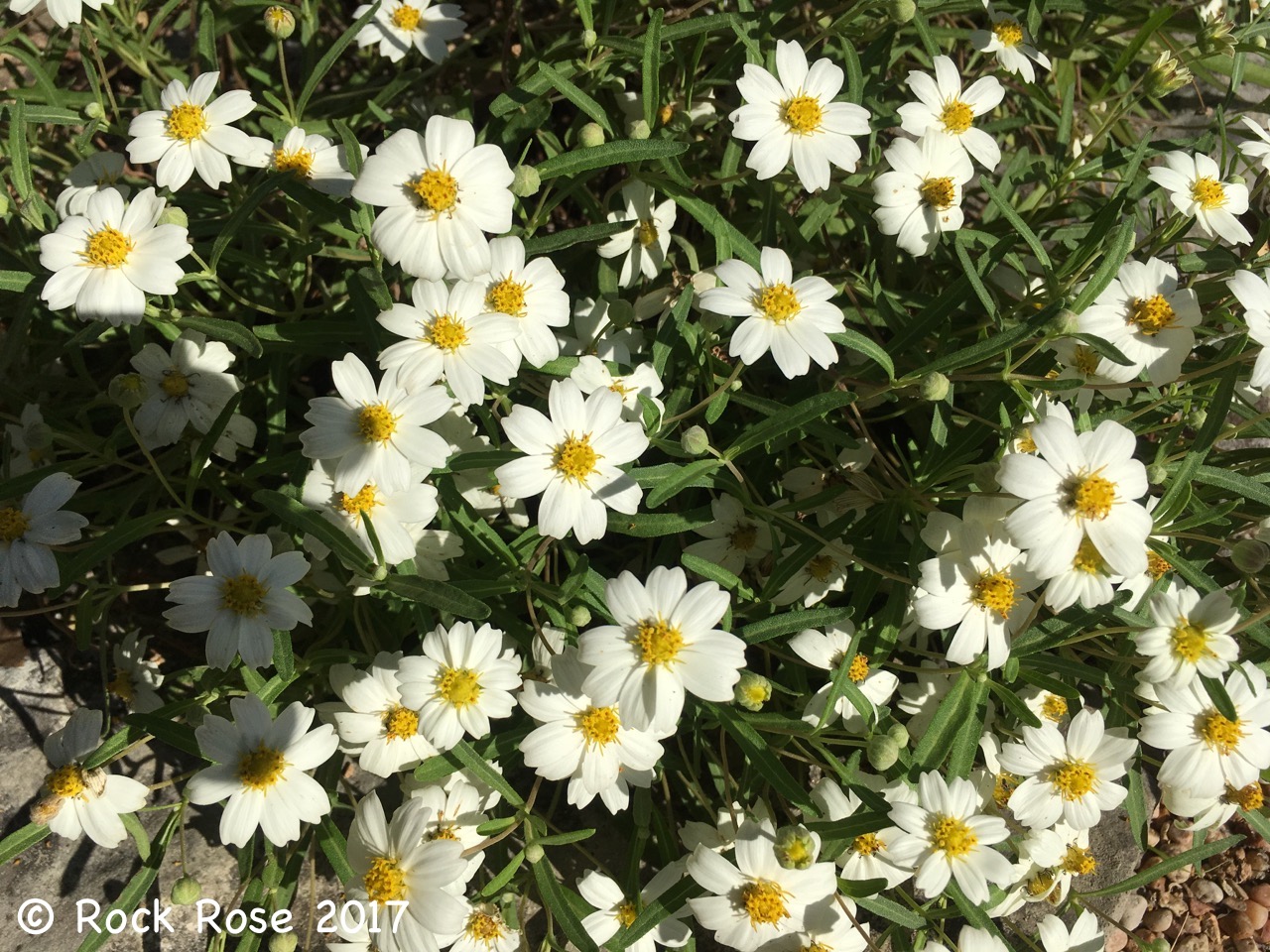
Of course the bluebonnets, Lupinus texensis, being an annual will soon be gone but the accompanying blackfoot daisies, Melampodium leucanthum, will bloom all summer and will be at their best in the fall.


Blackfoot daisy
The claret cup cactus flower, Echinocereus triglochidiatus, is one of my favorite. The flower is longer lasting than many cactus flowers.


In a shady corner, and there aren't many in this garden, baby blue eyes, Nemophila phaceliodes.


A few seeds gathered from some flowers on an unbuilt lot and I now have several clumps of Barbara's buttons, Marshallia caespitosa. They are perennial but when summer comes the foliage dies back only to appear again in late winter.


Lyre leaf sage, Salvia lyrata, pops up all over the garden and would make a great ground cover with its attractively pattered leaves.


One of my favorite places to sit in the garden is in the breezeway between the garage and house There I can enjoy the view of this part of the garden with flowers and bubbling water feature. Yesterday I watched the wrens flying back and forward building a nest in-between the pots on the top shelf of the cactus theater.


Such messy builders but such fun to watch.


I hope you are enjoying spring in your garden wherever you are.


Tuesday, April 23, 2019

WHO IS ON THE STAGE THIS WEEK

The most dominant flowers of the last 4 weeks have been the bluebonnets, columbines and Indian paintbrush. They are now busy setting seed for next year while a whole new range of plants take over, primarily the yellows. Our roadsides are quite stunning with their yellow composites mixed in with blanket flowers.

My garden is not so shabby either.

Square bud primrose, Calylophus barlandieri, nestled in among rocks and gravel.


Engelmann's daisy, Engelmannia peristenia. I remember when I bought this at the Wildflower Center sale some years ago someone said they would be everywhere, and they are.


But so far, only in the from Courtyard garden where I pull those that are in the wrong places. I am hoping to get them to move outside the walls at the front. The question is always, will I be around at seed collection time.


Four nerve daisy, Tetraneuris scaposa,


Damianita, Chrysactinia mexicana.


Threadleaf coreopsis, Coreopsis verticillata, swaying around on two foot high thin stems.


And California poppy, Eschscholzia californica, a vigorous self seeder.


These are all native to Texas but there are a few more yellows enjoying the stage. The native Coreopsis tinctoria is a few weeks away from flowering but other tall and short coreopsis are flowering.


And the silver leaf gazania, Gazania tomentosa, perfectly at home in a bed of gravel.


And in the English Garden the many petaled, fragrant  Rosa 'Molineux' named by David Austin for the football stadium of his favorite soccer team, Wolverhampton Wanderers.


And finally the large yellow named bearded iris which is a favorite because blooms after my other iris have finished blooming.


Will the yellow flowers please take a bow.

Saturday, March 31, 2018

THE MOST ANTICIPATED SPRING BOOM

Would you find it hard to choose the plants in your garden whose bloom you most anticipate. It isn't hard for me. Today two of those much anticipated plants were blooming. The first is the Claret cup cactus, Echinocereus triglochidiatus. My anticipation begins when I start to count the number of blooms I am going to have this year. Bud formation began a few weeks ago and I counted 16 buds.


If you look closely you can see more blooms which will open later this week. Whereas many cactus blooms are ephemeral these ones are made of sturdier stuff and last a number of days. Do I remember saying I didn't like red flowers? I soon got over that when this cactus arrived in my garden. For most of the year it sits quietly among the rocks preparing for next year. I don't fertilize or water and that's just what it gets in its native Texas Hill Country setting. I gave it just a home like that in my front courtyard garden among the limestone rocks. It makes a great partner for the bluebonnets, Lupinus texensis, and the square bud primrose, Calylophus sp. In front a purple skull cap has seeded and its blooms will give some shade to the claret cup during the hot summer.

Then there is another cactus where I find myself counting buds. The ladyfinger cactus, Echinocereus pentalophus. On one small plant 13 buds. This is a banner year and I think our colder winter takes credit for this bloom. The three cactus plants were in the potting shed and the temperature in there got down into the high 30s. They can take some cold but would have probably been lost during the two 18ยบ F nights this winter. Mine are in pots. Plants with long trailing stems would really prefer to be in the ground where they can trail along the ground rather than hanging over the sides of a pot.


And deep in the heart of the flower, rolling around in the pollen is the same fruit fly-sized bee that also visits my Echinopsis flowers. What is it that attracts him to this kind of flower I wonder? Is he a specialist bee who visit cactus flowers? Was he waiting for this flower to open because it was not open until after noon.


And in a few weeks I will be anticipating the flowers on my lace cactus, Echonocereus reichenbachii. As you can see this genus is one of my favorites when it blooms in my spring garden. It all helps to soften the end of bloom time for the Lady Banks rose. Farewell! See you next year. I'll be saying the same of my cactus in a weeks time.

Monday, May 15, 2017

GARDEN BLOGGERS' BLOOM DAY, MAY 2017

It has been a while since I posted on bloom day. Suddenly it was upon me and I had no time to gather the photos.

Surely the opening photograph for this month's Bloom day post has to be the Monarda 'Peter's Purple' He's certainly King of the garden at the moment.


And Queen of the May garden is the blanket flower, Gaillardia pulchella. Not so easy negotiating the pathways at the moment.


And we have a princess too,  Clematis texensis 'Princess Diana'. What a beauty she is. Just a few weeks ago there was no sign of growth and I was sure I had lost the plant over the winter. In less than a month she has grown to almost cover the trellis.


So many bloomers. The spineless prickly pear, with two different blooms on the same plant.


I wonder why that is?


And all the day lilies.


All but the tiny orange one without names.
Echinacea purpurea, just coming into bloom.


The larkspurs, love-in-a-mist and poppies have finished already but blackfoot daisies, Melampodium leucanthum,  still keep going.


Among the other natives, the purple skullcap, Scutellaria wrightii.


Which pairs well in a rock garden setting with the square bud primrose, Calylophus berlandieri, and pink skullcaps.


Square bud primrose with ruby crystal grasses

Pink skull cap seeded in the dry creek
Scabiosa back for the third year. A rescue plant.


And Texas betony, Stachys coccinea, not a showy plant but the hummingbirds love it.


Another native, horsemint, Monarda citriodora.


The native chocolate daisy, Berlandiera lyrata, with its delicious chocolate fragrance.


And for the first time in a while success with Cleome.


These are just a few of the flowers that are blooming in my rocky Texas garden in mid May.

Thank you Carol at Maydreams gardens for hosting Bloom day. Find out what is growing in other gardens this May Bloom Day.