My Blog List

Showing posts with label sunken garden. Show all posts

Sunday, June 13, 2021

WHO WOULD WIN

I often ask myself when I am out in the garden, "Who would win if I just let the garden take care of itself." Would it become a mono-culture or would every year bring a different winner. I think maybe the latter and I say this because I often say, "It's been a really great year for such and such a plant" I think mother nature gives every plant a chance.

This year the cone flowers, Echinacea purpurea, would take the prize.

They were busy preparing for this year last year when they set hundreds of seeds-which, of course, I allowed to remain.  And I am not really sorry because I think they just look marvelous. I wish they would last a little longer although I suppose the idea is to let something else take center stage. They have even muscloed their way into the English garden. Of course as often happens they are right by the stepping stone instead of in the more open spaces.

And who among this group would take over. Mulleins, gopher plants, blanket flowers or wine cups. Each one of them would vie for top dog position in the garden.

Naturally the weather plays a big part on what will bloom successfully in each season. We had a relatively dry winter  and then all hell let lose with one of the deepest freezes, in fact the deepest freeze I have experienced while living in Texas. It wiped out a number of plants, in particular the larger ones. Maybe some of them were ready to go. I had a gorgeous Pride of Barbados that had volunteered in the small strip between sunken garden and pool. Over a period of 5 years, despite dying back to the ground every winter, its girth increased with every year. 


It was really too big for the space but that deep freeze did something I couldn't bring myself to do and that was remove it. But the good news is it left behind some offspring. One a little further along and one in the middle of the sunken garden. Maybe they will be too young to flower this year but I am excited that in the future they will. And in a prior year one grew between two rocks on the other side of the sunken garden. Maybe it was sheltered between those rocks and that was why it survived or maybe the covering of ice and snow helped insulate it. It does seem to be the smaller plants that survived.


Let's look at Monarda 'Peter's Purple' Is there a more successful spreader than this plant? It isn't that it seeds but that it sends its underground runners out in all directions to make new plants. One year it managed to successfully invade the yellow iris. How charming, I thought, when the iris finish here comes the bee balm. That is until the iris failed to bloom the following year, completely crowded out by bee balm. Then the bee balm decided to move out and this year the iris bloomed with a mighty vigor chasing the bee balm in its relentless spread.The bee balm is so adored by all manner of flying insects and hummingbirds too that I don;t have much of a problem letting it go on its merry way. 

My beautiful Philippine violets, Barleria cristata,  took a big hit. The two along the edge of the pathway(volunteers) in the Sunken garden are slowly making their way back but the big one has split itself into four plants leaving a gaping hole in the center. It is a perfect place to add a pot and it so happens that last winter an arm broke off the plumeria, which I potted up and is growing. 

 One plant that is not permitted in the back gardens is the Engelmann daisy, Engelmannia peristenia. I can remember when I bought 3 small 4" plants at the Wildflower Center sale. "Oh! you'll have plenty of those" someone said. Now I have more than even I could have imagined and I constantly pull them out-not an easy propositions as they send down a big successful taproot. That is why they do so well in dry gardens . But they are beautiful when in bloom in the early morning. By afternoon their yellow petals have curve under. They do give the garden a somewhat wild appearance.

 And that was before the American beautyberry, Callicarpa americana, and the liatris, Liatris spicata.  started to move in. I think the latter might be the most freely seeding plant in Texas. At least in my garden. It does add gorgeous color in the later months of the year. 

But of course I am not going to let any one of these plants the chance to take over. I leave that to the next gardener who lives here.


Tuesday, April 27, 2021

SPRING IN THE SUNKEN GARDEN

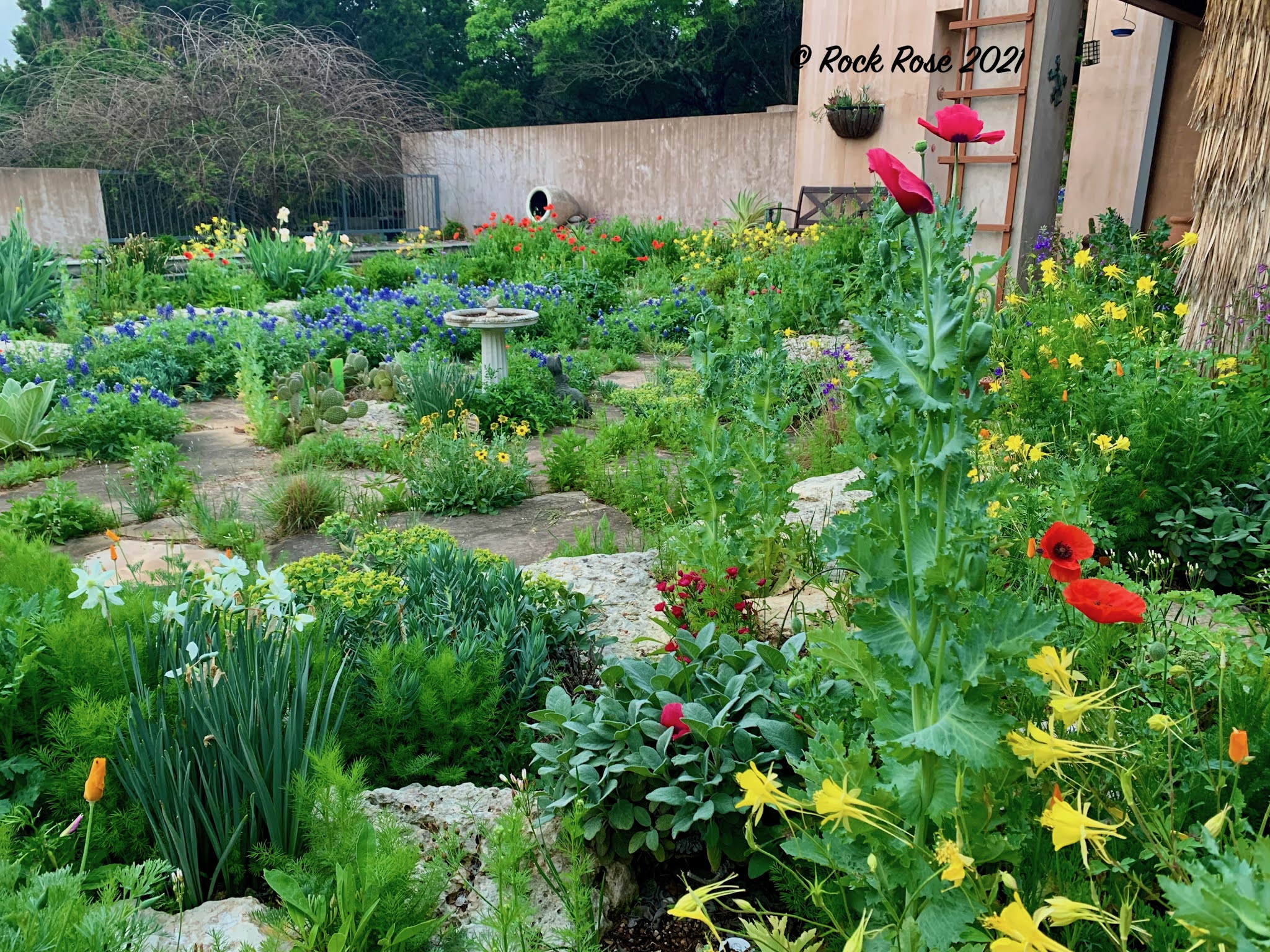
 The area between the house and the pool was a blank canvas and perfect to create a sunken garden. The inspiration was partly inspired by the many sunken gardens I have visited in England, my grandfather's garden where I spent my teenage years and the sunken courtyard at the Lady Bird Johnson Wildflower Center. Many of the rocks dug up during the building of the house were saved in order to create a foundation wall around the sunken area. The floor is Arizona sandstone over decomposed granite. I'm sure the builder was happy not to have to cart those rocks away. Nature has done much of the planting and I am happy for that although it does create considerable work keeping it under control. But, both David and I delight in all the blooms that appear-as if from nowhere. The scene changes from week to week and from year to year. Spring is the most floriferous time.

The only step down is along the front and even here it requires some agility as a Gulf Coast penstemon, Penstemon tennuis, has seeded right in the middle of the two stones. How could I possibly pull it when it was so happy there. I love this penstemon but it is prone to root aphids, placed there by ants who farm its honeydew. They are not easy to control and will kill the plant.

A few plants have been with me since the beginning and one is the chocolate daisy, Berlandiera lyrata, 

Compact in the early weeks it does eventually become rather rangy. It has only seeded in one other place and I suspect this is because I usually cut it back part way through the season and the new seed heads may not have time to mature. 

Mullein, may be considered a weed by many but I love its beautiful form over the winter before sending up a tall flower spike with yellow flowers. It is also a favorite of the bees. Many may seed but only a few will be chosen. This was a lucky one on the lower level.


In early spring bluebonnets can really take over and I'm afraid this year I have let rather too many and some of the plants growing beneath have suffered. A single bluebonnet plant can spread to cover 3' and is better suited to a meadow setting.


Hinckley's yellow columbine. Here there and everywhere as usual.


 It is always interesting to watch how plants grow and move. A large cluster of bee balm was gradually evicted by this yellow iris, so that now there are only a few plants left. Time for the iris to be divided and passed along nd maybe the bee balm will move back in.


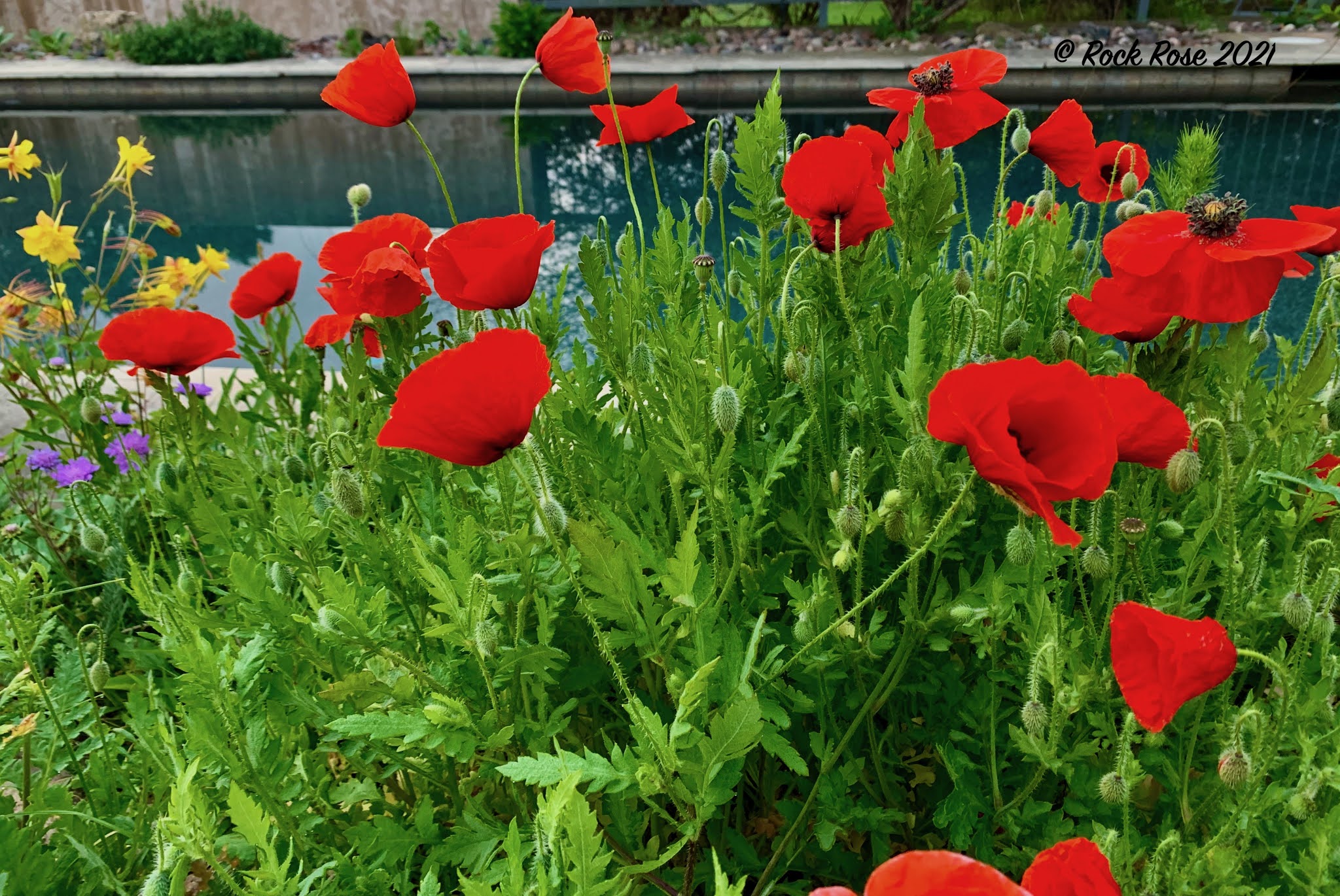
 I always let the corn poppies grow wherever they wish. Easy to pull out and something will always take their place later.


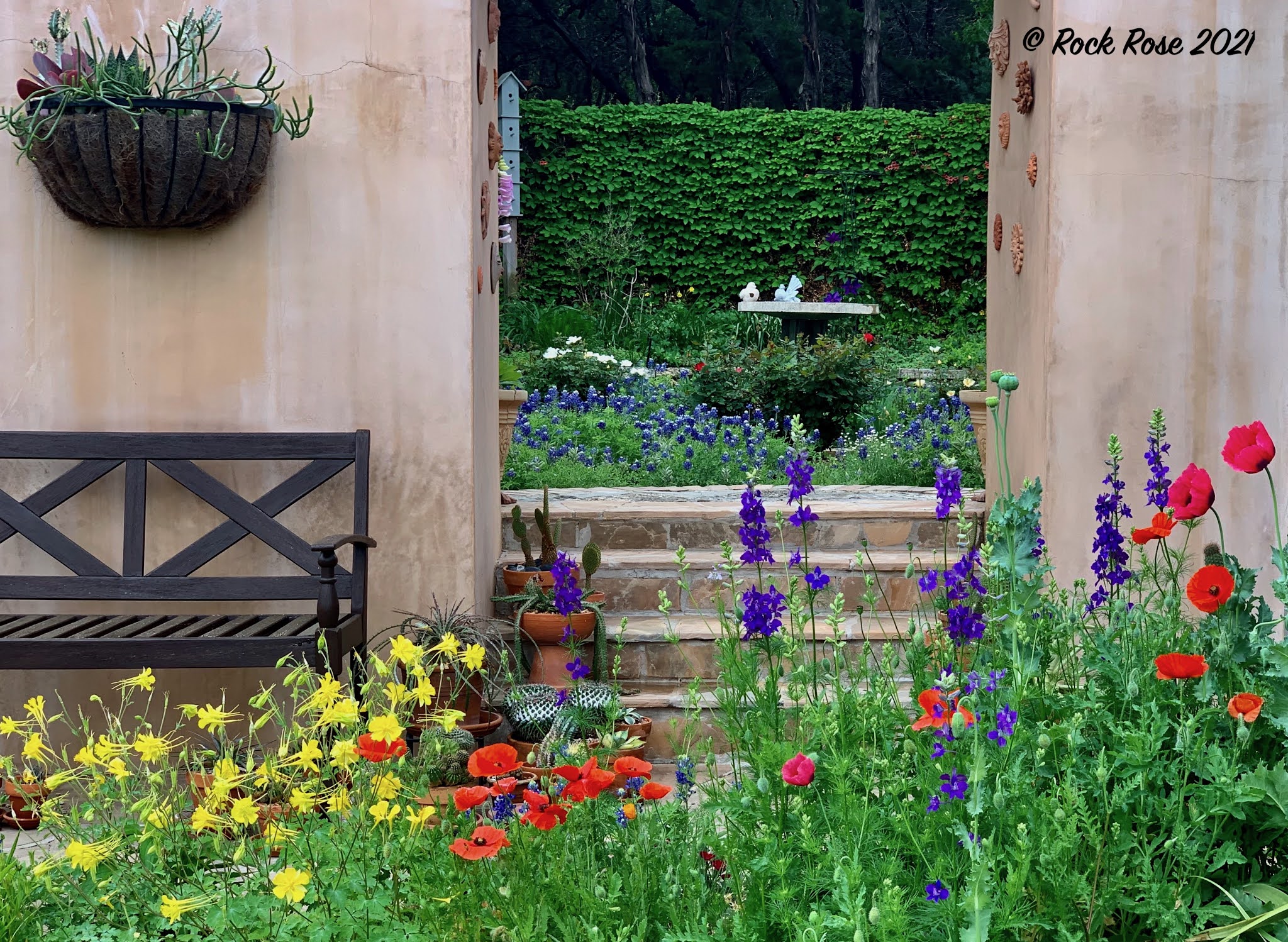
One of my favorite views is standing in the sunken garden and looking up to the Sun and Moon Archway. A mix of columbine, larkspur and poppies.
 

The gopher plant, Euphorbia rigida, has flowered and gone to seed. Some of the longer leaves have been removed to leave a small cluster of seed heads for seed saving. Nigella hides the leaves of the faded daffodils above the  mealy blue sage and larkspur.
 

Late April and the wine cups begin to bloom and spread, and spread and spread! Frequent trims will keep them in order. 

There will be a few plants missing this year and they will be missed. Two beautiful Pride of Barbados were lost to the freeze. The seed had appeared from nowhere and we had several years of their summer blooms. There is however, a very small one growing between two of the ledgestones and possibly in a more favorable place. 


It's time to get out there and remove some of the more boisterous residents in the sunken garden.

Wednesday, October 7, 2020

GOODBYE SUMMER, HELLO FALL

At last! Temperatures are moderating and fall is on the way. It is not just the gardener who is celebrating the advent of the new season but the garden plants are too.

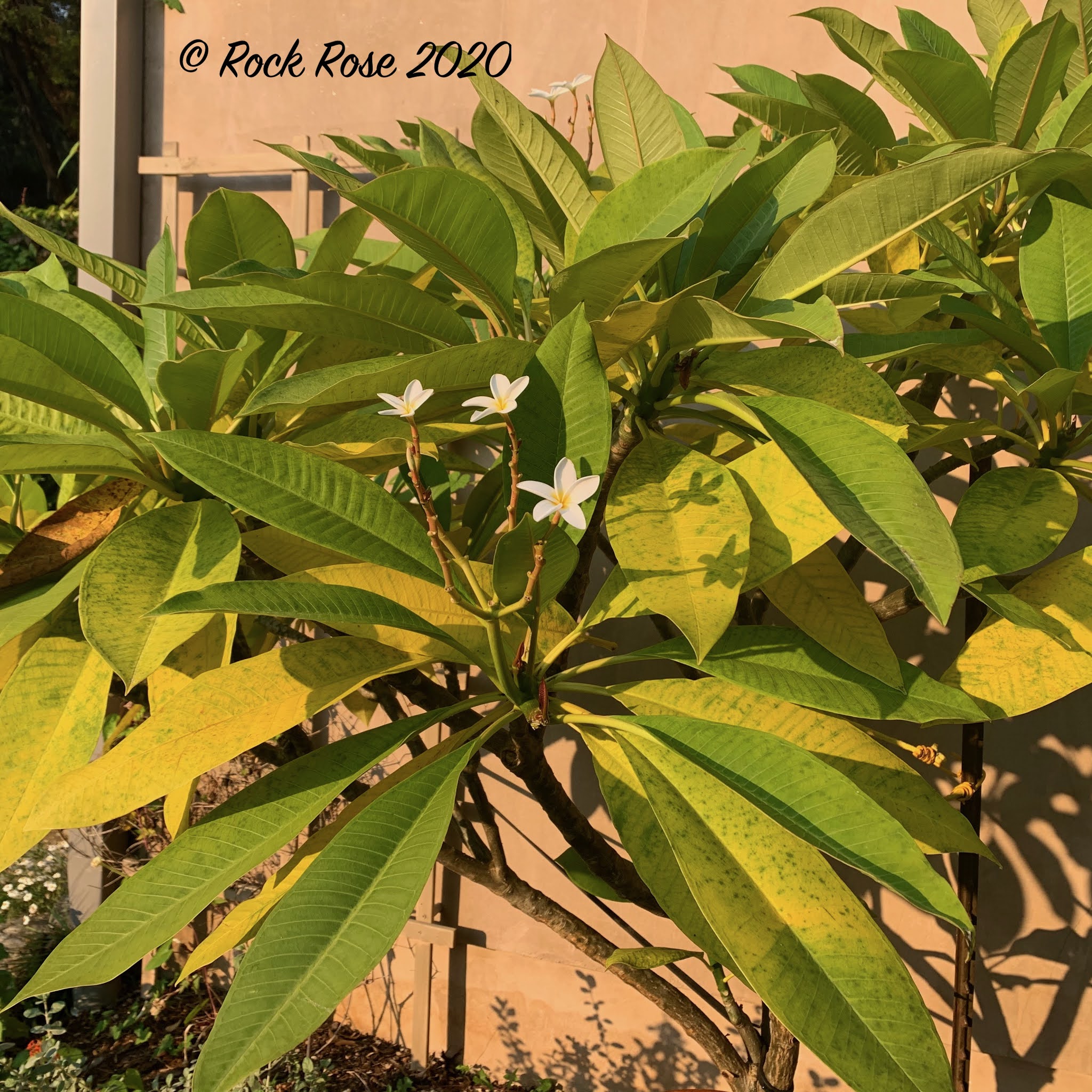
All that is except the plumeria. A few nights of temperatures in the 50s and it is already beginning to cry "I'm out of here" Shortening days mean the plant starts to cut back on food production, the leaves turn yellow as the supply of food is reduced. The leaf forms  an abscission layer and eventually falls off. 

 Every day new leaves fall and soon it will be time to move the plant into the garage. During the winter it will receive no water and will go completely dormant. Because the plants are so large I plan to do some pruning before I move them which will make the job a lot easier. 


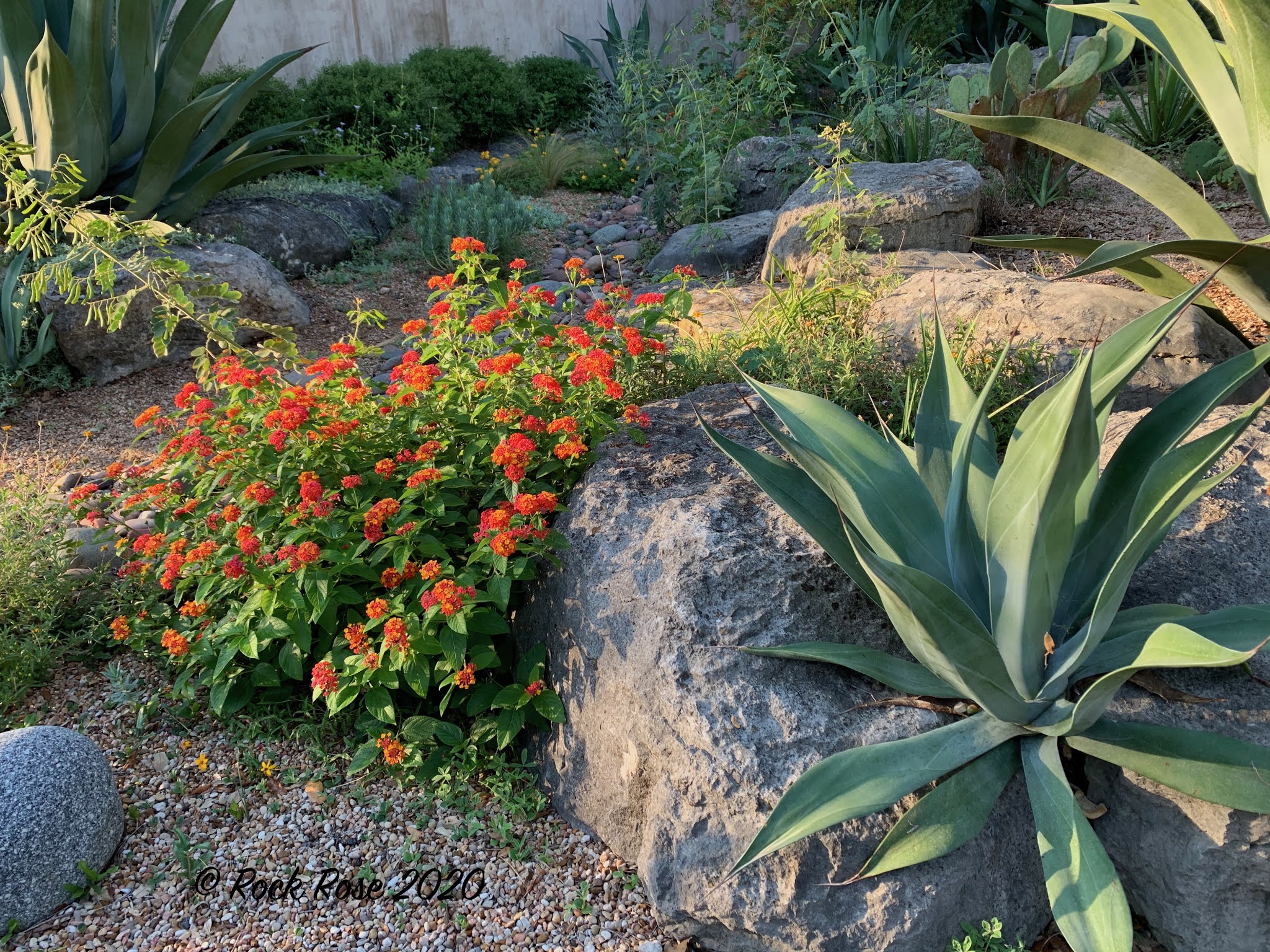
Flower colors become more vibrant as with the native orange lantana, Lantana horrida. And the award winning David Austin rose, Rosa 'Molineaux', blooming again for the first time in months. This shrub rose is a repeat bloomer and named for David Austin's favorite soccer team. 


There are lots of flowers that are repeat blooming such as the Verbena, Verbena bonariensis whose lanky growth was cut back to the ground a few weeks ago.


Another repeat bloomer is the soft leaf yucca, Yucca recurvifolia, which the deer have failed to find. 


It has become quite a free-for-all of flowering plants in the sunken garden with Perovskia, white Salvia greggii, mealy blue sage, Salvia farinacea, frost weed Verbesina virginica, and Mexican bush sage, Salvia leucantha.


 But there are some plants that bloom only in the fall. They wait patiently for the shorter days before they begin to bloom. Notable in my garden is the Philippine violet, Barleria cristata. 


It blooms best when given plenty of sun and is one of my favorite fall bloomers because it attracts neither bugs nor disease. It dies to the ground during a normal winter and shifts a little from its original positions as the center often becomes very woody and dies out. 

And finally the bush clover, Lespedeza thunbergii, waits patiently to bloom in the partly shaded border of the English garden. 


There are lots of short day plants which will bloom over the next few months including chrysanthemums, poinsettias, Christmas cactus. Make sure the later receives at least 15 hours of darkness from now on. 

Happy Fall Y'all.

Thursday, August 20, 2020

DON’T BE SO TIDY IN THE GARDEN

"Don't be too tidy in the garden" I have heard these words spoken many times before by well known gardeners and horticulturalists. It gives me an excuse to be the gardener that I am. Someone who loves the cottage garden look and can never pull a plant out until it just screams to be gone. Even when a plant no longer looks at its best it may still provide a meal for something. 

These are the spent flowers of Verbena bonariensis. They have been blooming for weeks and a few tiny flowers still remain even through the plant has gone to seed.

Those tiny seeds, and they are almost microscopic, are the reason I am leaving the plant a while longer. Every evening we enjoy the antics of the American goldfinches as they swing and do their acrobatic tricks on the stems of the plants. Many of the long stems are bent double and nearly touching the ground but the finches are so light and agile that they manage to stay balanced on the stem as they pick off the seeds. 

Easier to manage are the seeds on the blanket flowers, Gaillardia pulchella, which are more than happy to grow anywhere they can find a foothold. 

Not looking their best after days of 100° but the finches are not interested in looks. They are interested in the ripe seed heads. Many of them are just picked clean. Fortunately for me they are somewhat untidy and leave plenty off seeds scattered around which will serve for next years crop of flowers. 

That common mullein wouldn't win any prizes. 

The soft fuzzy leaves that always looked so perfect earlier in the year are crispy brown at the bottom. Every evening the stalk is nothing but a brown stick. But every morning a few new flowers open and there is always a bee having its breakfast. Seeing those flower buds on the left makes me realize that it will be quite a few days before I can pull the plant out. 


Those same solitary bees are also busy on the purple skullcap, Scutellaria wrightii and the snapdragon vine, Maurandella antirrhiniflora.


The first time I saw this vine was in Pam Penick's old garden. It was climbing up the pole of a beautiful Dovecote. It was quite large flowered which might have been due to better sil conditions or being a cultivar. Either way my native one is a small flowered scrambling, rather unattractive vine which has scrambled up to almost take over the Carolina jessamine. But the bees are on there every evening so I feel reluctant to remove it. 

Lizards scurry around in the leaf litter and the Carolina wren is often rooting around in there too. Clearly here are some tasty morsels hiding in there. There will be plenty of time in late fall for doing a big tidy.

How about you. Are you a tidy gardener. 

Saturday, August 1, 2020

THE CONSTANT EDITOR

I took advantage of a recent cloudy morning by going out in the garden with my Cobra head, my scissors, my pruners and the garbage can. Yes, pruning and removal day again. In a rock garden you should be able to appreciate the rocks and the only time you can do this in my sunken garden is in winter and early spring when most perennials are dormant. It is time for a rethink and renewal.


Early summer rains just made everything grow like weeds, and there are plenty of those. Even plants that would be great in another garden setting are no longer welcome. Plants like mealy blue sage, Salvia farinacia, and Ruellia sp. as well as fragrant mist flower, Eupatorium havanense. When this plant made its appearance a few years ago I was more than thrilled but it has pushed out the bee balm. It is now on the move again, almost covering the day lilies and somewhere behind is a yellow iris which only put out a few blooms this year. A big shout out for  something to be done. I am thinking I may just have to remove that mistflower.  I'm almost positive there are rocks under there too.
Mid-June the sunken garden was looking quite nice, although I had at this point already removed the spent annuals like Love-in-a -mist, Nigella damascena, poppies and  other spring annuals. The cone flowers, Echinacea purpurea, were in full swing but by mid July they were finished. Another task on my list unless I want them everywhere.


From one angle, on the other side of the wall in the English garden, the late July garden looks fine but I begin to see already that the Pride of Barbados, Caesalpinia pulcherrima, has already attained a size that may demand its removal before next year. Walking around the pool has become more difficult and having had that rather bad accident last year makes me very nervous about walking around there. Maybe a little chop back for now!


I have already removed all the plants in one area and have a plan to add a few more rocks before I soften the area with small plants. At the same time I will amend the soil which should help its moisture retaining ability.


And further along the wall there are Crocosmia sp. which have become  just a floppy mass. How to keep them upright I wonder. Less or more water. I remember my grandparents having these, they called them Monardia, in very sandy soil all the way along their driveway and they were very upstanding.

So I am on the hunt for hardy, small rock garden plants. Unlike English nurseries where the rock gardener would be sure of finding an area dedicated to rock garden plants, our nurseries have no such thing.Yes, they do have cactus and succulents in one area but there are plenty of other plants which could well be classified as being suitable for a rock garden. I guess there aren't enough of us with rock gardens.

The local nursery in the town where I grew up
When I visited the local nursery in the town in England where I grew up I was left drooling over all the different dianthus they had. I fear I might be a dianthus collector if I lived there. Dianthus do well here-or at least certain ones do and they are a favorite winter annual surviving sometimes for several years. But the selection is always disappointing.

So far I have been listing the plants that can take full sun and might be suitable for the 'new' rock garden.
Blackfoot daisy                                  Additions to the list from Deb Wilson
Square bud primrose                          Crag lily, Echeandia texensis
Germander                                         Hill Country penstemon
Dianthus                                             Evening primrose
Scabiosa
Achillea
Skullcaps
Alyssum
Sedums
Iceplant
Creeping phlox
Four nerve daisy
Leadwort plumbago
Thymes
Small iris species
Gulf coast penstemon

It will be a matter of balancing spring and winter bloomers. For those that are dormant at any time they must look presentable. I may be tempted to add species tulips and their seed heads are quite presentable even until the plant dies back.
Undoubtedly I will add to the list over time but I would like to try to keep the planting in this garden different from the other gardens which is not the easiest thing to do. I am open to suggestions for plants that do well in our Central Texas climate.

Sunday, June 14, 2020

EARLY ONE MORNING , JUST AS THE SUN WAS RISING

When I went out into the garden this morning I couldn't help but think of an old English folk song which begins  "Early one morning, just as the sun was rising" I learnt this song when I was very young and have come to learn that it was one of the most popular songs for young women in service to sing in the 18th century. The maids were mourning their lovers who were going off to war.There was no maid singing in the valley below but there was a song in my heart over the beauty of the morning.

Surely for every gardener this is the best time of the day.  The cool morning air, plants recovered from the prior day's heat, everything looking its best. Ready to face another hot Texas day.


I always go first to look at the sunken garden because the sun will make its first appearance here and with no shade it gets hot very quickly. It is amazing how differently the sun strikes the garden in the summer.


In winter the sun rises well to the left of the potting shed but now it is coming up over the greenhouse. The gap in the trees means that it eneter the garden just than bit sooner.


Soon it will flood the patio giving the cactus and succulents a few hours of sun which they seem to prefer.


Up the steps into the English Garden and a quick look back over my shoulder.. The sun is coming up over the trees.


 On summer mornings we can no longer eat breakfast on the dining patio. It was one of the reasons we created a patio dining area in the English garden where the high wall shades the garden until about 9am. As this was one of the last gardens we made it gave us the opportunity to watch the sun at various times of the year and help with the design of what we wanted from the garden. We shall be having breakfast here this morning and every morning as long as it is not raining.


It is a very green and serene area, looking towards the house, with just a few blooms of the Mandevilla vine which survived our mild winter. In the other corner the plumeria which spent the winter bare root in the garage. Flower buds are just beginning to develop.


 Of course having created a theme with the sun and moon archway I can't really complain about the sun. Time to get breakfast on the table.