My Blog List

Showing posts with label Tulipa clusiana. Show all posts

Sunday, March 15, 2020

WORTH THE WAIT

There are lots of plants whose flowers are ephemeral. I'm thinking of the flowers on my cactus which bloom for just one day. I wouldn't give up that moment for anything. And then there are flowers that give us a few more days to enjoy their beauty. Among these are the Spring flowering daffodils, grape hyacinths and tulips. Even those few days of flowering are worth the year-long wait.
Living in the south we enjoy a good selection of spring bulbs that come back year after year but when it comes to longevity only the species tulips do well in the southern garden.


Tulipa clusiana Lady Jane, returns year after year if given the right conditions. Fast draining, poor soil. If it finds a happy place it will spread over the years producing nice clump of flowers to brighten the early spring garden. When the flowers close at night they show off their pink underbelly.


One of the reasons I like the clusiana tulips is because they have elegant seed heads which I look attractive even after they have dried. I scatter the seeds in different places. The leaves die back at about the same time as the seed heads.

Another member of the clusiana family is Tulipa clusiana 'Tinka" Lemony yellow when fully opened with pink underbelly when closed.


Planted in 2016 the package was labeled  Tulips humilis 'Persian Pearl' but I learn that one has a yellow center. It is more likely to be Tulipa humilis 'Little beauty' which has a bluish center. Either way the plant is a beauty and perfect for rock gardens as the flowers only stand about 4" tall.


On this rainy the petals are closed up. I am thrilled to see more blooms this year. One year there were no blooms, the plants lying dormant under the gravel until they got just the right conditions.


Originating in the hills of Turkey, these tulips were brought to Europe in the mid 1500s. There they were bred to be the tulips we find today. For us in the south those tulips must be planted every year. These tulips can be left in the ground. They love the baking heat because that is the conditions under which they grew in the wild. So much easy to care for, forget and then enjoy every spring.
Look for these bulbs in the fall when they arrive at the nurseries or order them on line. And remember to plant in fast draining soils to prevent rot.

Sunday, March 17, 2019

EARLY SPRING BLOOMS

Our mild winter has been kind to many of my flowering blooms, although I have to admit I did protect the freesias during some recent nights when the temperatures fell in to the 20s. The same with some of the iris because they were in bud.


The purple iris were a passalong and came without a name which is often the case in my garden. The pretty little narcissus alongside this clump is also without a name, much to my regret.


Another passalong iris, known only as Peach, lives up to its name. It smells of peaches.


The naturalizing species tulips, or lady tulips, Tulipa clusiana, have not disappointed this year. Some years ago I read that the seed were not viable and I would pick off the seed heads after flowering. Then I discovered that the seed pots were attractive in themselves and allowed the seed to fall. Now there are many new plants forming.

Tulipa clusiana Lady Jane

Tulipa clusiana, Lady Jane with petals closed
Tulipa clusiana var. chrysantha, has yellow petals with red markings on the underside.


The species tulips, Tulipa humilis, Persian pearl was planted several years ago. It bloomed the first year and then nothing for 2 years. Now once again it is going to bloom. This is one of the shortest stemmed tulips, just a few inches tall.


I took the upper photo this morning and this one when the petals opened up when the sun came out.


All these tulips are perfect for the rock garden where they will receive good drainage.

The freesias have been magnificent, whether in pot or in the ground. They did receive addition protection from freezes but worth every cover I brought in and out.


And the same with pots of anemones.


I just wish they would all last just a little longer.

Monday, November 12, 2018

TULIPS ON MY MIND

Earlier this week I was watching Carol Klein's Plant Odyssey about the tulip. When she visited the dry mountainous regions of Turkey where the original tulips grew I was reminded of the only tulips I can grow in my garden in Texas, the species tulips. These are the most perennial of all tulips and have been returning year after year in my gravelly garden, multiplying slowly over the years.


To be successful they demand extremely good drainage and if planted in regular garden soil will rot. I have had that happen on more than one occasion. The most successful location has been alongside a claret cup cactus clump in my front courtyard and close by an artichoke agave. Clearly the drainage there is perfect. There, they have bloomed for at least 10 years.


This particular variety is Tulipa clusiana 'Lady Jane' but there are several other that do well in southern gardens. I bought a couple more packets this year. The bulbs are small compared with the hybrid tulips. It is easy to see which way to plant them and I added grit to the bottom of the hole to make sure the base of the bulb stays dry.


Tulipa 'Tinka' is yellow with red outer tepals.


And this short flowering Tulipa humilis 'Persian red'


I don't think I had ever thought much about why flowers open and close as they do but watching this fascinating program I learnt that as the day warms up the cells on the inner surface of the tepals grow faster than the cells on the outside and the flower opens, then at the end of the day the cells on the outside of the tepal grow faster and the flower closes.


I had heard about Tulipmania in Holland in the 1600s but was to learn more during the program when Carol visited a grower of tulips in Amsterdam. There he showed a 'broken' tulip among his flowers. These rare, beautifully marked flowers, the result of a virus, were the cause of tulip mania. The most famous of all being Semper Augustus. Today broken tulips are removed and destroyed for fear of the virus spreading among the other bulbs. Modern day broken tulips have been bred to form stable bulbs but none are as beautiful of that one that caused Tulip Mania.
Fascinated by the story we watched the film available on Netflix but were disappointed in the story they told. I think I will learn more by reading the book The Tulip by Anna Pavord.

Thursday, March 15, 2018

SPRING BULBS

I am in two minds over which spring bulbs will be in my garden next year. I have to weigh up how they look for weeks after the bloom has finished. I know the large public gardens and parks yank their bulbs when they are over, planting new ones every year. For me that is not an option. Or is it? I had never thought of doing this myself.
I have a few favorites which I think are definitely worthwhile leaving in the ground. Number one is the Species tulip Tulipa clusiana, Lady Jane.


Originating from the rocky poor soils of Afghanistan and the Caucuses, it is ideally suited to the poor, dry, limey soils of the Texas Hill Country. It naturalizes well and although I was told the seed are not viable it pops up in several places away from the original bulbs so I think it does reseed occasionally. And the seed pods are what makes the plant tolerable during its bulb regeneration mode. They are one of the few bulbs where I leave the seed pods to mature. It doesn't seem to harm them.
I have tried several of the species tulips including Tulipa clusiana Cynthia, and Tulipa humilis, Persian Pearl, but none return quite so faithfully as Lady Jane.
The flowers close up in the evening and in the early morning their pretty pink undersides are visible until the flowers open once again.


The spring star flower, Ipheion uniform, a native of Argentina and Uruguay, will always be a keeper. It's short grassy leaves are easily hidden among summer growth. It is a great plant for the front of the border.


Why is this next bulb called summer snowflake? It is one of the first spring blooms arriving at the same time as snowdrops in northern climates. The blooms of Leucojum aestivum are similar to the nodding blooms of snowdrops and last for at least two weeks. I have never divided this large clump so I may try to divide 'in the green' this year.


Each of the nodding tepals carries a characteristic green dot.


I love the fragrance of the narcissus family, particularly those with multiple flowers but once the flowers are gone their wide strappy leaves become rather messy as spring progresses. I find the blooms to be fleeting and often damaged by heavy rainfall and late frosts. Maybe they are best grown in a pot where they can be removed from the garden after the blooms die. That is what I did with my paper whites this year.


But it's hard to resist the fragrance of Narcissus tazetta 'Erlicheer' with its double flowers and sometimes as many as 6 flowers on each stem.


and the pretty delicate flowers of Narcissus 'Thalia'


Or this unknown multi-flowered stem.


I certainly have preference for the multi-stemmed flowers with the later flowers Narcissus 'Cheerfulness' yet to bloom.
My personal feeling is that the perfect place for daffodils in in a woodland setting or in grasslands where their foliage can be left to die back. Will I have the heart to pull mine out? I really don't think I have it in me.

Tuesday, March 15, 2016

GARDEN BLOGGERS' BLOOM DAY, MARCH 2016

I'm in love. Well, who wouldn't be with these little beauties, Tulipa praestans,  Persian pearl. I planted these in the fall and with the rain and warm days they opened all at once.


 They are like little jewels in dry gravel landscape.


These species tulips are the only kind of tulips that grow successfully in Central Texas. I have Tulipa clusiana, Lady Jane and Tulipa clusiana var. chrysantha.

Tulipa clusiana Lady Jane

Unlike Lady Jane Grey my Lady Jane seems to be here to stay unlike chrysantha whose numbers have dwindled over the years.
Among my other spring bulbs the Ipheion uniflorum, star flower is a reliable bloomer in early spring. The bright blue star-like flowers spring from strappy foliage.


An impulse purchase of freesias was a success. Many years ago I grew some in pots and then plant them in the ground. They return year after year. Hopefully these will do the same.


This is probably the only flower that is blooming at the correct time. The native anemone, Anemone berlandiera is usually the first flower to bloom in the spring.

Ten weeks stocks started from seed in the fall .

Ten week stocks

California poppies with alyssum and dianthus

Blackfoot daisies, Melampodium leucanthus, and Four nerve daisy, Tetraneuris nervosa.


And the Lady Banks' Rose, Rosa banksiae. I purchased this as a cutting from the rose at the Rose Museum in Tombstone, Arizona. The rose there came from an original cutting of the one at Kew Gardens which was the original one brought from China!
This year she is gorgeous and outshining the yellow one at the front. There are many more blooms to come.

Of course always plenty of bluebonnets although not as many this year.


 We are having an unprecedented early spring after little in the way of winter. Today the temperature was 90º It feels like summer on this March bloom day. Have you had an unusual winter? An early spring? Catch up with your favorite garden bloggers on this bloom day. Thanks Carol at May Dreams Gardens for hosting the day.

Wednesday, March 18, 2015

TULIPS FOR THE SOUTHERN GARDEN. TULIPA CLUSIANA

About 10 years ago I purchased a handful of tiny bulbs labeled Tulipa clusiana, Lady Jane. I was told they were species tulips and their small size would be perfect for my rock garden. And perfect is what they were. Thriving on utter neglect they appear every spring unfurling their petals in the morning and closing at night. They seem more than content with the gravelly, dry soil and are a perfect companion for my Parry's agave.
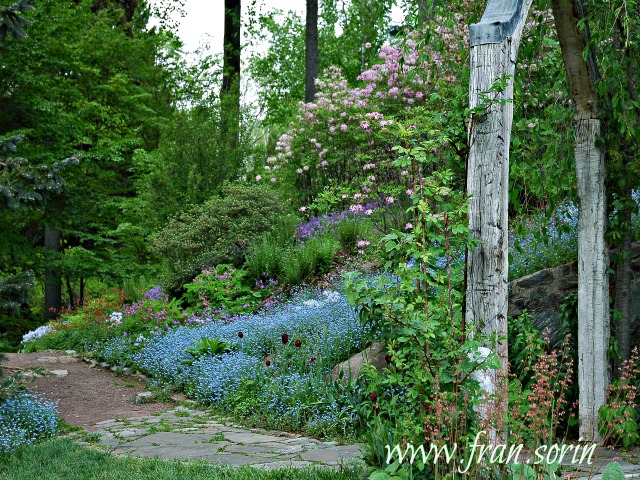

One of their great advantages is that they do not require the same chilling as the larger tulips and are perfect for a climate which has milder winters. Furthermore they naturalize quite readily.The burgundy tipped stamens are distinct against the almost pure white petals.


By evening time the flowers close showing their pretty pink undersides. I have found the Lady Jane variety to be the most successful in my garden. Every year I am tempted to try others but have had little success.

Saturday, March 15, 2014

GARDEN BLOGGERS' BLOOM DAY MARCH 2014

Welcome to March in my garden, which is far from being its normal self following a terrible freeze just over a week ago. We are not used to having a temperature as low as 20° at this time of the year and it has taken its toll on Southern gardens. Despite this, there are some plants who just don't care and they are the ones blooming today.


In the early morning Tulipa clusiana Lady Jane showing her underskirts.


An hour later she begins her show,


Until finally her petals are fully open. In Texas these are the only tulips that can be grown successfully, naturalizing and returning whatever the weather. I think they are sorely under utilized.


This large agarita bush, Mahonia trifoliata, was just a little behind some of the others and so her blossoms managed to survive unscathed. There is an intense honey fragrance on the air today.


A cluster of unknown narcissi on the corner of the once named Spanish oak garden. I shall be sorry when their blooming finishes because they have just been magnificent this year. I think the spring bulbs have benefited from our very cold winter.


Viburnum 'Spring bouquet' Has been its most magnificent this year.


Close up of viburnum flowers.


Ipheion


Summer snowfake, Leucojum aestivum.


Narcissi with California poppy.


First buds on the stocks.


Gopher plant, Euphorbia rigida


Erigeron daisy.


The first of many bluebonnets to come. Please join Carol at Maydreams to share your March blooms.