My Blog List

Showing posts with label Garden visits. Show all posts

Sunday, September 10, 2023

THE GARDENS AT D' ÉTRETAT, NORMANDY

In May we found ourselves, once again, sailing into the port of Le Havre, France. On previous occasions we had toured the D Day beaches, and rented a car to visit Claude Monet's garden at Giverny and the town of Honfleur. This time our plan was to go to the gardens at D'Étretat just a few miles up the coast. Years ago it was easy to pick up a car in the port but Covid disrupted cruise travel and now the car rental was somewhere in town. We had to walk outside the port gates to call for an Uber. Thank goodness David was carrying a copy of his passport because that was the only ID they would accept. And thank goodness for Apple maps to get us out of the town and on our way north to the Alabaster Coast. Of course I was familiar with the White Cliffs on the English side of the channel but was not aware that on the French side were similar cliffs, all part of the same geological formation.

The Alabaster Coast with The Porte d'Aval, and Aiguille de Betral.

We arrived in the town of Etretat following directions to the gardens. I was forewarned there was no parking at the garden and that we could park at the station and walk 15 minutes up the hill to the garden. Or we could walk from the town which lies at the foot of the cliffs. We parked at the station where about half a dozen cars were parked and the first of many French parking meters to challenge us. There was a stiff, chilly wind blowing on the station hill so it was a relief to turn into the road that went up to the garden. No sign posts of any kind only Apple maps. We were later to find that signs are not a strong point of theirs in Europe.

It was quite a hike up the hill and once we rounded the corner reaching the top of the hill we were hit with  the full force of those cliff-top winds.I t was quite a relief to pass through the gate and into the shelter of the garden.


The town of Étretat became popular with Parisians in the early 1900s with the building of hotels and casinos. In 1905 the actress Madame Thébault chose to build a villa, not in the town but high up on the top of the cliff. She called the house Villa Roxelene. You can see how open and barren the windswept cliff-top is although it appears by the time this photograph was taken there is quite a growth of vegetation around the house.

The first of many trees was planted starting in 1905 which created a shelter-belt from the cliff-top winds. Some of the remaining trees are over 100 years old.  I'm not sure what else was done to make a garden but by 2015 there were only fragments of the original garden remaining. Alexandre Grivko, a landscape architect conceived a contemporary garden that would pay homage to the location. Within 2 years he had transformed the garden to one which looked as though it had been there for 100 years. He used the principles of Le Nôtre limiting the number of species in the garden. The garden opened to the public in 2017.

No piece of art could represent those winds better than this one.

The fact that many of the original trees remain must have helped enormously when the new garden was laid out as well as determining the location of gardens spaces. There are seven named gardens. Jardin Avatar, Jarin Émotions, Jardin Impression, Jardin d'Aval, Jardin Zen and Jardin La Manche. 

Unsure of which pathway to take we found ourselves ascending into the Jardin d'Amont to the highest point in the garden. Beneath us lay this most amazing topiary garden.


We descended into the Jardin Avatar arriving at the Clockwork Forest. We should have but didn't turn the key.

The whole of D'étretat is a garden of magnificent clipped topiary. A testament to the designer and to those who care for the plants. You can imagine the incredibly labor intensive work to keep all the plants trim as well as healthy. Although not all the topiary is box I wonder about the risk of them becoming infected with box blight. They are not averse to have gardeners working in the garden when visitors are present although it appears that by May most of the clipping was done and everything was perfection itself.

The gardeners can access the hedges by a wooden walkway between the plants. Even so the smoothness of all the cutting was amazing. What is their secret?

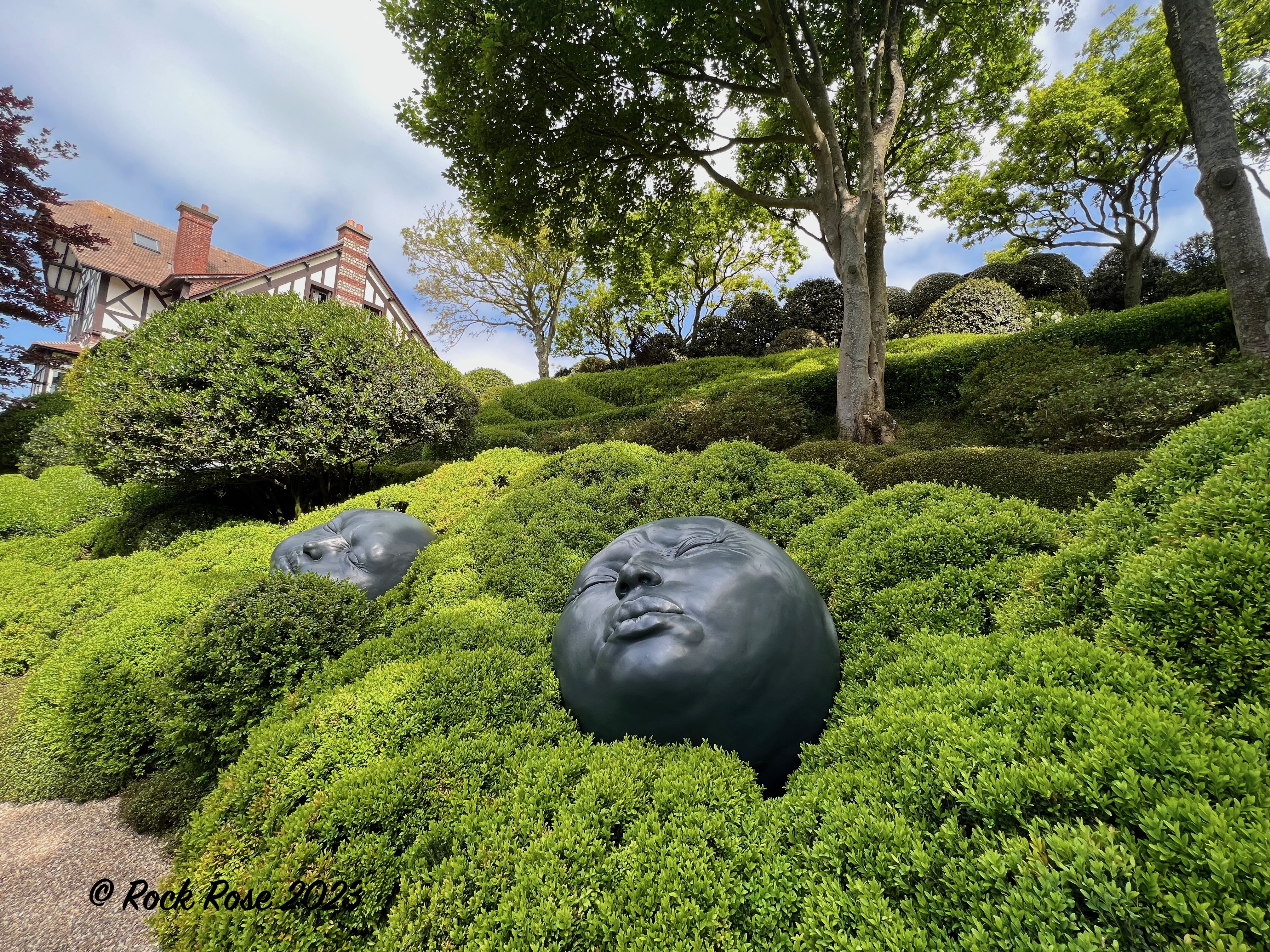
Despite the beautiful topiary this is a garden that requires artwork. Sometimes I find on visiting gardens that the art pieces bear no relationship to the plantings. Although we found that the majority of the art pieces fit well with the topiary, the artistic descriptions of what they represent was totally lost on both of us. For instance, the Jardin Emotions represented the oyster beds that lie/lay beneath the cliffs and the large round polyester resin heads showing a variety of emotions representing the mood of the ocean. The emotions are easy to see and I did think they added a fun element to the garden. I wonder if many people who visit feel the same way we did about the art of Samuel Salcedo. 

 These heads do look as though they are floating contentedly in the frothy sea. 

One of my favorite gardens was the Jardin d'Aval. The Alice in Wonderland garden. I liked it for the 10 metre long solid oak table carved from a single block. We sat here for a while waiting to have the garden to ourselves and taking in the topiary flowers and gorgeous slipper orchids. 


Madame Thebault loved orchids and although this is not a garden of flowers there was one bed of these gorgeous lady-slipper orchids, Cypripedium.


 There are topiary flowers. 

And topiary archway which echo the cliffs below.

In the Zen garden there was some strange sound effects which we couldn't make head nor tail of. I think it may have been Japanese. It was just a little weird. But the spinning spindles did add something to what would just be a rather ordinary forest area. White azaleas bloom here in early spring.


What they represented was a little more difficult for us to understand. I later found that the spindles represented the sound waves of the word 'art' when uttered in different languages. I would never have known.

 One or two wooden carvings were scattered around the garden but by far the most impressive woodwork was of the settee and chair. 

 We took the opportunity to rest here for a while before heading down the cliff path to the town. 


There were lots of cliff walkers and the town was very busy. Being a Sunday the restaurants were packed . We walked back through town to the car and headed back to Le Havre. We were both glad to have taken the time to visit the garden and it should be on everyone's list of gardens to visit when in this part of Normandy. 

Thursday, August 8, 2019

FORGET MY GARDEN, LOOK AT THESE

Nine weeks away from home can have a pretty detrimental effect on a garden-especially in the summer heat of Texas. I am still wading my way through rampant growth of the weedy kind. So far 12 bins of waste and still more to come. When I retreat to the house I like to relive some of the gardens I visited on my travels, while in England this summer. These two are private gardens which I visited in June. Many of you will be quite familiar with the first.


The first is the garden of fellow English blogger and garden book author Victoria Summerley, in her garden at Awkward Hill, Bibury. This was our second visit to Victoria's garden, the first being a few years ago when on one of those perfect English, summer mornings we strolled around her garden. But, as is often the case I can be easily distracted by the moment and failed to take any photographs. I wanted to put that to rights.

I had bought tickets to Highgrove, the private gardens of HRH The Prince of Wales, at Highbury. We needed to spend the night nearby and remembering there was an inn in Bibury David booked us into The Swan for one night.
Well, we couldn't go to Bibury and not go to see Victoria, so it was decided we would visit her the evening before our Royal tour. Another chance to get out the camera...or rather the phone.
We were on a rather tight schedule flying in to Southampton from Guernsey, where we had spent a week, hiking. By the time we got to Bibury it was close to 7pm, our prearranged visit time. On our prior visit we had driven up to the house but this time we walked taking a completely different route, crossing the bridge over the River Coln, which flows through the center of the village.


The path leads to Arlington Row, a row of cottages dating to the 17C,  and on up to Awkward Hill at the top.


It was a gorgeous evening. Victoria greeted us and with glass in hand we headed out into the garden. There are certain touches that just make a garden welcoming. A beautiful bouquet of garden flowers on the table and a chinz pillow on the chair beckoning to sit down. But this time I was determined to get those photos.


The cottage is built of honey-colored Cotswold stone which has softened over time. We saw some new houses being built and were surprised how bright and out of place the new stone looked when compared with the age-weathered stones of the older village cottages.
A lovely wide terrace runs across the back of the house and between patio and house roses clamber up the wall.


After a few moments of chat Victoria's dog, Rufus, enticed David into joining him for a little ball play, in his part of the garden-the lawn.


Isn't he a handsome chap?


Whereas the majority of English gardens are narrow and long, Victoria's garden not only has good depth but width. It also borrows from the surrounding landscape and but for the low wall you might think it went on and on for acres.
At some time the land had sloped away from right to left and in order to create level areas of grass the gardens were stepped down, dividing into 3 main areas. On the high side it is bordered by a low wall with a narrow strip of planting, except where steps take you up to the higher level. The wall of next door's house forms the boundary.
I love the way Victoria has broken up the greenery with a large pot. It gives a place to rest the eye before moving on the look at the tree with hanging bird cage.


As does a large circular plaque with encircling birds on the wall and the peak of a Tuscan-style pot among the greenery.


A strongly defined planting along the lower side of the central lawn area is bounded by a flagstone pathway. A large New Zealand flax and artemisia and fleabane, Erigeron karvinskianus, soften the edge of the path.


You can just see the edge of the stone steps which lead down to the next garden.


It is always good to turn and look back to see where you came from or you might easily miss the stacked-stone steps and artfully placed pots.


There is just something very English about positioning a bird path in the center of a lawn and reminds me of our garden at home where my father had made the bird bath out of stone. Not quite as handsome as this one, I might add. This one certainly looks as though it has some antiquity.  I love the way the generous stone-edged area around the bath adds more weight to the scene.


An intimate seating area sheltered by the stacked stone wall shows the grade level from the house. The ever present Mexican fleabane, Erigeron karvinskianus. 


Moving down and around the side of the house there is a lovely water feature.


And I noticed Victoria had been busy clearing large areas below and to the side, where she is now tending her bee hives.


I don't suppose a staddle stone would look right in a Texas garden but in the Cotswold it is a must.


I have a keen interest in hyperfufa pots. Here is one made from an old sink.


This one might be authentic.


Thanks Victoria for welcoming us to your garden again and goodbye Rufus.


The following morning we drove to the village of Tetbury to visit Highgrove. It has taken me years to get tickets to visit so you can imagine the excitement. Alas, no photos were allowed except in the waiting area where are hung many of the watercolors painted by Prince Charles, along with a few family photographs displayed on a table.


The tour, and guide were fantastic and maybe it was better to not have the distraction of a camera.
We had lunch in their dining room before heading to Worcester to stay with a college friend of David and our second garden.
It is always a pleasure to visit with Neil and Lesley and their lovely garden and we were blessed with the same beautiful evening as the previous day. While Lesley tended to dinner in the kitchen I  strolled down the garden path. That topiary has grown another level since we were last there. I can't remember now if it was an entirely different plant from the hedging or some other species that sprouted up through the middle and Neil took advantage of. Either way it breaks the line of the hedge. Eyes are drawn straight to it.


Unlike Victoria's garden this one is long but cleverly broken into separate areas. Beyond the garage to the right a pergola.


And opposite a stone table and benches with this gorgeous pot planted with hens and chicks.


A fine stand of orange kniphofia and a tall grass almost hides the lawn from view..


You might be excused from continuing down the garden path once you catch sight of the greenhouse.


 I went inside to see Neil's collection of cactus and other assorted plants. It seems he can grow cactus much better than I can.


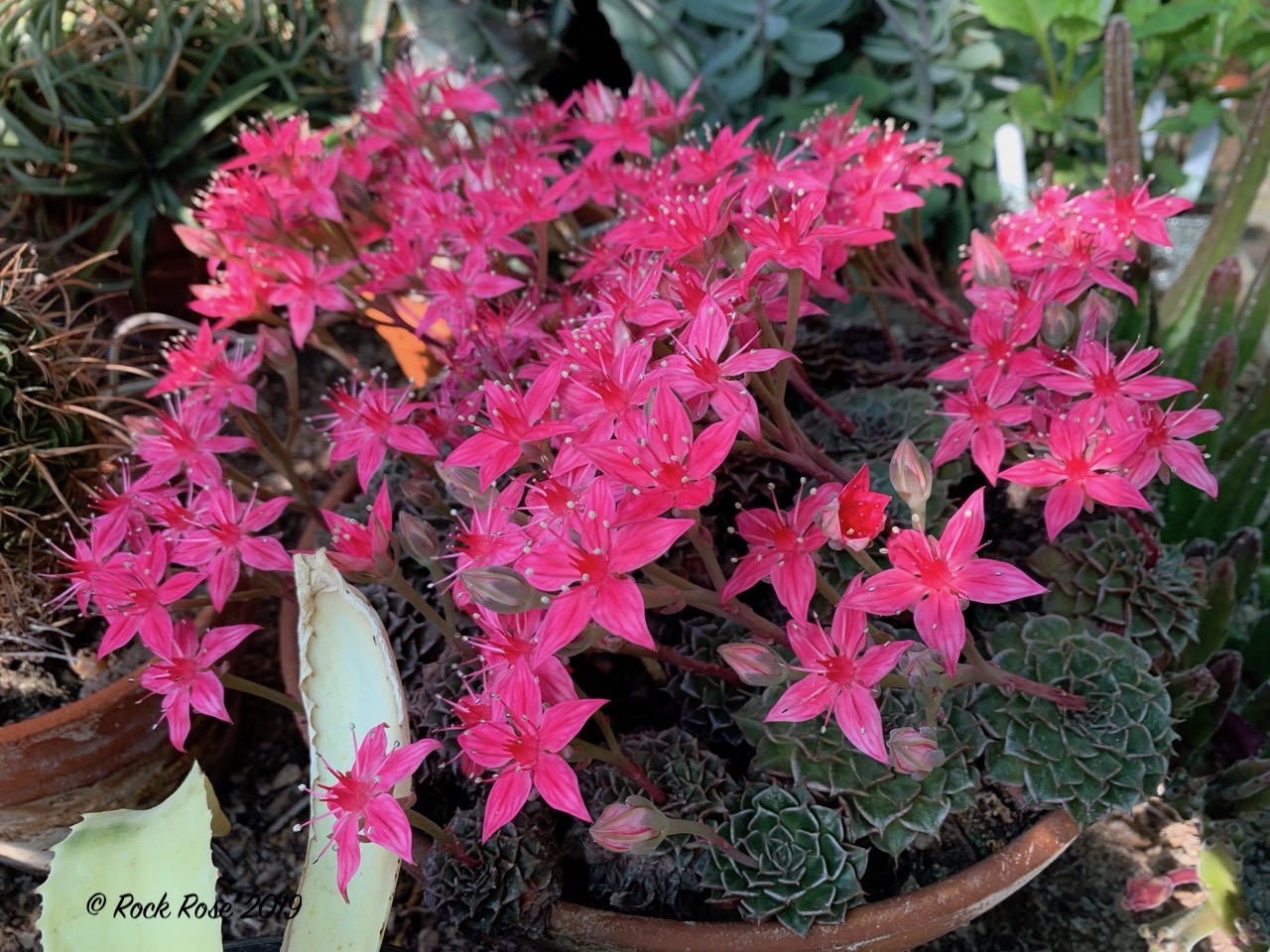
Oh! What's this? Graptopetalum tacitus? I need to be on the lookout.


And at the far end there is a grape vine. It's going to be good harvest!


I spotted a new shale-mulched bed at the end of the greenhouse.


Across the lawn A rose catenary stretching down the garden, breaks for a few feet and then continues. Do I remember from previous visits that this was the Monocot bed?


And on the opposite side a fool your eye Gothic mirror.


Then it was time to crack open a bottle of champagne to celebrate the birthday boy.


Thanks Neil and Lesley for a wonderful visit.

"Now it is back to the weeding"