My Blog List

Showing posts with label blue eyed grass. Show all posts

Tuesday, April 6, 2021

THE 4 O'CLOCK BLUES

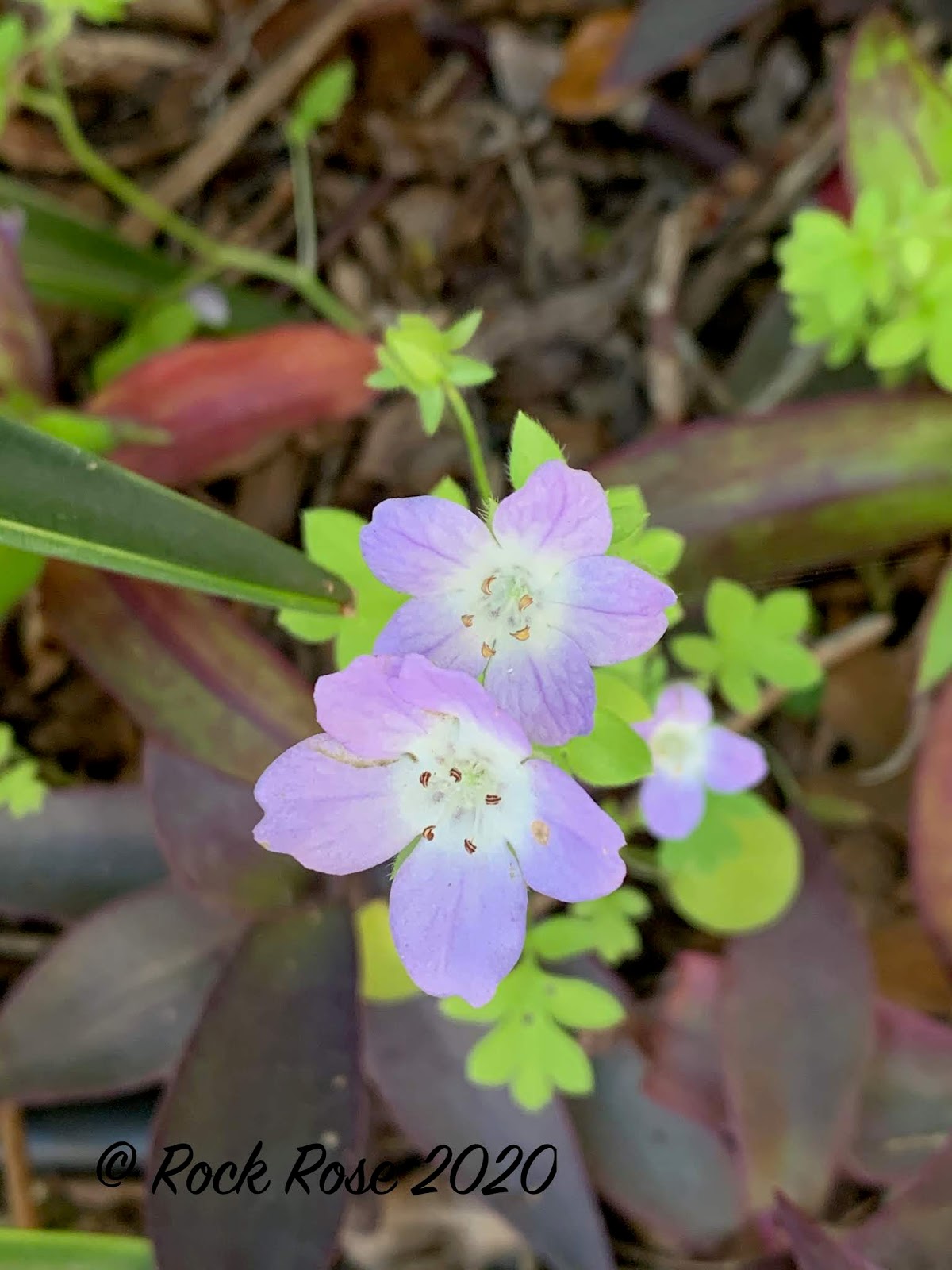
Just as many flowers are fading in the afternoon sun these two little native beauties are just beginning to open. The first is Blue gilia, Gilia rigidula, a member of the phlox family.

I rescued this plant many years ago from the lot next door to us and so glad I did. This delicate plant has spread modestly but seems happy in the place where it is planted. Above the retaining wall in the dry, rocky, shaded, filtered light with no irrigation needed. It is the perfect location because the wall is about 4 feet high so the plant can be enjoyed without stooping. 

I have never seen the plant for sale in the nurseries.

The second afternoon bloomer is the Blue-eyed grass. Sisyrinchium angustifolium. Mine occurred naturally although I have seen hybridized varieties in the nurseries. 


 It loves a sunny location and spreads very easily from seed forming good-sized clumps. It is perfect in a rock garden setting enjoying the spaces between the pavers.

And who could pass up the chance to share more photos of the bluebonnets, Lupinus texensis, that grow both inside and outside my walled garden. Faithful as ever in their appearance every spring and filling the warm afternoon air with a sweet fragrance.


These are the kind of blues a gardener loves.

Friday, March 27, 2020

A FIRST EVERY DAY

You walk around the garden and spot the first bloom on the ....... I'm sure you could easily fill in the blank. Surely every gardener shares this experience. And spring is the time when every day seems to bring that 'first flower' experience.
Here are some of my first flower experiences this week and most of them natives.

First I saw the bud then overnight a flower on the Ladyfinger cactus, Echinocereus pentalophus. These flowers last for at least 3 days and usually arrive in succession.


The blue gilia,  Giliastrum rigidulum. More commonly found in west Texas but I found one small patch growing on my lot and was successful in moving it to a place where I can see it and enjoy its beauty. It is almost at eye level so cannot be missed. It usually opens in the afternoon. Do you see the weevil? Not the dreaded agave weevil though.


Blue-eyed grass, Sisyrinchium angustifolium, seeds among the gravel and between the pavers. As does the Engelmanns daisy which has seeded alongside.


the pink evening primrose, Oenothera speciosa. Oh! Yes, it will run wild but that' fine. A quick pull here and there will keep it under control.


Baby blue-eyes, Nemophila phacelioides. I only have a little patch of shade and that's where they grow.

Everyone else may be able to grow the spiderwort, Tradescantia sp with ease. For me it is a rare event.


What's that I see through the shower window? It's the first blooms of the Anacacho orchid tree, Bauhinea lunarioides.


And the cross vine, Bignonia capreolata. has found tis way 20' from the mother plant.


And I have a mental block on what this plant is called. Help me out will you, please? Update. Thanks to Lyn for the id of Pavonia lasiopetala if I remember the species name correctly.


And wood sorrel, Oxalis.sp. For some it is a weed, for me I am happy to have just a few flowers in this shady corner.


Oh! How I love that morning, spring-time stroll around the garden. There will be more tomorrow, I'm sure.

Saturday, March 30, 2019

THE SLOW SUCCESSION

This week we hosted a large group of visitors from the Garden Clubs of America. As usual there had been fretting for several weeks about how the garden was going to look, what would be blooming and what wouldn't. You know the gardeners' cry, "You should have been here last week, or even this morning." I do try hard not to say that any more. Timing seems to be all important when a garden tour is on the books. Constant checking the weather report and temperatures. If only I could say, "come over today" That may be the only kind of garden tour in our future.
Of course the bluebonnets were blooming beautifully as well as the mallows, freesias, iris,


Globe mallow


and lots of other unusual things like kale and cabbage....gone to flower in our strange Spring, but left for the pollinators.

Flowers of Napa cabbage
Lovely clumps of fragrant narcissus 'cheerfulness'


and clumps of native wild alliums looking at home between the rocks.


And Texas yellow star, Lindheimera texana, which has established itself in a dry corner of the garden.


And because this was an afternoon tour even the Gilia rigidula was on show. Growing on top of the retaining wall between the secret garden and the English garden where it is much easier to appreciate than if it was growing low down on the ground. You are not likely to see this for sale unless in a specialist nursery. I found mine on the property and moved it to this spot.


But days later some of these plants are fading and others making an appearance. The warm sun this week and the claret cup cactus, Echinocereus triglochidiatus started to bloom.


And another round of the ladyfinger cactus, Echinocereus pentalophus.


and more and more blooms opening every day on the Lady Banks rose , Rosa banksia 'lutea'


And last evening as I strolled around the garden, I noticed the blue eyed grass,  Sisyrinchium was blooming. My Monday visitors missed seeing these.


I am now asking myself if my next garden visitors will see them. Will they last another 8 days. But of course there will be something else in bloom. The poppies and penstemons for sure and maybe the mallows will keep going for another week. The skullcaps and blackfoot daisies should be coming into their own. Yes. Spring and early summer are a succession of plants that bloom, fade and are replaced by others, so what am I fretting about? Just my nature.

Sunday, March 19, 2017

THE GREENING OF THE SUNKEN GARDEN

David commented on a marked change in the sunken garden following rain and warm temperatures. If I don't get around to doing some culling we won't even know the sunken garden is there. But what would I do without all my little self seeders.


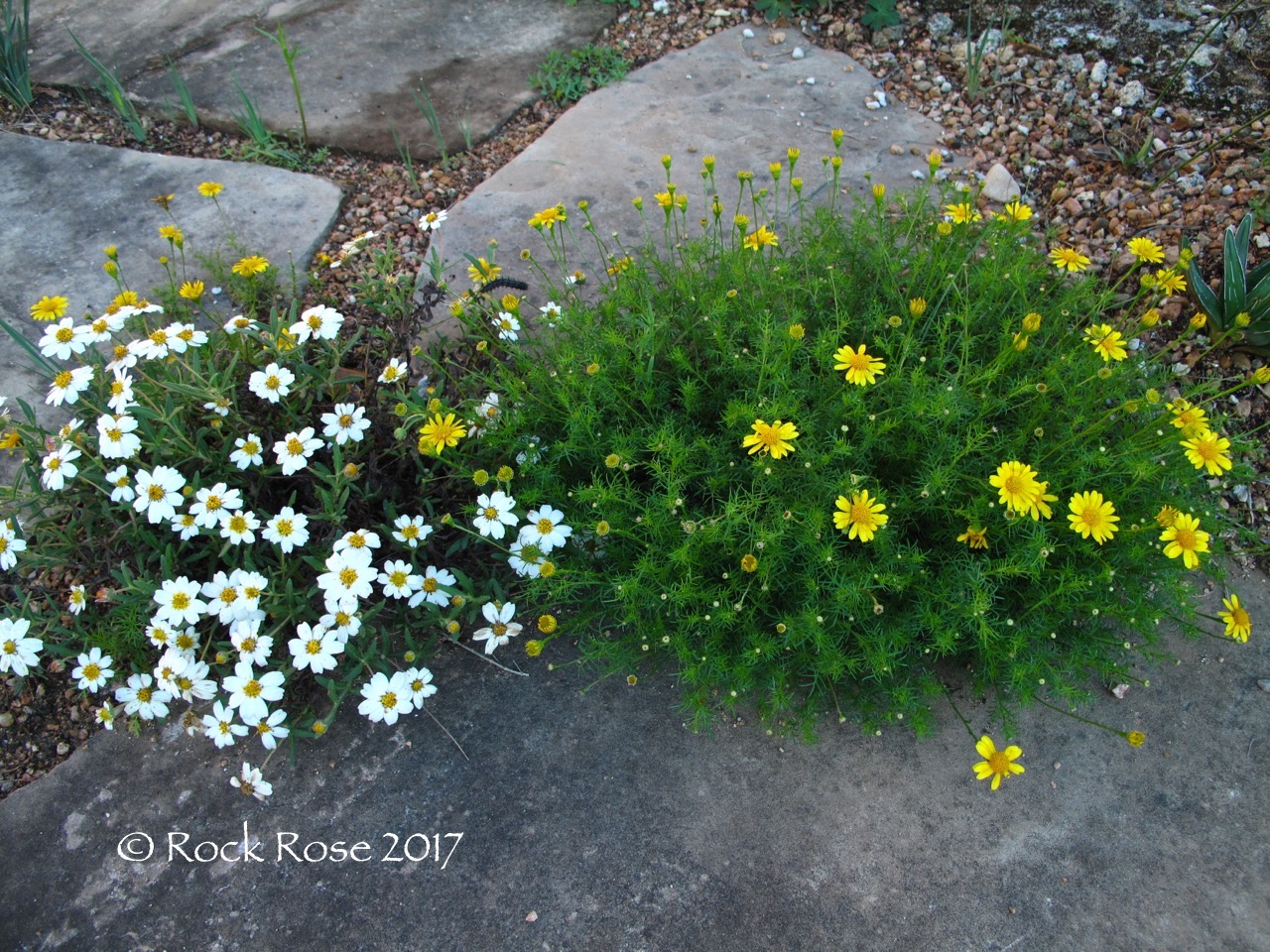
The blackfoot daisies,  Melampodium leucanthum, and the dahlberg daisies, Thymophylla tenuiloba.


The Indian blanket flowers, Gaillardia pulchella,   and the sedum, Sedum potosinum.


the gopher plant, Euphorbia rigida. I didn't really want it down below in the sunken area but here it will stay.


The blue eyed grass, Sisyrinchium angustifolium.


The chocolate daisy, Berlandiera lyrata. This one has been here for years enjoying a cool root run under the sandstone pavers.


The California poppies. I am so glad this white one is back again this year. Eschscholzia californica.


But there are plenty of orange ones too.


And the first of the corn poppies, Papaver rhoeas.


There are a few seeders who can be a little annoying. The false garlic, Nothoscordum bivalve, with the white flowers and yellow centers and wild onion, Allium canadense, with pale purple flowers. Both are pretty but are the devil at seeding themselves and once the bulb forms they are not so easy to root out as the bulb works its way deep into the soil. This year I struck a deal with them. They can flower but they can't set seed!


We may not be able to grow those lovely pom-pom alliums but we have our own and I love the flowers.

Nothoscordum bivalve


Allium canadense
They make a pretty addition to a rock garden. All these plants seed freely in the sunken area of the garden. Because the specs between the pavers are less than 1" it would be difficult to plant without self sowing plants.

Wednesday, February 15, 2017

EARLY SPRING

I have never looked upon early February as being spring before. Usually our first spring bloomer is the Carolina jessamine, Gelsemium sempervirens. And yes, this year it is just starting to bloom.


But our warm weather has brought a host of plants to challenge this spring bloomer. Many are the flowering bulbs, like Ipheion uniflorum with its star-shaped blue flowers.

iph

And the summer snowflake, Leucojum aestivum, the southern answer to the snowdrop. Why is it not called the spring snowflake?


Both theses are about a month early this year and today a solitary flower on the blue-eyed grass, Sisyrinchium sp. caught my eye. These are native to this area and now grow in the garden from gathered seed. This year is going to be a spectacular year for them as favorable conditions have meant an explosion in the number of plants with their iris-like leaves. Hopefully their bloom will not be spoilt by the unseasonably warm temperatures.


I dragged the citrus out of their winter home because I could see flowers beginning to develop. Within a few days this one plant was in full bloom. This was a plant I had root pruned last year and had only one or two lemons. I think it is going to make up for the this year as long as we don't see a hard freeze.


The bees have been busy for days and I can already see tiny lemons forming.


There are still plenty of lemons on the other trees and tonight, for dessert, we had crêpes drizzled with sugar and lemon juice. No need to wait for Shrove Tuesday this year.


Growing up, as I did, on the west coast of England there was never a time when I asked for it to rain. Quite the contrary I was always asking for it not to rain. As those rain-laden winds blew off the Irish Sea and rose to climb over the Pennines, they dropped their rain. But here in Texas, with no rain for weeks,  I have been praying for rain and it looks as though finally we will get some. It may be too late for some plants. My Lady Banks rose has already started blooming but the the blooms are small and many quickly dried up in the heat.


There is still the white Lady Banks in the back garden. Lots of buds but no open flowers.
And yes, the rain came. Only and inch but maybe some more next week. For now Spring continues.