My Blog List

Showing posts with label agave. Show all posts

Sunday, August 27, 2023

HOME FROM THE HILLS

After 6 weeks away you can imagine I was a little nervous about how my garden would look. The summer monsoon had not materialized and temperatures had been unseasonably hot. Tales from the DBG in Phoenix told us of the saguaro suffocating in the unusually high night-time temperatures. We are a little higher in Oro Valley (3000') which makes us cooler by about 8° More than my fingers were crossed when we pulled into the driveway. But I had to wait until morning because it was already dark too late to walk around. We had arrived home to a strong thunderstorm and temperatures in the 70s so next morning I was delighted to find the front garden looking very good.

The bougainvillea on the front walkway had a few blooms. Just enough to brighten the wall. 

 It looks as though a bird has been busy making a nest. For now it is just a platform of twigs and may even have been abandoned. Possibly a thrasher or cactus wren. Our comings and goings may be too much for it.


The chocolate daisy, Berlandiera lyrata, opens up with new flowers every morning, so I was happy to see it was still putting on a show. It is getting a little lanky and could do with a prune but is now the right time? Like most I am not happy to cut off a good bloom.

And the blanket flower, Gaillardia pulchella, still going strong. It was blooming when we left six weeks ago.


Other native plants likes the skullcap, Scutellaria potosina ssp platyphylla add a splash of purple in front of the young Whale's tongue agave, Agave ovatifolia. Despite all the structural plants I am not happy to do without a little color.

Along with the bright white of the blackfoot daisy, Melampodium leucanthum. 


So many of these plants are a reminder of my Austin garden, although there the barrel cactus were in pots. I regret now that I didn't bring the larger ones. I think I could have pulled them out of their pots and brought them bare root.

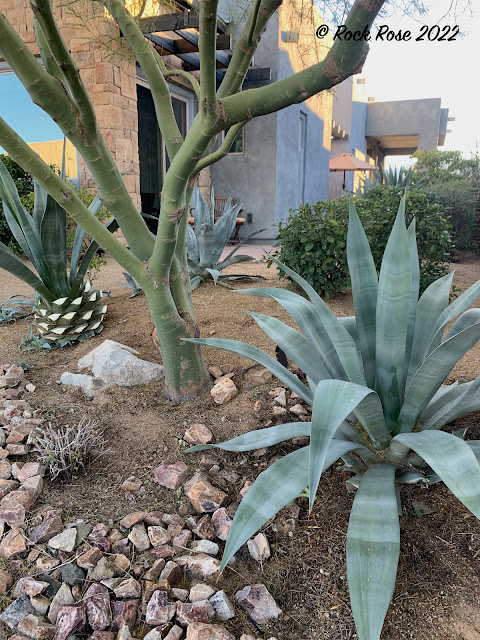
There are only a few large agave remaining. This one is on the corner beneath the palo verde. But wherever we took out the Agave weberi new pups are springing up. I am potting some of them up to plant out behind the house. There is good value to be had out of these large structural agave and I find I miss them. For the first time ever I have started to protect them from the weevil by using the systemic Imidacloprid around the base.
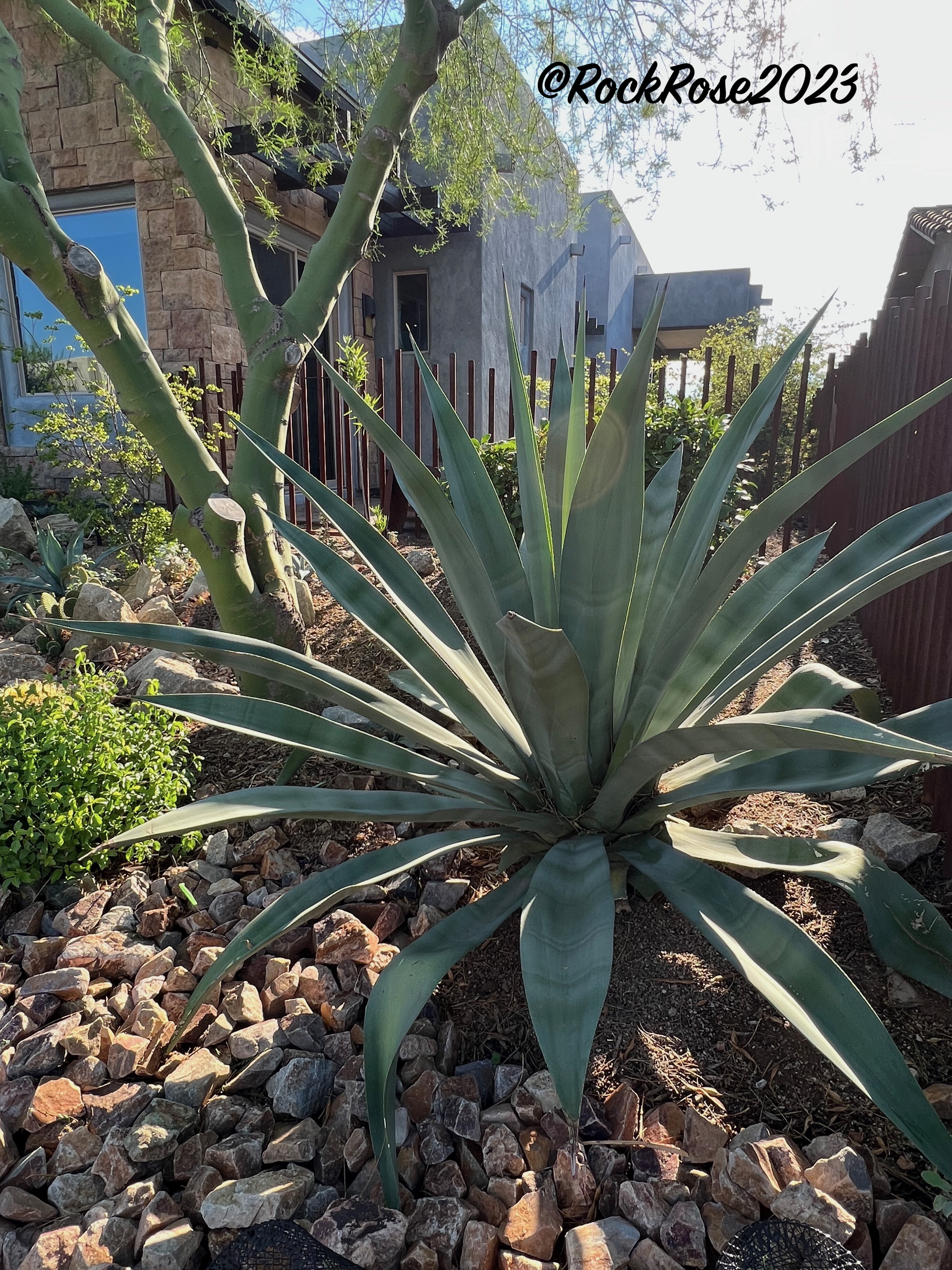
 Another very spiny agave guards the edge of the driveway and is forever in risk of being run over. It is a slow grower but it puzzles me why they would have planted it so close to the edge. It has produced only one pup which I relocated.

I am really quite fond of the brittle bush, Encelia farinosa, which blooms in the spring with masses of yellow flowers. It reseeds around the garden and I leave some of them to grow into small bushes.


One of the plants I was most concerned about was the Meyer lemon tree. It had lived in a large pot for 12 years, providing us with tens of lemons every year. We brought it with us and last year planted it in the ground. It looked good during the winter and produced many blooms but it wasn't happy and by May almost all its leaves had turned yellow and dropped off. I full expected it to be dead and was already planning to put in a new one this winter. Amazingly extra watering and some summer showers had brought it back to life and there is new growth.I will always give any sign of life in a plant a chance so it remains to be seen whether I will be replacing this after all.

Also down the side of the house the grapefruit tree is looking great and the 6 grapefruit are getting bigger. They have about 4-5 months to grow to full size and ripen.

It is my potted plants that suffered the most and many died. The lime tree had fallen over along with the plumerias. I must try to get the lime in the ground although the Mexican lime is one of the least hardy of the citrus. I may just have to give up in the plumeria. A large jade plant had completely rotted away. I don't know if it was the heat or lack of water but there was no9thing left of it. Of my herb and vegetable raised planters only the basil, sage, chive and peppers survived. David had put in a new water line to water them from beneath but I think they were getting too much water being on every day. This was really due to there being mixed water need plants on the same circuit. There is a lesson to be learnt here, although I think I have had the same lesson many times before. A constant presence in the garden is the only answer.

 Another storm blew through and was the trigger for all the Mammillaria grahamii to bloom. They have certainly put on a big show-a show always worth waiting for. 


One of the benefits of living in an arboreal desert.

Friday, May 6, 2022

THE THREE Rs OF DESERT GARDENING

 I have been reading Jeff Moore's book. Under the Spell of Succulents. It is a wonderful book, beautifully illustrated and loaded with information.  There is only one problem. Many of the gardens are in California- In my eyes the perfect climate for growing, well____ just about everything. It seems I squandered my 6 years in Southern California growing the wrong thing! Sadly he devotes only two pages to desert gardens. Clearly he knows what will and what won't grow here.

I did learn two major things which seemed to be directed at my new adventure in desert gardening. His mantra of the 3 Rs. Rocks, Restraint and Repetition. Let's see how I am doing. 

Rocks-I had 9. I knew I wanted more, even before I read his book. We have now collected from a local source over 36 decent sized which I have been using to create a rock garden. It may look a little bit currant bun at the moment but I am hoping plants will fill in and soften the look. They are not rocks I would have chosen but this is what we have. The expense of having someone bring in and place larger ones was beyond what we wanted to spend. These broken chunks of granite tend to be rather angular but surely I can soften their edges with plantings. 


 I am also thinking of giving them a diluted paint wash to help them blend in. I did that with some limestone ledge stones at my old garden. Then there is the 4" riprack and 1" stone mulch. We rented a UHaul for that job picking up a load at the stone yard. So far two UHaul rentals and two dusty stone yard visits. 


Restraint- I have always been known for that. At least from the money angle. I would buy 4" pots and only occasional gallons. But I think Jeff was referring to using a small palette of plants. Maybe I'm not so good at that but hope to manage this better in the desert. The odd large agave may look great as a statement plant but smaller ones look better when they are in groups.

Repetition-I'm been good at repeating some things-namely things that seed themselves or pup. But that was in Austin. I have lots of pups of A.americana and A.weberii but I would like something more exciting. I purchased 3 Agave "Blue glow" of which there were several already planted. I do worry a little that they will not like the full afternoon sun so I will probably protect them with some shade cloth through the first summer. I had hunted around for A. ovatifolia to no avail and then one day we visited Tucson Cactus and Koi and they had several. Sadly they were pock-marked from a hail storm that had passed through the area a few weeks ago. I was just going to buy one but David persuaded me to buy 3 at the discounted price. They are quite small but I know they will grow out of the damage if I treat them well.

                                                    A. ovatifolia "Frosty Blue"

 I had plans to put the second one on the other side of the front planting bed, beneath the large remaining A.weberii. Incidentally when I told a local nursery that these weberii did not have completely smooth edges he told me that almost all of the ones here were a cross between americana and weberii. They could give you a nasty gouge. On the spur of the moment I told David we should take it out. Within minutes I had cut off most of the leaves and he was there to do the final job. Now there was room to plant the A.ovatifolia. 


Of course I read too late his advice about taking out any current planting so as not to have to work around the plants and compromise the design. On the front walkway I couldn't bring myself to do that as the barrel and echinoeereus cactus were about to bloom. They looked too comfortable to mess with. 


I worked around them trying to create a drainage swale and mounding on either side, disturbing the cactus as little as possible. He was right of course. He also talked about bringing in soil to create the mounds. We did not. We used what we had. It's just desert sand which is fine for most of the desert plants that grow around us.


My garden is now a desert garden and I am surrounded by saguaro and barrel cactus at every turn and discovering the desert is not necessarily the place for all cactus and succulents. Some will withstand the baking summer sun but others demand shade if they are going to survive. I brought with me a large collection of cactus and succulents and herein lies the struggle. Clay pots were perfect for Austin. Not so in the desert. The air is so dry it sucks any moisture out of the pot. I find myself watering more frequently than in Austin. In my former home I would leave them for 6 weeks in the summer, under the shelter of a patio. They quickly responded to a little attention when I came home although they may never have been prize winners, bearing the scars of winter and summer damage. But here they are and I have been doing my best to make them feel at home. Some have been put in the ground. I brought 3 barrel cactus one of which I picked up in a neighborhood concrete wash in a subdivision in Phoenix. At first I thought it was growing in a crack in the concrete but was surprised to find it totally unattached. "I have a home for you" I also brought some agave- A. demettiana, variegata. My neighbor has one so they found a new home in the ground. Also an A. demettiana 'Joe Hoak' I may have to give all some frost protection in winter. I have planted a ladyfinger cactus, Echinocereus pentalophus, in the shade of the ironwood tree. 

I have moved them from one spot to another as the sun moved across the sky finally settling on a place down the North side of the house.  Until I discover the sun has found its way to that spot by the afternoon. So now the only place is under cover along the east facing patio or in the house. 

Most have flowered well this spring but it might be a struggle to keep them happy if we go away.  This cactus asks for little in the way of water or fertilizer and puts on a stunning show of blooms. The blooms last for several days.


                                                 Echinicereus pentalophus

This is not going to be as easy as I thought!

Sunday, April 3, 2022

ADDING MORE ROCKS AND NEW PLANTS

It is characteristic of me to be working in more than one place at the same time. A few weeks ago I turned by attention to the front of the house, abandoning some of the others areas I had been working on. The whole front needs a revamp which includes removing plants that have grown too big for the area. A huge A. weberi and two baja ruellia, Ruellia peninsularis. Baja ruellia, is a great plant, but when squeezed up against a wall and in poor soil with no attention but chopping they don't do well. No sooner do I say to David, this one is going and those two as well, than he is out there with his saws and choppers. It's a two day job.

We have garbage pick up twice a week and this is our way of disposal. It's a full bin every week.

There is also a giant hesperalo, Hesperaloe funifera, which David does not like which will remain for the time being. Purely a well established structural plant for now. And one Agave weberi at the back.


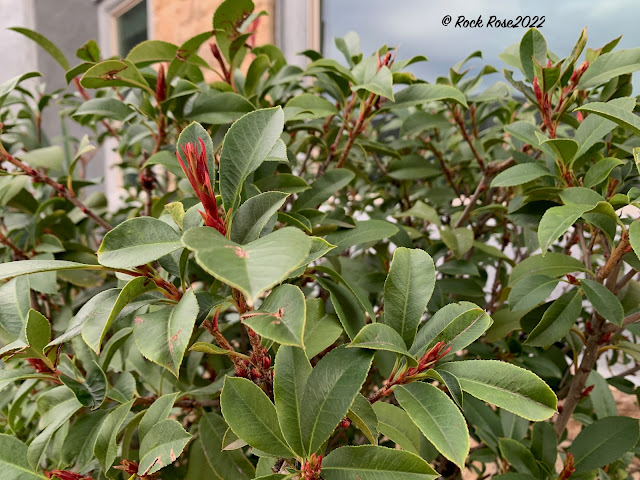
And a photinia, Photinia x fraseri, which will also remain for the time being. They add some height and winter structure, I am still thinking about what to put there. Maybe a desert willow. For all the bad press the photinia received in Austin, it seems to thrive here and no one would disagree with how wonderful the new growth looks in the spring. I read that it can be trained into a small tree so I will take a look at this one and see if that is an option.

It also does well as cut branches in the house. It is now blooming although as someone said the blooms have an unpleasant smell. 

So with a good area now cleaned out I turned my attention to adding more rocks adding 12 more to the front. We have found a good local supply of both larger granite rocks and the Coronado brown rip rap that are used for erosion control. Monsoon season demands this. To bad we no longer have a truck  but we are managing with car loads for now. We will eventually rent a trailer in order to bring in some of the smaller rock to use as a ground cover. I redid all the edge rock adding more around the sides. 

Then planting began. I added the 3 barrel cactus I brought with me and purchased 3 Agave 'blue glow,' one A. parryi, a damianita, Chrysactinia mexicana,  and a chocolate daisy, Berlandiera lyrata. The A. blue glow is a cross between A. attenuata and A. ocahui. It is prized for its blue green floiage with red and yellow margins and its compact size. I will see how well they do in this location, which is west facing. I removed a sad clump of claret cup cactus, Echinocereus triglochidiatus,  that were rotting due to too much moisture. I am trying to rejuvenate the parts that still showed life but am not too hopeful. 

I am on the hunt for a Whales tongue agave, A.ovatifolia, but as yet have not come across any.


 I also found a home for the concrete balls I made for my Austin garden.

A nice specimen of the blue barrel cactus, Ferocactus glaucescens, is starting to bloom. It reminds me of the crown of thorns starfish.

The area at the back is where the clean outs are for our sewer line and for now I have just added a germander, Teucrium fruticans "Azure Blue' 


I see lots of plants growing in gardens that I would love to have but it is a matter of  balance between seasonal bloomers, structural plants and plants to carry the garden through the hottest months of the year. And we shall be gone for a few weeks this summer as we drive up to Madison, Wisconsin to attend he Garden Bloggers Fling. Click here for details.

Will you be there? I hope so.


Wednesday, March 2, 2022

WAIT A YEAR, THEY SAY

 I'm sure you have heard this piece of advice given when you move into a new house. Take the time to understand the passage of the sun through the year, mark the various micro climates around the garden. When the garden is already planted watch through each of the seasons as plants come and go. Catalogue which plants you have, which will stay and which will go. All the while planning new areas and new plantings.

Sound advice but not for me. I will say I complained the first time I saw the house. "It's already planted. There is no gardening to do" How wrong I was. After moving in and taking a good look around I very quickly saw there was no time to lose. Most of the agave have reached a point where they need to be removed. So far we have removed 3. There are at least 3 more to remove. One monster, one large one and one smaller one at the back. If David thought he would never have to remove another agave after the tens he removed at our last house he was wrong. Thank goodness we kept the chain saw and the pick axes which I insisted on bringing.

Why would anyone plant an A. weberi so close to the fence? It had grown so big that growth of the Texas Mountain laurel planted next to it had been compromised.

I cut off the leaves and then called in the big guns to get out the root. 


Next to go, this monster. I have always thought A. weberii to be pretty innocuous as agave go but these ones have small teeth.

This time David didn't beat about the bush but got out the chain saw, making quick work of it. 


I have my eye on this spot to plant either a new calamondin or an satsuma tree. The shops are full of citrus at the moment so I shouldn't have a problem finding one.

I have begun work on making a retaining wall around the mound. Originally the area was piled up with rocks, which prevented us from walking down the side. Now with the soil retained further back I can use left over rocks to make a pathway. 

I am not 100% happy with the rock work but I must make do with what I have on hand and these angular lumps of granite are not as easy to work with as the flat limestone stones I have used in the past. Still I am hoping that succulents and cactus will soften the edges and find a happy home in the nooks and crannies.

After reorganizing the rocks beneath the roof scupper outfalls I will get a few bags of gravel from the local big box store to put down on the rest of the pathway and between the cracks.


There is more rock work to do here but I am making a list of plants that I hope to introduce to this part of the garden. Most are desert dwellers. On my list are,

Agave parryi, var, truncata, Artichoke agave,  Euphorbia resinifera Moroccan mound, Echinocereus triglochidiatus Claret cup, Echinocereus engelmannii Engelmanns hedgehog, Aloe x 'Blue elf', as well as many flowering perennials with which I am familiar like Melampodium leucanthum, Blackfoot daisy, Tetraneuris acaulis, Angelita daisy, Damianita and Berlandiera lyrata, chocolate flower.

Let the shopping begin.


Monday, January 17, 2022

THE STOCKERS TAKE STOCK

 Moving to a new garden is no piece of cake. Unless maybe it is your first and comes already made. Such was the case when we bought our first house in 1972 in Beaconsfield, Quebec, Canada. It came with lawns, fruit trees, a Russian olive, a weeping willow, lilac, spring bulbs, iris and a rockery. What more could a newbie gardener wish for. I did tinker with it adding a veg. garden and fruit bushes and a post and rail fence.  Fast forward nearly 50 years with 6 more gardens under my belt, none of which came with so much as a blade of grass, to December 2021 when we purchased, what we expect to be our final house, in the Sonoran desert of Oro Valley, Arizona. The much smaller house on a very small lot is already landscaped and to a non-gardener might be considered complete. 


The builder was very generous with the plants which was clearly required by the association to make sure properties were pleasing to the eye. Even to installing lights and drip irrigation. It would appear the original owners added more plants to the plan although many have been lost. Javelina, rabbits, rats, mice and lack of care may be to blame. Or was it just over planting? If they had just waited, but you know how that goes. They left me the plans which are very helpful in identifying a few of the plants I am not familiar with.  


Then, there were additional plans with more plants added. I have no idea how many were in the final installation but it is clear that many are missing like S. greggii and gaura. 

I was incredibly excited to find quite a number of Agave "Blue Glow" and Anacacho orchid trees, Texas mountain laurel and a number of Mexican olive trees. Now I learn the latter are rather messy as their brown leaves hold even through winter and I will need to remove the fruits so we don't encourage rats.


And several Agave Victoriae reginae. I brought Brer rabbit with me and he seems happy in his new home. He was a housewarming gift 22 years ago when we built our last house.


There are more large A. weberi that I need. Already past their prime. We have already begun removing some of the lowers leaves becasue they provide a good hangout for mice and rats.

 And we are not making a pineapple out of this one but slowly removing the leaves with each trash day! It will finally be removed and as yet I don't have plans for what will be there. Maybe a Whales tongue, A. ovatifolia. There are a number of pups which I will likely use to replaced other outgrown agave.


Oh! and there are quite a lot of red tip photinia. That was a no-no in Austin so not quite sure how conditions might differ here. They look healthy. I suspect they are the builders standard plant which grows quickly is evergreen and wows with those red tips.

There are a number of bushes I am not familiar with and frankly most of them will have to come out or at least be cut down to the ground as they are growing into other bushes.They have been miserably hacked by the landscapers to keep them under control-with a blunt pair of sheers. It is sad to see the Texas mountain laurel treated in this way as well as a number of Anacacho orchid trees. Only one has been allowed to take a tree form and then a small one shows promise of making it to adulthood. 

At first glance I remember thinking there wasn't much gardening to be done but a second glance has told me otherwise. I have been scanning local landscapes for which plants will work best here. Once again much will depend on micro climates and visiting wildlife. Although our property is fenced on 3 sides we intend to complete the fencing. It may keep javelinas away but not rabbits. 

This weekend we got to grips with some drainage we needed to understand and the irrigation system. We have had to order a new control box as most of the buttons weren't working. What was that David was thinking about not having to do such things! We also removed the Mediterranean fan palm(what a brute) and I planted an Agave desmettiana I brought with me. It feels good to get my hands in the dirt although I'm not sure I would call it that. It's basically just gritty sand. 

Maybe I will get to a nursery this week.

Monday, January 30, 2017

SCISSORS, PRUNERS, SHEARS AND SAWS

Having just returned from 2 months away there is much work to do in the garden. Harsh freezing weather has wreaked havoc among the agaves which have melted into rotten masses. This will not be a pretty post but will serve to show that not everything goes well in the garden and you just can't let these kinds of happenings get you down.


Although there are a few agaves that are hardy down to 10º I have many that will shrivel when the temperatures get below 25º My neighbor tells me one night it sank to 16º Hence the carnage.
I have had this Aloe 'David Verity' for over 7 years. It won't be flowering this year.


And these Agave colorata, are supposed to be hardy to 18º Maybe they are not totally lost. I'll give them a chance.


It was simply a matter of taking a saw to the leaves and cutting through them and putting them in the garbage. And lots of leaves were showing this kind of damage. They were sawn off. I still have tens of Agave weberii  to deal with but they will have to wait. I have more pressing things to tackle.


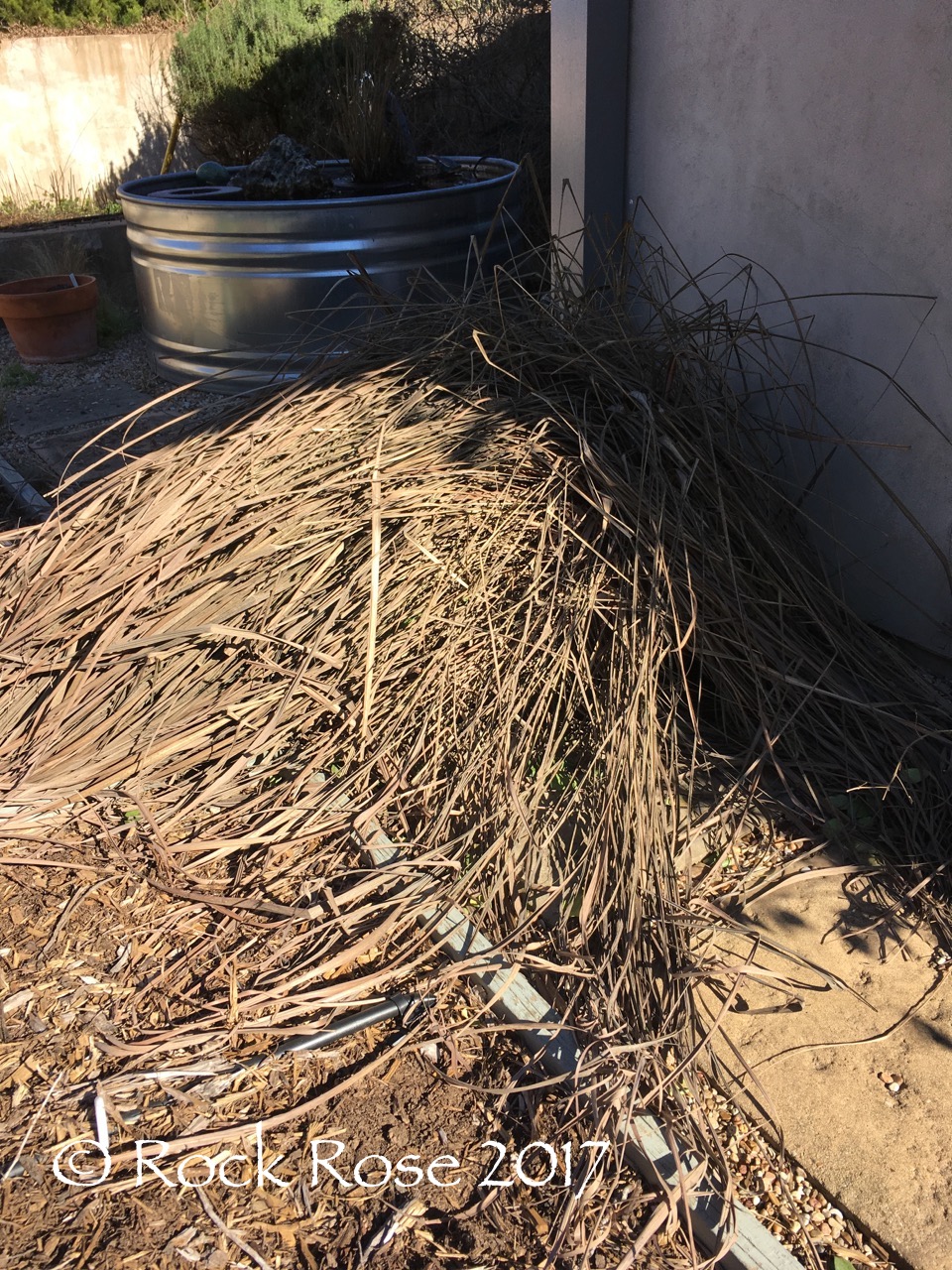
Then it was the turn of the grasses. It is no surprise that the lemon grass, Cymbopogon, didn't make it, not even under the protection of all those dead leaves. Fortunately I took some shoots in the fall and they are safely in the greenhouse. This was how it looked in September.


And today before I removed the whole clump.


Look how tidy the area is now.


I can walk down the path. I will replant in the same spot as soon as any risk of frost is gone. There is no irrigation there so I find it amazing how well it does.
With summer-like temperatures this week I knew the next job was to cut back the grasses before they start growing. The ruby crystal grass, Melinis nerviglumis, gets the hedgehog cut. Starting the top center with a good pair of scissors and working around to create a round shape.


If there is less dead tissue I let it be. If the center is really dead and the plant a couple years old then I pull it out. The roots are extremely fibrous, as you can see below, so sometimes it is impossible to pull the whole plant out. Then I pull a small section at a time leaving behind the roots. There are always plenty of seedlings to take its place.


Next I will tackle the inland sea oats, Chasmathium latifolium,  although I think they have probably already dropped their seed heads. The good news in that corner of the garden is that the Mahonia, Mahonia aquifolium, is about to flower. This is the first year as the plant was moved two years ago from a too sunny spot where most of its leaves fried. So much happier here.


It like a breath of spring to see flowers. By the end of the week I think there will be more.
At the end this day I feel as though I have accomplished quite a lot. My wrists and hands are weary and sore. That comes of not always wearing gloves. And there is dinner to make!