My Blog List

Showing posts with label Ruby crystal grass. Show all posts

Monday, May 3, 2021

RIGHT PLANT WRONG PLACE, BLUEBONNET PURGE.

I couldn't help but smile when I read this. They are talking about bluebonnets, our Texas State flower.

"While it may be a myth that picking the beautiful blue flowers is illegal, conservation is crucial to preserving these delicate native plants"

Delicate native plants indeed! Not where I live. And I do believe the Ladybird Johnson Wildflower Center would agree with me on that. That is why they are smart to make a dedicated bluebonnet patch within their garden because otherwise the plant would just take over the whole garden.


That is exactly what happened in all of my inside gardens. I am asking myself why did I let this happen again because I have learnt from experience that if I let them grow in here I will spend hours pulling them after they are spent.  Not to mention the poor plants which struggle to grow beneath them and how it impedes walking through the garden. For the last three days I have pulled hundred, piling them in various places under the trees. If they ripen, all well and good, if not then I still have hundreds more whose seed I can collect for places where I want them to grow. It was imperative to remove them before the rain came....and it di. 4.2" over three soggy days.
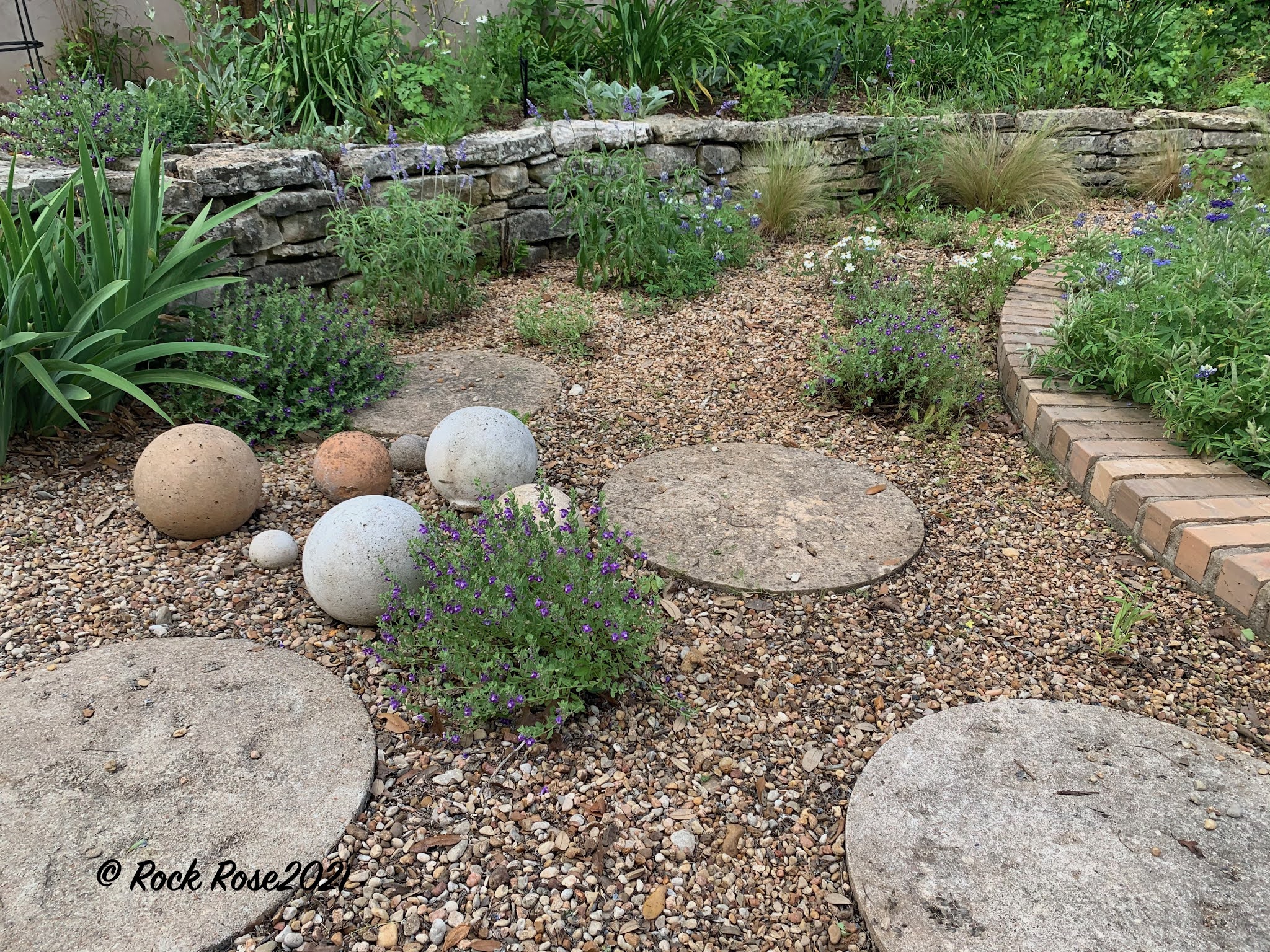
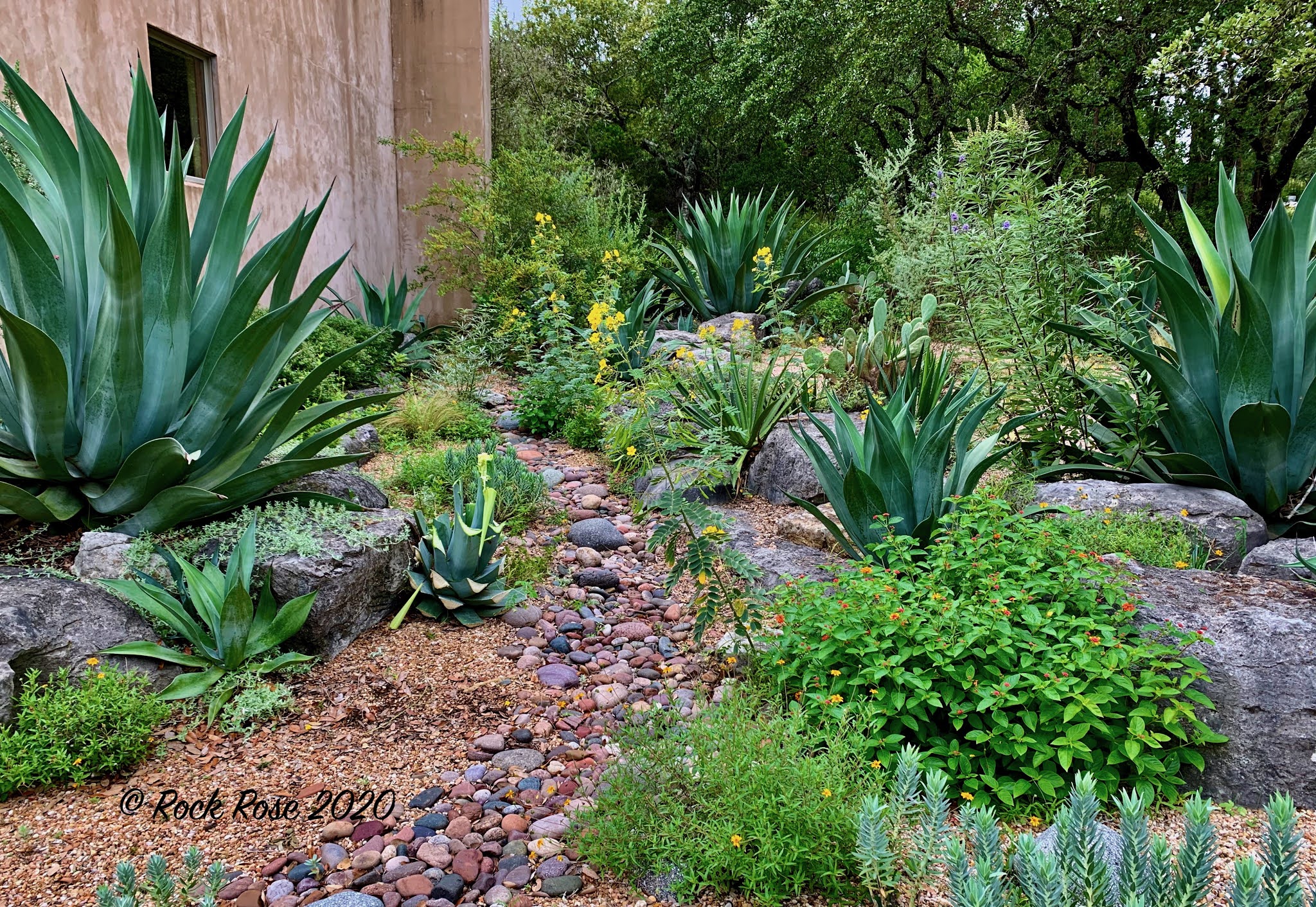
Ah! The other plants in the gravel can breathe again. The skullcaps, Scutellaria sp.blackfoot dasies, Melampodium leucanthum, mealy blue sage. Salvia farinacea. These much more mannerly plants who will only occupy a small area. I am more than happy to have them brighten up the larger expanses of gravel.

An occasional ruby crystal grass or Mexican feather grass. 


My absolute favorite fro this gravel garden is the purple skullcap, Scutellaria wrightii, I prune it to a more rounded shape in the spring and scatter the seeds around in the fall.

The other players permitted to remain in this garden are ruby crystal grass, Melinus nerviglumis, Mexican feather grass, Nasella tennuisima and a modest amount of love-in-a-mist Nigella damascena.


I will remind myself next year that this is the look I prefer and certainly saves days of work.


Saturday, September 26, 2020

A BUCKET A DAY KEEPS THE WILDERNESS AT BAY

 I think I would somehow feel cheated if I didn't pull out at least one bucket of vegetation every day. It is what I do best! When I analyze my style of gardening it is to allow plants to grow with wild abandon. Self seeding plants everywhere and plants allowed to remain until even I find it necessary to bid them goodbye. That takes a lot but it does eventually arrive. And every year I look on enviously at my fellow gardeners with their well-managed borders and thriving plants and wish I could do it that way. But I am trying and maybe two buckets a day would get me there.


This week I started to pull out Gomphrena 'fireworks' as well as some of the many ruby crystal grasses in the herb garden. I like to have a few plants growing between the pavers but by the end of summer it becomes too many. The Ministry of Silly Walks has nothing on how we get from A to B in this garden. And in every other garden too! While in that area I tackled pulling out one of the clumps of society garlic. It is actually growing in one of the herb beds but unlike the real chives (not garlic chives) it is prolific in its spread. The roots had become so intertwined that in the end I had to use a pick axe and even with that I left a lot of roots behind. A quick text to my new neighbor to see if she would like some and she did. I am more than happy not to have to put them in the garbage can.

It leaves a nice space to add some new herbs for the winter, like parsley, chives and maybe some dwarf sage-if I can find it and of course some edible flowers like calendula and violas. The one dwarf sage plant, Salvia officinalis minum, I had died this summer. It was so well behaved that I regret its passing.

 Further along I have removed the purple basil which did not like the rain. Cilantro is beginning to germinate from last years seeds. I had to break a little piece off the seed leaf and roll it in my fingers to smell it. Yes! Cilantro. I did the same with another seedling growing in between the pavers-definitely parsley.

It was a bad year for my various thymes. The lemon and variegated thymes did poorly. Only the culinary one seems to make it from year to year, which is a good thing because I use a lot of both fresha nd dried thyme in cooking.

I'm hoping the Mexican mint marigold will flower this year as last year, for the very first time, it failed to flower. I don't see any flower buds yet.

I moved around into the front of the house to tackle a rather large agave that was in the way.  At one time we could walk across the creek and up some steps into the granite area. Delightful when it appeared from beneath the rocks it was now too big and impeding the way.

 If you have ever had the need to remove an agave then you know the only way to tackle it is to cut off the leaves one by one. I use a serrated knife. I suppose you would call that the easy bit of the job.

 Now to find someone to do the hard bit. David! And even he complained how difficult it was because the plant had come from up above and its root was firmly wedged under the rock. 

But there is more to be done. This one needs to go too so that once again we can walk up the steps.


But that will have to wait for another day. The buckets are full.


Sunday, September 17, 2017

THE SEPTEMBER GARDEN

When hurricane Harvey slammed into the Texas coast, 200 miles away, it brought some much needed rain to Central Texas. Along with that we saw a significant drop in daytime temperatures but more importantly night time temperatures in the low 60s. Warm days and cool nights. For a few days it was like being in California. The plants showed an immediate response; the sickly yellow leaves greened up and the flowers colors brightened. It was glorious but not to last. Still, for those brief few days I enjoyed every moment in the garden.
Sometimes I think fall is better than spring. Everything in the garden has become more blousy. There is barely a scrap of earth or gravel to be seen.


I never know from one year to the next how this will look or which flowers will be present-except there will always be plenty of rock roses.


The Salvia leucantha I have been planning to move for years is still there. The hummingbirds are very adept at flying in through the window in the high wall that separates the gardens.


A week ago there was but one bloom on the butterfly pea, Clitoria ternatea. Now there are many. The blackfoot daisy, Melampodium leucanthum, continues to spread across the step.


Ruby crystal grass, Melinis nerviglumis, is flowering. There will be plenty of those again next year.


  Globe amaranth, Gomphrena haggeana, 'Strawberry fields' is everywhere.


As are the purple and pink varieties growing in the pathway of the vegetable garden.


The spider zinnia will eventually be evicted from its home in the vegetable bed but I will save the seeds for next year.


In the sunken garden it grew where the white California poppy once grew.


In the sunken garden there are gomhrena, pink and purple skullcaps, aura, mealy blue sage, white Salvia greggii, and an errant member of the cucumber family which came in on the compost.


As well as zexmenia, Wedelia texana,  chocolate daisy, Berlandiera lyrata,  and returning alyssum.


But the absolute show stoppers of the moment are the liatris in the front courtyard. Purple is definitely the color of the moment.


Last year I removed many of the bulbs and planted them outside the walls. It seems that every seed germinates but they are silent all summer until their bloom time in the fall.


Phlox paniculata John Fanick, After the first flowering I pruned it back and here it is again. Smells wonderful.


Trailing Snapdragon vine, Asarina procumbens is a native of Mexico but seems to do well here as an annual.


Tradescantia sillamontana with its cobweb leaves and pretty pink flowers, easily grown from cuttings.


In the spring I bought a hanging basket because it looked simply gorgeous. I repotted it into a larger basket with baby diapers in the bottom. It was an impulse buy. It has been watered all summer on a drip system twice a day, and received an occasional fertilize. I have cut it back completely about 3 times. It took a beating on one side during the hurricane but is recovering.


The mandevilla vine is into its second year. I cut it down and put it in the potting shed last winter. It dried out and went dormant but started to come back after a good spring soaking. I will try to keep it for another year.


It is wonderful to see so much color back in the garden and there is still the Philippine violet yet to bloom. Soon it will be fall and these icky-sticky days will be a thing of the past!

Monday, January 30, 2017

SCISSORS, PRUNERS, SHEARS AND SAWS

Having just returned from 2 months away there is much work to do in the garden. Harsh freezing weather has wreaked havoc among the agaves which have melted into rotten masses. This will not be a pretty post but will serve to show that not everything goes well in the garden and you just can't let these kinds of happenings get you down.


Although there are a few agaves that are hardy down to 10º I have many that will shrivel when the temperatures get below 25º My neighbor tells me one night it sank to 16º Hence the carnage.
I have had this Aloe 'David Verity' for over 7 years. It won't be flowering this year.


And these Agave colorata, are supposed to be hardy to 18º Maybe they are not totally lost. I'll give them a chance.


It was simply a matter of taking a saw to the leaves and cutting through them and putting them in the garbage. And lots of leaves were showing this kind of damage. They were sawn off. I still have tens of Agave weberii  to deal with but they will have to wait. I have more pressing things to tackle.


Then it was the turn of the grasses. It is no surprise that the lemon grass, Cymbopogon, didn't make it, not even under the protection of all those dead leaves. Fortunately I took some shoots in the fall and they are safely in the greenhouse. This was how it looked in September.


And today before I removed the whole clump.


Look how tidy the area is now.


I can walk down the path. I will replant in the same spot as soon as any risk of frost is gone. There is no irrigation there so I find it amazing how well it does.
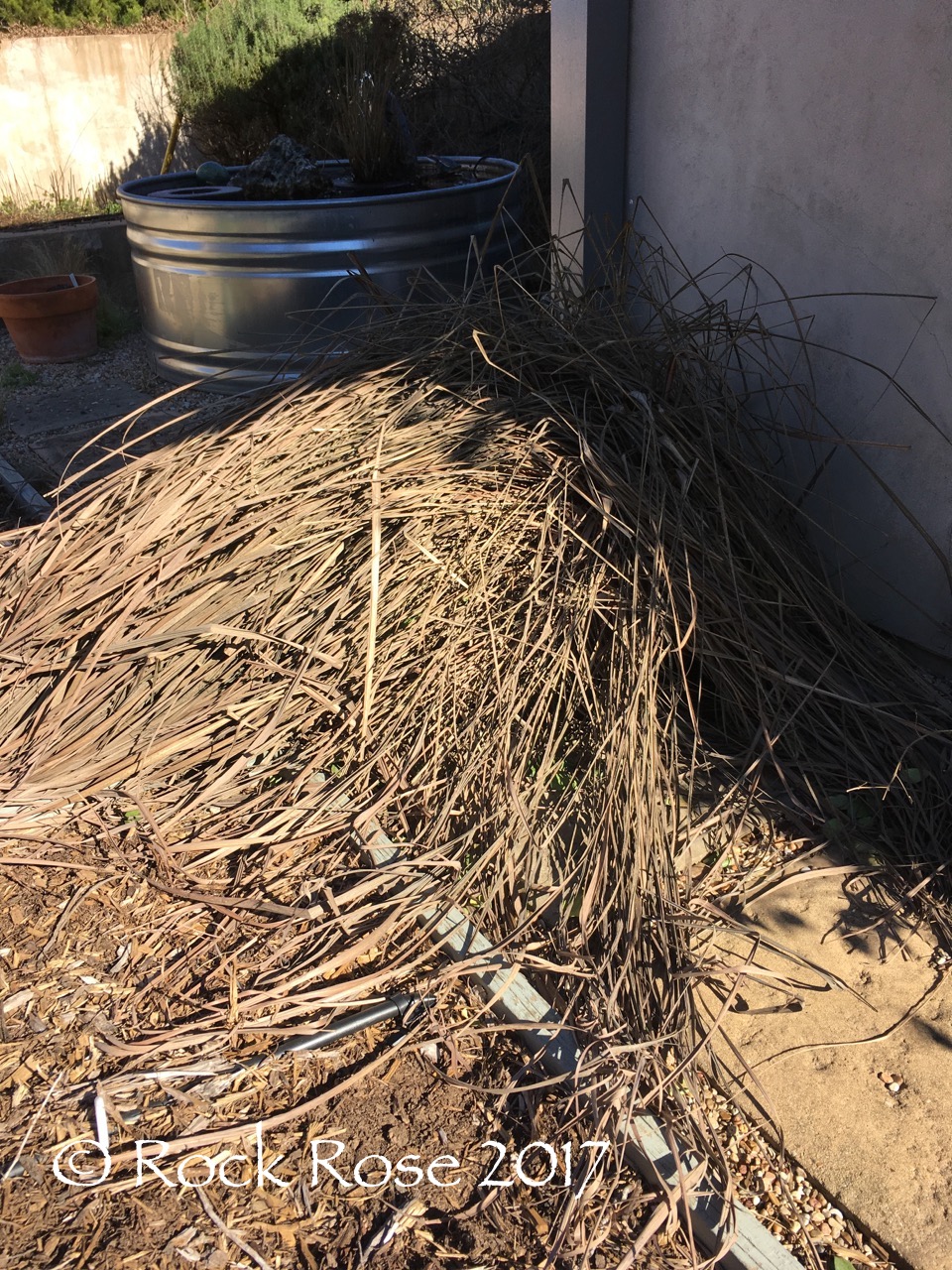
With summer-like temperatures this week I knew the next job was to cut back the grasses before they start growing. The ruby crystal grass, Melinis nerviglumis, gets the hedgehog cut. Starting the top center with a good pair of scissors and working around to create a round shape.


If there is less dead tissue I let it be. If the center is really dead and the plant a couple years old then I pull it out. The roots are extremely fibrous, as you can see below, so sometimes it is impossible to pull the whole plant out. Then I pull a small section at a time leaving behind the roots. There are always plenty of seedlings to take its place.


Next I will tackle the inland sea oats, Chasmathium latifolium,  although I think they have probably already dropped their seed heads. The good news in that corner of the garden is that the Mahonia, Mahonia aquifolium, is about to flower. This is the first year as the plant was moved two years ago from a too sunny spot where most of its leaves fried. So much happier here.


It like a breath of spring to see flowers. By the end of the week I think there will be more.
At the end this day I feel as though I have accomplished quite a lot. My wrists and hands are weary and sore. That comes of not always wearing gloves. And there is dinner to make!