My Blog List

Showing posts with label Saguaro. Show all posts

Sunday, June 8, 2025

THE WEIRDLY, WONDERFUL SAGUARO

The saguaros ( pronounced sa-war-o) are in bloom and they look fabulous. With their white-flowered bouquets held mainly on the crown they look positively bridal. How fortunate we are to look out every day at our Belle, who never fails to disappoint us through the month of April, May and into June. 


This spring we have eagerly watched her from the very first time we took out the binoculars looking for those tell-tale little pips to appear. You can barely make out the tiny protuberances close to the crown, but as the days go by and they start to swell you know the saguaro is going to bloom. 


We were concerned she might take a year off from blooming because she is not looking her best this year because of the drought. 3 years ago she was looking quite plump having filled with water during a decent rainy winter. 


The monsoon last year did not deliver and we have had no rain this winter. Barely half an inch since November. Saguaros are perfectly adapted to drought and immediately there is any rain falls on the ground they quickly send out tiny roots close to the surface to take up the moisture. They fill up their stems and the pleats expand to full size. I remarked recently how wavy and thin many the saguaros were looking so it will be interesting to see the change when and if we get rain. 


And yet they have bloomed heavily this year. Is this a stress bloom? 


Saguaro, Carnegiea ( Cereus)  gigantia, along with prickly pear are known as arboreal cactus, meaning they are tree-like with a center supporting structure similar to a tree. It is rare to find an old one standing with such a well defined skeleton. This one is on an old, abandoned nearby golf course.


They are usually found more like this.


A close up of the skeleton shows the trunk as being made up of a series of woody ribs.


Tree-like bark on a 150+ year old saguaro. 


The saguaro are primarily native to the Sonoran desert, the upper edges of the Colorado desert and a small area of California near to the Colorado river, growing between 600' and 3,600' It is an extremely important plant in the Sonoran desert ecology. Its fruits have been gathered by indigenous peoples to make conserves and drinks. The seeds, high in fat  used as food and more recently used as chicken feed. The ribs of the plant are used for building materials and as a tool for collecting the fruits. 

The saguaro is also important to many species of birds and bats who feed on the nectar within the flower.  The distribution of white winged dove and the elf owl almost completely mirrors that of the distribution of saguaro. The fruits, when the pods split open are a major food source of desert birds. Woodpeckers make holes in trunks which provides a nesting are for many birds. Even branches of the saguaro make a good nesting site for larger birds.

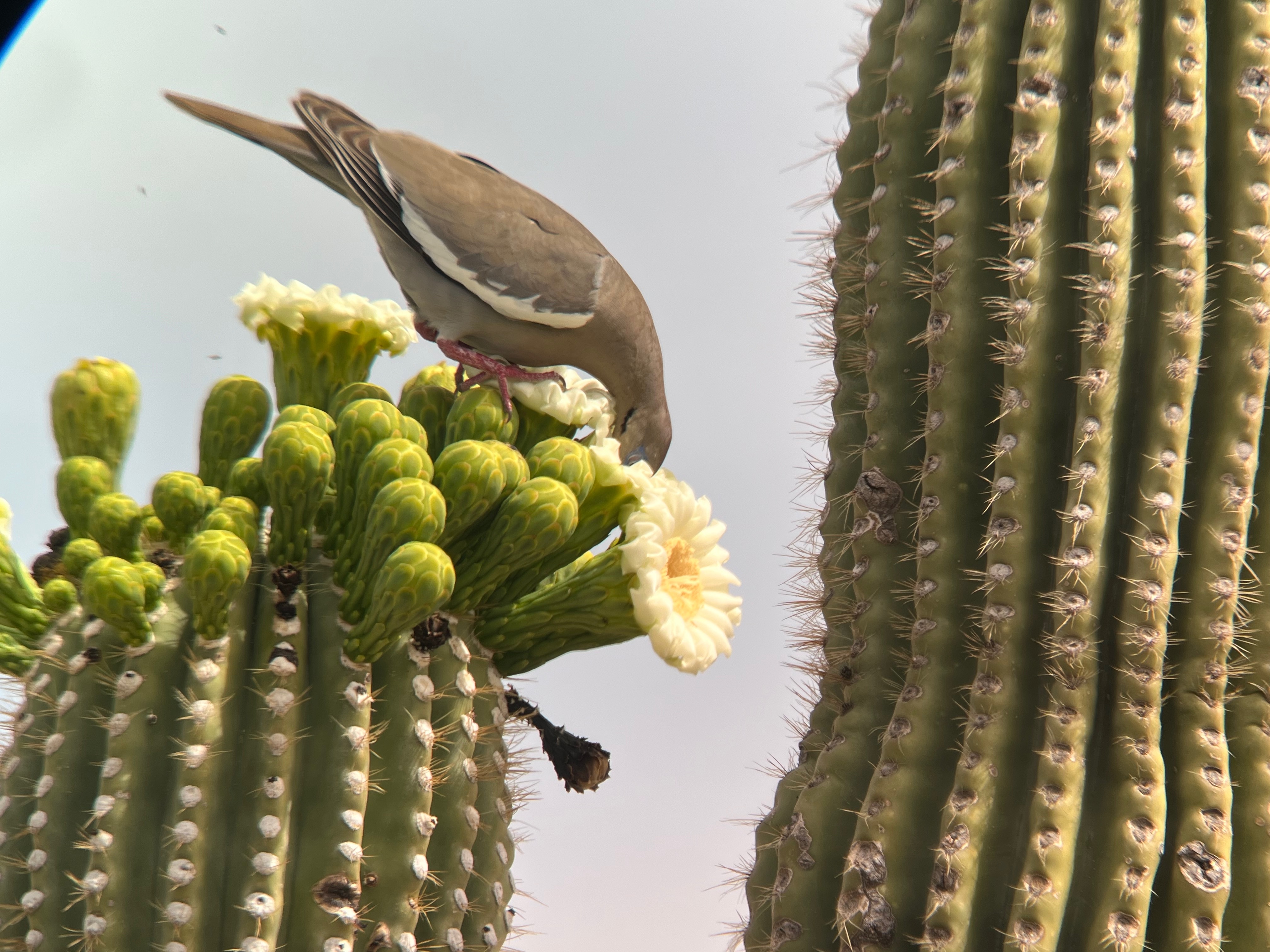
White winged dove sips nectar from the  open flower of the saguaro and doing double duty pollinating the flowers. 


But it is the woodpecker holes that are responsible for the rather curious structure known in the desert as the 'boot'. Often seen  on display at nature centers or in the visitor center at the Saguaro National Park and Sabino Canyon. When woodpeckers carve out their hole the tree protects itself by producing a rough bark-like material, completely walling off the intrusion. Following the death of the saguaro, after it has fallen to the ground and much of its substance decayed the boot will remain. We have been fortunate to find two of these among fallen saguaros. Once dried they make a curious artifact that maybe only a desert dweller will prize. A good intact boot might have been used by indigenous peoples as a water carrier or holder. 


A saguaro does not grow arms until it is at least 50+ years old. Many saguaros take on the regular candelabra shape but sometimes there is no rhyme nor reason to where the branches appear. Some are spectacularly wild in appearance. 


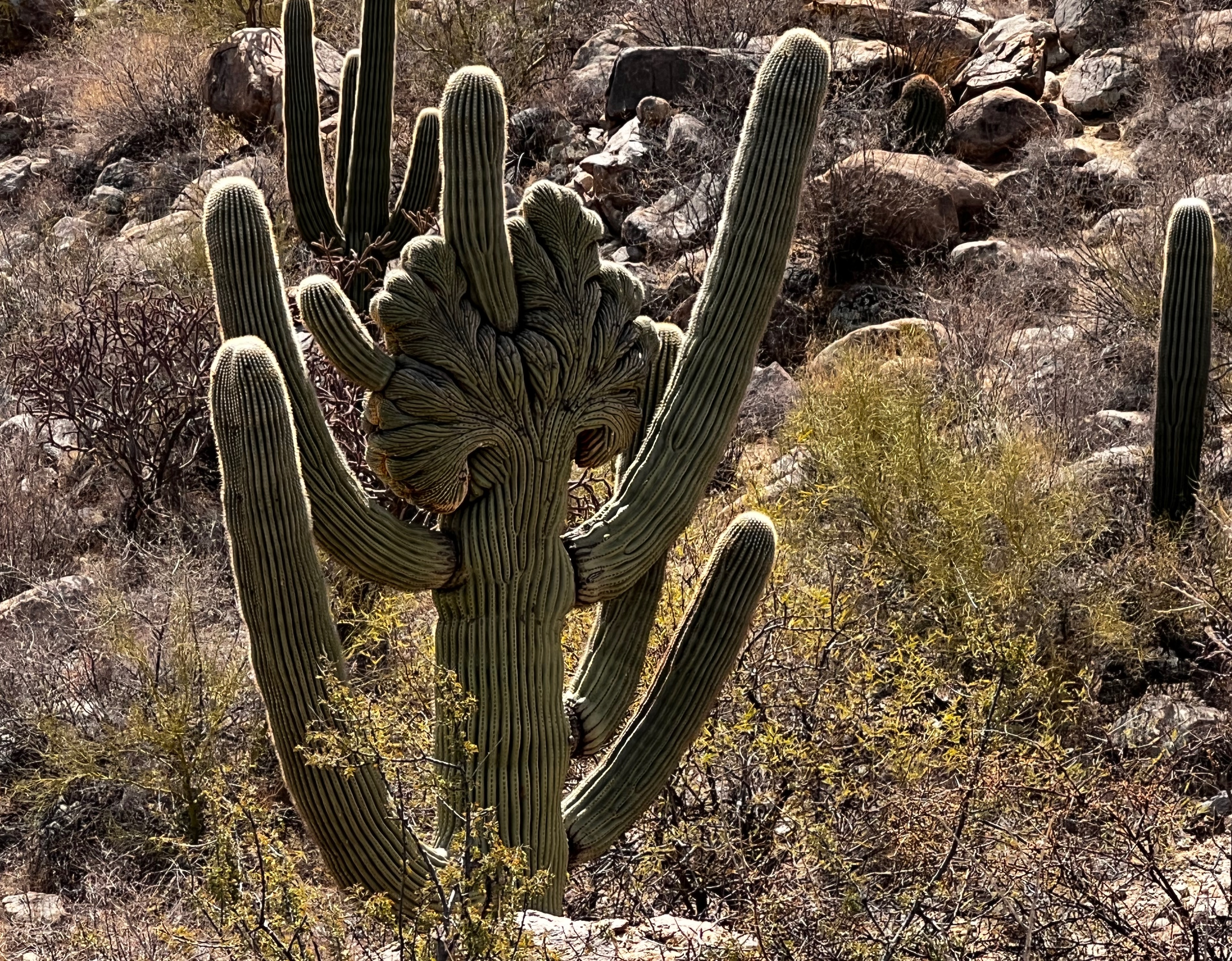
and then there are some spectacular cristate forms where the arm creates pleats on the end of the tip which grow upwards instead of in a cylindrical manner. No-one knows why this happens. It appears to be neither causes by virus or damage to the growth point. It is probably genetic. 


Then some appear to change their mind and start sending up a normal branch. 


Estimates show that 1 in every 100,000-200,000 will cristate. Where we live in Stone Canyon, in an area of 1400 acres with an estimated 14,000-25,000 saguaros, there are 22 crested saguaros. An extremely high ratio. Someone in our neighborhood has donned his snake boots and combed the area to record all the crested saguaros. He led us on a hike one day to share a few of his findings. We also like to leave the trail and follow up one of the many washes in search of the crested form. 

Now into June the height of flowering season is over. The fruits begin to swell and will provide the bird life with food through the hottest part of the summer. 


On the golf course while saguaro may benefit from some additional water they are also at the mercy of the errant golf ball. 

Global warming is causing the death of thousands of saguaros. The saguaro closes its pores during the day and opens them up at night for photosynthesis. Overly high nighttime temperatures, this last two summers  have meant their pores have failed to open. They have had to rely on stored water with the resulting loss of integrity of the stem. They will often drop and arm in the same way that trees will drop leaves in order to survive. We have been a little more fortunate that the desert floor because we are at 3000' and about 8 degrees cooler than Phoenix but even here the changing weather conditions have taken their toll on the saguaro count. Plus in order for saguaros to germinate and survive they need at least 3 good wet seasons. We are all hoping for a really good monsoon this year although the predicted extreme highs in the coming weeks have us all a little worried. 


Friday, June 30, 2023

A DESERT BUFFET

 We are very fortunate to have right off our patio a beautiful saguaro. Because she has such well-placed arms and very few flaws we have called her Belle. She tells me when to get up as her shape appears through my bedroom window, as daylight arrives.


                                                            Belle with the rising moon.


                                                            Belle with the rainbow
 

As you can see Belle likes to be included in any desert event especially with visitors.

                                                            Belle with two of our boys

Belle didn't bloom last year but she certainly made up for it this year with her abundance of blooms on every arm. Having no experience with how often and how profusely saguaro bloom I would have said that this was a bumper year. After all it was a super bloom of wildflowers in the spring so why not a super bloom of saguaros. The answer to that is, whereas wildflowers do need a good rainfall to trigger blooming saguaro store so much water in their trunks they do not need a good monsoon and wet winter to bloom. Yet every saguaro around was covered with blooms this year.

Of course, we missed Belle blooming, and all the other saguaros, because we were gone for 6 weeks from mid May. This was an earlier flowering one I saw before we left. As we departed I had just begun to see little pips at the very top. The flowers on the saguaro are ephemeral often opening in the evening and gone by the end of the next day. On our return flowering was over and the fruit had formed. They have a job to do making and ripening their fruits quickly before it gets too hot. The ripe fruits are called bahidaj. 


Within days of our return bright pink started to show as the fruits split open to expose the succulent cherry red flesh and thousands of black seeds. It is an open invitation for birds to feast.


Birds have been busy eating the flesh and seeds.


The Tohono O'odham(Desert people) who lived in the Sonoran desert for centuries harvest the fruit, as their ancestors did before them for hundreds of years. They pull the fruit using a dried saguaro rib with a small grease wood stick or catclaw attached to the top to form a hook. Each fruit is opened and the flesh and seeds collected. A small piece from the first fruit is rubbed over their heart to bless the fruit and the empty seed pod laid on the ground facing the sun. This is to ask for monsoon rains to come which will ensure the fruit for next year. Water is added to the pot of fruit and boiled down and strained to form a syrup which they enjoy during winter. The remaining pulp and seeds are dried and ground to use in cooking. 

As for our fruits we sit and watch as white-winged doves, goldfinches, cactus wrens, curve-billed thrashers, towhees and cardinals come to feast at the buffet. 


Saturday, November 13, 2021

WE HAVE A HOUSE IN THE DESERT

I have been pondering for days what to write about moving to a new house, in a new town with a new garden. For that is exactly what we, in our late 70s, are doing.  Lots of friends are calling us brave. Some say they will never leave the house they have. Did we have a choice? We had talked about it for years and then suddenly on the spur of the moment we called in a realtor. That set the whole thing in motion and before we knew it, with no decisions made about where we were going to go, we were out of the house we had lived in and the garden we had created over a 21 years time period.

                                                                     The sunken garden in Austin

Our original thoughts were to move to the Phoenix area and then driving back from there in April we spent a few days in Tucson. We fell in love with the area, the surrounding mountains and desert scenery, and decided that is where we would look for a new home. A house like this with a garden like this would be my dream house and garden. Of course, this one was not for sale.

It has not been easy. Over the last month we have put offers in on 3 houses, pulling out from each of them for various reasons. Surely it would be third time lucky. The house had everything. It had a Southwest exterior, a very modern interior and just enough garden for me. We offered sight unseen although our realtor did a video walk- through. Our offer was accepted and we made plans to attend the inspection. After seeing the property, and hearing some of the things in the inspection report we withdrew our offer. Thank goodness we had gone to the inspection. I suggest this is something everyone do and keep your eyes well open. Most of the times inspections bring up minor things which can easily be fixed but for us there were clear indications of a very poor build with poor contractors and the drainage issues that would have been incredibly costly to resolve. We felt relieved that we had not lost our earnest money.

On the rebound, we went to look at another house we had rejected from photographs because it just didn't have enough garden. My realtor told me that most houses that people buy will tick 7 out of 10 of the things they were looking for. Yes, I was aware that finding a 10 would be difficult having come from a 10 out of 10. I'm not sure where this one was on the scale but I believe it is well below 7. The biggest issues were the small amount of garden surrounding the house which left only a modest amount of gardening opportunity and the house was quite dark by my standards. The owners had had the windows tinted. I dreamed of having a white modern kitchen-this one was modern but darker than I had hoped for. We left for home and over the next few days David mentioned the house several times saying he thought we should buy it. He is not as fussy about the light and garden as I am. He was not happy living in the apartment and wanted to get on with his life. I had to think long and hard about whether I could be happy there. As a part of that I began to convince myself that I was being silly about the amount of gardening. After all my age was against me and we had already decided it was time to make a change in that direction. Desert gardening would not be quite so intensive and there were things I could do, some changes I could make to the plants already there. I have already come to love cactus and succulents and many of my potted plants would welcome being planted in the ground. David ascertained that the window tinting could be removed if we felt it necessary and maybe we would soon realize that we needed it. After all we have no first hand knowledge of the desert except for short summer forays to stay in Phoenix with our son. The good thing about this area is that it is slightly cooler than the desert level as it is at about 3000' That was definitely one of the attractions of the area even though it is subject to some frosts in the winter. We would have plenty of hiking opportunities including the Catalina Mountains and Mount Lemmon which is 9000' On a summer's day the temperature among the pines up there is 30° cooler than the desert floor.

Every house that we had placed an offer on had a view and whereas that had never been something on our list it now became important. To make up for the lack of garden behind our house there was a view with a towering saguaro on one side. We decided to put in an offer which we held firm on and they accepted. David flew out on Sunday and along with our son attended the inspection. All went well and save for a few small repairs the house had a clean bill of health. 

                                                                  The view

 The fence is interesting being made of what looks like corten steel. It is not something I have seen before but is very attractive and doesn't block the view. It continues around the house on three sides and should keep the javelinas out! There may be no deer in the area but there are certainly plenty of desert critters. I know pack rats can be a problem. Will they eat my plants I wonder? I am going to have a whole new garden experience. 


                                                       My first project will be the front elevation

My plan is to completely redo this area at the front of the house, removing the bushes along the side and the large agave. I will need to research the choice of plants I can use in this area, which has a westerly exposure. The last time we bought a resale was in 1981 in California when we ripped out all the paving, making new pathways and removing the snail infested dichondra. This should be a relatively easy job as the hardscape will stay. Because I had no thought in my mind that this would be the house we would buy I paid little attention to other areas of garden I might improve. It will be a complete surprise. We close on the house December 1st and expect to be in there before Christmas. Which reminds me of the Christmas balls we decorated our Austin agave with 2 years ago. When we lost them all I had no idea what I was going to do with them, now I know-at least for a little while!