My Blog List

Showing posts with label camas. Show all posts

Sunday, February 25, 2024

SURPRISE, SURPRISE

 I might have expected David to find something special for our 56th Wedding Anniversary, and he did. I walked into the guest bedroom and immediately spotted something new on the wall. A photograph, on canvas, that I had taken last summer while hiking in Idaho.  It is the elephant head, little red elephant, Pedicuaris groenlandica.


This sub-alpine plant blooms in mid summer and our timing for the hike was perfect. We had hiked the Norton-Big Lost Lakes loop many times. There are three sub-alpine lakes, Norton Lake, Big Lost Lake and Smoky Lake. It was at Smoky Lake where I wandered into the lakeside meadow filled with wildflowers  and where I found the plant. 


At first I thought it was an orchid  but then I saw the little heads and a light went on. I had seen it in my book, Idaho Mountain Wildflowers, A Scott Earle. It was the elephant head. Do you see his little face, two large ears and trunk? 

The location was just a described where other lovers of moist ground were blooming; the Explorer's gentian, Gentiana calycosa. Found between 9000'-10000' 


and the Elegant camas, or mountain death camas Anticlea elegansm. Also a lover of boggy ground and high places.


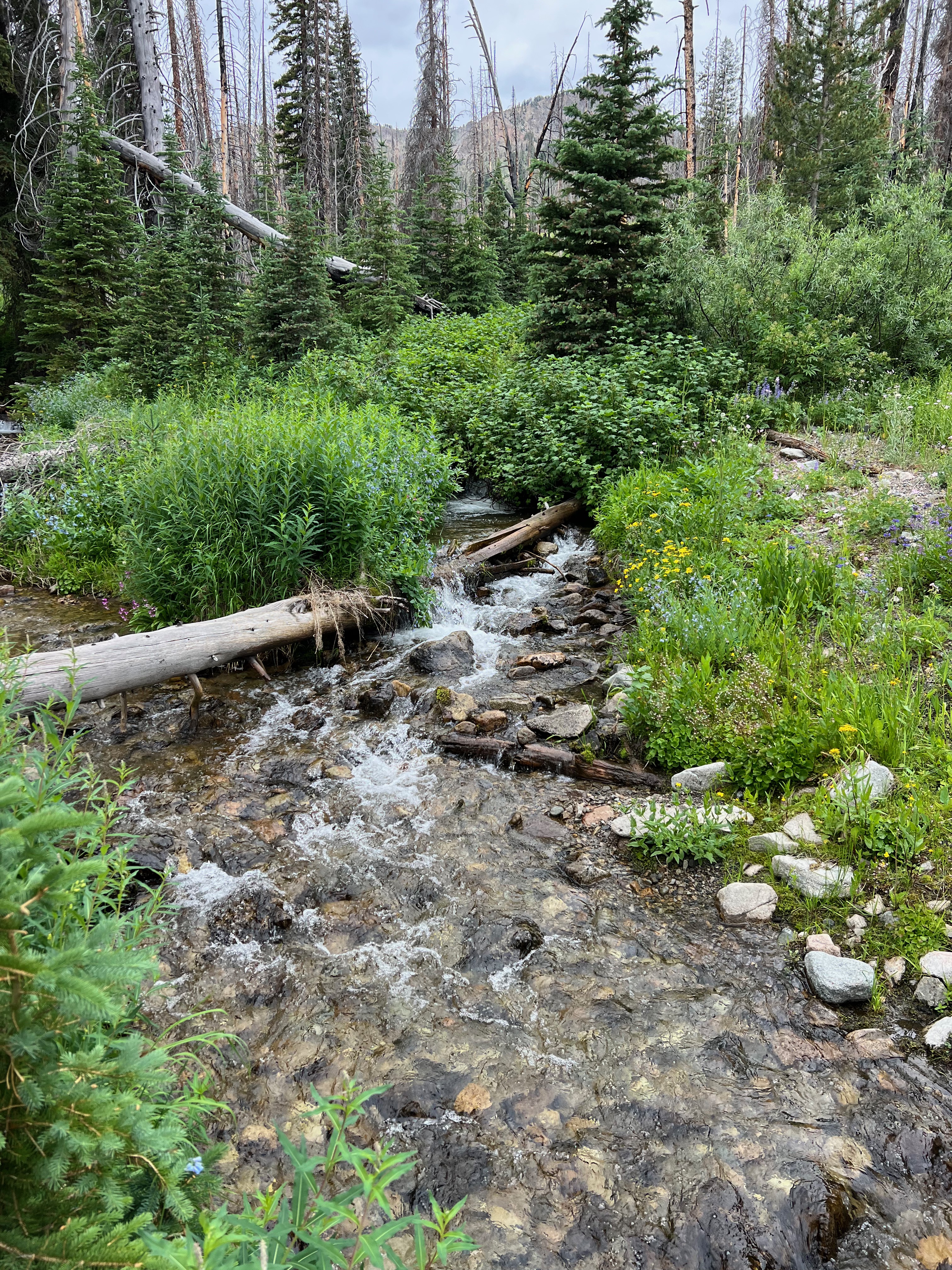
From the gorgeous flower-filled meadow the hike takes you down along side the creek which runs out of the lake. The sides filled with monkey flowers and all manner of stream side plants. It has to be one of my favorite hikes in Idaho for the wealth of wildflowers.


What a wonderful idea for an anniversary gift. Every time I walk into the room it will bring back memories of that wonderful hike and that wonderful find. We will be heading back there again this year and this time I will find the Steers head, Dicentra uniflora

It even got me blogging again!


Friday, August 4, 2023

A STUNNING DISPLAY OF YELLOW LUPINS

Sixteen miles north of Ketchum, Idaho, we turned onto Baker Rd. The road is a dirt road which travels about 10 miles up the valley, climbing 1000' to the trail heads for Baker Lake and Osberg Ridgeline Trail. We have hiked Baker many times but this time we were to take the Osberg Trail.

 The hillsides here were changed dramatically 10 years ago when a major forest fire swept though here burning much of the forest. It is hard to imagine a great trail climbing up through the burnt out trees but we were in for a surprise. 

It was a chance meeting with a couple who were summer volunteers at the Sawtooth Visitor Center. We had met them in Organpipe NM in February and as they told us they would be volunteering there this summer we were camping close by we popped in to see them. They told us about the fabulous stands of fireweed, Chamaenerion angustifolium, growing along the hillside. Fireweed is known as a pioneer plant, quickly colonizing areas of burnt or disturbed land. We couldn't miss out on the opportunity to see them.

The trail first dropped down to cross the creek where monkey flowers, Mimulus, lewisii, and Mountain shooting star, Dodecatheon, find their perfect niche.


 Elegant camas, Anticlea elegans

We then began a steady climb up through the forest. As usual I was stopping frequently to take photos. 


 Sticky geranium, Geranium viscosissimum, and Streambank wild hollyhock


Mountain dandelion, Agosteris

Lots of fireweed but only the odd one blooming. They are a few weeks away from blooming, their flowers only yet in tight bud, which surprised me. I had imagined a huge display of pink would greet us. Maybe further along.


It's hard to keep a good hiking pace going when you constantly stop to take a photo. It is not often I spot Monkshood, a plant with which I was so familiar in England. and along the edges of the trail penstemons. Some pale in color some bright purple.

 I will forever call them bluebonnets after living in Texas. Here I must call them lupins as they are much paler in color, sometimes verging on white with tinges of pink and yellow. 


White yarrow against a burnt tree stump. 


 All these wildflowers are familiar characters in the Sawtooth Mountains. 


Lewis's blue flax, Linum lewisii above.

 and phlox, Leptosiphone nuttallii.


 And the gorgeous white Mariposa lily, Calochortus eurycarpus. But the best display was yet to come as we spotted large swathes of yellow on the bare hillsides above.


 The lupins had kindly left open a narrow trail through which we could walk without disturbing their beauty.


Even David, and this is rare, took out his phone and began taking photos.


And here a white lupin alone among the yellow.

We were absolutely besotted with the spectacle before our eyes. How fortunate we were to have caught the display at its peak and on a perfect cloudy day. All the way down I was trying to come up with adjectives that would best describe the scene we had witnessed. Magnificent, spectacular, mind blowing, stunning? and then I remembered a little bit of British slang, I thought gobsmacking might just fit the bill. 

So it wasn't fireweed but lupins that were putting on a show. But there is no doubt that fireweed will have its turn in the coming weeks.