My Blog List

Showing posts with label sage.. Show all posts

Saturday, January 11, 2020

WINTER IN THE HERB GARDEN

Most days I go out into the herb garden to pick herbs for the kitchen. At this time of the year there is parsley, thyme, oregano, sage, the ever abundant garlic chives and rosemary, which are all good herbs for winter cooking.


Parsley has done a magnificent job of reseeding itself. It is even growing in the pathway cracks. You can never have too much parsley.


Oregano gets cut back several times a year to make sure it stays round and bushy with fresh leaves. Most of my kitchen uses are for dried oregano which I make from the fresh young leaves but I also use fresh oregano chopped with parsley and thyme in herbed polenta. A little goes a long way.

Dried oregano is wonderful when roasting butternut squash. Drizzle the cut side of the squash with olive oil and sprinkle with salt and a couple of pinches of the dried crushed oregano.
 

Sage also was trimmed back this winter so has plenty of fresh new growth. I love to use the fried leaves on top of risotto. This one is the common culinary sage, Salvia officinalis.


It has the added bonus of beautiful sprays of blue flowers in the spring.

S.officinalis flowers. Late March
This one is Salvia officinalis "Berggarten" which has the more rounded leaves. It can also be used in the kitchen although it has a stronger flavor. I use it mainly to add leaf interest to the garden.


I also have a very compact cultivar S. officinalis "minimus" which I have used at the front of the beds.


There is a small thyme bed at the base of the pillar planter. I try to grow a variety of thymes including lemon, variegated silver and German thyme.I shall have to replenish some of these thymes this spring. They get very woody with age.


Alyssum brings some welcome color into the winter garden as well as a sweet fragrance on warm sunny days.


Rosemary is just beginning to flower. For some unknown reason we lost most of our rosemary during the summer. I need to take cuttings this year to replace them.


This week was a tough week for me. Blood work, infusions, met with radiologist, a nuclear injection, followed by surgery on Thursday to remove the cancer and the sentinel nodes. Things are looking good and the preliminary biopsy on the lymph nodes showed the cancer had not spread. I await confirmation of this and the findings on the biopsy of the lumpectomy. Clear margins mean I will move on to the next phase-30 days of radiation! I started the weekend with a much lighter heart and really ready to get back out in the garden. It is perfect timing for the spring garden.

Sunday, April 12, 2015

A PERFECT DAY FOR VISITORS

When visitors come to my garden at this time of year I really like them to come early in the morning. That's because there is no shade and when the sun beats down the flowers tend to sulk. So when I learnt my visitors this week would arrive around 2:30pm I was worried for how they would find it. I need not have worried because the sun never came out and made for a really nice showing.

Sunken garden with bluebonnets, blackfoots, skullcaps.
California poppies, bluebonnets

Hinckley's columbine, corn poppies, 
 The Zephirine drouhin growing in the corner grew from a root of a potted rose that was in the corner. She is the most spectacular of the 3 Zephs. I have and has never been watered or fertilized. I let her do her own thing which is exactly what a rose likes.

Zephirine drouhin
 My visitors got to see both my Lady Banks roses. I bought a cutting of the  white Lady Banks rose, Rosa banksiae x banksiae from the Rose Museum in Tombstone, Arizona. The original rose was brought there in 1885 and was a cutting from the original rose brought from China by a Sir Joseph Banks expedition in 1805.
Lady Banks' rose
My yellow rose in the front garden was at its peak this week and what a show with her clusters of tiny double yellow flowers.


Another big bloomer and at its peak this week was the cross vine, Bignonia capreolata, tangerine beauty. Would you know there was a greenhouse hiding under here? This is the very same vine that I cut back down to the ground 2 years ago. As I pulled out a root from a standing position I fell backwards and ended up being unable to move for 3 days. I have to cut it back again this year but a cut-back is all it is getting.

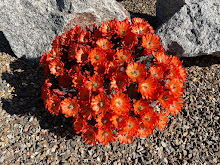
Everyone got to see the Claret cup cactus. This clump had 20 blooms this year.


And in the herb garden the culinary sage was a mass of purple blooms.


I had a few ladies question me about the tiny plant pots on top of the bamboo canes. Do you know why they are there? So I don't poke my eye out!


Yes, my visitors couldn't have come at a more perfect time.


Sunday, February 17, 2013

SAGE

Old book stores are always on the must list of shops to visit when we are traveling. Look what I came across in the old book and print store, when recently on a visit to Florida.


It is a page from Elizabeth Gordon's, Flower Children, which I plan to frame and put on the kitchen wall. Now I don't approve of books being taken apart to sell the individual pages but the price tells me this is not from a first edition. I would have loved to have had this book when I was a child. In fact I would be happy to have it now. Do you have this book?
I'll bet there are a few granddads out their nodding their heads in agreement!
But what of my sages, and there are many. I have four different kinds planted in my herb potager.


Here is the culinary sage, Salvia officinalis, with the narrow leaves. This is the one I use most often in cooking. Next to it is the Salvia officinalis 'Berggarten'. I like this sage more for its ornamental features. The leaves are more rounded and it tends to for a nice low clump.


This sage has a similar flavor and can also be used for cooking.


This sage might look similar to the Salvia officinalis but its aromatics are quite different. It is Salvia clevelandii. I adore the smell of this sage and cannot resist brushing the foliage as I pass by. It isn't easy to grow here as it prefers the dry chaparral areas of Southern California and the Baja. I grow it in the well drained soil of the herb garden where it receives afternoon shade.

In the same location is the Salvia officinalis 'triclor'. I have seen beautiful full mounding plants in other gardens but seem to struggle to keep this one alive through the summer. Still it is worth trying to achieve such a look. Maybe this year.


The sages are subject to damage from spider mites so if you are going to grow them keep a sharp lookout for those leaves turning a dusty color. With the dry conditions we have been experiencing this winter it won't be long before the spider mites arrive.

Friday, October 26, 2012

IT'S THAT THYME

Ah! the first days of Autumn and the promise of cooler days to come. Well, not quite yet for central Texas, at least not in the afternoons. But the mornings are cooler and we are starting to think of the fall garden which is really our best gardening season. I would say that rarely a day goes by that I don't go out into the garden to pick herbs to use in cooking. Now is the time to do a little work in the herb beds.

Herb garden
This is my main herb growing area. I have sage, oregano, thymes of all varieties, garlic and regular chives, basil, lemon balm and our Texas tarragon substitute, Mexican mint marigold, Tagetes lucida. Also a few herbs I don't eat but which are technically herbs, santolina and society garlic. Parsley is missing this year because the plants, being biennial, flowered and died and the new seedlings I put in the ground didn't make it. I just bought a replacement parsley plant.

Silver and lemon thyme
One of the things about herbs is that they, like all the other plants at this time of the year, start to send their nutrients back down into the roots. The oils in the tissue become more concentrated which means they freeze at much lower temperatures. We are fortunate to have most of our herbs throughout the winter. If we cut back now then new leaves will form and they will be full of flavor and will also make better cuttings. I have never been much of a pruner but I do prune my herbs constantly. Oregano gets a constant pruning and keeps flushing out new leaves.

Thai basil 
When basil seeds between the pavers I let it stay. This one I cut back a few weeks ago so that it would bush out. It will die during a freeze but the seeds that fall in the cracks will germinate when the weather warms up in the summer.

Mexican mint marigold.
Mexican mint marigold, Tagetes lucida, dies back in the winter but is sure to return to the garden either
as the old plant or as a re-seeder. This one has also seeded in the pathway and will be trimmed to form a rounded bush. It will stay for a few years until it becomes so large as to overstay its welcome.

Culinary or common sage Salvia officinalis
The sage gets a frequent chopping because recently I have discovered how wonderful the leaves are when fried until they are crisp. Wonderful over cheese ravioli. I prefer to use this common sage but at a pinch will use the Salvia Berggarten, below.

Berggarten sage
This sage makes an attractive plant in the rock garden but it does have a tendency to travel so in the spring I remove the newly formed plant and plant somewhere else.

variegated chile pequin
Last year this variegated form of chile pequin showed up. I am happy to see it appear once again. The mockingbirds are welcome to the chiles. In fact they have been having a feast moving from chile pequin to lantana, to beauty berry. I often wonder if it is the same one that comes back year after year because at night he sets up camp in the Lady Bank's rose in the front garden. He has a tough job policing all the gardens but he does manage to chase the other birds away. He may have met his match the other day. The roadrunner came into the garden. I know he's looking for my lizards!


Friday, November 19, 2010

A VISIT FROM OLD JACK

I always pay attention when the weather man says there is going to be a freeze in the hill country but not in the city. We are only 7 miles from downtown, but frequently the coldest spot in the area. So last night I covered and brought in and picked.

I picked all the peppers, squash and tomatoes.

Glad I did.

Some plants, like this Berggarten sage, don't mind the dusting of ice crystals.

But the basil is a different matter. By tonight the leaves on this plant will have turned black.

The bees will no longer want to visit the flowers on this Thai basil plant, which I photographed yesterday afternoon. This weekend I will have my work cut out pulling out all the damaged plants. Winter is finally on the way.