When we moved to the Sonoran Desert in December I had one thing on my mind. Now I can grow all those wonderful cactus and succulents in the ground. Not so fast. We live on the edge of the desert and when I walk out there I notice that there are a limited number of cactus growing and no agave. Only saguaros, fishhook, mammillaria and cholla. There are, however, lots of small trees and bushes and it is these trees that make a nursery for the cactus to start their life.
The fruits of the cactus are eaten by the birds, the birds perch in the trees, and their poop along with seeds falls to the ground beneath the tree. Even young plants need a little shade. To garden successfully here you need trees.
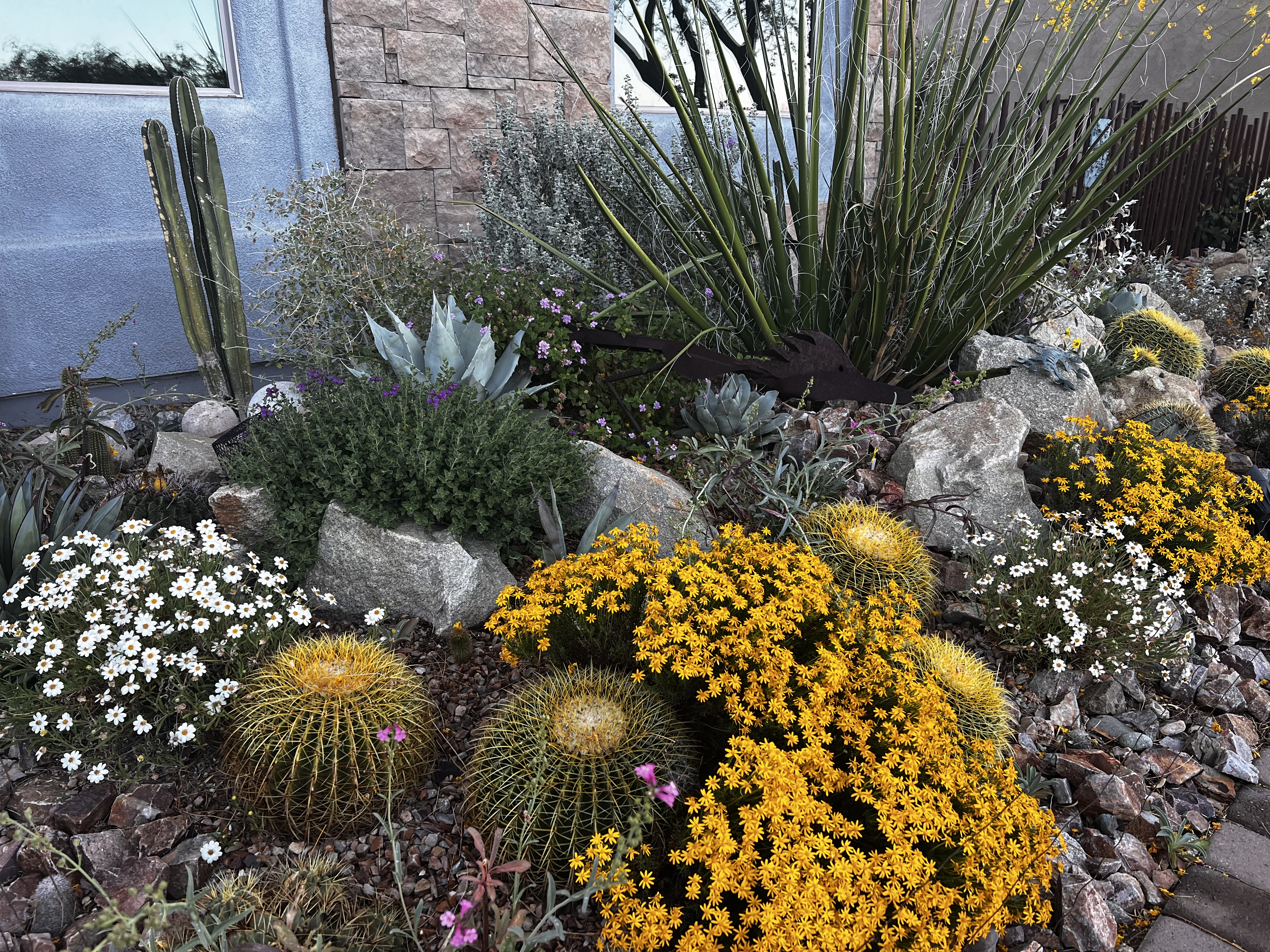
I have 3 good sized trees which anchor 3 corners of our small garden. The first is the ironwood, Olneya tesota. It is evergreen with pinnately compound leaves which give filtered light. It has pea like flowers although this one is not putting on the kind of show I am seeing out there in some neighborhoods. It does drop its small leaves which have to be brushed out of the cactus that are growing beneath it.
I am gradually extending the planting area by removing some bushes that had been pruned so poorly they would never recover. I am thinking of putting my lemon tree in the ground here. I think it would benefit from a little filtered shade. I have added rocks and a few skullcaps and blackfoot daisies.A drip irrigation system is in place.
I have also added a couple of penstemon and plan to try some wildflowers beneath the tree next spring. I threw a packet of scarlet flax in January and they have done quite well. The soil is desert soil and appears not to have been amended which is perfect for wildflowers.
Unfortunately the tree doesn't offer any shade for us but a patio set and umbrella close by allow us to enjoy the tree, the view of the desert, the hummingbird feeder and the birds that come to drink at the bird bath. We have been eating most meals out here and I do feel as though I am on vacation. The fact that daylight arrives early before 5 am means our days have shifted somewhat. That and the coolness of the desert mornings. At least for the moment.
Our second large tree at the opposite end of the patio is the Texas Olive, Cordia boissieri,
What a show it has given us this spring. We removed all the bushes that were growing beneath this one, added a few agave and covered the area with rocks. The olive tree does have a few disadvantages. It holds onto its leaves a long time so it is a constant drop for several months in the spring. It makes fruits which are attractive to wildlife including javelinas. For that reason I am in the process of pulling them off before they mature. Plus it is extra work for the tree to mature the fruit. It seems we got more than our fair share of this tree as there are at least 6 more in the front of the house our house being the only house in the neighborhood which has them. A desert willow would be nice or a fruiting pomegranate.
The tree has a long bloom season and is visited by hummingbirds. I am pruning most of the ones out front to be more like trees.
It would be hard to compete with the Desert museum Palo verde tree for blooms. It has been spectacular for several weeks but of course now all the flowers are down and there is work to be done. They say this tree is less messy than the more common one! To stand under here in the warm sun is to hear the buzz from hundreds of bees. There is a lot of honey being made somewhere. I haven't even begun to work under the tree yet. That will have to wait until the monsoon rains arrive.
This tree is in the front right of the house on the edge of the driveway. For a tree that was only planted 5 years ago it is enormous and of some concern for the future. Its great value right now is to provide wonderful filtered shade for much of the day as the sun moves around and overhead.
There are several other small trees which have been pruned into bushes. Two Texas mountain laurels which I am trying to prune up to be trees. I am learning which plants bloom on old wood and which on new wood. The mountain laurel I know will be making next year's flowers now so there will be no pruning except to shape up the tree. Judging by the lack of seed pods these trees were never allowed to bloom. It was when I was pruning the mountain laurel in the side garden that I had my close encounter with the Gila monster. A good reason to prune up all the bushes.

I began to notice a number of my agave bleaching out. At first I was concerned that they had been visited by the agave weevil but then wondered if it might be the incredibly strong sunlight. That used to happen to my A. ovatifolia in Austin during the summer and I would often give it some relief by shading it. So I experimented by cutting pieces of 70% shade cloth and laying it over the plants. Within a few days they gained back some of their original color. It looks as though the covers will stay on until our dry summer is replaced by our wet summer when the monsoon rains arrive.
Newly planted agave get the shade treatment during the summer.
Many nurseries have markings on their cactus to show which direction to plant. As many are field grown it assures the plant will be placed according the direction it had been growing in the ground.
My large collection of potted cactus and succulents have had a hard time finding their rightful place in the garden. The problem is the seasonal movement of the sun. While I was aware of such changes in Austin it is strikingly evident as the back of our house backs directly to the east. Clear blue skies mean a fierce sun. Most of my plants were getting scorched.

In December the north side of the house was almost completely shaded by the house. We purchased several masonry blocks and a plank of wood to raise the plants off the ground. That didn't stop the rats from nibbling off the flowers on several cactus. As spring progressed sun began to creep around the corner so we moved the structure around to the east side with some shade from the ironwood tree. That was not enough so we moved the plants under the patio. Pack rats came around and ate down all the succulent plants. The heat has become too much for some of the plants and I have moved them into the house. What next? We will be traveling for several weeks so I am hoping a good watering before I go will suffice. We really have no idea the challenges summer will bring.