My Blog List

Showing posts with label Blue gilia. Show all posts

Tuesday, April 6, 2021

THE 4 O'CLOCK BLUES

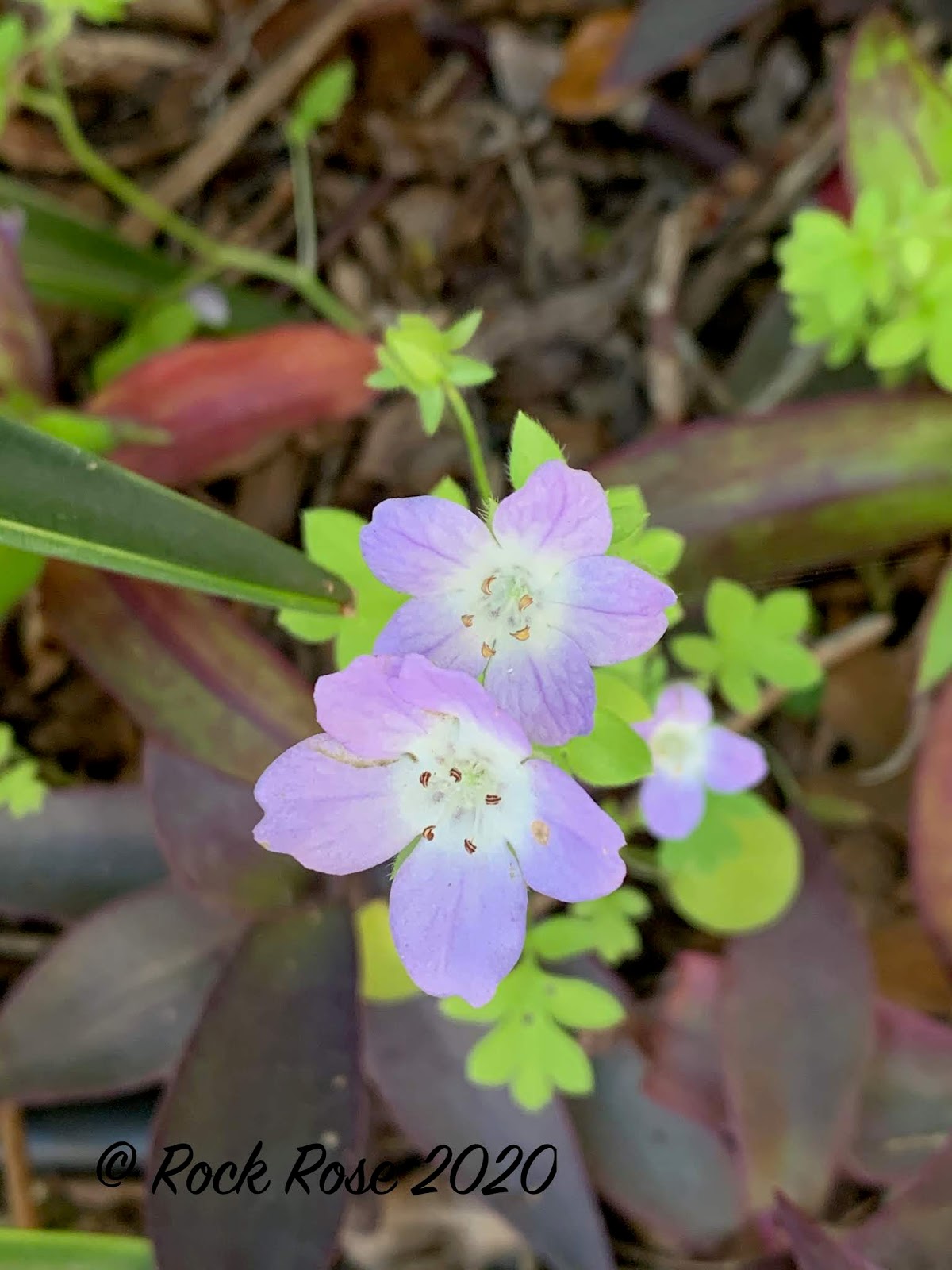
Just as many flowers are fading in the afternoon sun these two little native beauties are just beginning to open. The first is Blue gilia, Gilia rigidula, a member of the phlox family.

I rescued this plant many years ago from the lot next door to us and so glad I did. This delicate plant has spread modestly but seems happy in the place where it is planted. Above the retaining wall in the dry, rocky, shaded, filtered light with no irrigation needed. It is the perfect location because the wall is about 4 feet high so the plant can be enjoyed without stooping. 

I have never seen the plant for sale in the nurseries.

The second afternoon bloomer is the Blue-eyed grass. Sisyrinchium angustifolium. Mine occurred naturally although I have seen hybridized varieties in the nurseries. 


 It loves a sunny location and spreads very easily from seed forming good-sized clumps. It is perfect in a rock garden setting enjoying the spaces between the pavers.

And who could pass up the chance to share more photos of the bluebonnets, Lupinus texensis, that grow both inside and outside my walled garden. Faithful as ever in their appearance every spring and filling the warm afternoon air with a sweet fragrance.


These are the kind of blues a gardener loves.

Friday, March 27, 2020

A FIRST EVERY DAY

You walk around the garden and spot the first bloom on the ....... I'm sure you could easily fill in the blank. Surely every gardener shares this experience. And spring is the time when every day seems to bring that 'first flower' experience.
Here are some of my first flower experiences this week and most of them natives.

First I saw the bud then overnight a flower on the Ladyfinger cactus, Echinocereus pentalophus. These flowers last for at least 3 days and usually arrive in succession.


The blue gilia,  Giliastrum rigidulum. More commonly found in west Texas but I found one small patch growing on my lot and was successful in moving it to a place where I can see it and enjoy its beauty. It is almost at eye level so cannot be missed. It usually opens in the afternoon. Do you see the weevil? Not the dreaded agave weevil though.


Blue-eyed grass, Sisyrinchium angustifolium, seeds among the gravel and between the pavers. As does the Engelmanns daisy which has seeded alongside.


the pink evening primrose, Oenothera speciosa. Oh! Yes, it will run wild but that' fine. A quick pull here and there will keep it under control.


Baby blue-eyes, Nemophila phacelioides. I only have a little patch of shade and that's where they grow.

Everyone else may be able to grow the spiderwort, Tradescantia sp with ease. For me it is a rare event.


What's that I see through the shower window? It's the first blooms of the Anacacho orchid tree, Bauhinea lunarioides.


And the cross vine, Bignonia capreolata. has found tis way 20' from the mother plant.


And I have a mental block on what this plant is called. Help me out will you, please? Update. Thanks to Lyn for the id of Pavonia lasiopetala if I remember the species name correctly.


And wood sorrel, Oxalis.sp. For some it is a weed, for me I am happy to have just a few flowers in this shady corner.


Oh! How I love that morning, spring-time stroll around the garden. There will be more tomorrow, I'm sure.

Saturday, February 15, 2020

YOUR GARDEN STYLE

I have met people who never look back. Maybe it is a function of age but I think mine was triggered by a box of photographs I inherited and by a sudden interest in genealogy. And, as a life-long gardener, I began to realize my younger self might have influenced my style of gardening.


From a very young age I loved wildflowers. You see me here with a bunch of straw at hay making time. At a similar age, on holiday in Devon, I wanted to pick the big white bindweed flowers growing along hedgerow. My father chastised me telling me I must leave them for others to enjoy! Bindweed? I ask you !! And there was the time my parents thought of taking over the lease on a pub in the countryside and I was thrilled to bits because the bank alongside the pub was full of primroses. It never happened... but I know I would have been thoroughly happy living where I could walk the country lanes. Making daisy chains, searching for four leaf clovers, marveling at the tiny flowers of scarlet pimpernel, the cowslips, buttercups, sucking the honey from the purple clover flowers, celandines and marsh marigolds growing in the brook and the seed heads of shepherd's purse. I have plenty of that on my septic field right now.  It was always about the native flowers growing around me.

Fast forward to arriving in Texas in early February1968, just in time for the wildflower season. This time no one telling me not to pick the flowers!


And I am still that lover of wild flowers today and it is reflected in my gardening style. It is a free-for-all cottage garden style.

The sunken garden May 2019
It's why I love the little puffball flowers of Barbara's buttons, Marshallia caespitosa.

April 2019
 The common corn poppy, Papaver rhoeas,  flowering in profusion.

Sunken graden 2019
 And weedy Love-in-a-Mist, Nigella sp.
And a summer flower of the English hedge row. Foxglove Digitalis purpurea,. I have tried growing them from seed with only modest success so I now buy them in 4" pots,early in the year, potting up as they grow larger until I can finally move them into their larger pots. I think they are going to bloom earlier this year as I see a flower spike starting. What color will they be? I have no idea although they say you can tell by looking at the underside of the leaf. If that is the case they will be all white.

February 2020
Front courtyard April 2019

And the delicate blooms of Blue Gilia Gilia rigidula

March 2019

And of course our state flower the Texas bluebonnet.


And it can all become a little unruly after a while and that is why this year some changes are in order.

Herb garden May 2019
 I must endeavor to keep the pathways clear of all but the smallest and tidiest of plants. And that means alyssum, narrow leaf zinnias and possibly the daisy fleabane. Possibly the odd tidy grass and if there is space enough to walk by, the Verbena bonariensis. And I might just allow a few coreopsis and blanket flowers. This is not going to be easy.
For the moment I am excited to look at photographs from last year's spring and to know what is soon to come.

Saturday, March 30, 2019

THE SLOW SUCCESSION

This week we hosted a large group of visitors from the Garden Clubs of America. As usual there had been fretting for several weeks about how the garden was going to look, what would be blooming and what wouldn't. You know the gardeners' cry, "You should have been here last week, or even this morning." I do try hard not to say that any more. Timing seems to be all important when a garden tour is on the books. Constant checking the weather report and temperatures. If only I could say, "come over today" That may be the only kind of garden tour in our future.
Of course the bluebonnets were blooming beautifully as well as the mallows, freesias, iris,


Globe mallow


and lots of other unusual things like kale and cabbage....gone to flower in our strange Spring, but left for the pollinators.

Flowers of Napa cabbage
Lovely clumps of fragrant narcissus 'cheerfulness'


and clumps of native wild alliums looking at home between the rocks.


And Texas yellow star, Lindheimera texana, which has established itself in a dry corner of the garden.


And because this was an afternoon tour even the Gilia rigidula was on show. Growing on top of the retaining wall between the secret garden and the English garden where it is much easier to appreciate than if it was growing low down on the ground. You are not likely to see this for sale unless in a specialist nursery. I found mine on the property and moved it to this spot.


But days later some of these plants are fading and others making an appearance. The warm sun this week and the claret cup cactus, Echinocereus triglochidiatus started to bloom.


And another round of the ladyfinger cactus, Echinocereus pentalophus.


and more and more blooms opening every day on the Lady Banks rose , Rosa banksia 'lutea'


And last evening as I strolled around the garden, I noticed the blue eyed grass,  Sisyrinchium was blooming. My Monday visitors missed seeing these.


I am now asking myself if my next garden visitors will see them. Will they last another 8 days. But of course there will be something else in bloom. The poppies and penstemons for sure and maybe the mallows will keep going for another week. The skullcaps and blackfoot daisies should be coming into their own. Yes. Spring and early summer are a succession of plants that bloom, fade and are replaced by others, so what am I fretting about? Just my nature.

Wednesday, March 23, 2016

WILDFLOWER WEDNESDAY: BLUE GILIA

It's Wildflower Wednesday and I'm joining Gail at  Clay and Limestone to post about a little native growing in my garden.
It might seem strange to be posting about this delicate bloomer today, with our famous Texas bluebonnet putting on such a big show. However, Blue gilia, Gilia rigidula, this pretty diminutive Texas wildflower is one of my spring favorites.


It isn't a plant you will find in your local nursery, in fact I have never seen it outside of my own garden although I am sure it is to be found in the Hill Country and further west. You can see how delicate is its foliage, easily trampled by unwary feet. But above that foliage a bright blue star shaped flower.


It took a beating from the hail last year so the patch isn't quite as large as in previous years but it seeds quite readily in the right kind of soil. It prefers dry, chalky soil and gravel.


This genus was named after the 18th Century Spanish botanist, Felipe Luis Gil. Gilia rigidula is native to Central, west Texas and New Mexico but there are other species of this wildflower to be found in other parts of the USA.

Sunday, May 10, 2015

NURTURING TINY TREASURES

I've always preferred the tiny flowers to large showy blooms. I have memories of my childhood lying in the grass and looking for scarlet pimpernels. I didn't know then that one day I would have them in my own garden and consider them a weed. But why I wonder, they are pretty little flowers when seen up close.

Scarlet pimpernel, Anagallis arvensis.
When I received a prize at the age of 11, in my first year in high school, it was natural for me to spend the money( it had to be at the local book store) on a wild flower book and I chose The Observers Book of Wild Flowers. I still have the book.


I am still a lover of tiny flowers. These sedums, with their starry flowers found a perfect niche in this broken rock. I purposefully left the gap when the rock broke as it was being brought into the garden.


Sedum potosinum, forms a neat mat of evergreen leaves which burst into bloom in the spring. It is easily propagated by breaking off a small piece and tucking into the soil.


Left unchecked it will spread to cover the ground but can be easily controlled.


Thymes also work well between pavers their roots protected by the stones.


 These plants flower at ground level but tiny flowers may go unnoticed unless brought to eye level and one way to do this is plant on top of a retaining wall.


Several years ago I found this little native blue gilia, Gilia rigidula, growing under some cedar trees. I transplanted it to this area where it has spread modestly over the years. It bloomed prolifically a few weeks ago and will bloom again on and off through the rest of the season.


I have not seen this plant at nurseries or even at the Wildflower Center, maybe due to its fragility. 
A few bluebonnets bloomed here this year due to the more open nature of the area after the loss of some Spanish oak trees.
And what a lovely surprise to see a bloom stalk on my grandfather's pipe, Callisia fragrans.


The flowers are so complicated I'm not sure if it is compound and whether they are petals, sepals or tepals.


And who can forget the little flowers on the Mammilaria cactus. When I spotted these bright little flowers on my thumb cactus they were barely visible hanging from the fireplace hearth.


 I moved it up onto a ledge where its little flowers could be admired.


Do you have tiny treasures in your garden? If not it may just be that they are there but you haven't noticed them.