My Blog List

Showing posts with label columbine. Show all posts

Tuesday, April 27, 2021

SPRING IN THE SUNKEN GARDEN

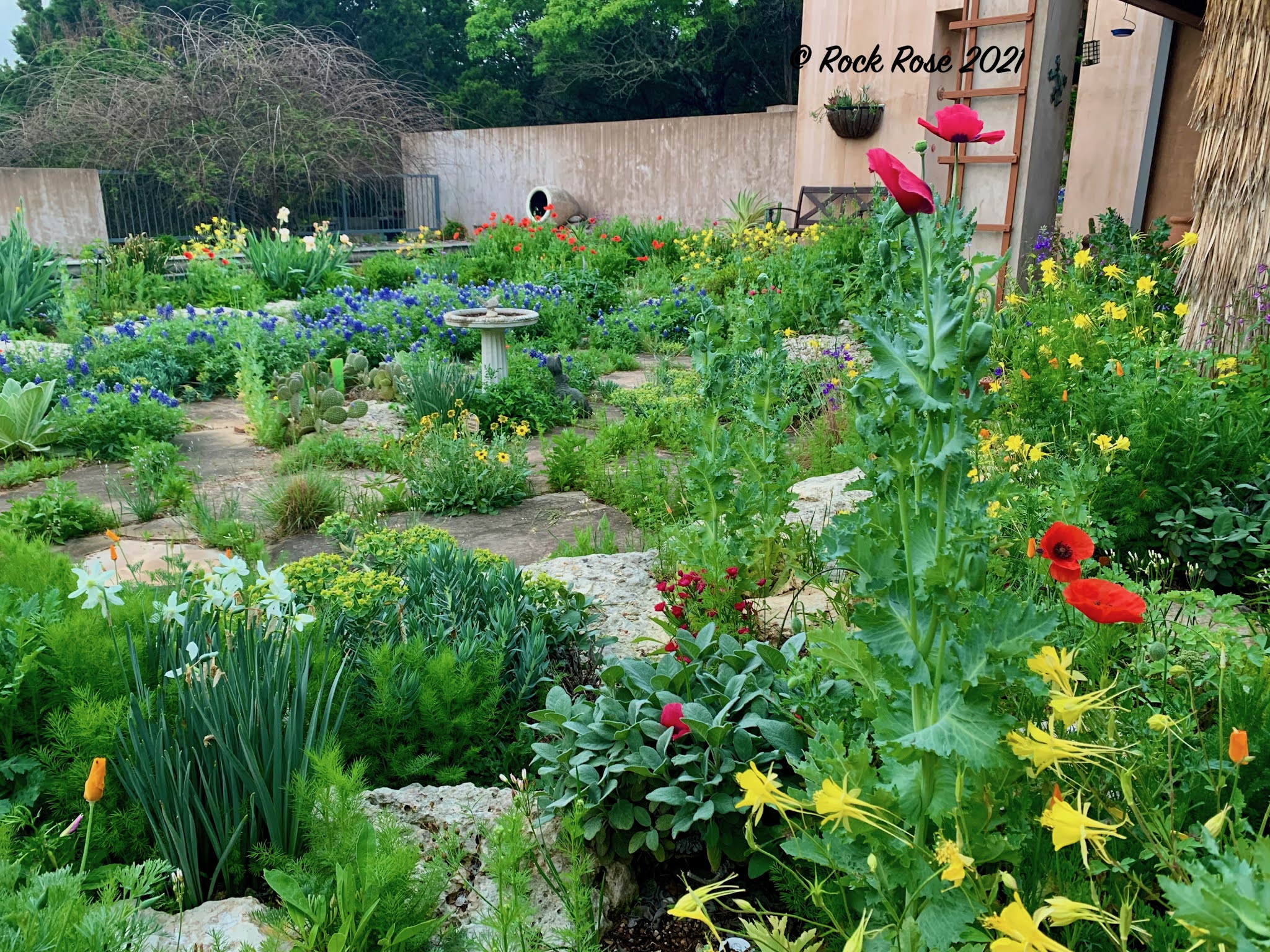
 The area between the house and the pool was a blank canvas and perfect to create a sunken garden. The inspiration was partly inspired by the many sunken gardens I have visited in England, my grandfather's garden where I spent my teenage years and the sunken courtyard at the Lady Bird Johnson Wildflower Center. Many of the rocks dug up during the building of the house were saved in order to create a foundation wall around the sunken area. The floor is Arizona sandstone over decomposed granite. I'm sure the builder was happy not to have to cart those rocks away. Nature has done much of the planting and I am happy for that although it does create considerable work keeping it under control. But, both David and I delight in all the blooms that appear-as if from nowhere. The scene changes from week to week and from year to year. Spring is the most floriferous time.
The only step down is along the front and even here it requires some agility as a Gulf Coast penstemon, Penstemon tennuis, has seeded right in the middle of the two stones. How could I possibly pull it when it was so happy there. I love this penstemon but it is prone to root aphids, placed there by ants who farm its honeydew. They are not easy to control and will kill the plant.

A few plants have been with me since the beginning and one is the chocolate daisy, Berlandiera lyrata, 

Compact in the early weeks it does eventually become rather rangy. It has only seeded in one other place and I suspect this is because I usually cut it back part way through the season and the new seed heads may not have time to mature. 

Mullein, may be considered a weed by many but I love its beautiful form over the winter before sending up a tall flower spike with yellow flowers. It is also a favorite of the bees. Many may seed but only a few will be chosen. This was a lucky one on the lower level.


In early spring bluebonnets can really take over and I'm afraid this year I have let rather too many and some of the plants growing beneath have suffered. A single bluebonnet plant can spread to cover 3' and is better suited to a meadow setting.


Hinckley's yellow columbine. Here there and everywhere as usual.


 It is always interesting to watch how plants grow and move. A large cluster of bee balm was gradually evicted by this yellow iris, so that now there are only a few plants left. Time for the iris to be divided and passed along nd maybe the bee balm will move back in.


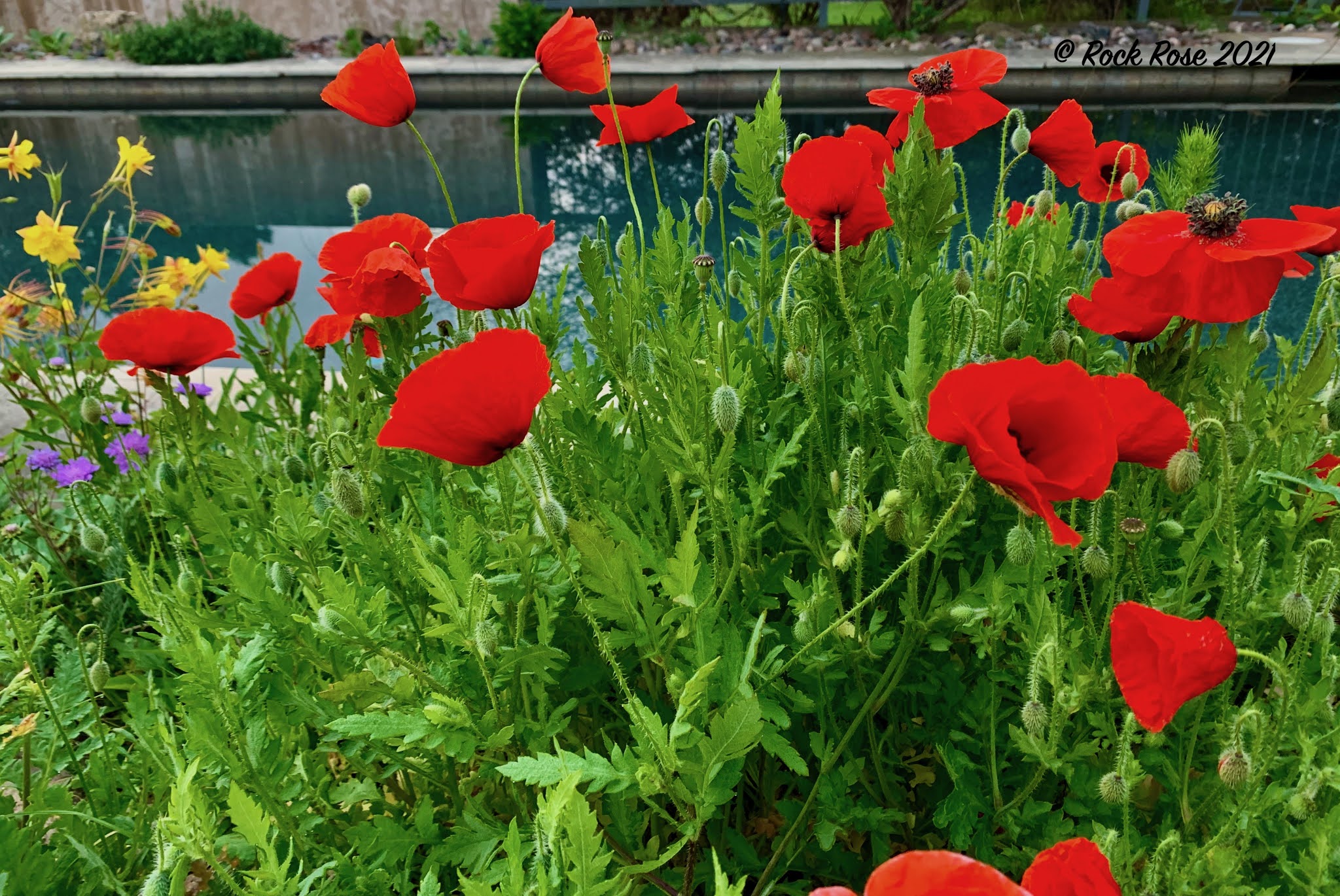
 I always let the corn poppies grow wherever they wish. Easy to pull out and something will always take their place later.
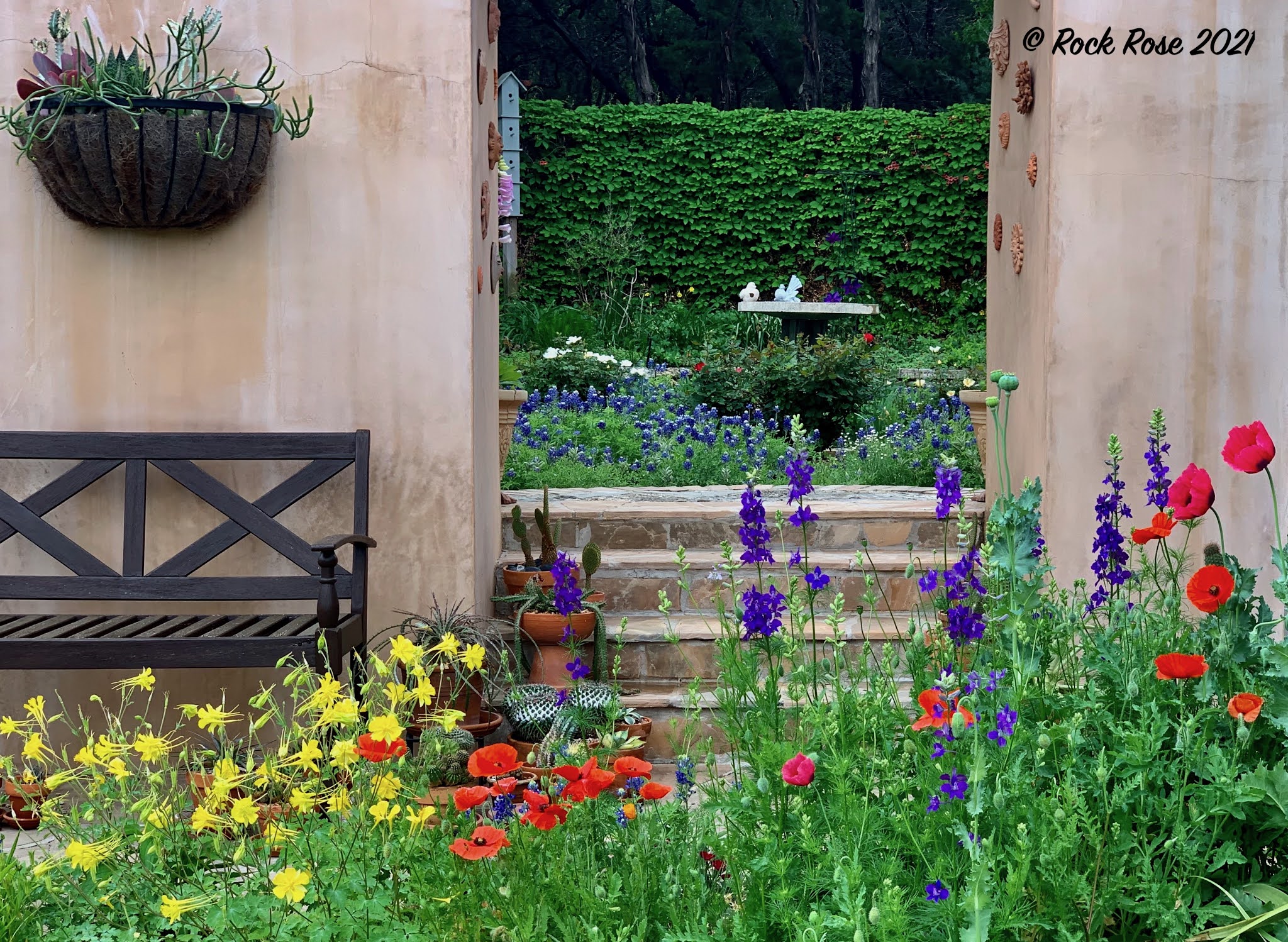
One of my favorite views is standing in the sunken garden and looking up to the Sun and Moon Archway. A mix of columbine, larkspur and poppies.
 

The gopher plant, Euphorbia rigida, has flowered and gone to seed. Some of the longer leaves have been removed to leave a small cluster of seed heads for seed saving. Nigella hides the leaves of the faded daffodils above the  mealy blue sage and larkspur.
 

Late April and the wine cups begin to bloom and spread, and spread and spread! Frequent trims will keep them in order. 

There will be a few plants missing this year and they will be missed. Two beautiful Pride of Barbados were lost to the freeze. The seed had appeared from nowhere and we had several years of their summer blooms. There is however, a very small one growing between two of the ledgestones and possibly in a more favorable place. 


It's time to get out there and remove some of the more boisterous residents in the sunken garden.

Tuesday, May 2, 2017

CELEBRATE NATIONAL WILDFLOWER WEEK, May 1-7

Do you have wildflowers growing in your garden? I do. Let's see what is blooming out there this week as we celebrate National Wildflower Week.

I'll begin with Colorado Venus' looking-glass, Triodanis coloradoƫnsis. (A)What a lovely name.


And where did it come from because I have never seen it before? It came inside a hole in a rock I brought into the garden when I redid the dry creek along the garage wall.


The plant is annual so I shall watch carefully for the seed pods ripening. I would like to have more next year.
A final blooming of the lace cactus, Echinocereus reichenbachii.(P) Even after the blooms die it remains a tidy addition in the rock-scape.


And the blousy Engelmann's daisy, Engelmannia peristenia, (P) opening with new flowers every day from a winter rosette of leaves.


The pathways in the vegetable garden are crowded with blanket flowers, Giallardia pulchella. (A) Goldfinches feast on their seeds but always leave plenty to bloom next year.


And Mexican bush sage, Salvia leucantha,(P) blooming months ahead of schedule this year. Will it bloom again in the fall as the hummingbirds begin their long winter flight to SouthAmerica?


The trailing wine cup, Callirhoƫ involucrata, (P) spilling over the dry-stone wall. Always everyone's favorite when they visit the Wildflower Center.


The flowers on the Texas prickly pear may only last for a day but they may leave behind some nice fruits. These fruits, call tuna, ripen to a burgundy red and can be used to make jelly.


Wooly stemodia, Stemodia lanata, (P) makes a good ground cover and is deer resistant.


It has tiny blue flowers.


Our native Lantana, Lantana horrida (P) is also deer resistant and blooms through the hottest months of the year with little water.


Purple skullcap,  Scutellaria wrightii,(P)  can be pruned into a tidy clump and blooms all summer.


Echinacea, Echinacea purpurea, (P) a summer bloomer and another favorite of the birds when it goes to seed.


The Blackfoot daisy, Melapodium leucanthum, (P) another deer proof summer bloomer.


The columbines are among the earliest of spring flowering plants. here the Hinckley's yellow columbine, Aquilegia hinkleyana, (P).


and the more delicate smaller flowered Aquilegia canadensis,(P)


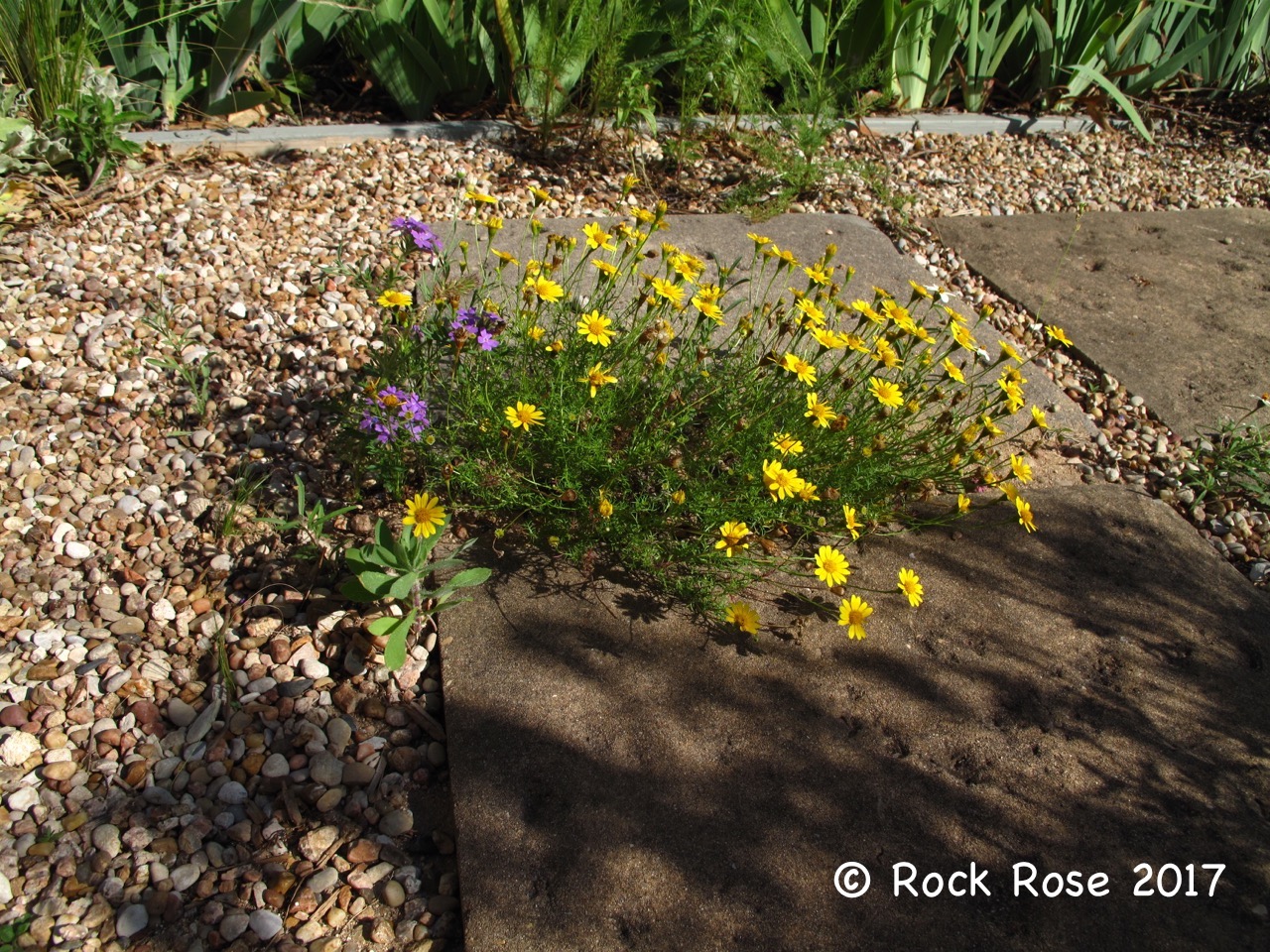
Damianita, Chrysactinia mexicana,(A)is both drought and deer tolerant but does best when given occasional waterings.


All these plants are blooming in my west Austin, rocky landscape, with minimum watering.

If you would like to learn more about wildflowers for you area you can get information on the Ladybird Johnson Wildflower Center website. There are all kinds of programs going on this week in Celebration of National Wildflower week.

Tuesday, March 29, 2016

WHY I LIKE ROCKS

It's easy for me to like rocks- I have plenty of them. It makes sense to use what you have and with terrain like mine rock gardens are certainly the answer. There is little soil and creating raised areas is the only way.
In the front courtyard area it's a colorful time in the spring.


Among my favorites are the square bud primrose, Calylophus berlandieri, and the blackfoot daisy,Melampodium leucanthum.
 

This year we only have a few bluebonnets which is probably a good thing as one plant can cover an area 3'x3'


The first of the Claret cup cactus, Echinocereus triglochidiatus, buds opened today. I have three small clumps but not quite so many flowers this year. It isn't easy to find these native to Texas cactus but I would love to have more. I'm not the only one to love them. The ants have been particularly annoying this year, mounding up the soil around them. I had to take serious measures.


There is even a double take on this area. The reflection in the dining room window.


At this time of the year there is less color in the raised bed on the other side of the path. A few columbines and the mallow under the arching branches of the Lady Banks' Rose. Later there will be day lilies on the upper tier.


This is the area we removed damaged plants from last year. I added a few rocks along the dry creek and the pot. For the time being it will hold and Agave weberi 'Arizona star'


Although there is a good display of bluebonnets outside the walls it is not as prolific as in prior years due to the loss of last years bluebonnets to hail. ( Will I ever stop talking about that hail damage? Probably not as the damage is far reaching). Thank goodness for nature always leaving a few behind in case of such happenings and for garden friends who share their seeds.


Around the side of the house there are only a few in the pathway that was completely filled last year. I think I like it better this way. So much easier to walk without trampling. I wonder whether the large Agave weberi will live for another year or will the agave snout weevils found in this area last year have found a new host?


In the sunken garden more native plants. Skullcaps, erigeron daisies, chocolate daisies and the fading seeds heads of the gopher plant.


Our spring is about one month early this year but at least the temperatures have moderated. Let's keep it that way for a few more weeks.

Monday, June 15, 2015

GARDEN BLOGGERS' BLOOM DAY . JUNE 2015

Rainy skies are once again hanging over central Texas on this bloom day. Our recent strange weather pattern is making for some anomalies in the garden. Flowers that would normally bloom in the fall are blooming now and some that finish their bloom cycle in the spring are booming again. These are the flowers blooming in my Central Texas garden at the moment but photographed before the rain started.


Standing cypress, Ipomopsis rubra, is a biennial and reseeded in my garden this year. Although they grow in dry sandy soil it would seem that the unusual amounts of rain we had in May are responsible. The hummingbirds love this plant which is usually around in the fall when the hummingbird migration begins. A June appearance is very early for my garden.

And how unusual to see another crop of California poppies. I am thinking that many were beaten to the ground by the hail we had in April and were determined to bloom.


This is the first blooming of these rescue, nameless day lilies I bought several years ago. This year I moved them into a better spot and they like it there. I am thrilled with their rich, deep color.


They are growing in front of a spineless prickly pear cactus. Is that scale I see on some of the pads. This is a common problem with prickly pear and easy to miss.
Another hummingbird favorite is the Dicliptera suberecta, sometimes called the hummingbird plant. But be careful about using a name like that because there are quite a few plants with this common name.


Another late bloomer is the columbine, Aquilegia chrysantha.


Scabiosa was another rescue plant that has continued to perform for several months. Battered by hail it has come back again.


An Agapanthas  I nursed back to flowering this year, along with the foxgloves.


Small flowers often go unnoticed but how could you miss these. The plant on our outside table sends out these long shoots which stretch right across the table in all directions. Then produces  the tiniest of flowers.


 Many thanks to Carol at May Dreams Gardens for bringing you here. I hope everyone is enjoying a wonderful bloom day in their garden.