My Blog List

Showing posts with label plumeria. Show all posts

Sunday, June 13, 2021

WHO WOULD WIN

I often ask myself when I am out in the garden, "Who would win if I just let the garden take care of itself." Would it become a mono-culture or would every year bring a different winner. I think maybe the latter and I say this because I often say, "It's been a really great year for such and such a plant" I think mother nature gives every plant a chance.

This year the cone flowers, Echinacea purpurea, would take the prize.

They were busy preparing for this year last year when they set hundreds of seeds-which, of course, I allowed to remain.  And I am not really sorry because I think they just look marvelous. I wish they would last a little longer although I suppose the idea is to let something else take center stage. They have even muscloed their way into the English garden. Of course as often happens they are right by the stepping stone instead of in the more open spaces.

And who among this group would take over. Mulleins, gopher plants, blanket flowers or wine cups. Each one of them would vie for top dog position in the garden.

Naturally the weather plays a big part on what will bloom successfully in each season. We had a relatively dry winter  and then all hell let lose with one of the deepest freezes, in fact the deepest freeze I have experienced while living in Texas. It wiped out a number of plants, in particular the larger ones. Maybe some of them were ready to go. I had a gorgeous Pride of Barbados that had volunteered in the small strip between sunken garden and pool. Over a period of 5 years, despite dying back to the ground every winter, its girth increased with every year. 


It was really too big for the space but that deep freeze did something I couldn't bring myself to do and that was remove it. But the good news is it left behind some offspring. One a little further along and one in the middle of the sunken garden. Maybe they will be too young to flower this year but I am excited that in the future they will. And in a prior year one grew between two rocks on the other side of the sunken garden. Maybe it was sheltered between those rocks and that was why it survived or maybe the covering of ice and snow helped insulate it. It does seem to be the smaller plants that survived.


Let's look at Monarda 'Peter's Purple' Is there a more successful spreader than this plant? It isn't that it seeds but that it sends its underground runners out in all directions to make new plants. One year it managed to successfully invade the yellow iris. How charming, I thought, when the iris finish here comes the bee balm. That is until the iris failed to bloom the following year, completely crowded out by bee balm. Then the bee balm decided to move out and this year the iris bloomed with a mighty vigor chasing the bee balm in its relentless spread.The bee balm is so adored by all manner of flying insects and hummingbirds too that I don;t have much of a problem letting it go on its merry way. 

My beautiful Philippine violets, Barleria cristata,  took a big hit. The two along the edge of the pathway(volunteers) in the Sunken garden are slowly making their way back but the big one has split itself into four plants leaving a gaping hole in the center. It is a perfect place to add a pot and it so happens that last winter an arm broke off the plumeria, which I potted up and is growing. 

 One plant that is not permitted in the back gardens is the Engelmann daisy, Engelmannia peristenia. I can remember when I bought 3 small 4" plants at the Wildflower Center sale. "Oh! you'll have plenty of those" someone said. Now I have more than even I could have imagined and I constantly pull them out-not an easy propositions as they send down a big successful taproot. That is why they do so well in dry gardens . But they are beautiful when in bloom in the early morning. By afternoon their yellow petals have curve under. They do give the garden a somewhat wild appearance.

 And that was before the American beautyberry, Callicarpa americana, and the liatris, Liatris spicata.  started to move in. I think the latter might be the most freely seeding plant in Texas. At least in my garden. It does add gorgeous color in the later months of the year. 

But of course I am not going to let any one of these plants the chance to take over. I leave that to the next gardener who lives here.


Wednesday, October 7, 2020

GOODBYE SUMMER, HELLO FALL

At last! Temperatures are moderating and fall is on the way. It is not just the gardener who is celebrating the advent of the new season but the garden plants are too.

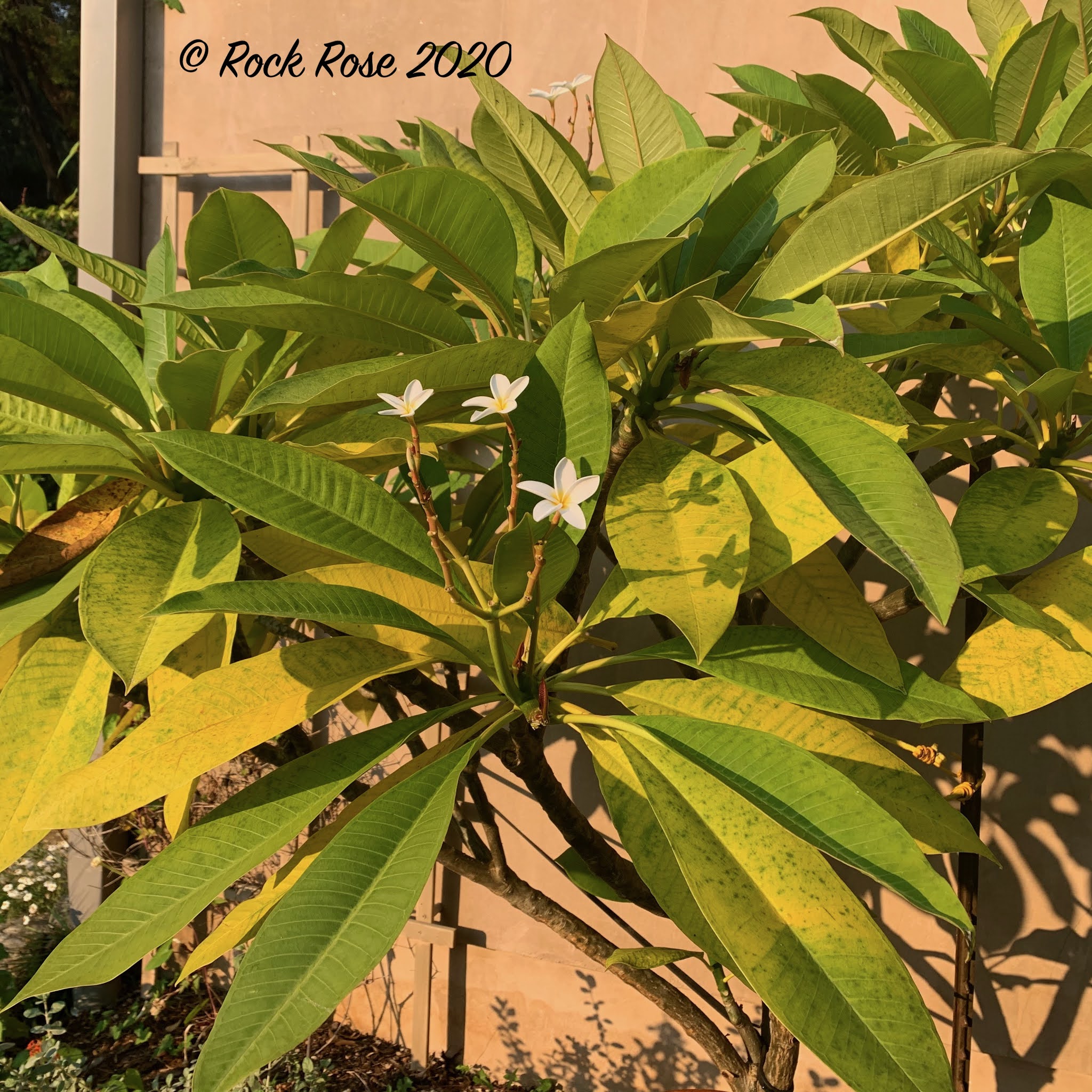
All that is except the plumeria. A few nights of temperatures in the 50s and it is already beginning to cry "I'm out of here" Shortening days mean the plant starts to cut back on food production, the leaves turn yellow as the supply of food is reduced. The leaf forms  an abscission layer and eventually falls off. 

 Every day new leaves fall and soon it will be time to move the plant into the garage. During the winter it will receive no water and will go completely dormant. Because the plants are so large I plan to do some pruning before I move them which will make the job a lot easier. 


Flower colors become more vibrant as with the native orange lantana, Lantana horrida. And the award winning David Austin rose, Rosa 'Molineaux', blooming again for the first time in months. This shrub rose is a repeat bloomer and named for David Austin's favorite soccer team. 


There are lots of flowers that are repeat blooming such as the Verbena, Verbena bonariensis whose lanky growth was cut back to the ground a few weeks ago.


Another repeat bloomer is the soft leaf yucca, Yucca recurvifolia, which the deer have failed to find. 


It has become quite a free-for-all of flowering plants in the sunken garden with Perovskia, white Salvia greggii, mealy blue sage, Salvia farinacea, frost weed Verbesina virginica, and Mexican bush sage, Salvia leucantha.


 But there are some plants that bloom only in the fall. They wait patiently for the shorter days before they begin to bloom. Notable in my garden is the Philippine violet, Barleria cristata. 


It blooms best when given plenty of sun and is one of my favorite fall bloomers because it attracts neither bugs nor disease. It dies to the ground during a normal winter and shifts a little from its original positions as the center often becomes very woody and dies out. 

And finally the bush clover, Lespedeza thunbergii, waits patiently to bloom in the partly shaded border of the English garden. 


There are lots of short day plants which will bloom over the next few months including chrysanthemums, poinsettias, Christmas cactus. Make sure the later receives at least 15 hours of darkness from now on. 

Happy Fall Y'all.

Sunday, June 14, 2020

EARLY ONE MORNING , JUST AS THE SUN WAS RISING

When I went out into the garden this morning I couldn't help but think of an old English folk song which begins  "Early one morning, just as the sun was rising" I learnt this song when I was very young and have come to learn that it was one of the most popular songs for young women in service to sing in the 18th century. The maids were mourning their lovers who were going off to war.There was no maid singing in the valley below but there was a song in my heart over the beauty of the morning.

Surely for every gardener this is the best time of the day.  The cool morning air, plants recovered from the prior day's heat, everything looking its best. Ready to face another hot Texas day.


I always go first to look at the sunken garden because the sun will make its first appearance here and with no shade it gets hot very quickly. It is amazing how differently the sun strikes the garden in the summer.


In winter the sun rises well to the left of the potting shed but now it is coming up over the greenhouse. The gap in the trees means that it eneter the garden just than bit sooner.


Soon it will flood the patio giving the cactus and succulents a few hours of sun which they seem to prefer.


Up the steps into the English Garden and a quick look back over my shoulder.. The sun is coming up over the trees.


 On summer mornings we can no longer eat breakfast on the dining patio. It was one of the reasons we created a patio dining area in the English garden where the high wall shades the garden until about 9am. As this was one of the last gardens we made it gave us the opportunity to watch the sun at various times of the year and help with the design of what we wanted from the garden. We shall be having breakfast here this morning and every morning as long as it is not raining.


It is a very green and serene area, looking towards the house, with just a few blooms of the Mandevilla vine which survived our mild winter. In the other corner the plumeria which spent the winter bare root in the garage. Flower buds are just beginning to develop.


 Of course having created a theme with the sun and moon archway I can't really complain about the sun. Time to get breakfast on the table.

Thursday, May 24, 2018

A GARDENER MUST DO THIS EVERY DAY

Every morning, before the heat of the day sets in, I take a stroll around the gardens. Most times I am carrying a cup of tea and not infrequently I put it down, pull out my phone and take a  photograph of a particularly pleasing view. Early morning is the best time which captures plants refreshed by cooler night temperatures.

View from the vegetable garden over the wall into the pool garden
The Monarda 'Peters Purple' and the tall spires of mullein, in the sunken garden, just looked perfect this morning.
I have no control over where the mullein place themselves. In fact I tried to transplant one this year and it didn't like the place I put it. But these just add a little drama to the back corner of the garden. Gone is the sadness of losing the Rosa Zepherine drouhin rose that once sprawled over the wall.


This spring we removed much of the planting along the back of the pool and replaced it with Mexican river rocks. I only left a few grasses and echinacea. On my morning walk I made a note that the wall looks a little stark. Maybe a taller grass behind the rock or maybe a mullein will plant itself there. I am definitely much happier to have the rock rather than the bare soil and I like the variety of colors in the rock.


Just a few more weeks to enjoy all 'this' in the herb garden. Soon it will be time to remove the parsley and cilantro gone to seed, and the seed heads of nigella.


And the Confederate rose agave clump, on the center pedestal, with the mother plant sending up a flower stalk. I will probably have to redo the whole pot because the mother plant is going to leave a big hole. Will the youngsters stay in there or will I have to make a completely new planting?


Two things took me by surprise in the herb garden. The flowering of the dill. Rather like parsley it makes a pretty umbel worthy of a place in any garden.


And an unusual variation in the color of Coreopsis tinctoria. Among all the yellows a beautiful burgundy. Now if that isn't a reason not to pull out all those seedlings. You never know which will be a surprise. I must remember to collect seeds.


I like this clump of self-sown echinacea in the English garden. If only it bloomed all summer!


But I need to remove this pink self sown lantana nearby. It just gets too big and requires too many cut backs during the summer.


This walk around the garden is not just a pleasure but an important part of noting changes you need to make. What works and what doesn't. Now on with the day's work


Sunday, July 23, 2017

THE DESICCATED GARDEN

A friend went away for a couple of weeks leaving her indoor cat with only an occasional visitor to feed and water him. When she arrived home the cat never stopped meowing for over an hour. He had so much to tell her, mostly about how much he had missed her but probably about leaving him for so long too.


If plants could do the same thing I know I would be getting an ear-full right now. While I was busy swanning around Europe for a month my poor garden was slowly desiccating. I really did try my best to prepare it for my absence but I also rely on a little rainfall to help out. It was not forthcoming this time and my drip irrigation system is no match for this brutal Texas sun. (The garden is too much of a responsibility to leave to someone so I let it fend for itself.) There is a lot of damage out there.
You probably had no problem identifying the desiccated individual above. When I left there were a couple of nice green cantaloupes, which I carefully wrapped in netting, to thwart the critters.


I was so looking forward to enjoying a plate of melon with prosciutto, just as we have had many times in the past 4 weeks.


So, you can imagine how I felt when the reality sank in that my lovely cantaloupes would not be on the menu. Ah! well, maybe next year.

All my cactus and agaves are in pretty bad shape. Most of them were under cover where they only get morning sun but the dry heat has most of them shriveled and sunburnt. There is plenty of sun scald on the ones that are in the open.


But I have learnt one thing over the years and that is that these will mostly repair themselves when they get a little water and temperatures moderate. For now I am getting out the sunscreen cloth to give them a little relief and next year I will put them under the trees outside the garden.

It is never a good thing to arrive home in the late afternoon, when the day has taken its toll. That first  walk around the garden can be heartbreaking.  Much better to wait until the morning when new flowers will have opened on the gaura and will be wafting on the early morning, cooler air. Cooler by Texas standards at 75° and enough to give a little respite for the plants.

My first morning, jet lag had me up before 5am and, in the dark, doing my first job; filling the stock tank pond in the entry garden which was down about 12" Fortunately because the plants are in floating islands they had survived the drop even though leaning. As daylight broke there were a couple of lovely surprises. Both the white echinopsis and the plumeria were flowering.


Then I began to water with the hose giving the plants growing in the gravel a much needed drink. That has been my main focus for two days in the short window of cooler mornings. Just a little water each day to get the plants used to the fact that I am home to take care of them. And this morning a water lily in the recently filled stock tank bloomed with a beautiful white flower. ( A passalong from my friend Cat at the Whimsical Gardener)


Things are already starting to look up.

Friday, August 12, 2016

P IS FOR...............

PERSIMMON
The native Texas persimmon, Diospyros texana, grows wild in my garden. A small tree with exfoliating bark which exposes a pink white and grey patterned trunk, it grows to about 10' It is a favorite source of fruit for wildlife producing small green fruits which ripen to black in the month of August.


The tree is dioecious, meaning that male and female are separate individuals. So this is a female tree. I have another female tree behind the potting shed. It seeded there a few years ago.


Exposed bark
Imagine my surprise when, walking out through the gate, I saw a fox up in the tree. I backed off, and watched him for 10 minutes as he pawed at the branches to reach the fruit. The branches may be strong but they are not very wide. Foxes are clearly very nimble.


PAPAYA
Last fall I was surprised to find three papaya plants growing in the compost bins. I shouldn't have been, because I must have put thousands of seeds in there and as my compost never gets really hot it is inevitable that seeds will survive.  Being the gardener that I am, unfortunately, I had to save them, potting them up and keeping them in the greenhouse over the winter.


They have done amazingly well this summer growing to about 5' and now sporting flowers. I now needed to do some research. Not that I was hoping to actually grow some fruit but purely for my own education.
Native to South America but now grown in many tropical areas, the plant resembles a small palm tree in growth, losing the lower leaves and leaving a bare trunk. Trees are either male, female or bisexual. I think the first one I have is a female so unless it has both male and female flowers there will be no chance of fertilization. I am not sure about the other tree or the 5 that have popped up in the ground. They only germinated this spring so have some catching up to do. They love the heat and they are certainly getting that this summer. They are in full sun against a very hot south facing wall.


Given the right conditions they will fruit successfully in a pot. I photographed this one below earlier this year in Bagan, Mayanmar. Judging by the multitude of flowers I think this particular one must be bisexual. But Bagan is in the desert so not quite the Central Texas climate.

Potted papaya, Bagan, Myanmar

Same plant with fruit
Even if the plant fails to fruit I will try to winter it over in the house as a nice house plant. As to those 5 other ones in the ground......you know how hard it is going to be for me to just pull them out, unless they are all males.
,
PLUMERIA

A  gift of 3 bare stems 2 years ago, from garden blogger Austin Agrodolce,  who wrote about her own plumeria here in 2012. They, too, were passalongs and I passed along one of my plants to someone else. All are white and quite divine.


The rootless stem began to send out leaves when it was sitting in my laundry room. I potted it up but the first year it failed to bloom. This year it has bloomed non-stop for several months with new leaves and fruit buds forming all the time. It has a delightful fragrance. I feel like I am in tropical heaven.

PLUMBAGO

Plumbago auriculata

Plumbago auriculata, may be native to South Africa but it certainly loves Texas. A deciduous shrub, which usually dies back to the ground every winter, did not do so this year. I did cut it back a little but it really has become rampant this year. It is heat tolerant but prefers some afternoon shade.
Ceratostigma plumbaginoides is a creeping form of the plant with a darker blue flower and hugging the ground. I am glad that it has now taken over from the blue mistflower which was very untidy. This may, however, be a bad sign if it spreads unwanted into other plants. It has been slow to spread for me and is deciduous in winter, but makes up for that at the hottest time of the year when it greets every day with fresh self-cleaning flowers.

Ceratostigma plumbagoides
POMEGRANATE.
I used to have the most prolific pomegranate tree. In 2009 there were more than 150 fruits. It had been a mild winter followed by a rainy summer. It was a bountiful harvest but also that wet summer spelled doom for the tree as a fungus developed in the main trunk. We eventually pulled it out.
With no other place to plant another tree we eventually planted one outside the walls. Deer browse and there is no water. This year there are 5 pomegranates. They look rather small but I'm hoping they will provide us with a few arils for our breakfast cereal and salad. Pomegranates are always expensive so every one will be worth its weight in gold!